Elderly Checkup in China: Booking Guide for Senior Health Screening
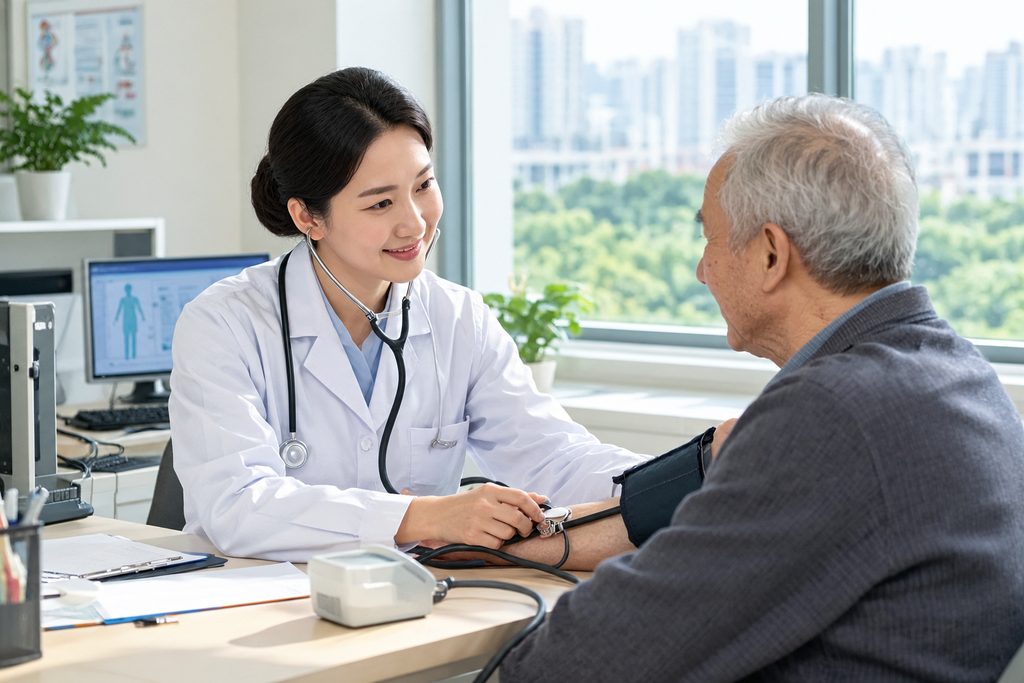
Elderly Checkup in China: Booking Guide for Senior Health Screening
While a comprehensive private health screening in the United States routinely runs $2,500 to $5,000, a comparable executive-tier examination at a top-tier Chinese hospital often lands between $500 and $1,500. That gap explains why so many adult children now research the elderly health checkup cost China hospitals charge before booking anything. This guide walks through what a senior screening actually includes, where to get it done, how to reserve it from overseas, and what the real-world snags look like.
How This Actually Works, Step by Step
Most families assume they can simply pick a hospital online, pay, and show up. That is not how Chinese public hospitals operate for international patients. Here is the realistic sequence.
You start by gathering the senior’s existing records — recent bloodwork, imaging reports, medication lists, and any specialist notes. Our team translates these into Chinese and forwards them to the relevant department. A physician reviews the file and recommends which screening package fits: basic, cardiac-focused, oncology-focused, or a full executive panel.
From there, we coordinate the appointment through the hospital’s international office or VIP channel. Public general outpatient registration cannot be reserved from abroad in advance — that queue is same-day only. The international and VIP desks are the practical route for a booked, English-supported visit.
The senior arrives, completes the screening (usually half a day to a full day), and results come back within three to seven working days. A follow-up consultation explains the findings. If something needs treatment, that becomes a separate planning conversation.
What a Senior Screening Package Usually Contains
A standard executive checkup for someone over 65 in China is broader than most Western annual physicals. Typical components include blood count and chemistry panels, tumor markers, thyroid function, ECG, echocardiography, carotid ultrasound, abdominal ultrasound, chest CT or low-dose CT, bone density scanning, and — for men — prostate ultrasound with PSA. Women’s packages add mammography and gynecological screening.
Gastrointestinal endoscopy is often offered as an add-on. It is one of the most valuable tests for this age group, and it is frequently bundled at a fraction of Western pricing. Whether to include it depends on the patient’s history and sedation tolerance, so this is a decision to make with a physician, not a booking form.
Where to Book: Finding the Best Geriatric Checkup Hospital in Shanghai and Beyond
Shanghai draws a large share of senior screening patients, and for good reason. The city concentrates several of China’s highest-ranked hospitals, and its international clinics are accustomed to foreign patients. Searching for the best geriatric checkup hospital Shanghai has to offer usually points families toward two categories: top public hospitals with dedicated international health centers, and private international hospitals.
Our database of 340+ top-ranked hospitals across 37 cities groups public tertiary hospitals by Fudan ranking tiers. Beijing hosts the most Top 100 hospitals, Shanghai follows, and Guangzhou ranks third. For a city-by-city view, the Shanghai hospital guide lays out which facilities run English-supported health screening centers.
Beijing matters too, especially for families combining a checkup with specialist follow-up. Questions about how much does a senior health screening cost in Beijing usually resolve to a similar range as Shanghai — roughly $500 to $1,500 for executive packages, with cardiac or oncology-heavy panels pushing toward the upper end.
| Setting | Typical Package Cost | English Support | Insurance Billing |
|---|---|---|---|
| Public tertiary hospital, standard health center | $300–$800 | Limited | Pay upfront, claim later |
| Public hospital international / VIP health center | $600–$1,500 | Yes | Pay upfront, claim later |
| Private international hospital | $1,200–$3,000+ | Full, native-level | Direct billing with many insurers |
| TCM-focused wellness assessment | $200–$600 | Varies | Usually self-pay |
Prices vary by hospital and case complexity, and add-ons like endoscopy or advanced imaging change the total. Treat every figure as a starting range, not a quote.
A Realistic Timeline
Yes. Records can be submitted, reviewed, and a screening plan prepared before anyone flies. A video consultation lets the medical team assess fitness to travel. The screening itself still requires the patient’s physical presence.
Medical travel uses the S2 visa category, with S1 for stays beyond 180 days. Accompanying family members apply under S2 as well. Requirements change, so verify current documentation with the nearest Chinese embassy or consulate before applying.
At an accredited tertiary hospital, generally yes, provided the medical team knows the full history in advance. Disclose all medications, implants, and allergies. For complex cases, a pre-travel video consultation allows the screening plan to be adjusted.
Your Next Step
A senior health screening in China can deliver genuinely comprehensive diagnostics at a fraction of Western pricing — but only when the hospital, the package, and the logistics are matched to the patient’s actual condition. That matching is the part that determines whether the trip is worthwhile. Our team at China Medical Services helps international patients review records, identify appropriate hospitals, coordinate appointments, and arrange bilingual support on the ground. We do not provide medical care and we do not promise specific clinical outcomes. If you would like an initial assessment of what a screening trip might involve for your family member, you can start with a free consultation — no obligation, just a clearer picture.
This article is for general information only and does not constitute medical advice. Screening decisions should be made with a qualified physician who can review the individual patient’s history.
Frequently Asked Questions
Yes. The hospitals used for international patients are JCI-accredited and follow the same international safety standards as top hospitals in the US and Europe. Surgical teams perform high volumes of procedures — often more than their Western counterparts — which studies show leads to better outcomes.
Costs vary by procedure and hospital, but international patients typically save 40-80% compared to US prices — even when factoring in travel and accommodation. A consultation with our team will give you an exact, all-inclusive quote with no hidden fees.
Send us your existing medical reports to get started. We handle everything from hospital selection and appointment scheduling to visa assistance and post-operative recovery planning. Your medical records are reviewed by the specialist before you even book a flight.
For more medical information and treatment options in China, visit chinamedservices.com (China Medical Services).
