Dental Implants in China: English Dentists & Real Costs
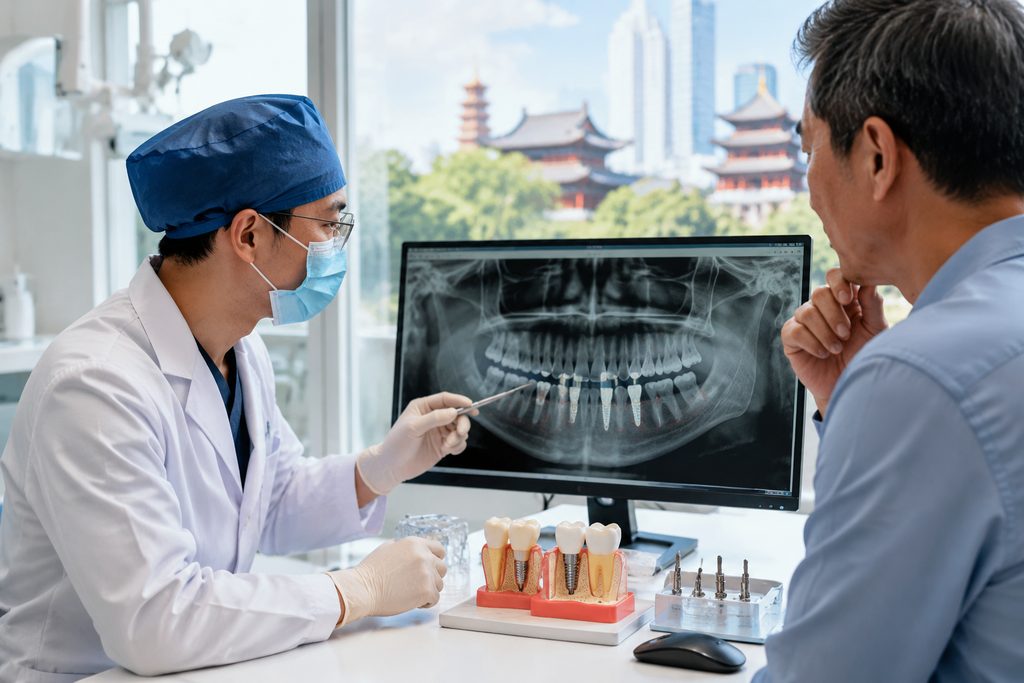
Dental Implants in China: English Dentists, Honest Costs, and How to Plan
Roughly 600,000 dental implants are placed in China every year, according to figures cited by the Chinese Stomatological Association — and a growing share of those patients are foreigners. If you have been quoted $4,000 to $6,000 for a single implant in the United States or the UK, the dental implants cost China math is hard to ignore. But price is only half the story. The other half is finding a clinician you can actually talk to, in your language, about a procedure that involves drilling into your jaw.
This guide covers what implants really cost at Chinese hospitals and international clinics, where English-speaking dentists practice, how to judge safety, and the step-by-step path from your first email to a finished crown. We are China Medical Services — we coordinate care for international patients, and we will tell you plainly where the friction points are.
How This Actually Works, Step by Step
Most people assume you fly to Shanghai, walk into a clinic, and get an implant the same week. That is not how it works. Here is the real sequence.
Step one: you send records. A panoramic X-ray (orthopantomogram) or a CBCT scan, plus any recent dental notes. If you do not have a CBCT, that is fine — it gets done in China. Most clinics want the X-ray at least two weeks before any consultation so the dentist can assess bone volume.
Step two: a remote review. A Chinese oral surgeon or implantologist reviews the imaging and tells you whether you are a candidate, how many implants are needed, and whether you require a bone graft or sinus lift. This matters enormously for cost. A straightforward single implant and a full-arch restoration are different procedures with different price tags.
Step three: a video consultation. You speak with the dental team directly — usually 20 to 40 minutes — and hear their recommendation. Ask about implant brand, abutment material, and the crown. Ask who does the surgery and how many implants that person places per year.
Step four: you travel. Surgery is scheduled after an in-person examination, because no reputable dentist operates on a jaw they have only seen on a screen. Depending on the case, the implant fixture goes in first, then a healing period of 3 to 6 months follows before the crown is fitted.
Step five: follow-up. This is the part people underestimate. If you fly home after surgery, you need a local dentist willing to handle the restoration phase. Not all will. Sort that out before you book flights, not after.
What Dental Implants Cost in China — and Why the Range Is Wide
Here is the honest picture. A single implant at a Chinese public hospital’s international department typically runs $800 to $1,800 for the fixture and surgery, with the crown adding another $300 to $800. At a private international clinic — the kind with English-speaking staff and JCI accreditation — expect $2,000 to $3,500 per implant, all-in.
Compare that to $3,000–$6,000 per implant in the US and £2,000–£3,000 in the UK. The savings are real, but they vary by hospital and case complexity. A patient needing a sinus lift pays more than one who does not.
| Setting | Single implant (all-in) | Full arch (per jaw) | English support |
|---|---|---|---|
| US private practice | $3,000–$6,000 | $20,000–$50,000 | Yes |
| UK private practice | £2,000–£3,000 | £15,000–£30,000 | Yes |
| China — public hospital international dept. | $1,100–$2,600 | $8,000–$18,000 | Usually, via international office |
| China — private international clinic | $2,000–$3,500 | $12,000–$25,000 | Yes, standard |
Prices vary by hospital and case complexity. The implant brand matters too — Swiss and German systems (Straumann, Nobel Biocare) cost more than Korean systems (Osstem, Dentium), which are widely used in China and clinically well-regarded. Ask which brand is being quoted. A $900 implant and a $2,500 implant are not the same product.
Finding an English-Speaking Dentist in Shanghai, Beijing, and Beyond
China’s best dental care concentrates in a handful of cities. Shanghai and Beijing lead, followed by Guangzhou, Shenzhen, and Chengdu. If you are searching for an English speaking dentist Shanghai has plenty — particularly in the Jing’an and Pudong districts, where international clinics cluster around expat neighborhoods.
Two categories of provider serve foreigners:
- Public hospital stomatology departments — affiliated with universities, often excellent clinically, with international or VIP wings that handle English-speaking patients. Beijing’s Peking University School of Stomatology and Shanghai’s Ninth People’s Hospital are the two most cited names in Chinese dentistry.
- Private international clinics — United Family, Jiahui, Parkway, and similar groups. Higher prices, shorter waits, direct insurance billing, and staff who routinely work in English.
For a broader view of how hospital tiers work in China, our ranking of top-ranked Chinese hospitals by city explains the Fudan system and what “A++++” actually means.
One caveat worth stating clearly: public hospital general dental clinics generally do not let you book a specific surgeon from overseas in advance. You register on the day. If you want a named specialist and a confirmed appointment slot, that runs through the hospital’s international department — and the price is roughly 1.5 to 2 times the standard channel. That is not a markup invented by intermediaries; it is how the hospital structures VIP access.
A Realistic Timeline
Dental implants are not a single trip for most patients. Here is a realistic schedule for a straightforward single implant.
| Stage | Timing | What happens |
|---|---|---|
| Records + remote review | Week 1–2 | Send X-ray/CBCT; surgeon assesses bone and gives preliminary plan |
| Video consultation | Week 2–3 | Discuss options, brand, cost, and travel dates |
| Visa (S2) + flights | Week 3–6 | S2 visa processing typically 4–10 business days; allow buffer |
| Trip 1: surgery | Week 6–8 | In-person exam, implant placement, 3–7 days in country |
| Healing / osseointegration | Month 3–6 | Implant fuses with bone; you can usually return home |
| Trip 2: crown fitting | Month 5–7 | Abutment and crown placed; another 5–10 days in country |
Two trips is the norm. Some clinics offer “immediate loading” protocols where a temporary crown is fitted the same week, but that depends on bone quality and is not suitable for everyone. Anyone promising a permanent crown in three days without seeing your scan should be treated with suspicion.
Visa note: medical treatment in China falls under the S2 visa category, with accompanying family members applying under the same category. The M visa is for commercial and trade activity and has nothing to do with medical care. Requirements shift, so confirm current documentation with your nearest Chinese embassy or consulate — and get the hospital’s supporting letter in hand before you apply.
Is Dental Implant Safe in China? What the Evidence Says
This is the question that keeps people up at night, and it deserves a direct answer. Implant survival rates globally sit around 95% at ten years for single implants in healthy patients, per long-running systematic reviews published in journals like Clinical Oral Implants Research. Those figures come from studies across many countries, and Chinese university dental hospitals publish their own outcome data consistent with international benchmarks.
The variable is not the country. It is the clinic, the surgeon, and your own health. Diabetes, smoking, untreated gum disease, and poor bone quality all lower success rates regardless of where you sit in the chair.
So how do you judge a provider? Ask these questions:
- How many implants does the operating dentist place per year? Look for someone in the hundreds, not dozens.
- Which implant system, and is it a brand with globally available prosthetic parts? This matters if a component fails after you go home.
- Is there a CBCT scan before surgery? If a clinic will place implants without 3D imaging, walk away.
- What is the written warranty on the fixture and the crown?
- Who handles complications if you are back in your home country?
For patients weighing a broader range of procedures, our overview of specialty rankings across 45 medical departments shows how Chinese hospitals compare in fields like orthopedics and oncology — useful context for understanding that dental care sits within a much larger, well-developed system.
What Can Go Wrong — and What Happens Then
Yes, but with limits. Public hospital general dental clinics do not offer advance booking from overseas — you register on arrival. You can arrange a video consultation and a written treatment plan in advance, and secure an appointment through a hospital’s international department. What you cannot reliably do is lock in a specific surgeon and date without going through that VIP channel.
The procedure itself is well established at Chinese university dental hospitals, and outcomes track international norms. The practical risk is communication, not clinical quality. Misunderstanding aftercare instructions — when to eat, when to rinse, which medications to take — causes more problems than the surgery. Use an interpreter for every appointment involving instructions.
There is no single answer, because the best choice depends on your case. For complex surgical work, university-affiliated stomatology hospitals in Beijing and Shanghai are strong options. For convenience, English service, and direct insurance billing, private international clinic groups are the easier path. Compare both on surgeon volume, imaging standards, and written warranty terms — not on marketing.
For a single implant, plan 5 to 7 days for the surgical trip. The crown fitting is a separate trip of similar length, 3 to 6 months later. Full-arch cases may require longer stays and more visits. Build buffer days into your itinerary; healing does not follow a flight schedule.
Your Next Step
The core message is simple: dental care in China can cost a fraction of Western prices without sacrificing clinical standards, but the savings only hold up if you plan the logistics — records, visa, language, and follow-up — before you book anything. Our team at China Medical Services coordinates hospital matching, appointment scheduling, written second opinions, and bilingual accompaniment for international patients. We are not dentists and we do not provide medical advice; we handle the navigation so your clinician can focus on your teeth. If you would like a straightforward assessment of your case and realistic cost expectations, start with a free consultation — no pressure, no obligation, just a clear picture of what is possible.
Frequently Asked Questions
Yes. The hospitals used for international patients are JCI-accredited and follow the same international safety standards as top hospitals in the US and Europe. Surgical teams perform high volumes of procedures — often more than their Western counterparts — which studies show leads to better outcomes.
Costs vary by procedure and hospital, but international patients typically save 40-80% compared to US prices — even when factoring in travel and accommodation. A consultation with our team will give you an exact, all-inclusive quote with no hidden fees.
Send us your existing medical reports to get started. We handle everything from hospital selection and appointment scheduling to visa assistance and post-operative recovery planning. Your medical records are reviewed by the specialist before you even book a flight.
For more medical information and treatment options in China, visit chinamedservices.com (China Medical Services).
