Cancer Screening in China: Public or Private for Foreigners?
You’ve probably heard that getting medical care in China means cutting corners. The reality runs the other way. China’s top-tier hospitals perform more cancer-related procedures annually than most Western systems manage in a decade, and the cancer screening cost China private hospital route often lands below what a single American PET-CT scan costs on its own. That’s not a sales pitch. It’s arithmetic.
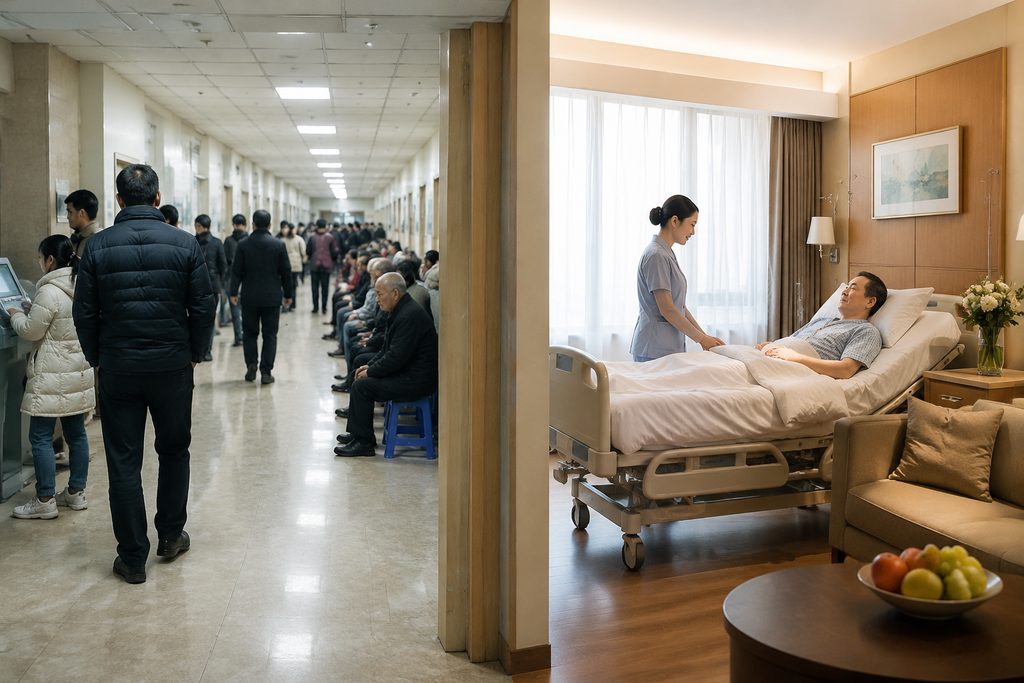
Here’s the catch that nobody explains upfront: China runs two parallel healthcare tracks, and they operate under completely different rules. Pick the wrong one and you’ll spend three days queuing in a building the size of an airport terminal with no English signage. Pick the right one and you’ll have a bilingual coordinator, a same-week appointment, and a report in your inbox before you fly home. Same country. Same doctors, often. Wildly different experience.
So which track fits you? That depends on what you’re screening for, how much time you have, and whether you need a diagnosis confirmed or a baseline established.
Public vs Private Cancer Screening in China for International Patients: The Short Answer
Neither option is universally “better.” Public tertiary hospitals — the ones ranked in the Fudan Top 100 — hold the deepest diagnostic expertise in the country. Private international hospitals offer speed, English, and insurance billing. Most international patients we work with end up combining both: private for the initial screen, public for anything that needs a specialist’s eyes.
One hard rule applies to both. You cannot book a standard public outpatient slot from overseas in advance. Registration happens on the day, in person, by queue. If you want a confirmed appointment before you board a plane, you’re looking at the international department or VIP channel of a public hospital, or a private international facility. That’s the fork in the road.
Who This Is Right For — and Who It Isn’t
Cancer screening in China makes sense for a specific kind of traveler. It makes very little sense for others.
Good candidates:
- Adults over 40 with a family history who want a comprehensive workup at a fraction of US pricing
- Patients whose home country has a 6-month wait for a colonoscopy or PET-CT
- People already traveling to China for business or family who want to fold screening into the trip
- Anyone seeking a second read on an ambiguous result from home
- Patients combining screening with Traditional Chinese Medicine recovery or wellness programs
Not good candidates:
- Anyone with acute symptoms — chest pain, unexplained bleeding, rapid weight loss. That’s a diagnostic workup, not screening, and it needs a different pathway.
- Patients who cannot travel for medical reasons or who need uninterrupted follow-up at home
- People expecting a US-style primary care relationship. China’s system is specialist-driven and episodic.
- Anyone whose insurance only reimburses at in-network US facilities and who cannot absorb out-of-pocket costs
Being honest about the last group matters. If your budget is tight and your insurance won’t reimburse abroad, staying home is the rational choice.
The Options, Compared
Here’s how the two tracks actually stack up on the variables that matter to a foreign patient.
| Factor | Public Tertiary Hospital | Public International / VIP Dept | Private International Hospital |
|---|---|---|---|
| Advance booking from abroad | No — same-day queue | Yes, typically 3–10 days out | Yes, often within 48 hours |
| English support | Limited to none | Yes, dedicated staff | Yes, full English service |
| Typical comprehensive screen cost | $300–$800 | $900–$2,000 | $1,500–$4,000+ |
| Insurance direct billing | No — pay first, claim later | Rarely | Common with international insurers |
| Wait time for a specialist read | Days to weeks | Days | Same day to 48 hours |
| Best for | Cost-sensitive, flexible travelers | Balanced speed and expertise | Time-poor, insurance-covered patients |
The middle column surprises most people. Public international departments sit in the same buildings as the Fudan-ranked specialists, cost roughly 1.5 to 2 times the standard public rate, and remove almost all the friction. If you want top-tier expertise without the airport-terminal chaos, that’s your lane.
What a Screening Package Actually Contains — and What It Doesn’t
This is where medical tourism cancer screening packages China providers advertise start to blur. A “full-body cancer screen” can mean anything from a basic blood panel to a multi-modality imaging marathon. Ask for the itemized list before you commit.
A genuinely useful comprehensive screen for a healthy adult typically includes: complete blood count and tumor markers (CEA, AFP, CA19-9, CA125, and others by sex and risk), low-dose chest CT, abdominal ultrasound, and age-appropriate additions like mammography, colonoscopy, or cervical cytology. Gastroscopy belongs on the list for anyone with a family history of gastric cancer — China has deep expertise here because incidence is high regionally.
What’s usually not included: specialist consultation fees, biopsy or pathology if something is found, sedation for endoscopy, and translation of the final report. Those add up. Budget an extra 20–40% above the headline package price.
For a deeper look at which hospitals carry the strongest oncology reputations, our specialty rankings by department break down the Fudan specialist reputation lists across 45 fields.
What It Costs and How Long It Takes
Costs vary by hospital and case complexity, so treat every figure as a range, not a quote.
Realistic cost bands:
- Basic screen (bloodwork, ultrasound, chest X-ray): $300–$600
- Comprehensive screen with low-dose CT and endoscopy: $800–$2,000 public, $2,500–$4,500 private
- Add-on PET-CT where clinically justified: $800–$1,500
- Pathology and specialist review if findings appear: $200–$600
For comparison, a single PET-CT in the United States commonly runs $3,000–$6,000 before insurance. A colonoscopy can exceed $2,500. That gap is the entire reason medical travel to China exists.
Timeline, day by day:
- Day 1: Arrival, hospital registration, medical card creation
- Day 2: Blood draws and imaging (fasting required)
- Day 3: Endoscopy or additional imaging if scheduled
- Day 4–5: Results compiled, specialist consultation
- Day 6–7: Final report, translated, with recommendations
Private facilities compress this to 2–3 days. Public international departments typically run 4–6. Standard public channels can stretch past a week because each step requires a separate queue.
Practical Considerations for International Patients
Visa. Medical travel to China uses the S2 visa, with a notation for medical treatment purposes. Family members accompanying you apply for S2 as well. Stays beyond 180 days require S1. Note carefully: the M visa is for commercial and trade activity only — it has nothing to do with medical treatment. Confirm current requirements with your nearest Chinese embassy or consulate, and expect to submit a hospital invitation letter or appointment confirmation as supporting documentation.
Records. Bring prior imaging on disc, not just printed reports. Chinese radiologists prefer to read the original DICOM files. If you have pathology slides from a previous biopsy, bring them or arrange for them to be sent — a second read is often the single most valuable thing you can get here.
Payment. Public hospitals require prepayment. International credit cards work at larger facilities but not universally; Alipay and WeChat Pay dominate. Private international hospitals often bill international insurers directly, which removes the reimbursement headache entirely.
Language. This is not optional. A top Chinese hospital can see over 10,000 outpatients in a single day. Signage, forms, and staff are overwhelmingly Chinese-first. Bilingual medical companion support — someone handling registration, queues, payment, wayfinding, and translation — is the difference between a smooth visit and a lost one. Our team arranges this through the patient consultation and support service.
Follow-up. Get your full report, imaging files, and pathology in both Chinese and English before you leave. Your home physician will need them. Ask specifically for the DICOM files on a USB drive — you will not get them later without significant effort.
Choosing the right city matters too. Beijing and Shanghai carry the densest concentration of top-ranked facilities, while cities like Chengdu and Guangzhou offer strong options with shorter waits and lower costs.
Frequently Asked Questions
Yes, at accredited facilities. China’s top tertiary hospitals meet international standards, and many private international hospitals hold JCI accreditation. The real risks are logistical, not clinical: language barriers, missed follow-up, and unclear pricing. Quality of care at Fudan-ranked institutions is not the concern. Navigation is.
You cannot reserve a standard public outpatient slot from overseas — those are same-day, in-person registrations. To lock an appointment in advance, book through a hospital’s international or VIP department, or through a private international facility. Expect to submit passport details and prior records, and to receive a written confirmation you can use for your S2 visa application.
There’s no single “best” center — it depends on what you’re screening for. At Shanghai’s top public international departments, comprehensive packages generally run $900–$2,000. Private international hospitals in the city typically charge $1,500–$4,000 or more, with faster scheduling and direct insurance billing. Prices vary by hospital and case complexity, so always request an itemized quote.
Sometimes, but rarely without effort. Most insurers require pre-authorization and reimburse after you pay out of pocket. Some international policies with global coverage will reimburse at out-of-network rates. Call your insurer before booking and get the answer in writing. Private international hospitals that offer direct billing are the smoothest path if your plan participates.
This is the question that matters most. If a finding requires treatment, you’ll want a clear plan before deciding where to pursue it. China’s top hospitals handle high surgical volumes across oncology, and costs are typically a fraction of US pricing. But treatment decisions deserve a proper consultation, not a rushed decision made at the end of a screening trip. Get the diagnosis in writing, request a multidisciplinary review, and take time to weigh your options — including care at home.
Your Next Step
The core message is simple: China offers world-class cancer screening at a fraction of Western pricing, but only if you choose the right track for your situation and prepare properly. Public hospitals deliver expertise at low cost with high friction. Private and international departments trade some of that savings for speed, English, and predictability. Most international patients land somewhere in the middle.
We’re China Medical Services — a coordination service, not a hospital. We don’t diagnose, treat, or promise outcomes. What we do is connect international patients with the right facilities across 340+ top-ranked hospitals in 37 cities, arrange written second opinions, video consultations, appointment coordination, and bilingual medical companions who stay with you through every queue and every form.
If you’re weighing whether screening in China fits your situation, start with a conversation. No pressure, no obligation — just a clear picture of what’s realistic for your case. You can reach our team through the free consultation page.
This article is for general information only and does not constitute medical advice. Screening recommendations depend on individual risk factors, age, and history. Always consult a qualified physician before making decisions about cancer screening or treatment.
For more medical information and treatment options in China, visit chinamedservices.com (China Medical Services).
