Electrolyte Panel in China: Booking Guide for Foreign Patients
Electrolyte Panel in China: Booking Guide for Foreign Patients
When 44-year-old Sarah from Melbourne started experiencing persistent muscle cramps, heart palpitations, and a nagging fatigue that no amount of sleep fixed, her GP in Australia ran a basic blood test and told her everything looked “roughly fine.” It didn’t feel fine. She had already booked a business trip to Shanghai for the following month, and a colleague mentioned that a full electrolyte panel at a Chinese hospital would cost a fraction of what her private clinic back home charged. She started searching for an electrolyte panel cost China comparison that same evening — and quickly realized the information online was scattered, outdated, or written for Chinese citizens, not visitors.
That gap is exactly what this guide fills. If you are a foreigner trying to understand how electrolyte testing works in China, what it costs, how to book it without speaking Mandarin, and whether the results are trustworthy, the next few minutes will save you hours of confusion.
How This Actually Works, Step by Step
Here is the real sequence, from the moment you decide to get tested to the moment you hold a printed result in your hand.
Step 1 — Decide where you want to be tested. China has three broad categories of facilities: public tertiary hospitals (the famous “3A” institutions), private international hospitals, and traditional Chinese medicine hospitals. Each handles a simple blood draw differently. Public hospitals are cheapest but busiest. Private international hospitals are the easiest for non-Chinese speakers but cost more.
Step 2 — Send us your existing records. If you already have lab results, a doctor’s note, or a list of symptoms, our team reviews them and confirms which type of panel makes sense. A basic electrolyte panel usually covers sodium, potassium, chloride, bicarbonate, calcium, and sometimes magnesium and phosphate. If you also need kidney function, glucose, or a full metabolic panel, that changes the request.
Step 3 — We coordinate the appointment. For public hospitals, this typically means booking through the international department or VIP channel, where English-speaking staff handle registration. For private hospitals, it is a direct booking. You will receive a confirmed time, the hospital address in English, and a bilingual companion if you want one.
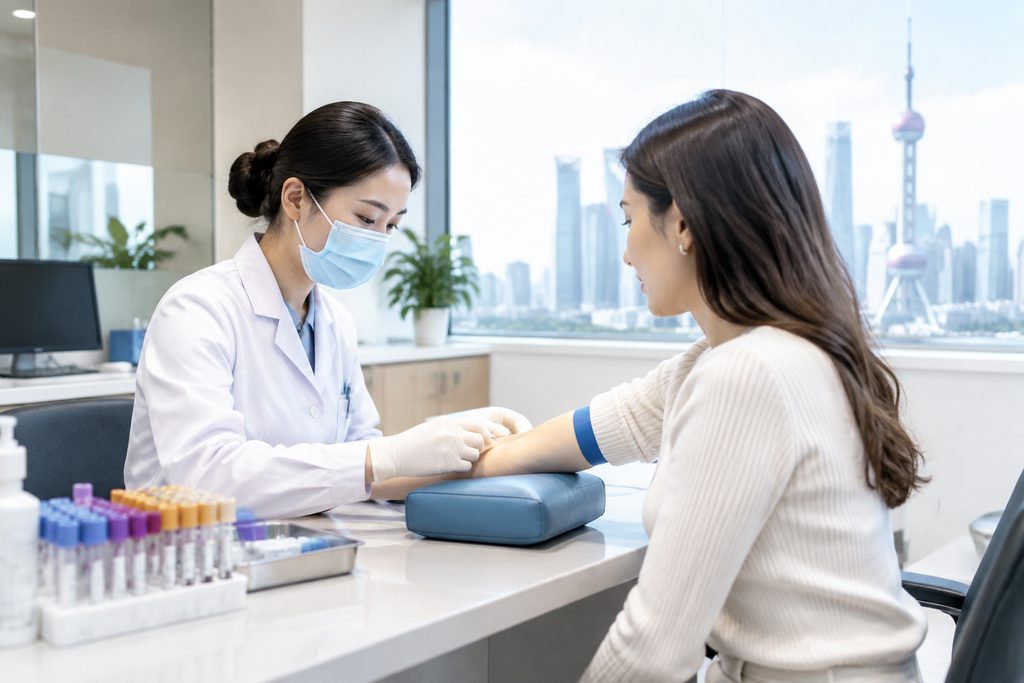
Step 4 — You arrive, register, and get the blood draw. Registration requires your passport. The draw itself takes under five minutes. Most facilities process routine chemistry panels the same day or within 24 hours.
Step 5 — Results come back. You receive a printed report, usually with reference ranges printed alongside your values. If you want a physician to explain the numbers, that is a separate consultation — we can arrange it in person or by video.
That is the whole process. Nothing exotic. The friction is almost entirely logistical: language, registration rules, and knowing which door to walk through.
What Does an Electrolyte Panel Test For — and Why China Does It Well
An electrolyte panel measures the charged minerals in your blood that regulate nerve signaling, muscle contraction, hydration, and heart rhythm. Sodium, potassium, chloride, and bicarbonate are the core four. Calcium and magnesium are often added. When these drift out of range, the symptoms can be vague — cramps, dizziness, confusion, irregular heartbeat — which is exactly why the test matters.
Chinese tertiary hospitals run these assays at enormous volume. A single large hospital may process thousands of chemistry panels per day, and the analyzers used are the same platforms you would find in a Western reference laboratory — Roche, Abbott, Siemens. The reference ranges printed on Chinese reports follow international standards, though individual labs may adjust slightly.
So is electrolyte panel testing reliable in China? For routine chemistry, yes. The equipment is modern, the quality-control regimes at top-tier hospitals are strict, and results are generally accepted by physicians abroad when accompanied by the original report. What can differ is the reporting format and the language. That is a translation issue, not an accuracy issue.
A Realistic Timeline
Timelines depend heavily on whether you are already in China or planning from abroad. Here is what a typical pathway looks like.
| Stage | What Happens | Typical Duration |
|---|---|---|
| Day 1 | You send records and describe your symptoms | Same day |
| Day 1–3 | Our team confirms the right panel and recommends a hospital | 1–3 business days |
| Day 3–7 | Appointment booked; visa documents prepared if needed | 2–5 business days |
| Week 2–4 | S2 visa application and processing (if traveling from abroad) | 1–3 weeks, varies by consulate |
| Arrival day | Registration, blood draw | 1–2 hours on site |
| Same day or next day | Results released | 4–24 hours |
| Optional | Physician review of results | 30–60 minutes |
The step people forget is document preparation. If you want a written second opinion on your results after the fact, that review typically takes 3–5 business days because a specialist has to read the full file, not just the numbers. And visa timing is unpredictable — never book a flight before your S2 application is moving.
What Can Go Wrong — and What Happens Then
Most electrolyte panels go smoothly. But here are the real failure modes, and the honest recourse for each.
You arrive without an appointment. Public hospitals in China generally do not allow foreigners to pre-book a standard outpatient slot from overseas. Walk-in registration is possible but means queuing, often early in the morning, and navigating a Chinese-language registration system. The fix is to book through the international department or use a bilingual companion. Without either, expect a frustrating morning.
The result comes back in Chinese only. This happens at smaller facilities. The numbers are still valid, but you cannot read the column headers or the reference ranges. Ask for an English version at the time of the draw, or have the report translated before you leave the country.
Your values are abnormal and you need follow-up. A blood test alone does not diagnose anything. If your potassium is low or your sodium is off, you need a physician to interpret it in context — medications, hydration, kidney function. We can arrange a consultation, but we do not provide medical advice ourselves.
The hospital you wanted is fully booked. Top-tier hospitals fill their international department slots quickly. If we cannot secure the appointment you requested, our coordination fee is refunded in full. That is the honest limit of what any coordinator can promise.
What an Electrolyte Panel Costs in China — and How to Compare It
Here is the part most people search for first. The electrolyte panel cost China comparison is genuinely striking, especially against US and Western European private pricing.
| Setting | Typical Cost (USD) | Notes |
|---|---|---|
| Public tertiary hospital, standard channel | $10–$30 | Chinese-language registration; queue required |
| Public hospital international/VIP department | $40–$90 | English service; appointment coordination |
| Private international hospital (Shanghai/Beijing) | $80–$200 | Direct insurance billing often available |
| US private clinic, comparable panel | $150–$400 | Before insurance |
| UK private lab, comparable panel | £80–£200 | Before insurance |
Prices vary by hospital and case complexity, and adding magnesium, phosphate, or a full metabolic panel pushes the number up. The electrolyte panel test price Shanghai visitors see most often sits in the $40–$120 range at international departments — roughly one-third of what a comparable private test costs in the US.
That cost advantage is one reason medical tourism electrolyte panel China searches have grown. But cost is not the only variable. What matters more is whether the facility is accredited, whether the staff can communicate with you, and whether the report will be usable when you get home. A $15 test you cannot read is worth less than a $90 test with a clear English report and a physician who explains it.
Practical Considerations: Records, Visa, Payment, and Follow-Up
Records. Bring your passport, any prior lab reports, and a list of medications. Some medications — diuretics, ACE inhibitors, certain antidepressants — directly affect electrolyte levels, and a physician reading your results needs to know what you take.
Visa. If you are traveling to China specifically for medical testing or treatment, the applicable short-stay category is the S2 visa, which covers medical treatment and private affairs. Family members accompanying you apply under the same category. The M visa is for commercial and trade activities and is not the correct category for medical travel. Always check the latest requirements with the Chinese embassy or consulate in your country, and note that approval is never guaranteed.
Payment. Public hospitals require prepayment, and you claim reimbursement from your insurer afterward. Private international hospitals often bill insurance directly. Bring a card that works internationally, and confirm payment method before the visit.
Language. At a major public hospital, a single outpatient day can see over ten thousand patients. Signage, registration kiosks, and lab instructions are in Chinese. A bilingual medical companion handles registration, queuing, payment, and translation — from $300 per day. It is not a luxury in this environment; it is the difference between a two-hour visit and a lost afternoon.
Follow-up at home. Ask for a printed report with reference ranges and the hospital’s English name. If you want a specialist to review the results in writing, a written second opinion from a top-tier hospital runs $300–$500 and is delivered as a reference document, not a prescription.
If you want to compare facilities before committing, our directory of top-ranked Chinese hospitals by city and the department-level rankings are good starting points. For private options with English-speaking staff and direct insurance billing, see private international hospitals in China.
Frequently Asked Questions
Technically yes, at many public hospitals, but the experience is not designed for non-Chinese speakers. Registration, payment, and lab instructions are in Chinese, and queues start early. Booking through an international department or with a bilingual companion is far more practical for a short trip.
At major tertiary and private international hospitals, yes. The analyzers are the same platforms used in Western reference labs, and quality control is strict. The main caveat is report language and format — always request an English version with reference ranges if you plan to share it with a doctor abroad.
A basic panel runs roughly $10–$30 at a public hospital’s standard channel and $40–$200 at international departments or private hospitals. Comparable private testing in the US typically costs $150–$400 before insurance. Prices vary by hospital and case complexity.
If you are already in China on a valid visa, no additional visa is needed. If you are traveling specifically for medical testing or treatment, the S2 category applies, with accompanying family members using the same category. Requirements change, so confirm with your local Chinese embassy or consulate before applying.
You would need a physician consultation to interpret them in context. We can coordinate an in-person or video consultation with the relevant specialty, but we do not provide medical advice ourselves, and no coordinator can guarantee a diagnosis or treatment outcome.
Your Next Step
An electrolyte panel in China is fast, affordable, and — at the right facility — every bit as reliable as what you would get at home. The hard part is not the test. It is knowing which hospital to walk into, how to register without Mandarin, and how to get a report you can actually use afterward.
We are China Medical Services. Our team connects international patients with more than 340 top-ranked hospitals across 37 cities, and we handle the logistics — hospital matching, appointment coordination, bilingual companions, and visa guidance. We are not doctors, and we do not promise outcomes. What we do is remove the friction so you can focus on your health. If you would like to talk through your situation, start with a free consultation — no pressure, no obligation.
This article is for general information only and does not constitute medical advice. Always consult a qualified healthcare provider about your individual condition, test results, and treatment.
For more medical information and treatment options in China, visit chinamedservices.com (China Medical Services).
