3T MRI in China: What It Means for You — Cost, Quality, Access
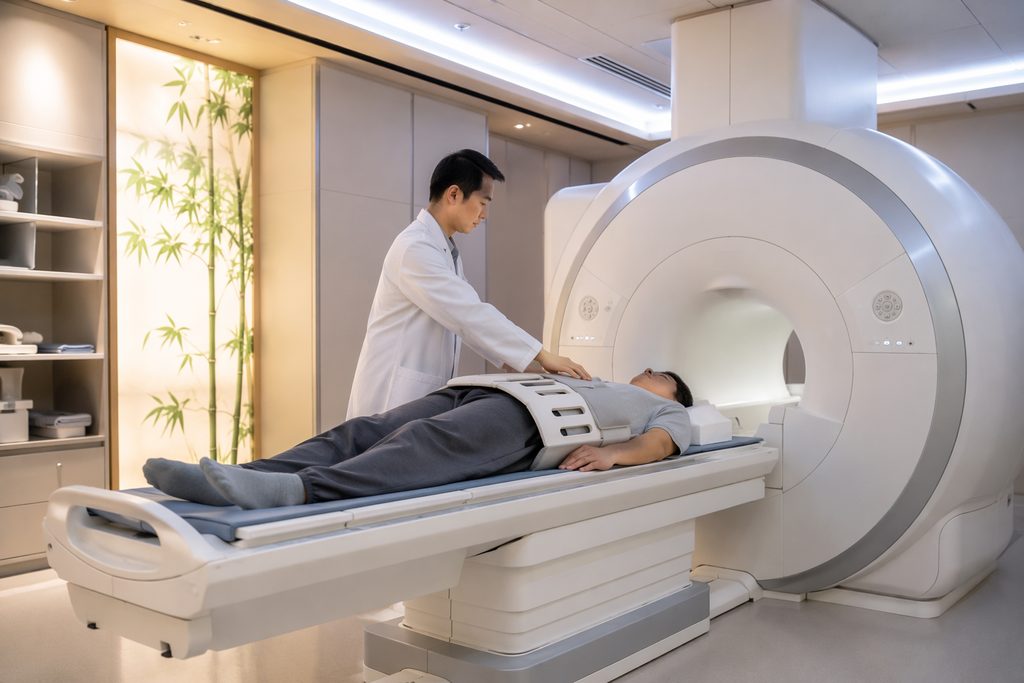
3T MRI in China: What It Means for You
A 3T MRI scan cost in China typically runs $300 to $900 at a top-tier public hospital — against $1,500 to $4,000 for the same study in the United States. That price gap is real, and it is not a sign of lower quality. The same 3-Tesla machines made by Siemens, GE, and Philips sit in Chinese radiology departments, often newer than the units in many Western community hospitals. What the price does not tell you is the part that actually matters: how to get an appointment, who reads the images, and whether the report will be usable by your doctor at home.
That last point deserves a moment. A scan is only as good as the radiologist interpreting it and the documentation that follows you. So the real question is not “is it cheaper.” It is whether the whole pathway — booking, imaging, reporting, translation — works for someone who does not speak Mandarin and is not physically in the country yet.
3T MRI Scan Cost in China: The Short Answer
Expect $300–$900 for most 3T MRI studies at a leading public hospital, and $700–$1,800 at a private international hospital. The variance comes down to three things: which body region is scanned, whether contrast dye is used, and whether you are on the standard or the international/VIP channel.
Here is the catch nobody mentions upfront. Standard outpatient imaging at Chinese public hospitals generally cannot be reserved from overseas in advance. You register on the day, in person, in a queue. That rule is not a bureaucratic quirk — it is how a hospital handling 10,000+ outpatient visits a day keeps order. For an international patient flying in, that reality changes the entire planning equation.
Who This Is Right For — and Who It Isn’t
Not everyone should fly across the world for an MRI. Being honest about that is the only way the rest of this article is worth reading.
This pathway tends to fit well if you are:
- Facing a diagnostic question your home system cannot resolve quickly — a suspicious lesion, an unclear neurological finding, a tumor follow-up scan you have been waiting months for
- Quoted a price at home that is genuinely out of reach, and you are paying out of pocket
- Already considering treatment in China and want imaging done where the treating team can review it directly
- Combining the scan with a broader health check or a specialist consultation during the same trip
- Comfortable with a structured, professionally coordinated process rather than a walk-in
This is probably not the right move if you are:
- In an acute emergency. If you have stroke symptoms, sudden severe headache with neurological deficit, or suspected spinal cord compression, go to the nearest emergency department. Do not book a flight.
- Carrying a pacemaker, certain implanted neurostimulators, cochlear implants, or metallic intraocular foreign bodies. MRI safety screening is strict everywhere, and some devices are absolute contraindications. This must be cleared by a radiologist before any travel.
- Severely claustrophobic without a plan. A 3T scanner is a narrow bore. If closed MRI has been intolerable before, discuss open MRI or sedation options first.
- Pregnant in the first trimester, unless the referring physician judges the scan medically necessary.
- Someone whose home country offers a fast, affordable, well-covered scan. If your insurance covers it and the wait is two weeks, stay home. The China route wins on speed and price, not on convenience.
The Options, Compared
Cost is only one column. Here is how the realistic alternatives stack up for an international patient weighing a 3T MRI.
| Option | Typical Cost (USD) | Wait Time | Language Support | Best For |
|---|---|---|---|---|
| US hospital, insured | $1,500–$4,000 | 1–6 weeks | Native English | Insurance covers it; timeline is acceptable |
| US imaging center, cash | $500–$1,800 | Days to 2 weeks | Native English | Self-pay, local, non-urgent |
| China public top-tier hospital (standard channel) | $300–$900 | Same-day to several days, in person | Limited; needs coordination | Price-sensitive, already traveling to China |
| China public hospital (international/VIP channel) | $700–$1,600 | Often bookable in advance | English-speaking staff | Patients who need advance scheduling |
| China private international hospital | $700–$1,800 | Days | Full English service | Comfort, direct insurance billing, speed |
Which column fits you? If you are insured and can wait, the first row is the rational choice. If you are self-paying, need an answer fast, and want a top radiologist reading the study, the international channel at a major Chinese hospital is the sweet spot. Private international hospitals suit patients who value a Western-style experience and direct insurance settlement over the lowest possible price.
Is 3T MRI Safe in China? And How Accurate Is It for Something Like a Brain Tumor?
These two questions travel together, and both have honest answers.
Safety. A 3T MRI is a 3-Tesla MRI — the field strength is a physical constant, identical in Shanghai, Boston, or Berlin. The scanner does not become more or less safe based on geography. The safety variables that actually matter are the same everywhere: proper screening for implants and metallic foreign bodies, correct use of gadolinium contrast in patients with reduced kidney function, and adherence to scanning protocols. China’s top-tier hospitals operate under national imaging standards and, at the leading institutions, international accreditation. The genuine risk is not the machine. It is skipping the pre-scan safety questionnaire because of a language barrier.
Accuracy for brain tumors. 3T MRI is generally preferred over 1.5T for intracranial imaging because the higher field strength improves signal-to-noise ratio and spatial resolution. That translates into better characterization of small lesions, clearer delineation of tumor margins, and stronger performance in techniques like perfusion imaging and MR spectroscopy, which help distinguish tumor from treatment-related changes. So how accurate is 3T MRI for brain tumor evaluation? At a well-equipped center with an experienced neuroradiologist, it is a high-accuracy tool — but accuracy is a property of the whole system, not the magnet alone. The protocol chosen, the contrast timing, and the radiologist’s expertise all shape the result.
For patients researching where to go, the relevant question becomes: which Chinese hospitals combine high-volume neuroradiology with international patient services? That is exactly the kind of matching our team handles — and you can browse the specialty rankings by department through our directory of China’s top-ranked departments.
How Long It Takes: From First Inquiry to Images in Hand
The magnetic field strength is a fixed physical property, so a 3T scanner is a 3T scanner anywhere. Leading Chinese hospitals use equipment from the same global manufacturers found in Western centers. Safety depends on proper implant screening and correct contrast use, which is why an accurate medical history in a language the staff understand matters enormously.
Sometimes, but rarely automatically. Most public hospitals require upfront payment, and you then submit for reimbursement. Private international hospitals more frequently offer direct billing with selected insurers. Verify with your insurer before booking — do not assume coverage.
You will want a treating physician, not just a report. This is where planning ahead pays off: identify in advance which specialist or hospital you would consult if the findings require action, and confirm how quickly you could be seen. A scan without a follow-up pathway is only half a plan.
A package bundling imaging with coordination, translation, and accompaniment generally lands in the $1,000–$2,500 range depending on the scan type and service level — well below comparable US pricing. Final quotes vary by hospital and case complexity, so treat any figure as an estimate until your specific case is reviewed.
Your Next Step
A 3T MRI in China offers genuine advantages — lower cost, faster access, and world-class equipment — but the value only materializes when the logistics are handled correctly. The scan itself is the easy part. Getting there, being understood, and bringing usable results home is where the real work sits.
We are China Medical Services, a coordination and navigation service, not a hospital and not a diagnostic provider. We do not interpret images or give medical advice. What we do is connect international patients with the right hospitals and specialists across 340+ top-ranked hospitals in 37 cities, arrange appointments, and provide bilingual support on the ground. If you would like to understand your options before committing to anything, a free consultation is the natural first step — no pressure, just clarity. You can start that conversation through our consultation page.
This article is for general information only and is not medical advice. Imaging decisions should be made with a qualified physician who knows your history. Costs and timelines vary by hospital and case complexity.
Frequently Asked Questions
Yes. The hospitals used for international patients are JCI-accredited and follow the same international safety standards as top hospitals in the US and Europe. Surgical teams perform high volumes of procedures — often more than their Western counterparts — which studies show leads to better outcomes.
Costs vary by procedure and hospital, but international patients typically save 40-80% compared to US prices — even when factoring in travel and accommodation. A consultation with our team will give you an exact, all-inclusive quote with no hidden fees.
Send us your existing medical reports to get started. We handle everything from hospital selection and appointment scheduling to visa assistance and post-operative recovery planning. Your medical records are reviewed by the specialist before you even book a flight.
For more medical information and treatment options in China, visit chinamedservices.com (China Medical Services).
