Endoscopy in Zhengzhou: How to Arrange It as a Foreigner
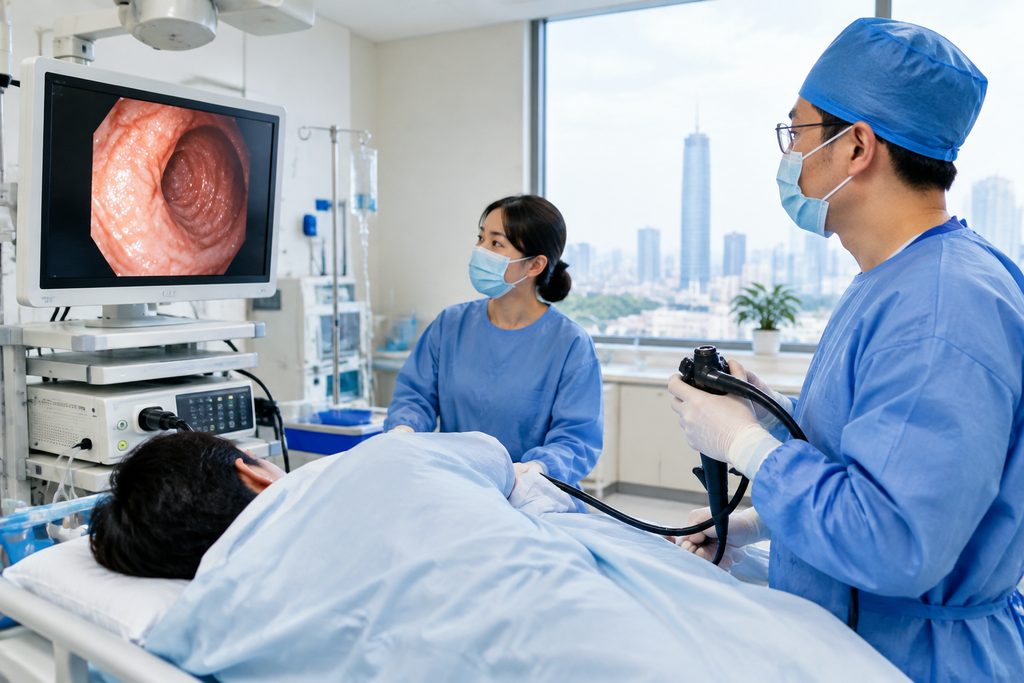
You have probably been told that arranging medical care in China as a foreigner is a bureaucratic maze — that you need a local ID, a Chinese-speaking relative, and weeks of patience. For an endoscopy in Zhengzhou, the opposite is closer to the truth. Zhengzhou is home to some of the largest teaching hospitals in central China, and a straightforward upper GI endoscopy there can be arranged in days, not months. The catch is not the medicine. It is the logistics.
This guide walks you through exactly how endoscopy in Zhengzhou works for international patients: what it costs, how to book, what the hospital will ask for, and where the process genuinely gets difficult. We are not doctors. We are the coordination layer between you and the hospital — and we will tell you honestly where the friction sits.
How This Actually Works, Step by Step
Here is the real sequence, without the marketing gloss.
Step one: you send your existing records. Not a summary — the actual documents. Recent blood work, any prior endoscopy or imaging reports, medication list, and a short note explaining your symptoms and what you want investigated. If these are in English, they need translation into Chinese before a hospital department will review them properly. That translation is not optional; a gastroenterologist at a Zhengzhou tertiary hospital will not act on an English-language PDF.
Step two: a specialty team reviews the file. This is where a written second opinion or a video consultation comes in. A Chinese gastroenterology department looks at your records, decides whether an endoscopy is even the right next step, and tells you what preparation is required. Sometimes the answer is “yes, come.” Sometimes it is “you need a different test first.” Getting that answer remotely saves you a wasted trip.
Step three: the appointment gets coordinated. Here is the part most guides get wrong. At Chinese public hospitals, routine outpatient appointments are not bookable from overseas in advance the way they are in the US or UK. Registration typically happens on the day, in person, in a queue. If you want a confirmed slot with a senior specialist and English-language support, that runs through the hospital’s international or VIP channel — and it costs roughly 1.5 to 2 times the standard fee.
Step four: you arrive, register, and have the procedure. Upper endoscopy itself usually takes 10 to 20 minutes. Sedation practices vary by hospital, so confirm in advance whether conscious sedation is offered and whether you need an escort.
Step five: results and follow-up. Preliminary findings are often discussed the same day. Biopsy results, if taken, typically take 3 to 7 working days.
What Endoscopy Cost China Hospitals Actually Charge
This is the question that brings most people here. The honest answer: a diagnostic upper GI endoscopy at a Zhengzhou tertiary public hospital generally falls in the range of $150 to $400, depending on whether sedation is used, whether biopsies are taken, and whether you go through the standard or international channel. A colonoscopy runs higher — typically $300 to $800 — because of the bowel preparation protocol and longer procedure time.
Compare that with the United States, where a diagnostic upper endoscopy without biopsy commonly bills between $1,500 and $3,500 before insurance, and a screening colonoscopy frequently exceeds $2,500. Even private international hospitals in China, with English-speaking staff and direct insurance billing, tend to land well below Western pricing.
| Procedure | Zhengzhou Public Tertiary | China Private International | United States (typical) |
|---|---|---|---|
| Upper GI endoscopy (diagnostic) | $150 – $400 | $500 – $1,200 | $1,500 – $3,500 |
| Colonoscopy (diagnostic) | $300 – $800 | $800 – $2,000 | $2,500 – $5,000 |
| Endoscopy with biopsy | $250 – $600 | $700 – $1,500 | $2,000 – $4,000 |
| Sedation / anesthesia add-on | $50 – $150 | $150 – $400 | $400 – $1,000 |
These are reference ranges, not quotes. Final pricing varies by hospital and case complexity, and a hospital will confirm the actual figure only after reviewing your records. Anyone who gives you a firm number before seeing your file is guessing.
One structural point matters more than the price itself: Chinese public hospitals require prepayment. You pay at the hospital, then claim from your insurer afterward. Private international hospitals more often bill your insurance directly. If you are traveling on a self-funded basis, the public route is dramatically cheaper. If you need the paperwork handled for you, the private route is smoother.
A Realistic Timeline
People underestimate the waiting steps. Here is a realistic schedule for a foreign patient arranging endoscopy in Zhengzhou, assuming no complications.
| Stage | Timeframe | What Happens |
|---|---|---|
| Records gathering | Day 1 – 3 | You collect reports, blood work, medication list |
| Translation & submission | Day 3 – 7 | Documents translated to Chinese, sent to department |
| Remote review | Day 5 – 12 | Written opinion or video consultation returned |
| Appointment coordination | Week 2 – 3 | International channel slot confirmed |
| Visa (S2) | Week 2 – 5 | Application, supporting hospital documents, processing |
| Travel & arrival | Week 3 – 5 | Flights, accommodation, airport transfer |
| Registration & procedure | Day of visit | In-person registration, prep, endoscopy |
| Biopsy results | 3 – 7 working days after | Pathology report issued |
Total realistic window from first contact to procedure: three to six weeks. If you are already in China, that compresses to roughly one week, because the visa and travel stages disappear.
What Can Go Wrong — and What Happens Then
We would rather you hear this now than discover it at a registration desk.
The appointment cannot be confirmed in advance. This is the single most common frustration. Standard public hospital registration is same-day and in-person. If your trip is built around a specific date, you need the international or VIP channel — and even then, no coordinator can guarantee a named specialist on a named day. What a legitimate service promises is best-effort coordination, with a refund if the appointment cannot be secured.
Your records are incomplete. Hospitals will not schedule a procedure on a vague description of symptoms. Missing blood work or an untranslated report stalls the whole chain. Fix this first.
The visa category is wrong. This trips people up constantly. The M visa is a commercial and trade visa — it has nothing to do with medical treatment. Foreign patients coming to China for medical care use the S2 visa, with the purpose of visit noted as medical treatment. Stays beyond 180 days fall under S1. Accompanying family members also apply for S2. Requirements shift, so confirm current rules with the nearest Chinese embassy or consulate and bring supporting hospital documents. No one can promise approval.
The procedure reveals something requiring follow-up. If the endoscopy finds a lesion needing further workup, you may need to extend your stay or plan a return. Build slack into your itinerary. Do not book a flight home for the day after your procedure.
Is Endoscopy Safe in China Hospitals?
This is a fair question, and it deserves a direct answer rather than reassurance.
China’s top-tier tertiary hospitals perform endoscopy at extraordinary volume. High procedure volume correlates with operator experience, and experienced operators have lower complication rates. Perforation risk in diagnostic upper endoscopy is low across the board — published international figures put it well under 1 in 1,000 for diagnostic procedures — and the equipment at major Chinese teaching hospitals is current-generation, comparable to what you would find in a Western academic center.
The genuine variables are not the medicine. They are communication and continuity. Can you explain your symptoms clearly to the gastroenterologist? Can you understand the consent discussion? Will the findings be documented in a form your doctor at home can read? These are the gaps that bilingual coordination closes.
Zhengzhou’s major teaching hospitals sit within a national system of roughly 35,000 hospitals. The institutions worth targeting are in the top few percent — the ones ranked by Fudan University’s hospital index or accredited by JCI. Our department-by-department rankings list which hospitals lead in gastroenterology and related specialties, which is a faster way to filter than reading hospital websites.
How to Arrange Endoscopy in Zhengzhou for Foreigners: The Decision Points
Once you accept the process, three decisions shape everything else.
Public tertiary versus private international. Public is cheaper and often has deeper specialist expertise. Private is easier — English-speaking staff, direct insurance billing, Western-style service — and costs more. For a routine diagnostic endoscopy, public tertiary through the international channel is usually the better value. For complex cases needing multidisciplinary input, the private route removes a lot of friction.
Remote review first, or travel blind? Always review first. A written second opinion or video consultation costs a fraction of a flight and tells you whether the procedure is even indicated. If it is not, you have saved thousands. If it is, you arrive with a plan rather than a hope.
Self-navigate or use a coordinator? If you read and speak Mandarin, have a Chinese bank card, and understand the registration system, you can do this yourself. If any of those is missing, the arithmetic changes quickly. A hospital with 10,000+ daily outpatient visits is not designed for someone who cannot read the signs.
On the question of a medical tourism endoscopy package in Zhengzhou: be skeptical of anything advertised as an all-inclusive bundle with a fixed price and a guaranteed date. Legitimate coordination is priced as a service fee, separate from hospital charges, and the hospital sets its own prices. Bundles that promise otherwise are usually marking up the hospital bill.
Practical Considerations: Records, Visa, Payment, Language
Records. Bring originals and translations. Blood work within 3 months, prior endoscopy or imaging reports, medication list with generic names, allergy history, and a signed consent form if a companion will act for you.
Visa. S2 for medical treatment, S2 for accompanying family, S1 for stays beyond 180 days. Apply with hospital supporting documents. Processing times vary by consulate and season — budget three to five weeks.
Payment. Public hospitals want prepayment. Bring a card that works internationally, or arrange funds in advance. Keep every receipt; your insurer at home will want them.
Insurance. Most Western insurers reimburse rather than pay directly at Chinese public hospitals. Check your policy’s overseas coverage before you travel. Private international hospitals more often bill directly.
Language. This is the real bottleneck. A bilingual medical companion handles registration, queueing, payment, wayfinding, and interpretation during the consultation — from $300 per day for a half or full day. It is labor and language support, not a shortcut to a specific doctor.
For those combining treatment with recovery time, Zhengzhou also has traditional Chinese medicine hospitals offering acupuncture and herbal consultation, which some patients use during the post-procedure period. Our TCM hospital overview covers what that involves.
Frequently Asked Questions
A diagnostic upper endoscopy in Zhengzhou typically runs $150 to $400 at a public tertiary hospital, versus $1,500 to $3,500 in the US. Colonoscopy ranges from $300 to $800. Final pricing depends on sedation, biopsies, and whether you use the international channel.
Not through standard public hospital registration, which is same-day and in-person. Confirmed advance slots with English-language support go through the hospital’s international or VIP channel, at roughly 1.5 to 2 times the standard fee. No coordinator can guarantee a specific specialist on a specific date.
At major tertiary teaching hospitals, yes — procedure volumes are high, equipment is current-generation, and diagnostic complication rates are low. The practical risks are communication-related: explaining symptoms, understanding consent, and getting results your home doctor can read.
The S2 visa, with medical treatment noted as the purpose of visit. Accompanying family members also apply for S2. Stays beyond 180 days require S1. The M visa is for commercial and trade activity and is not a medical visa. Confirm current requirements with your nearest Chinese embassy or consulate.
If you do not speak Mandarin, strongly consider it. Registration, queueing, payment, and the consultation itself all happen in Chinese at public hospitals. A bilingual medical companion handles all of it — it is language and logistics support, not a promise of priority access.
Your Next Step
The core message is simple: an endoscopy in Zhengzhou is affordable, technically sound, and genuinely arrangeable — but the medicine is the easy part, and the logistics are where trips fall apart. Review your records remotely first, confirm the visa category, and decide honestly whether you can navigate a Chinese hospital in Mandarin.
China Medical Services connects international patients with 340+ top-ranked hospitals across 37 cities. We do not provide medical care, we do not guarantee outcomes, and we do not sell priority access. What we do is translate your records, coordinate appointments through official hospital channels, and put a bilingual companion beside you on the day. If you would like to talk through your situation with no obligation, start with a free consultation — and take your time deciding.
For more medical information and treatment options in China, visit chinamedservices.com (China Medical Services).
