Nail Health Check in China: Cost, Clinics, and How It Works
Nail Health Check in China: How It Works, What It Costs, and Where to Go
A nail health check cost in China often lands between $80 and $400 for a full screening panel — a fraction of the $500 to $1,500 a Western dermatology clinic may bill for similar work. That gap exists because China’s public tertiary hospitals run enormous diagnostic volumes, and their laboratory and imaging capacity is priced accordingly. For an international patient, the interesting part is not the savings. It is what a Chinese nail assessment actually looks for, and how quickly the whole thing can be arranged.
Our team coordinates this kind of visit regularly. Here is how it really works.
How This Actually Works, Step by Step
Nail changes are rarely just cosmetic. Ridging, pitting, discoloration, thickening, separation from the nail bed — each pattern points somewhere different. Psoriasis, lichen planus, fungal infection, iron deficiency, thyroid dysfunction, melanoma of the nail unit, or simple mechanical trauma. A proper workup separates these, and that is what a Chinese dermatology department will do.
The sequence looks like this:
- You send records first. Photographs of the affected nails, any prior lab results, a short history of when the change appeared and whether it is spreading. No travel needed at this stage.
- A dermatology team reviews the file. The relevant specialty at a partner hospital assesses whether the case needs in-person examination, dermoscopy, or a nail unit biopsy — or whether it can be clarified remotely.
- You receive a written opinion. What the likely differential is, which tests are worth doing, and roughly what they cost.
- Appointment coordination. If in-person assessment makes sense, we handle registration, hospital card creation, and scheduling through the international department or VIP channel.
- The visit itself. Dermoscopy, KOH or fungal culture, bloodwork, and — where indicated — a nail plate or matrix biopsy. Most results return within 24 to 72 hours.
- Treatment plan and follow-up. Topical or systemic therapy, or referral to a hand surgeon for nail unit lesions.
That last point matters more than people expect. A pigmented streak running the length of a nail is the one finding that genuinely cannot wait. Chinese dermatology departments see high volumes of nail unit pathology and have dermatopathologists who read nail matrix specimens routinely.
What a Nail Health Screening Actually Involves
Foreign patients often arrive expecting a visual inspection. What they get is more thorough.
Clinical examination covers all twenty nails, not just the symptomatic one. Fingernails and toenails tell different stories. Toenail involvement suggests dermatophyte infection or psoriasis; fingernail pitting points toward psoriasis or alopecia areata; Beau’s lines indicate a systemic event weeks earlier.
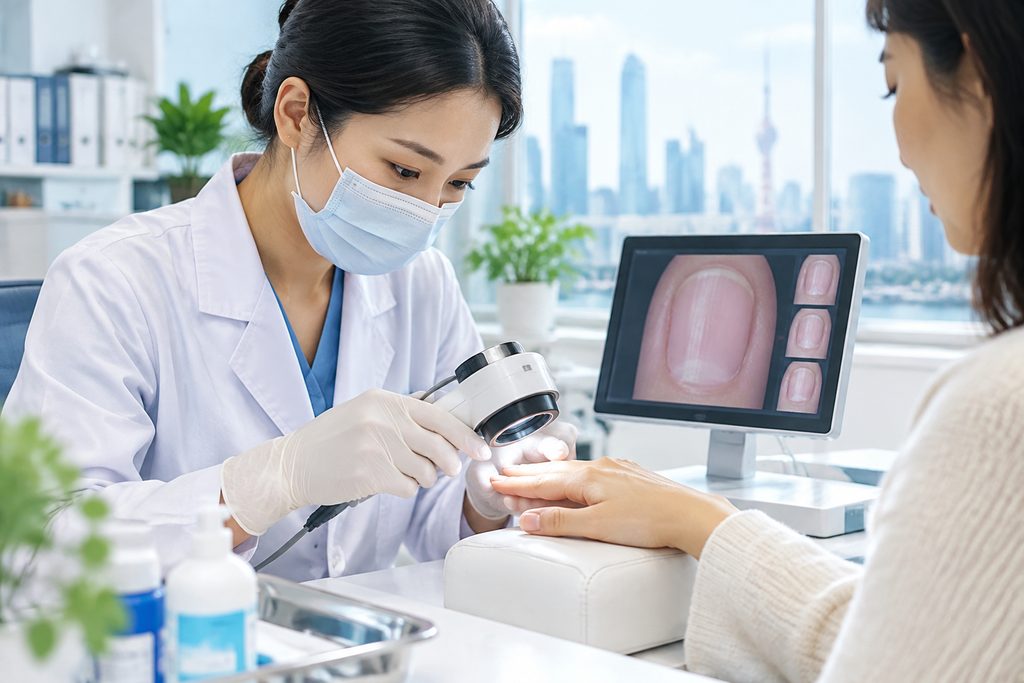
Dermoscopy is standard in Chinese tertiary dermatology. It is a magnified, polarized view of the nail bed and matrix, and it is the single most useful non-invasive tool for distinguishing benign pigmentation from subungual melanoma. This is where a Chinese hospital visit often outperforms a quick Western clinic appointment — dermoscopy is used routinely, not as an add-on.
Laboratory work depends on findings. Typical panels include fungal culture or PCR, complete blood count with ferritin, thyroid function, HbA1c, and — if autoimmune disease is suspected — antinuclear antibodies. Turnaround at major hospitals is fast. Many run these assays in-house.
Biopsy is reserved for cases where malignancy or inflammatory nail disease cannot be excluded. A longitudinal nail biopsy is a specialized procedure. Not every hospital does it well. This is one of the few situations where hospital selection genuinely changes the outcome.
A Realistic Timeline
Times below assume a straightforward case. Complex pathology, biopsy, or a specialist who books out further will extend things.
| Stage | Typical Duration | What Slows It Down |
|---|---|---|
| Record collection and translation | 2–5 days | Poor photo quality; missing prior labs |
| Written second opinion from dermatology | 3–7 days | Requests for additional images or history |
| Appointment coordination | 3–10 days | Public general clinic slots are same-day only; international department booking is faster but costs more |
| S2 visa application | 1–3 weeks | Consulate appointment availability; incomplete hospital invitation documents |
| In-person consultation and testing | 1–2 days | Some labs need fasting; biopsy scheduling |
| Results | 24–72 hours | Fungal culture can take up to 3 weeks |
| Treatment start | Same week | Biopsy cases wait for pathology |
Total from first contact to sitting in a consultation room: roughly three to six weeks for most patients. If you are already in China on another trip, the in-country portion can compress to two or three days.
What Can Go Wrong — and What Happens Then
Honest failure modes, because they exist.
You cannot book a public general clinic slot from abroad. This is a hard rule across Chinese public hospitals. General outpatient registration happens on the day, in person, in a queue. Anyone promising you a guaranteed 9 a.m. dermatology slot at a public hospital three months in advance is not describing how the system works. The legitimate route to a pre-arranged appointment is the hospital’s international department or VIP channel, which typically runs 1.5 to 2 times the standard fee.
Fungal culture comes back negative but the nail still looks infected. False negatives are common — roughly a third of dermatophyte cultures miss. Chinese dermatologists handle this by combining KOH microscopy, PCR, and clinical judgment. If your plan hinges on a single culture result, ask whether PCR is available.
The lesion turns out to be melanoma. Rare, but the reason nail screening exists. Recourse is referral to a hospital with dermatopathology and hand surgery under one roof. We would flag this early rather than let a cosmetic-focused clinic manage it.
Language breaks down at the pharmacy. Prescriptions are written in Chinese. Dosage instructions, topical application frequency, duration — all of it. A bilingual companion is not a luxury here. It is the difference between using a medication correctly and guessing.
Payment and insurance friction. Public hospitals require prepayment; reimbursement happens later, through your insurer, on your own time. Private international hospitals often bill insurance directly but charge more. Neither is wrong. They are different trade-offs.
Choosing a Clinic: Shanghai, Beijing, and What to Compare
The search for the best nail health screening clinic in Shanghai usually surfaces the same handful of names, and for good reason. Shanghai has 18 hospitals in the Fudan Top 100 — second only to Beijing’s 21. Dermatology at the major Shanghai tertiary hospitals is deep, and the private international hospitals clustered around the city offer English-speaking staff, JCI accreditation, and direct insurance billing.
Beijing runs a similar profile. A nail health check package price in Beijing at a private international hospital typically sits higher than the equivalent at a public tertiary hospital’s international department, but the private route removes most of the queueing and language friction.
What should you actually compare?
- Does the department do nail unit biopsies? If not, and your case is unclear, look elsewhere.
- Is dermoscopy routine? Ask directly.
- Who reads the pathology? A dedicated dermatopathologist, or a general pathologist?
- What is the follow-up structure? Nail conditions take months to respond. You need a plan for monitoring after you fly home.
- Language support. English-speaking staff at private hospitals; interpreter coordination at public ones.
You can browse dermatology and related specialty rankings through our department-level hospital directory, which maps China’s top ten hospitals across 45 specialties. City-specific options are grouped on the Fudan Top 100 hospital list, and private international facilities are listed separately.
Practical Considerations: Records, Visas, Payment, Follow-Up
Records. Gather everything before you travel: photographs, prior biopsy reports, bloodwork from the last six months, a list of current medications including topicals. Translated into English or Chinese where possible. Incomplete files are the single most common cause of a wasted first appointment.
Visa. Medical travel to China uses the S2 visa, with a notation for medical treatment purposes. Accompanying family members apply under the same category. Stays beyond 180 days require the S1 instead. Requirements shift, so confirm current documentation with the nearest Chinese embassy or consulate and with the hospital issuing your supporting letter. Note that the M visa is for commercial and trade activity and has nothing to do with medical treatment.
Payment. Public tertiary hospitals: prepay, then claim reimbursement from your insurer afterward. Private international hospitals: many settle directly with international insurance plans. Confirm before you arrive, not at the counter.
Follow-up at home. Nail conditions evolve over six to twelve months. Ask for a written treatment summary in English, including the diagnosis, medications with generic names, and a recommended monitoring interval. Your local dermatologist can then continue care without starting over.
Is a nail health check in China safe? For diagnostic screening, yes — the equipment is current, the labs are accredited, and the volume of cases seen means clinicians recognize patterns quickly. The risks are logistical rather than clinical: language, queueing, and payment mechanics. All manageable with preparation.
Frequently Asked Questions
Not through a public hospital’s general clinic — those slots are issued on the day, in person. Pre-arranged appointments are available through hospital international departments or VIP channels, usually at 1.5 to 2 times the standard fee. Coordination services can handle the registration and scheduling on your behalf.
Packages vary widely. A basic consultation with dermoscopy might run $80 to $150. Adding fungal PCR, bloodwork, and imaging pushes it to $250 to $400. Biopsy and pathology add more. Final pricing depends on the hospital and the complexity of your case, so treat any quoted figure as an estimate until a clinician reviews your file.
The diagnostics are safe and the standards at major tertiary and JCI-accredited hospitals are high. The realistic concerns are communication and logistics. Bring a bilingual companion or arrange interpreter support, and confirm payment and insurance handling in advance.
For a consultation with dermoscopy and lab work, two to three days is usually enough. If a biopsy is needed, add time for the procedure and pathology turnaround — plan on five to seven days total.
Yes. Request an English-language summary covering the diagnosis, test results, and treatment plan. Most major hospitals will provide this, though it may take a few days to prepare.
Your Next Step
A nail change that has persisted for more than a few weeks deserves a proper look, and China’s diagnostic capacity makes that look fast and affordable. The main thing to get right is the sequence: records first, remote review second, travel only if it adds value. Our team at China Medical Services coordinates written second opinions, video consultations, appointment scheduling, and bilingual accompaniment across 340+ top-ranked hospitals in 37 cities. We do not provide medical advice, and we cannot promise a specific appointment or outcome — we handle the logistics so the clinical team can focus on you. If you would like an initial assessment of your case, start with a free consultation and we will tell you honestly whether a trip to China is worth it.
This article is for general information only and does not constitute medical advice. Nail changes can indicate serious underlying conditions. Consult a qualified physician about your individual situation before making treatment decisions.
For more medical information and treatment options in China, visit chinamedservices.com (China Medical Services).
