Eye Exam in Beijing: What to Expect, What It Costs, and How to Book
Eye Exam in Beijing: The Short Answer
An eye exam in Beijing takes 45 to 90 minutes at most international clinics, and the eye exam cost Beijing patients pay ranges from roughly $80 for a basic refraction check to $400 or more for a full diagnostic workup with imaging. At a top public hospital’s international department, expect the lower end of that range. At a private international clinic with English-speaking staff, expect the higher end.
Here’s the part that surprises most visitors: the exam itself is fast and modern. The friction sits elsewhere — registration, payment, and the fact that most public hospital eye clinics do not accept online booking from overseas. Understanding that split is what separates a smooth two-hour visit from a wasted morning.
Who This Is Right For — and Who It Isn’t
Beijing’s ophthalmology departments handle an enormous volume. Several rank among China’s top 10 for ophthalmology on the Fudan specialist reputation list, and the equipment in these departments matches or exceeds what you’d find in most Western teaching hospitals. That said, not every eye problem belongs in a Beijing clinic chair.
Generally a good fit:
- Routine vision checks, new glasses or contact lens prescriptions
- Glaucoma screening and intraocular pressure monitoring
- Diabetic retinopathy evaluation, including OCT retinal imaging
- Foreign residents and long-stay visitors who need annual eye checks
- Second opinions on a diagnosis you already received at home
- Cataract assessment, including surgical planning discussions
Probably not the right move:
- Acute eye trauma or sudden vision loss — go to the nearest emergency department, not a scheduled clinic
- Anyone mid-treatment abroad whose ophthalmologist has not cleared travel
- Patients seeking a same-day surgical fix. In China’s public system, surgery follows an in-person consultation, not a phone call
- Travelers on a 72-hour visa-free transit with a tight connection — the logistics rarely work
Being honest about that second list matters. A Beijing eye clinic is excellent at what it does. It is not a walk-in emergency room, and no coordination service changes that.
The Options, Compared
Three real pathways exist for a foreigner needing an eye exam in Beijing. They differ in price, language, and how far ahead you can lock in an appointment.
| Factor | Public Hospital International Dept. | Private International Clinic | Standard Public Eye Clinic |
|---|---|---|---|
| Typical exam cost | $80–$200 | $200–$400+ | $30–$80 |
| English support | Usually available | Fluent, front to back | Rare |
| Advance booking from abroad | Yes, via international office | Yes, online | No — same-day queue only |
| Wait time for appointment | 3–10 days | 1–3 days | Same day, but hours in queue |
| Insurance direct billing | Rarely | Common (JCI-accredited) | No |
| Equipment level | Excellent | Excellent | Good, varies by site |
Which column fits you? If you have travel insurance that reimburses after the fact and you want a top-ranked ophthalmology department, the public international department is the value play. If you want zero language friction and direct billing, the private clinic wins. The third column exists, and it’s cheap, but without Mandarin you will struggle from the registration window onward.
What Actually Happens During the Visit
This is the section most guides skip, and it’s the one that determines whether your morning goes well.
You arrive, and the first stop is registration — not the exam chair. At a public hospital you’ll need your passport and a hospital medical card, which is created on site. Then comes payment for the consultation, usually upfront. Only after that do you see the doctor.
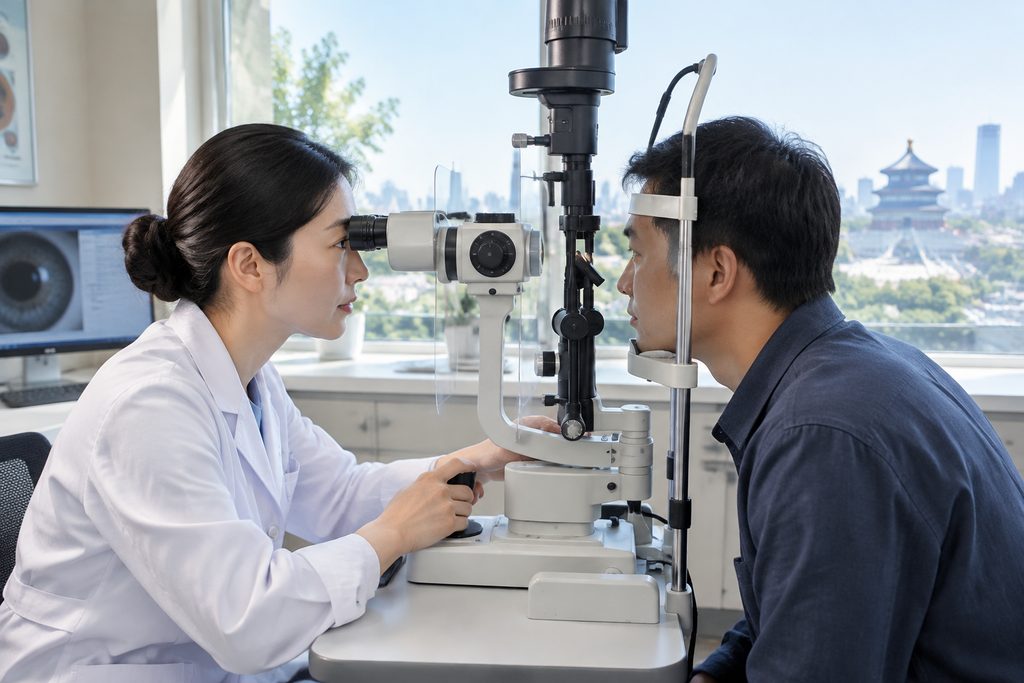
The exam sequence itself is familiar to anyone who’s had one abroad. Visual acuity chart. Autorefractor reading. Intraocular pressure check, often with a non-contact air puff. Then slit-lamp examination of the anterior segment, and a dilated fundus exam if the doctor wants to look at the retina. Dilation takes 20 to 30 minutes to kick in and leaves your near vision blurry for three to four hours. Bring sunglasses. You will not want to drive or navigate a subway map afterward.
If imaging is ordered — OCT, visual field testing, fundus photography — those happen in separate rooms, sometimes on a different floor, and each requires its own queue and payment step. This is where a bilingual companion earns their keep. A single eye workup can involve five or six counter visits.
How Long Does an Eye Exam Take in China?
A straightforward refraction and pressure check: 45 minutes door to door at a private clinic, closer to 90 at a public hospital once registration and payment are counted. Add imaging and you’re looking at two to three hours. Add dilation and the recovery time pushes your usable day to about half.
The variable isn’t the doctor’s speed. Chinese ophthalmologists move fast — many see 60 or more patients in a half-day session. The variable is administrative. Every payment, every test order, every pharmacy pickup is a separate stop. First-timers routinely underestimate this by an hour.
If you’re combining the eye exam with other medical appointments in the city, spread them across separate days. And if you’re weighing a broader diagnostic trip, our overview of top-ranked Chinese hospitals by city shows how Beijing’s 21 Fudan Top 100 hospitals cluster geographically, which helps you avoid cross-city travel between appointments.
Is an Eye Exam in Beijing Safe for Tourists?
Yes, with ordinary caveats. The equipment is calibrated and the clinical training is rigorous. Infection control in ophthalmology is taken seriously — disposable tips, sterilized contact tonometer prongs, single-use drops where indicated.
The real risks are mundane. Language gaps can lead to misunderstanding about which drops go in which eye. Payment confusion can leave you thinking a test is included when it isn’t. And if you’re dilated, navigating back to your hotel alone is genuinely unpleasant.
One more thing worth knowing: Beijing’s air quality varies by season, and patients with dry eye or allergic conjunctivitis often notice symptoms flare during winter heating months. That’s not a reason to avoid an exam — it’s a reason to mention your symptoms clearly so the doctor factors environment into the assessment.
Practical Considerations: Booking, Payment, and Language
To book an eye exam at a Beijing international hospital, you generally contact the hospital’s international office directly, or work through a coordinator who does it on your behalf. You’ll be asked for your passport details, a brief description of the problem, and any prior records. Bringing your last prescription and any recent imaging saves repetition.
Payment at public hospitals is upfront, in cash or by card, with insurance reimbursed later. Private international clinics often bill your insurer directly if they have a partnership. Check before you go — the difference between paying $350 out of pocket and paying a $40 copay is a five-minute phone call.
Language is the deciding factor for most readers. A Beijing eye exam with an English-speaking doctor is entirely achievable, but the English-speaking doctor is not the bottleneck — the registration clerk, the cashier, and the technician positioning your chin in the slit lamp are. That’s the gap a bilingual medical companion fills, and it’s why we exist.
On visas: medical treatment in China falls under the S2 short-stay category, with S1 for stays over 180 days. Accompanying family members apply under the same category. Requirements shift, so confirm current rules with your nearest Chinese embassy or consulate, and note that the M visa is for commercial and trade activity — it is not the medical route.
Follow-up after you return home matters too. Ask for a printed report with your measurements and a clear diagnosis line in English. Most top departments can provide this on request. Hand it to your regular ophthalmologist so your records stay continuous.
Frequently Asked Questions
At a standard public clinic, yes — but you’ll queue for a same-day number, and the queue starts early. At international departments and private clinics, booking ahead is expected and usually required. If your schedule is tight, do not gamble on walk-in access.
Routine vision checks are typically excluded from travel policies, which cover accidents and sudden illness. If the exam relates to a diagnosed condition or an acute problem, coverage is more likely. Call your insurer before the visit and ask specifically about outpatient ophthalmology. Get the answer in writing if you can.
The doctor will explain findings and recommend next steps, which may include imaging, a specialist referral, or treatment. You are never obligated to proceed in China. Many patients take the report home for a second opinion, and that is a perfectly reasonable choice. Nothing about a Beijing eye exam locks you into treatment here.
For a self-pay visitor at a public hospital international department, budget $150–$300 including consultation, basic tests, and any imaging. Private clinics run $250–$500. Add translation or companion support if you don’t speak Mandarin, and add a taxi budget — Beijing is large and hospital campuses are larger.
Your Next Step
An eye exam in Beijing is straightforward, affordable by Western standards, and technically excellent — provided you plan for the administrative layer that surrounds the clinical one. Know which pathway you’re choosing, bring your records, and expect the visit to take longer than the exam itself.
We are China Medical Services, a coordination team that connects international patients with hospitals across 340+ top-ranked institutions in 37 cities. We are not a hospital and we do not diagnose or treat anyone. What we do is handle the logistics: records translation, appointment coordination through official international departments, and bilingual support on the day.
If you’d like help figuring out which Beijing clinic fits your situation, start with a free consultation. No pressure, no obligation — just a clearer picture of your options.
For more medical information and treatment options in China, visit chinamedservices.com (China Medical Services).
