Sleep Study Cost in China: A Guide for International Patients
Sleep Study Cost in China: A Guide for International Patients
What if you could get a full overnight sleep study for less than the cost of a single night in a Western hospital — and have the results reviewed by a specialist within days? That question is exactly why so many international patients are now searching for the real sleep study cost in China before they book anything. A diagnostic sleep study, called polysomnography, is one of the most standardized tests in medicine. The equipment is similar everywhere. The price is not. In the United States, an overnight lab study commonly runs $1,500 to $5,000 or more before insurance. In China, the same test at a top-tier public hospital often lands between $150 and $500. That gap is real, and it is the reason this guide exists.
We are not doctors. We are a bilingual medical coordination team that helps international patients navigate China’s hospital system, and we have walked hundreds of families through this exact process. What follows is the honest version: what a sleep study actually costs, where the numbers move, how to book one, and what can go wrong.
How This Actually Works, Step by Step
The sequence is simpler than most people expect, but it is not instant. Here is the real path from first inquiry to a treatment plan.
Step one — you send your existing records. If you already have a home sleep apnea test result, a referral letter, or a prior polysomnography report, you send those files to us. If you have nothing yet, that is fine too; the sleep specialist will decide what testing is needed.
Step two — a Chinese sleep medicine department reviews the file. This is a written second opinion. A pulmonologist or sleep specialist at a hospital with an accredited sleep center reads your history and tells you whether an in-lab study, a home study, or something else makes sense. Turnaround is typically three to seven business days.
Step three — you decide between remote and in-person. Many patients start with a video consultation, which costs $100–300 at a standard international department or $500–800 with a top specialist. You hear the recommendation directly and can ask questions.
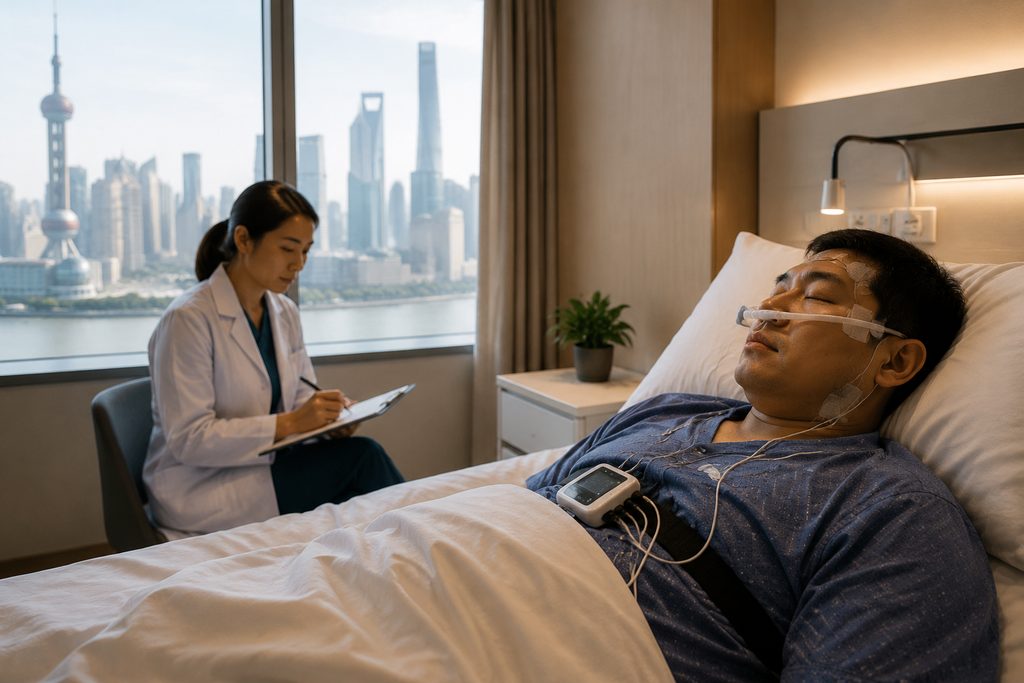
Step four — the study itself. An overnight polysomnography means you arrive in the evening, get wired with sensors, sleep in a monitored room, and leave the next morning. A home sleep apnea test is a smaller device you take with you and return.
Step five — results and a plan. The report is interpreted, and you discuss CPAP titration, an oral appliance, surgery, or watchful waiting, depending on what the data shows.
What Drives the Sleep Study Cost in China
Not through the standard public outpatient channel — routine registration in Chinese public hospitals happens on the day, in person. Advance coordination is possible through a hospital’s international or VIP department, which is why many international patients choose that route despite the higher price. We can assist with registration and appointment coordination, and if we cannot secure the appointment shown in your order, the coordination fee is refunded in full.
Medical travel to China uses the S2 visa, which covers short stays for medical treatment and private affairs; stays over 180 days use S1. Accompanying family members apply for S2 as well. The M visa is strictly for commercial and trade activity and is not a medical visa. Approval is never guaranteed and depends on current consulate requirements plus your hospital supporting documents.
At accredited sleep centers in major Chinese hospitals, yes — polysomnography equipment measures the same channels: brain activity, eye movement, muscle tone, airflow, oxygen saturation, and limb movement. The scoring standards are internationally recognized. The difference between a Chinese and a Western study is more often the room, the language, and the wait time than the technology.
That is a common and sensible plan. A written second opinion costs $300–500, and a video consultation runs $100–800 depending on the specialist tier. If you later decide to come to China for treatment, any consultation fee is credited in full toward the on-the-ground coordination service within 90 days — a one-time credit applied to the coordination fee only, never to hospital treatment charges.
Your Next Step
The core message is simple: a sleep study in China costs a fraction of what it costs in the US or Western Europe, and the diagnostic quality at an accredited center is comparable. The friction is not the medicine — it is the logistics, the language, and the booking rules.
We are China Medical Services, a bilingual coordination team working with 340+ top-ranked hospitals across 37 cities. We do not diagnose, we do not promise admission, and we do not guarantee any clinical outcome. We handle the parts that trip people up: records translation, international department scheduling, bilingual accompaniment, and visa guidance. When you are ready, start with a free consultation — no pressure, just a clear picture of what is possible in your case.
Frequently Asked Questions
Yes. The hospitals used for international patients are JCI-accredited and follow the same international safety standards as top hospitals in the US and Europe. Surgical teams perform high volumes of procedures — often more than their Western counterparts — which studies show leads to better outcomes.
Costs vary by procedure and hospital, but international patients typically save 40-80% compared to US prices — even when factoring in travel and accommodation. A consultation with our team will give you an exact, all-inclusive quote with no hidden fees.
Send us your existing medical reports to get started. We handle everything from hospital selection and appointment scheduling to visa assistance and post-operative recovery planning. Your medical records are reviewed by the specialist before you even book a flight.
For more medical information and treatment options in China, visit chinamedservices.com (China Medical Services).
