Spine CT in China: How to Arrange It, What It Costs, and Where to Go
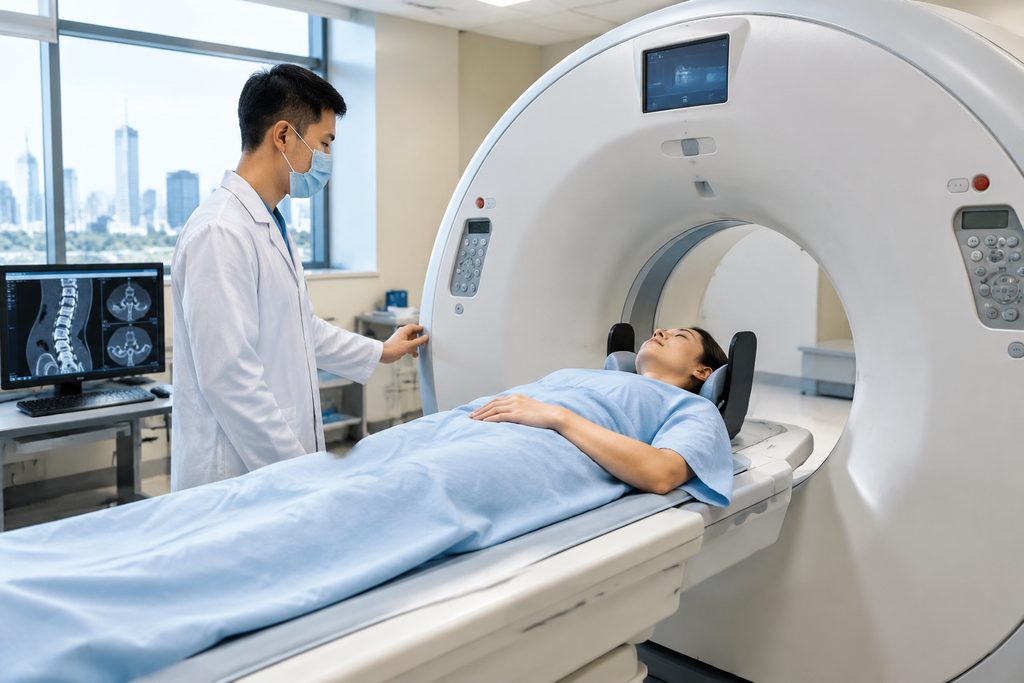
Spine CT in China: How to Arrange It, What It Costs, and Where to Go
When 47-year-old Daniel from Portland started losing feeling in two fingers of his right hand, his orthopedic doctor in Oregon ordered an MRI. The wait was five weeks. The quoted price, after his deductible, was $2,100. A colleague mentioned that a spine CT scan cost China hospitals charge a fraction of that — and could be done in days, not months. Daniel’s first question wasn’t about price. It was simpler: how does a foreigner actually arrange this?
Here’s the short answer. You can get a spine CT scan at a top-tier Chinese hospital within 24 to 72 hours of arriving, for roughly $150 to $500 depending on the hospital, the number of spinal segments scanned, and whether contrast dye is used. You cannot, however, simply walk in and book it yourself from overseas. Public hospitals in China don’t take advance appointments from international patients through their standard outpatient system. That single fact shapes everything about how you plan the trip.
Spine CT in China: The Short Answer
A spine CT scan in China costs between $150 and $500 at a major public hospital, and $400 to $900 at a private international clinic. The scan itself takes 10 to 15 minutes. You’ll have images and a radiologist’s report the same day or the next morning. Total time from landing to results: usually two to four days.
The complication is access, not availability. China’s best hospitals — the ones with 256-slice and 640-slice CT machines — run on a same-day registration model. You show up, you queue, you get a number. For a Chinese-speaking patient with a national ID card, that’s routine. For a foreigner without Mandarin, it’s the part where most people get stuck.
Key takeaway: The scan is cheap and fast. The bottleneck is getting registered, getting a doctor to write the imaging order, and understanding the report afterward. That’s a logistics problem, not a medical one.
Who This Is Right For — and Who It Isn’t
Not everyone searching for imaging abroad should actually fly abroad for it. Here’s an honest split.
Reasonable candidates:
- You’re already traveling to China for work, family, or another medical reason, and want imaging done while you’re there.
- You need a scan urgently and your home country’s wait is measured in weeks or months.
- You’re uninsured or under-insured, and a $2,000+ U.S. scan is genuinely out of reach.
- You want a second read on images you already have, plus a fresh scan on better equipment.
- You’re combining the scan with a consultation at a Chinese spine or orthopedic department.
People who should probably stay home:
- Anyone with an unstable spine fracture, cauda equina symptoms, or progressive neurological loss. That’s an emergency. Go to the nearest ER, not an airport.
- Patients whose insurance covers the scan at home with a short wait. Flying to save $800 rarely pencils out once you add airfare and hotels.
- Anyone who needs the scan as part of an ongoing treatment plan managed by a doctor back home who won’t accept outside imaging.
- Pregnant patients, unless the referring physician has specifically cleared the study.
The Options, Compared
Four realistic paths. The right one depends on your budget, your timeline, and how much hand-holding you want.
| Option | Typical Cost (USD) | Wait Time | English Support | Best For |
|---|---|---|---|---|
| U.S. hospital outpatient | $1,200–$3,500 | 1–6 weeks | Full | Insured patients, no travel |
| China public hospital, standard channel | $150–$350 | Same day–3 days | Minimal | Mandarin speakers, budget-focused |
| China public hospital, international/VIP department | $350–$700 | 1–3 days | Good | Foreigners wanting speed plus English |
| Private international hospital (Beijing/Shanghai) | $400–$900 | Same day–2 days | Excellent | Insurance direct-billing, comfort |
If you speak Mandarin and know the system, the standard public channel is unbeatable on price. If you don’t, the international department or a private hospital is worth the premium — not for better imaging, but for a process you can actually navigate.
How to Arrange a Spine CT Scan as a Foreigner in China
This is the section that matters most, and it’s the one most guides skip.
Chinese public hospitals require a doctor’s order before imaging. You can’t self-refer for a CT the way you sometimes can in the U.S. So the sequence looks like this: register at the hospital, see a spine or orthopedic physician, get the imaging order, pay, then go to the radiology department. Each of those is a separate queue in a different part of a building that may hold 10,000 outpatients a day.
Three practical routes exist.
Route one — the international department. Most top hospitals have a dedicated international or VIP wing. Staff speak English, the queues are shorter, and prices run roughly 1.5 to 2 times the standard channel. You’ll still need to see a physician first, but the whole thing can often be done in a single morning.
Route two — a private international hospital. Facilities like United Family, Jiahui, and Parkway operate on a Western model. You book ahead, you see an English-speaking doctor, and many bill your insurance directly. You can browse options on our private international hospital directory.
Route three — coordinated access. You send your existing reports ahead of time, a Chinese specialty reviews them, and a coordinator handles registration, the physician visit, and the imaging slot. This is the model China Medical Services operates on, and it exists precisely because routes one and two still assume you can find your way around a very large, very Chinese-language institution.
Tip: Bring your prior imaging on CD or a USB drive, plus printed reports in English. Chinese radiologists routinely compare new scans against old ones, and having them speeds up the read considerably.
Best Hospitals for Spine CT in Shanghai — and What Beijing Offers
Shanghai and Beijing hold the densest concentration of high-end imaging equipment in the country. For spine work specifically, you want a hospital with a strong orthopedics or neurosurgery department, because the radiologist reading your scan will be subspecialized.
In Shanghai, the names that come up most often are Zhongshan Hospital Fudan University, Ruijin Hospital, and Huashan Hospital — the last of which is particularly known for neurosurgery. You can see how these rank by specialty on our department rankings page, which lists the top 10 hospitals for each of 45 specialties.
Beijing’s spine CT scan price at a top hospital sits in the same $150–$500 band as Shanghai. Peking Union Medical College Hospital and the orthopedic specialty hospitals around the city are the usual recommendations. Beijing has 21 hospitals in the Fudan Top 100 — more than any other city — so choice isn’t the problem. Navigation is.
One caution on rankings. The Fudan general hospital list uses tiers (A++++ down to A), not numbered positions. Only the specialty reputation lists carry actual top-10 rankings. If a website tells you a hospital is “number 3 in China,” treat that claim skeptically.
Is Spine CT Scan Safe in China?
Yes, with the same caveats that apply anywhere. A CT scan delivers ionizing radiation — roughly 2 to 10 millisieverts for a lumbar spine study, depending on the protocol. That’s comparable to what you’d receive in a U.S. or European hospital using equivalent equipment.
Equipment quality at China’s top hospitals is not the issue. Many run 256-slice or 640-slice scanners that are as current as anything in the West. The regulatory environment is real too: China’s National Medical Products Administration oversees device approval, and JCI-accredited private hospitals meet international standards independently.
The genuine safety variables are these. Whether the scan is medically indicated at all — a CT is often unnecessary if an MRI would answer the question, and it’s worth asking your referring doctor. Whether contrast dye is needed, which matters if you have kidney issues or a history of allergic reaction. And whether anyone has reviewed your medication list, particularly if you take metformin.
Important: Radiation exposure accumulates over a lifetime. If you’ve had multiple CT scans in the past two years, tell the ordering physician. Sometimes an MRI or ultrasound is the better study.
What It Costs and What Drives the Variance
The spine CT scan cost China patients pay breaks down into a few components. The scan itself is the smallest part. The physician consultation that generates the order typically runs $15 to $50 at a public hospital and $80 to $200 at a private one. The radiologist’s written report is usually bundled into the imaging fee.
What moves the price:
- Number of segments. Cervical only is cheapest. Full spine imaging costs more.
- Contrast. Adding contrast dye increases both the cost and the appointment length.
- Hospital tier. A tertiary (Grade 3A) public hospital charges less than a private international clinic for the same study.
- Channel. International/VIP departments charge roughly 1.5 to 2 times the standard rate.
- City. Beijing, Shanghai, and Guangzhou run slightly higher than second-tier cities.
For context on the broader gap: a coronary artery bypass graft at a top Chinese public hospital runs $12,000 to $20,000, against $120,000 or more in the United States. Imaging sits on the same curve. It’s not that Chinese medicine is cheap in absolute terms — it’s that Western prices have drifted very far from the global norm.
Practical Considerations: Records, Visa, and Payment
Documentation. Bring your passport, prior imaging, prior reports, a list of current medications, and any allergy history. If you have a referring physician at home, a short letter explaining what question the scan should answer is genuinely useful — Chinese specialists read these.
Visa. Medical travel to China uses the S2 visa, which covers short-stay private affairs including medical treatment. Stays beyond 180 days fall under S1. Accompanying family members apply for S2 as well. Note that the M visa is for commercial and trade activity and has nothing to do with medical treatment — some outdated guides get this wrong. Requirements shift, so confirm current documentation with your nearest Chinese embassy or consulate before applying.
Payment. Public hospitals require payment upfront. You’ll typically pay by card or mobile payment at a kiosk or cashier window. Insurance reimbursement happens after you return home, and you’ll need itemized receipts and the radiologist’s report. Private international hospitals often bill insurers directly — confirm before you book.
After you go home. Request a digital copy of your images in DICOM format, not just the PDF report. Most Chinese hospitals can provide this on a disc or via a cloud link. Your doctor at home will need the raw files, not a printout.
Language remains the single biggest friction point. Signs, forms, and queue systems are in Chinese. Even in international departments, the radiology technicians you’ll interact with during the scan may not speak English. That’s not a reason to avoid China — it’s a reason to plan for it.
Frequently Asked Questions
Not directly through a public hospital’s standard channel. Public hospitals generally require an in-person physician consultation before issuing an imaging order. What you can arrange in advance is a consultation slot through an international department, or a coordinated visit where someone handles registration and the physician appointment on your behalf. Private international hospitals are more flexible and will sometimes schedule imaging ahead.
Often not, if the scan is your only reason for traveling. A round-trip flight from the U.S. plus two nights of hotel will usually exceed the savings on a single $2,000 scan. The math changes if you’re already in Asia, if you’re combining the scan with a consultation or treatment, or if you’re uninsured and facing multiple imaging studies. Be honest with yourself about which situation you’re in.
You’ll want a treatment plan, and that’s a different conversation than imaging. A Chinese specialist can review the images and give you a written opinion, which you can take back to your home physician for a second view. Nothing obligates you to treat in China. Many patients use a scan abroad purely to get answers faster, then decide where to act on them.
Not required, but strongly recommended. It clarifies what clinical question the scan should answer, which helps the radiologist focus the read. Without it, you may end up with a technically fine scan that doesn’t address what your home doctor actually needed to know.
Imaging doesn’t expire, but its usefulness does. A spine CT from two years ago won’t tell your doctor much about new symptoms. If you’re getting a scan in China to support an ongoing treatment plan, aim to have it done within a few months of when your home physician will act on it.
Your Next Step
Arranging a spine CT in China is genuinely manageable — the scan is fast, the equipment is current, and the price is a fraction of Western rates. What trips people up is the logistics: the registration queues, the language barrier, and the fact that no one will hand you a clear roadmap. That’s the gap we exist to close.
China Medical Services is not a hospital and we don’t provide diagnoses. We connect international patients with 340+ top-ranked hospitals across 37 cities, handle appointment coordination, and provide bilingual medical companions who stay with you through registration, payment, and the scan itself. If you’d like to understand your options before committing to anything, start with a free consultation at our patient services page — no pressure, just clarity.
This article is for general information only and is not medical advice. Imaging decisions should be made with a qualified physician who knows your history. Prices vary by hospital and case complexity and are given as ranges for reference.
For more medical information and treatment options in China, visit chinamedservices.com (China Medical Services).
