Ear Microscope Exam in China: A Quick Guide for International Patients
Key Takeaways
- An ear microscope exam in China typically costs a fraction of Western pricing — often under $150 for the consultation and procedure combined at a top public hospital.
- China’s leading ENT departments see tens of thousands of patients annually, which builds diagnostic speed and pattern recognition that smaller clinics rarely match.
- The real obstacle is not quality or price — it is access. Public hospital ENT clinics generally cannot be pre-booked from overseas, and walk-in registration means same-day queues.
- Understanding the difference between a routine microscope exam and a full endoscopic workup helps you ask the right questions before you travel.
According to industry estimates, more than 300,000 international patients travel to China each year for medical care — and a growing share of them are not seeking surgery at all. They are seeking answers. An ear microscope exam cost China comparison often surprises people: the same diagnostic procedure that runs $400 to $800 in a U.S. ENT office frequently costs between $50 and $150 at a major Chinese public hospital. That gap is real. But the path to getting the exam is not always obvious, and that is where most patients get stuck.
This guide walks through what the exam actually involves, what it costs, how to book it, and what to watch out for. No hype. Just the practical picture.
The Problem: Why Ear Diagnostics Get Delayed
Volume changes things. A senior otologist at a top Chinese hospital may perform 300 to 500 microscopic ear examinations per year — far more than the average Western general ENT. That repetition builds a kind of diagnostic intuition that is hard to replicate. Rare presentations become recognizable faster.
China’s 340+ top-ranked hospitals, ranked by Fudan University and JCI accreditation, sit within the top 5% of the country’s 35,000+ hospitals. The concentration of ENT expertise in cities like Beijing, Shanghai, and Guangzhou is genuinely high.
Technology at Scale
Most tertiary Chinese hospitals are equipped with modern operating microscopes, high-definition endoscopes, and digital imaging systems. Equipment is not the bottleneck. The workflow, however, is different from what Western patients expect. Registration happens on-site, often through a queue system or a hospital app. Appointments are typically same-day or next-day for diagnostic procedures, not scheduled weeks in advance.
Cost Advantage Without Quality Trade-Off
Why is the cost lower? Three structural reasons. First, labor costs in China’s public healthcare system are significantly lower than in the U.S. or Western Europe. Second, hospital efficiency is high — equipment is used continuously throughout the day. Third, the fee schedule for diagnostic procedures is set by government guidelines, not by market pricing.
Lower cost does not automatically mean lower quality. The same microscope, the same magnification, the same trained eye. What differs is the administrative overhead and the price tag attached to it.
What an Ear Microscope Exam Actually Involves
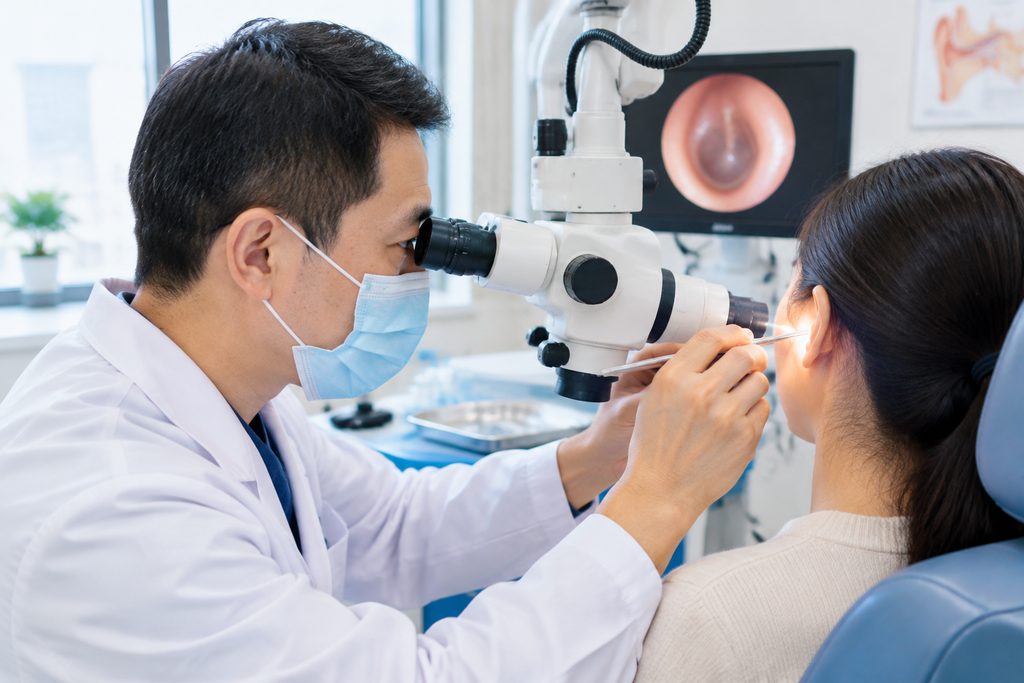
Before you book anything, it helps to know what you are booking. An ear microscope exam — sometimes called otomicroscopy — is a focused examination of the ear canal and eardrum using a binocular microscope. The instrument provides magnification of 6x to 40x, allowing the doctor to see details that a standard otoscope cannot.
Here is the typical sequence:
- Preparation: The doctor may remove earwax or debris first, either with a curette or by suction. This step is quick but essential — you cannot examine what you cannot see.
- Positioning: You sit in a specialized chair. The microscope is positioned in front of your ear. A speculum may be used to hold the canal open.
- Examination: The doctor inspects the canal walls, the eardrum, and — if there is a perforation — the middle ear space. Magnified views reveal subtle signs: retraction pockets, small perforations, fluid levels, or early cholesteatoma.
- Documentation: Many hospitals capture images or video through the microscope for your records. Ask for copies if you plan to seek follow-up care elsewhere.
How long does an ear microscope exam take? The examination itself usually runs 10 to 20 minutes. If wax removal or minor cleaning is needed, add another 5 to 10 minutes. Total clinic time — including registration and waiting — can stretch to 1 to 2 hours at a busy public hospital.
An ear endoscopy is a related but distinct procedure. Instead of a microscope, the doctor uses a thin rigid or flexible endoscope inserted into the ear canal. Endoscopy offers a wider field of view and is often used when the canal is narrow or when the doctor needs to look around corners. Some Chinese ENT departments use both, depending on the clinical question.
Cost Breakdown: What You Will Actually Pay
Prices vary by hospital tier, city, and case complexity. The table below reflects typical ranges at top-tier public hospitals in Beijing, Shanghai, and Guangzhou.
| Service | Typical Cost in China (USD) | Typical Cost in the U.S. (USD) |
|---|---|---|
| ENT specialist consultation | $15 – $50 | $150 – $400 |
| Ear microscope exam (otomicroscopy) | $30 – $80 | $200 – $500 |
| Ear endoscopy | $50 – $120 | $300 – $700 |
| Audiometry (hearing test) | $20 – $60 | $100 – $300 |
| Tympanometry | $15 – $40 | $75 – $200 |
| CT or MRI of temporal bone (if needed) | $150 – $400 | $800 – $3,000 |
These figures are estimates and vary by hospital and case complexity. Private international hospitals — such as United Family, Jiahui, or Parkway — charge more, often 1.5 to 2 times the public hospital rate, but offer English-speaking staff, shorter waits, and direct insurance billing.
For a patient paying out of pocket, the total for a consultation plus microscope exam plus hearing test at a top public hospital often lands under $150. That is the number that drives many international patients to consider medical travel to China in the first place.
How to Book an Ear Microscope Exam in China
Here is the part most guides skip. Booking is not like scheduling a dentist appointment in the U.S. Public hospital ENT clinics in China generally do not accept overseas pre-booking for routine outpatient visits. You register on the day, in person, and wait your turn.
That said, there are workable paths:
- International or VIP department: Many top hospitals have a dedicated international clinic that accepts advance appointments. You pay a premium — often 1.5 to 2 times the standard fee — but you get English-speaking staff and a scheduled time slot.
- Private international hospitals: Facilities like United Family Healthcare or Jiahui Health offer direct online booking, English-speaking ENT specialists, and insurance coordination. Costs are higher but the process is familiar to Western patients.
- Through a coordination service: A medical concierge can handle registration, hospital medical card creation, and in-person proxy visits using your records. This is especially useful if you are not yet in China.
If you want to book an ear microscope exam China appointment without flying blind, the practical move is to start with a written second opinion or video consultation. A Chinese ENT specialist reviews your existing reports — audiograms, imaging, prior notes — and tells you whether an in-person exam is even necessary. Sometimes it is not. Sometimes a remote review is enough to rule out serious pathology.
For patients specifically looking for the best ENT clinic Beijing ear endoscopy options, the top-tier hospitals cluster around Dongcheng and Chaoyang districts. Peking Union Medical College Hospital and Beijing Tongren Hospital are both well-known for otolaryngology. Shanghai’s Eye, Ear, Nose and Throat Hospital and Fudan University’s affiliated hospitals are comparable alternatives.
You can browse ENT departments and other specialties through our department directory, which lists top-ranked hospitals by specialty.
Is Ear Microscopy Safe in China?
This is a fair question, and it deserves a direct answer. Ear microscopy is a low-risk diagnostic procedure. Complications are rare. The main risks are minor: discomfort during wax removal, occasional bleeding if the canal is fragile, or a temporary sensation of fullness.
The safety question is less about the procedure and more about the setting. China’s top-tier hospitals follow standard infection-control protocols. Instruments are sterilized. Single-use speculums are common. The training pathway for Chinese ENT specialists is rigorous — typically five years of residency plus subspecialty fellowship for otology.
That said, not every hospital is equal. A small clinic in a rural area will not offer the same standards as a tertiary hospital in Beijing. If you are traveling specifically for medical care, stick to hospitals ranked in the Fudan Top 100 or accredited by JCI. Our list of top hospitals by city can help you narrow the field.
Practical Considerations Before You Travel
Visa: International patients coming to China for medical treatment typically apply for an S2 visa, which covers short-stay medical treatment and private affairs. Family members accompanying you apply for the same category. The M visa is for commercial and trade activities — it is not the correct category for medical care. Requirements vary by embassy, so check with your nearest Chinese consulate for the latest documentation list. You will usually need an invitation letter or appointment confirmation from the hospital.
Documents to bring: Prior audiograms, imaging CDs or files, biopsy reports if any, a list of medications, and a written summary of your symptoms and timeline. If your records are in English, ask the hospital whether they need certified translation. Many international departments handle translation in-house.
Payment: Public hospitals require prepayment for most services. International credit cards are accepted at larger hospitals, but smaller ones may only take cash or local payment apps. Private international hospitals often bill insurance directly. If you plan to seek reimbursement from a Western insurer, get an itemized receipt and a diagnosis code before you leave.
Language: This is the practical hurdle most patients underestimate. China’s top hospitals are enormous. Signage is often in Chinese only. Registration queues move fast. Without Mandarin, navigating the process alone is genuinely difficult. A bilingual medical companion can handle registration, queuing, payment, and translation — typically from $300 per day.
Follow-up after returning home: Ask for copies of all images, reports, and the doctor’s written assessment before you leave. Share them with your home ENT. Continuity of care matters, especially if surgery was discussed.
Frequently Asked Questions
How much does an ear microscope exam cost in China?
At a top public hospital, expect to pay between $30 and $80 for the microscope exam itself, plus $15 to $50 for the consultation. Private international hospitals charge more — often $150 to $300 for the same service. Prices vary by hospital and case complexity.
Can I book an ear microscope exam in China from overseas?
Routine public hospital ENT clinics generally do not accept overseas pre-booking. You register on the day. International or VIP departments at major hospitals do accept advance appointments, and private international hospitals offer online booking. A coordination service can also handle registration on your behalf.
How long does an ear microscope exam take?
The examination itself takes 10 to 20 minutes. If wax removal is needed, add 5 to 10 minutes. Total clinic time, including registration and waiting, is usually 1 to 2 hours at a busy public hospital.
Is ear microscopy safe in China?
Yes, at accredited hospitals. The procedure is low-risk. The main variable is the setting — stick to Fudan-ranked or JCI-accredited hospitals for the most reliable standards.
Do I need a visa for a diagnostic exam in China?
Yes. Medical treatment falls under the S2 visa category for short stays. Check with your nearest Chinese embassy or consulate for current requirements and required supporting documents.
Your Next Step
An ear microscope exam in China is fast, affordable, and widely available at the country’s top hospitals. The challenge is not the procedure — it is the logistics of getting to it. If you are considering ear endoscopy medical tourism in China, the sensible first move is a remote review of your existing records. That tells you whether travel is even necessary. Our team connects international patients with Chinese specialty departments for written second opinions, video consultations, and in-person coordination when needed. We are not a hospital and we do not provide diagnoses. We handle the logistics so you can focus on your health. Start with a free consultation and we will help you understand your options — no pressure, no obligation.
For more medical information and treatment options in China, visit chinamedservices.com (China Medical Services).
