Vascular Ultrasound in China: Cost and Prep for Overseas Patients
Vascular Ultrasound in China: The Short Answer
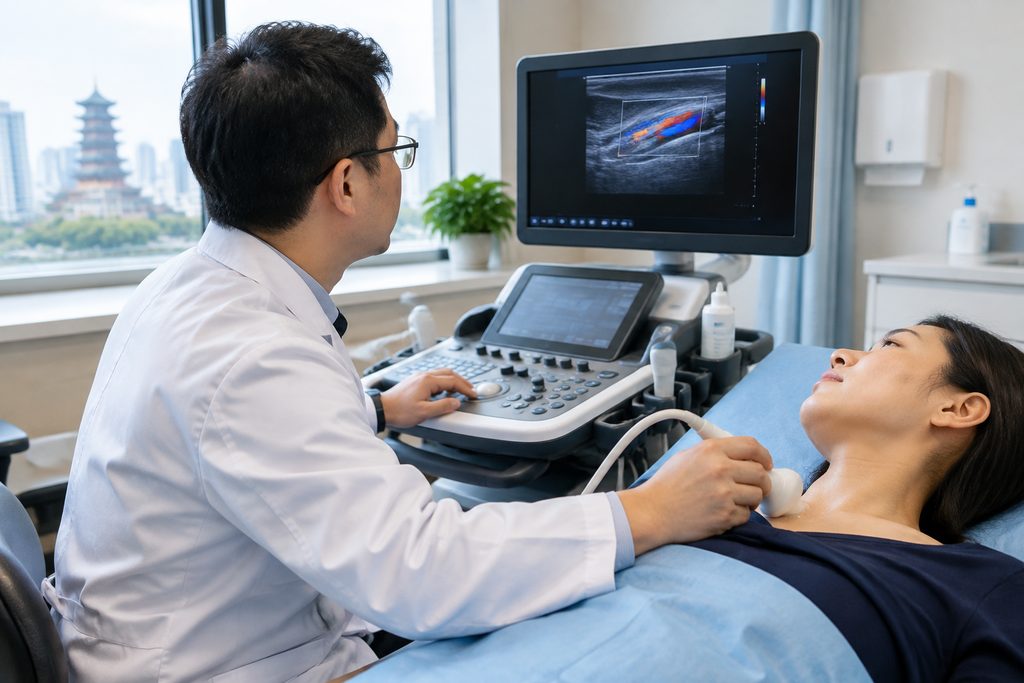
A vascular ultrasound in China typically costs between $80 and $400 at a top-tier public hospital, and between $250 and $700 at a private international clinic. The scan itself takes 20 to 45 minutes. You do not need sedation, injections, or an overnight stay. A vascular ultrasound — sometimes called a Doppler or duplex study — is simply a painless imaging test that uses sound waves to check how blood flows through your arteries and veins. No radiation. No needles. No recovery time.
But here is the part that surprises most foreign patients: cost is rarely the real obstacle. Getting an appointment slot at a busy Chinese hospital, understanding the prep instructions, and communicating your symptoms to the sonographer are the actual friction points. That gap between “cheap scan” and “scan I can actually access” is what this guide addresses.
Key takeaway: The scan is affordable and safe. The challenge is navigation — booking, prep, language, and follow-up. Plan for the logistics, not the price.
Who This Is Right For — and Who It Isn’t
Vascular ultrasound is a common, low-risk diagnostic tool. It is used to investigate a wide range of circulation problems, from leg swelling to carotid artery narrowing. If your doctor at home has already recommended one, or if you are experiencing symptoms that point to a circulation issue, you are likely a reasonable candidate for having it done in China.
You are typically a good fit if:
- You have symptoms like leg pain when walking, swelling, numbness, or a suspected deep vein thrombosis (DVT)
- You need a carotid artery check because of a history of stroke or transient ischemic attack (TIA)
- You are already traveling to China for other medical care and want a baseline circulation assessment
- You are managing a chronic condition such as diabetes or peripheral artery disease and need periodic monitoring
- You want a second opinion on imaging performed elsewhere
You should probably not pursue this in China if:
- You have an acute, life-threatening emergency — go to the nearest emergency department wherever you are
- You need immediate surgical intervention based on the result; the scan alone does not treat anything
- You are unable to travel or arrange follow-up care in your home country
- Your home country’s wait time is short and your insurance covers it fully — sometimes staying home is genuinely simpler
Being honest about that last point matters. Medical travel adds complexity. If your local system can see you in two weeks at low cost, that is often the better path. China’s advantage shows up when wait times at home stretch into months, or when the out-of-pocket price at home is prohibitive.
The Options, Compared
Where you have the scan done changes the price, the wait, and the experience. Here is how the main routes compare.
| Option | Typical Cost (USD) | Wait Time | English Support | Payment |
|---|---|---|---|---|
| Public top-tier hospital (standard channel) | $80–$250 | Same day to 1 week | Limited | Prepay, reimburse later |
| Public hospital international/VIP department | $200–$450 | 1–5 days | Yes | Prepay or direct billing |
| Private international hospital | $250–$700 | 1–3 days | Yes, fluent | Direct insurance billing often available |
| United States (comparison) | $500–$1,500+ | Days to weeks | Yes | Insurance dependent |
Which column suits you? If budget is the priority and you have a Chinese-speaking companion, the standard public channel delivers excellent imaging at the lowest price. If you need English communication and predictable scheduling, the international or private route costs more but removes most of the friction. The clinical quality of the ultrasound equipment itself is comparable across all three — the difference is service, not the sound waves.
Finding the Best Hospital for Vascular Ultrasound in Shanghai and Beyond
Shanghai is a common entry point for medical travelers, and it has no shortage of strong options. The question of the best hospital for vascular ultrasound in Shanghai depends on what you need alongside the scan — a vascular surgeon’s review, a cardiology workup, or a full second opinion.
China’s top-ranked hospitals are concentrated in a handful of cities. Beijing leads with 21 hospitals in the Fudan Top 100 ranking, Shanghai follows with 18, and Guangzhou has 10. These are drawn from more than 35,000 hospitals nationwide, placing them in roughly the top 5% by reputation and capability. For vascular imaging, hospitals with strong cardiology and vascular surgery departments are the natural choice — facilities like Fuwai Hospital in Beijing, which performs more than 14,000 cardiac surgeries a year, or Zhongshan Hospital in Shanghai.
You can browse ranked hospitals by city and specialty through our directory of top-ranked Chinese hospitals, or narrow down by department if you already know you need a vascular specialist. If English-language service and direct insurance billing matter more to you than price, the private international hospital network is worth reviewing.
One practical note: at large public hospitals, the standard outpatient channel generally cannot be pre-booked from overseas. You register on the day, queue, and see the doctor. To lock in a specific appointment time in advance, the international or VIP department is the usual route — and it costs roughly 1.5 to 2 times the standard fee. That premium buys scheduling certainty and English support, not better imaging.
How to Prepare for a Vascular Ultrasound
Preparation for a vascular ultrasound is minimal, but it is not zero. What you need to do depends on which blood vessels are being examined.
For a leg or arm artery/vein study, you generally wear loose, comfortable clothing and may be asked to remove jewelry or accessories around the area. No fasting is required.
For an abdominal vascular study — checking the aorta or renal arteries, for example — you will usually be asked to fast for 8 to 12 hours before the scan. Food and gas in the abdomen can obscure the images. Water is typically fine.
For a carotid artery study, no special prep is needed. Just avoid tight collars or necklaces.
Practical tip: Bring a list of your current medications, especially blood thinners. Also bring any prior imaging reports, even if they are in English. Chinese specialists can read English reports, and comparison with previous scans improves the value of the study.
If you smoke, you may be asked to avoid smoking for a couple of hours before the test, since nicotine affects blood flow and can skew results. Caffeine can have a similar effect on some measurements. These are minor points, but following them improves accuracy.
What It Costs and What Drives the Variance
The range of $80 to $700 sounds wide, and it is. Several factors move the number.
Hospital tier and channel. A standard outpatient slot at a public hospital sits at the low end. The same scan through an international department or private clinic sits at the high end. The imaging is equivalent; the service layer is not.
Number of vessels examined. A single-leg venous study is cheaper than a full bilateral arterial and venous assessment. More imaging time means a higher fee.
Whether a physician review is included. Some packages bundle a specialist consultation and written report; others charge separately. Always confirm what the quoted price covers.
Add-on studies. If the sonographer finds something that warrants an ankle-brachial index or a follow-up scan, that is billed separately.
What is typically not included: the initial consultation fee, translation services, hospital registration costs, and any follow-up appointments. Ask for an itemized estimate before you commit. Prices vary by hospital and case complexity, so treat any figure as a starting range, not a final quote.
Practical Considerations for Foreign Patients
Records and documentation. Bring your passport, your prior medical records, and a written summary of your symptoms and medical history. A translated summary helps, though many specialists read English.
Visa. If you are traveling to China specifically for medical treatment, the applicable short-stay category is the S2 visa, which covers medical treatment and private affairs. Family members accompanying you apply under the same category. Requirements are set by the latest embassy or consulate guidance and depend on supporting documents from the hospital. The M visa is for commercial and trade activities — it is not the right category for medical travel. Always confirm current requirements with your nearest Chinese embassy or consulate before applying.
Payment. Public hospitals generally require prepayment, with insurance reimbursement handled afterward in your home country. Private international hospitals often bill your insurer directly, which reduces upfront cost. Confirm your coverage before you travel.
Language. This is the most underrated factor. A large Chinese public hospital can see more than 10,000 outpatients in a single day. Signs, registration systems, and staff are primarily in Chinese. Without language support, even a simple scan appointment becomes a full-day navigation exercise.
Follow-up after returning home. Arrange for your imaging results and report to be shared with your doctor at home. A written report in English, or a translated one, prevents gaps in your care.
Frequently Asked Questions
Yes. Vascular ultrasound uses high-frequency sound waves, not radiation, and is considered safe for essentially all patients, including pregnant women. The safety profile is the same in China as anywhere else. The equipment at top-ranked Chinese hospitals is modern and comparable to Western standards. The main variable is operator experience, which is generally strong at high-volume centers.
At standard public hospital outpatient departments, you typically cannot pre-book from overseas — you register in person on the day. To secure a specific appointment time in advance, the international or VIP department is the practical route, though it costs more. Alternatively, a coordination service can handle registration, hospital card creation, and scheduling on your behalf. Expect to provide your passport, medical records, and a summary of your symptoms.
It depends on what is bundled. A package that includes the scan, a specialist consultation, an English report, and translation support can be good value, especially if you are combining it with other care. A package that simply marks up the scan price without adding real service is not. Compare the itemized contents against what you would pay separately, and confirm whether physician review is included.
A vascular ultrasound can detect narrowing, blockages, or clots that may require treatment. If that happens, you will need a specialist consultation and possibly further testing or intervention. This is exactly why having your results reviewed by a qualified physician — in China or at home — matters more than the scan itself. Do not treat an imaging result as a diagnosis. It is one piece of information that a doctor interprets alongside your history and symptoms.
Many top-tier hospitals can provide an English report, particularly through international departments. If you use the standard channel, you may receive a Chinese-language report and need translation. Ask about report language when you book, and request it in writing if English is essential for your follow-up care at home.
Your Next Step
Vascular ultrasound in China is affordable, safe, and widely available — the real work is in the logistics. Sorting out which hospital fits your needs, securing an appointment slot, preparing correctly, and getting your results in a language you can use are the steps that determine whether the trip is smooth or stressful.
We are China Medical Services, a coordination service — not a hospital, and we do not provide diagnoses or medical advice. Our team helps international patients match with appropriate hospitals, coordinate appointments, arrange bilingual accompaniment, and navigate visa and travel logistics. If you would like to understand your options before committing to anything, you can start with a free consultation through our patient support page. No pressure, no obligation — just a clearer picture of what is possible.
This article is for general informational purposes only and does not constitute medical advice. Always consult a qualified healthcare professional regarding your individual condition and treatment. Costs and availability are subject to change and vary by hospital and case complexity.
For more medical information and treatment options in China, visit chinamedservices.com (China Medical Services).
