Pediatric Medical Translation Service China: What Parents Need to Know Before the Hospital Visit
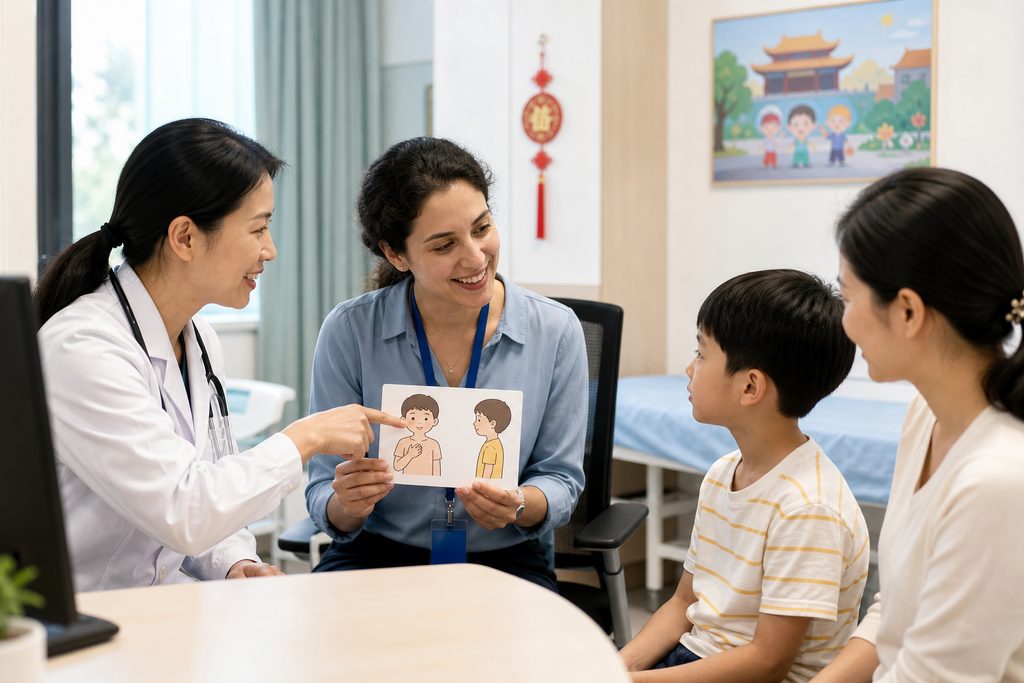
Key Takeaways
- Professional pediatric medical interpretation in China typically starts from $200 per day, with specialized child-life communication training that general adult translators lack.
- China’s top children’s hospitals handle patient volumes that dwarf Western counterparts — Beijing Children’s Hospital sees over 10,000 outpatient visits daily, creating an environment where experienced pediatric staff encounter rare conditions with unusual frequency.
- Without a dedicated child interpreter, a routine hospital visit in China can take 4-6 hours of confusion — simple tasks like finding the right department or understanding pre-procedure fasting instructions become genuine safety risks.
- Parents should understand that standard medical translation and pediatric-specific interpretation are fundamentally different skills — a translator who excels with adult cardiac patients may be completely unequipped for a frightened six-year-old.
The Problem: When Your Child Needs Medical Care in a Language You Don’t Speak
Walking into a Chinese hospital with a sick child feels like entering a different universe. The sheer scale hits first. Beijing Children’s Hospital processes approximately 10,000 outpatient visits daily. Shanghai Children’s Medical Center handles over 2.5 million patient encounters annually. The corridors pulse with urgency. Signs are in Chinese characters. Registration kiosks require Chinese ID numbers. And your child is scared, in pain, or both. You need to explain symptoms accurately. You need to understand medication instructions precisely. You need your child to cooperate during examinations. None of this happens without clear communication. The pediatric medical translation service China cost becomes a secondary concern the moment you realize what is at stake: a misunderstanding about dosage, a missed allergy warning, a child who panics during a procedure because no one explained it in words they understand.
Standard medical interpreters are trained for adult conversations. They translate “myocardial infarction” to “heart attack” and navigate complex treatment consent forms. But children are not small adults. A seven-year-old does not need to hear about “venipuncture.” She needs someone to say, “The nurse is going to use a tiny straw to take a few drops of blood from your arm — it will feel like a quick pinch, and then it is over.” That skill set is rare. Most hospitals in China, even top-tier institutions with international departments, do not staff dedicated pediatric communication specialists. They have interpreters. They do not have child-life interpreters. Understanding this distinction is where your search for a pediatric medical translation service China cost begins to make sense.
Who We Are
We are not a hospital. We do not diagnose conditions, prescribe treatments, or make clinical decisions. China Medical Services functions as your logistical backbone — we handle the complexity of navigating China’s healthcare system so you can focus entirely on your child. Our team coordinates hospital selection, appointment scheduling, visa guidance, and crucially, bilingual medical companions trained specifically in pediatric communication. We work with over 340 top-ranked hospitals across 37 cities. We have seen what happens when families attempt this alone, and we have built our service to prevent those outcomes. We are case managers, not clinicians. We bridge the gap between your family and China’s medical expertise.
Why Pediatric Medical Translation in China Requires a Completely Different Approach
Children Process Medical Information Differently Than Adults
An adult patient hearing “we need to run some tests” might feel anxious but understands the concept. A five-year-old hears “tests” and imagines something entirely different — perhaps a school exam, perhaps something frightening they cannot articulate. Pediatric communication requires developmental awareness. A child interpreter for hospital visit China must understand that a toddler needs simple, concrete language with comfort objects nearby. A ten-year-old needs honest explanations that respect their growing autonomy. A teenager needs privacy considerations and direct communication rather than being spoken about in the third person. These are not soft skills. They are hard competencies that directly affect clinical outcomes. Research published in the journal Pediatrics demonstrates that children who receive developmentally appropriate preparation before medical procedures show significantly lower distress levels, require less sedation, and recover faster. The interpreter is not just translating words. They are translating the entire medical experience into a cognitive framework the child can process.
Our bilingual companions receive specific training in pediatric communication protocols. They know how to explain an MRI to a claustrophobic eight-year-old. They understand that asking a child “where does it hurt” often yields better results than translating the parent’s description of symptoms. They recognize when a child is dissociating from pain versus simply being quiet. These nuances disappear with general medical translation.
Volume Creates Expertise You Cannot Find Elsewhere
China’s pediatric hospitals operate at a scale that generates clinical experience impossible to replicate in lower-volume systems. The pediatric cardiac surgery team at Fuwai Hospital performs over 14,000 cardiac procedures annually — many on children with complex congenital conditions. The orthopedics department at Beijing Jishuitan Hospital handles pediatric musculoskeletal cases that most Western surgeons see a handful of times in an entire career. What does this mean for communication? The medical staff in these departments have treated thousands of children with your child’s condition. They know the typical fears. They know the questions parents ask. They know the post-operative behaviors that signal complications versus normal recovery. An experienced pediatric medical interpreter in this environment does not just translate — they anticipate. They prepare you for what comes next because they have seen this exact scenario play out hundreds of times. The pediatric medical interpreter Shanghai price reflects this accumulated expertise, not just language ability.
The Structural Cost Advantages of Pediatric Care in China
Let us address what most parents actually want to know: what is the cost of medical translation for kids in China, and why does the overall care cost so much less than in Western countries? The pediatric medical translation service China cost starts from $200 per day for a bilingual medical companion. This covers half-day or full-day accompaniment through registration, consultations, examinations, and pharmacy visits. Compared to the United States, where a certified medical interpreter costs $45-75 per hour with a two-hour minimum, the economics shift dramatically for multi-day hospital visits. But the larger cost story involves the treatment itself. A pediatric cardiac procedure that costs $120,000 or more in the United States typically ranges from $15,000 to $25,000 at a top Chinese hospital. Pediatric orthopedic surgery follows similar ratios. These differences stem from structural factors — lower labor costs across the entire healthcare workforce, higher patient throughput that distributes fixed costs, and a payment system without the administrative overhead of American insurance billing. Quality does not suffer for these savings. China’s top children’s hospitals publish outcomes data in international peer-reviewed journals. Their infection rates, surgical success rates, and patient satisfaction metrics are comparable to major Western centers. The cost difference is not about cutting corners. It is about system efficiency.
| Service Component | Estimated Cost in China (USD) | Estimated Cost in United States (USD) |
|---|---|---|
| Pediatric medical interpreter (per day) | from $200 | $360-600 |
| Specialist consultation (top pediatric hospital) | $50-150 | $250-500 |
| Pediatric cardiac surgery (complex congenital) | $15,000-25,000 | $100,000-200,000+ |
| Pediatric orthopedic procedure | $8,000-18,000 | $50,000-100,000+ |
| MRI (pediatric, with sedation if needed) | $300-600 | $2,000-5,000 |
Note: All costs are estimates that vary by hospital, case complexity, and specific clinical requirements. Treatment costs do not include travel, accommodation, or coordination services.
What You Need to Know Before Going Alone
Some international hospital departments in China provide interpretation at no additional charge. United Family Healthcare, Jiahui International Hospital, and certain public hospital VIP wings offer English-speaking staff. But these services are typically general medical interpretation, not pediatric-specific communication. The interpreter may accurately translate the doctor’s words while completely failing to prepare your child for a frightening procedure. Also, free interpretation is usually limited to scheduled consultation times. It does not extend to navigating registration, understanding pharmacy instructions, or handling after-hours concerns. A dedicated companion stays with you through every step.
Compare against the alternatives. A certified medical interpreter in Shanghai working independently might charge $30-50 per hour. A hospital-contracted interpretation service might bill $50-80 per hour. Our bilingual companions cost from $200 per day, which at an 8-hour day works out to $25 per hour — but the difference is specialization. Our companions are trained in pediatric communication protocols, familiar with the specific hospitals where they work, and integrated into a broader coordination service that handles everything from visa documentation to discharge planning. You are not just paying for language conversion. You are paying for pediatric-specific communication competence and logistical navigation. The price reflects that specialized skill set.
Our companions prepare before your visit. We request your child’s medical records in advance, review the condition and relevant terminology, and match you with a companion who has experience in that clinical area when possible. For extremely rare conditions, the companion studies the terminology beforehand. During the consultation, they can request clarification from the doctor just as any professional interpreter would. The goal is accurate communication, not pretending to know everything. If a term is unfamiliar, the companion says so and asks for explanation — exactly what you would want.
This happens regularly. Pediatric medical environments are inherently stressful for children. Our companions are trained in de-escalation and distraction techniques appropriate to different developmental stages. They might use storytelling, breathing exercises, or simply give the child a few minutes to regulate before trying again. Chinese pediatricians are generally patient with uncooperative children — they see thousands of scared kids and have developed efficient, gentle examination techniques. The companion’s role is to explain what is happening in words the child can process while giving the child some sense of control. Sometimes this means the examination takes twenty minutes instead of five. That is fine. Forcing a terrified child through a medical procedure creates trauma that complicates future care.
Your Next Step
Bringing your child to China for medical care is a significant decision. The language barrier is real, but it is also solvable. With a pediatric-trained bilingual companion, your child receives not just accurate medical interpretation but developmentally appropriate communication that reduces fear and improves cooperation. The pediatric medical translation service China cost is a fraction of the overall treatment savings, and the peace of mind it provides is difficult to quantify. If you are considering a Chinese hospital for your child’s care, start with a free consultation. We will discuss your child’s specific situation, recommend appropriate hospitals, and help you understand exactly what the process looks like from start to finish. No pressure. No hard sell. Just clear information from people who navigate this system every day.
Frequently Asked Questions
Yes. We work with JCI-accredited and major Grade 3A tertiary hospitals that follow international safety standards comparable to top hospitals in the US and Europe. Surgical teams perform high volumes of procedures — often more than their Western counterparts — which studies show leads to better outcomes.
Costs vary by procedure and hospital, but international patients typically save 40-80% compared to US prices — even when factoring in travel and accommodation. A consultation with our team will give you an exact, all-inclusive quote with no hidden fees.
Send us your existing medical reports. The relevant specialty reviews them and gives you a written opinion, including treatment direction and options, before you commit to any travel. From there you can add a video consultation with the doctor, or have us attend an appointment on your behalf.
For more medical information and treatment options in China, visit chinamedservices.com (China Medical Services).
