Vascular Screening in Wuxi: Cost, Booking, and What to Expect
Vascular Screening in Wuxi: Cost, Booking, and What to Expect
Roughly one in three adults over 40 in China shows early signs of peripheral arterial disease on routine ultrasound, according to screening data reported by Chinese vascular surgery departments — and most of them feel nothing yet. That number matters to international patients too, because vascular screening cost Wuxi sits far below Western pricing while the equipment and reading standards often match it. Wuxi, a city of about 7.5 million in Jiangsu Province, is home to several high-volume tertiary hospitals with dedicated vascular surgery departments. This guide explains what screening costs, how booking actually works for foreigners, and where the process can stall.
How This Actually Works, Step by Step
Here is the real sequence, from your first email to the day you walk out with a report in hand.
Step one: you send your existing records. Prior scans, blood work, medication lists, and a short note about symptoms — leg pain when walking, swelling, a family history of aneurysm, whatever prompted the search. We translate the relevant parts into Chinese so the hospital’s international office can review them.
Step two: a specialty team reviews and replies. A vascular surgeon or internist at the receiving hospital looks at your materials and recommends which screening package fits. Carotid duplex? Ankle-brachial index plus lower-limb ultrasound? Abdominal aortic ultrasound? The answer depends on your risk profile, not on a menu.
Step three: we coordinate the appointment. This happens through the hospital’s official international department or VIP channel. You get a confirmed date and time window. What you do not get — because no one can honestly promise it — is a specific named doctor on a specific hour unless the hospital confirms it in writing.
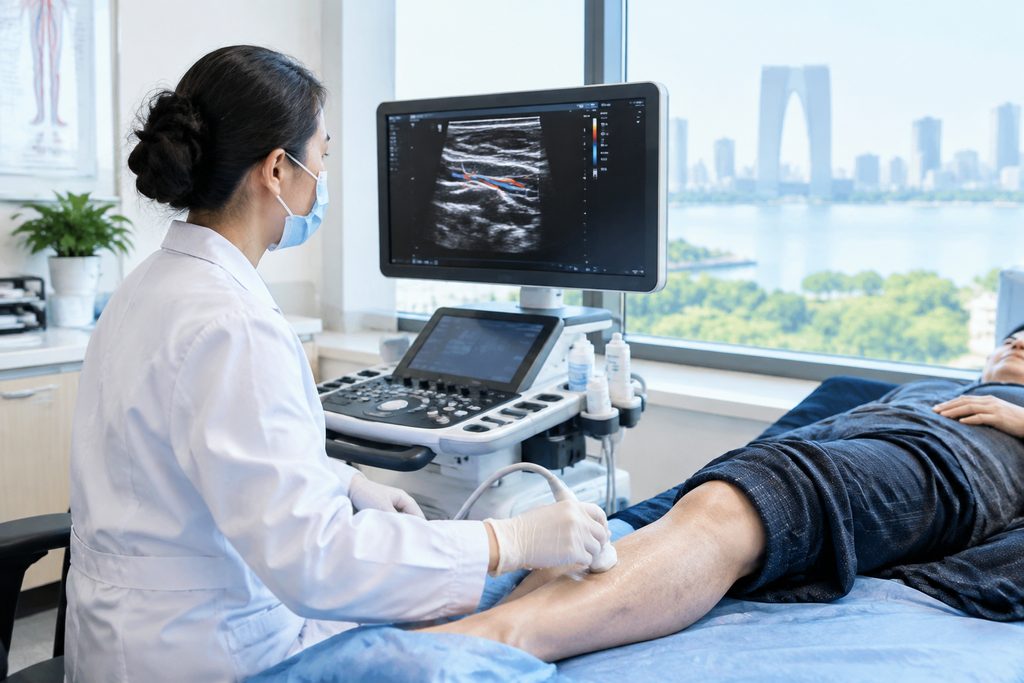
Step four: you arrive and are screened. Most vascular screening is non-invasive: ultrasound, blood pressure cuffs at multiple points, sometimes a blood panel for lipids and glucose. A full session typically runs 60 to 120 minutes.
Step five: results and a written opinion. Ultrasound findings are usually available the same day. A consolidated report with interpretation takes one to three business days.
What Vascular Screening Costs in Wuxi — Real Numbers
This is the question that brought you here. Prices below are ranges in USD and depend on hospital tier, how many vessels are examined, and whether a specialist consultation is bundled in.
| Screening Type | Typical Range in Wuxi (USD) | Typical Range in the US (USD) |
|---|---|---|
| Carotid duplex ultrasound | $80 – $180 | $500 – $1,200 |
| Lower-limb arterial ultrasound + ABI | $100 – $220 | $600 – $1,500 |
| Abdominal aortic ultrasound | $70 – $160 | $400 – $1,000 |
| Full vascular package (multiple territories) | $250 – $600 | $1,500 – $4,000 |
| Specialist consultation (international/VIP channel) | $60 – $200 | $300 – $600 |
So how much does vascular screening cost in China overall? For a single-territory ultrasound in a public tertiary hospital, expect $70 to $200. Package pricing at private international hospitals runs higher — often 1.5 to 2 times the public rate — but includes English-speaking staff and direct insurance billing.
Compare that to the United States, where a self-pay carotid ultrasound alone can exceed $1,000 before the radiologist’s reading fee. The gap is not because Chinese medicine is cheaper in quality — it is because labor, facility, and administrative costs differ enormously.
A Realistic Timeline
Screening itself is fast. Everything around it is not. Here is what to expect if you start today.
| Stage | Realistic Duration | What People Forget |
|---|---|---|
| Records collection and translation | 3 – 7 days | Old CDs and films may need digitizing |
| Specialty review and package recommendation | 2 – 5 business days | Chinese hospitals close for national holidays |
| Appointment coordination and confirmation | 3 – 10 days | Popular international departments book out |
| Visa (S2, medical/private affairs category) | 1 – 3 weeks | Requires hospital invitation documents |
| Travel and screening visit | 2 – 4 days on the ground | Build in a buffer day for traffic and registration |
| Report issuance and follow-up call | 1 – 3 business days after screening | Some panels take longer to finalize |
Total from first email to report in hand: roughly three to six weeks. If you already hold a valid visa, that compresses to about two weeks.
What Can Go Wrong — and What Happens Then
Honesty here is worth more than reassurance.
The appointment can’t be confirmed for your dates. International departments at top hospitals are busy. If the slot you want is gone, the recourse is a different date or a different hospital in the same city — Wuxi has more than one capable vascular center. Reputable coordination services refund the appointment fee if they cannot secure the booking shown in your order.
Your records are incomplete. A vascular surgeon cannot interpret a scan they can’t see. If your home hospital won’t release images, you may need to repeat imaging in China, which adds cost. Ask for your DICOM files before you leave your home country.
The screening finds something unexpected. This is the scenario people fear most, and it is also the reason screening exists. A significant stenosis or a small aneurysm means you will be referred for a consultation, possibly same-day. That is not a failure of the trip. It is the trip working.
Language breaks down at the wrong moment. Registration, payment, and pharmacy counters in Chinese public hospitals operate in Chinese. Even competent English speakers hit a wall at the cashier window. This is precisely where a bilingual companion earns their fee.
Is Vascular Screening Safe in China?
Yes — with context. The question “is vascular screening safe in China” usually hides two separate worries: equipment quality and operator skill.
On equipment: major Wuxi tertiary hospitals run current-generation color Doppler ultrasound systems from the same manufacturers used in Europe and North America. Hospital accreditation in China’s top tier is stringent, and many facilities hold international quality certifications.
On operator skill: Chinese vascular ultrasound technicians read enormous volumes. A single large hospital may perform thousands of vascular studies annually. Volume builds pattern recognition. That said, standards vary between a top-tier tertiary center and a small local clinic — which is why hospital selection matters more than city selection.
The screening procedures themselves carry essentially no risk. Ultrasound uses no radiation. Ankle-brachial index measurement involves inflating blood pressure cuffs, which is briefly uncomfortable but harmless. There is no contrast dye, no needle, no sedation in a standard vascular screening.
If your screening plan includes CT angiography with contrast, that changes the risk profile slightly — contrast agents can affect kidney function and rarely trigger allergic reactions. Discuss this with the ordering physician if you have kidney disease or a prior contrast reaction.
Choosing the Best Hospital for Vascular Screening in Wuxi
Wuxi is not Beijing or Shanghai, and that is partly the point: shorter queues, lower prices, and a calmer experience. But you still want the right department.
Look for a hospital with a standalone vascular surgery department, not just a general surgery unit that handles vessels occasionally. Dedicated departments mean dedicated ultrasound protocols and surgeons who see arterial disease daily.
Three practical criteria:
- Does the hospital have an international department or VIP channel that can pre-book for foreigners? Most public hospitals cannot pre-book ordinary outpatient slots from overseas — this is a hard rule, not a service gap.
- Can they issue the invitation documents you need for an S2 visa? Not every hospital handles this smoothly.
- Will they provide a written report in English, or only Chinese? Translation afterward is possible but adds a step.
For a broader view of which Chinese hospitals lead in cardiovascular and vascular specialties, our department-by-department rankings list the top centers by specialty reputation. If you are weighing Wuxi against larger cities, the Fudan-ranked hospital directory groups China’s top 100 hospitals by city so you can compare directly.
One more consideration: Wuxi medical tourism packages for vascular screening sometimes bundle the ultrasound with a general health checkup — blood panels, ECG, chest imaging. If you are traveling anyway, a bundled executive checkup often costs less than booking each test separately. Ask specifically what is included, because “vascular screening package” means different things at different hospitals.
Practical Considerations: Records, Visa, Payment, and Follow-Up
Records. Bring everything: prior imaging on disk, lab results, medication list with generic names, allergy history, and any prior vascular procedures. If your documents are in English, translation into Chinese helps the reviewing physician move faster.
Visa. Medical travel to China uses the S2 visa, which covers short-stay private affairs including medical treatment. Accompanying family members apply under the same category. You will typically need a hospital invitation letter and proof of the appointment. Requirements shift, so confirm current rules with the nearest Chinese embassy or consulate before you apply. Note that the M visa is for commercial and trade activity and is not the right category for medical treatment.
Payment. Chinese public hospitals require prepayment for most services. International insurance is usually reimbursed after the fact rather than billed directly. Private international hospitals more often offer direct billing with certain insurers. Bring a card that works internationally, and carry some cash for small fees.
Insurance. Call your insurer before you travel. Ask whether diagnostic imaging abroad is covered, what documentation they require, and whether pre-authorization is needed. Getting this wrong is the most common reason patients end up paying out of pocket unnecessarily.
Follow-up at home. A screening report is only useful if your home physician can read it. Request the images and the written interpretation in a format your doctor accepts. A one-year follow-up interval is common for stable findings, but that decision belongs to your physician.
Frequently Asked Questions
Not through the ordinary outpatient system — Chinese public hospitals generally do not release regular clinic slots for overseas pre-booking. Booking happens through the hospital’s international or VIP department, which is why coordination services exist. Expect to pay a coordination fee, and expect the hospital to confirm the final date.
A single-territory ultrasound in a Chinese public tertiary hospital typically runs $70 to $200, versus $400 to $1,500 in the US. Full multi-territory packages land between $250 and $600 in China. Final pricing varies by hospital and case complexity, so treat these as planning ranges, not quotes.
Standard vascular screening is non-invasive and carries essentially no risk. The larger variable is hospital quality, not procedure safety. Choose a tertiary hospital with a dedicated vascular surgery department, and ask whether contrast imaging — which carries slightly more risk — is part of the plan.
The S2 visa covers short-stay medical treatment and private affairs, and family members traveling with you apply under the same category. Requirements change, so verify current documentation with your nearest Chinese embassy or consulate. The M visa is for business activity and does not apply here.
You will be referred for a specialist consultation, often the same day. Screening detects; it does not treat. Any treatment plan requires an in-person evaluation by a licensed physician, and no service can promise a particular outcome or guarantee admission for a procedure.
Your Next Step
Vascular screening in Wuxi is affordable, fast, and technically solid — the friction sits in booking, language, and paperwork, not in the medicine. Get those three right and the rest is a two-hour appointment. Our team at China Medical Services helps international patients navigate Chinese hospitals: records translation, appointment coordination through official international departments, bilingual companions on the ground, and visa guidance. We do not diagnose, we do not treat, and we never promise a specific doctor or outcome. If you would like a clear picture of what screening in Wuxi would cost and involve for your situation, start with a free consultation — no obligation, just answers.
This article is for general information only and is not medical advice. Screening and treatment decisions should be made with a qualified physician who has reviewed your individual history.
For more medical information and treatment options in China, visit chinamedservices.com (China Medical Services).
