Cancer Screening Cost in China: What International Patients Should Know
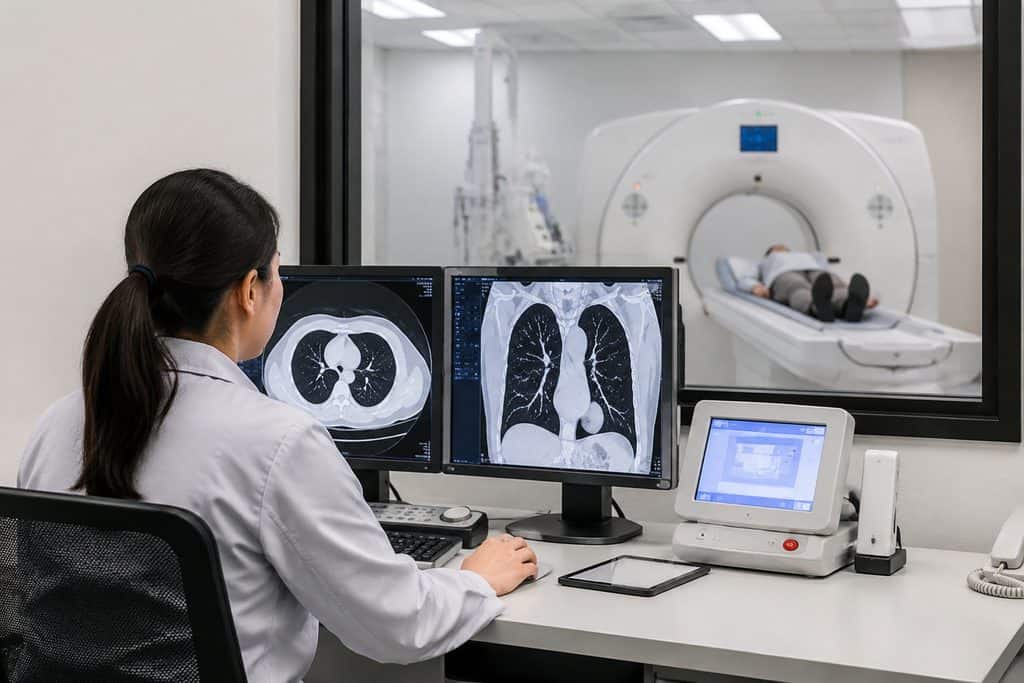
When 46-year-old David from Oregon started searching for a full-body cancer check, he did what most people do first: he looked at the price. In the US, a comprehensive private screening package can run $3,000 to $8,000 out of pocket, and insurance rarely covers it when there are no symptoms. A friend mentioned that a business trip to Shanghai might be a chance to get it done properly. So David typed one question into Google: what is the real cancer screening cost in China? That question has a concrete answer, and it is almost always lower than what he expected.
Cancer Screening Cost in China: The Short Answer
A comprehensive private cancer screening package at a top-tier Chinese hospital typically costs between $500 and $2,500, depending on the hospital tier, the depth of imaging, and whether you choose a public international department or a private international hospital. Basic packages start around $300. Premium executive packages with full-body MRI, low-dose CT, and tumor marker panels can reach $3,000 at private facilities.
That is the number. The caveat is that “cancer screening” is not one product. A 40-year-old with no symptoms needs a very different workup than a 60-year-old smoker with a family history of colon cancer. The price moves with the protocol, not with the marketing.
Who This Is Right For — and Who It Isn’t
Cancer screening in China works well for a specific kind of traveler. It is not for everyone, and pretending otherwise would waste your money.
Good candidates:
- Adults over 40 who want a comprehensive annual or biennial check without a US-style price tag
- People with a family history of cancer who need imaging their home system will not authorize without symptoms
- Patients already traveling to China for other reasons who want to combine a screening with the trip
- Anyone who has been told to “wait and see” and wants a second imaging opinion sooner
Not good candidates:
- Anyone with active symptoms — unexplained weight loss, a new lump, bleeding. That is diagnostic workup, not screening, and it needs a different pathway
- Patients who cannot travel for medical reasons or who need continuous specialist follow-up at home
- People expecting a single blood test to rule out cancer. No test does that, in China or anywhere
If you fall into the second group, staying home and pushing your local system harder is genuinely the better move. We say that plainly because it is true.
The Options, Compared
Here is how the real alternatives stack up. Prices are in USD and reflect typical 2025–2026 ranges. Every figure varies by hospital and case complexity.
| Option | Typical Cost | Wait Time | Language | Best For |
|---|---|---|---|---|
| US private screening clinic | $3,000–$8,000 | 2–6 weeks | English | Insurance-covered cases, local follow-up |
| UK private screening | £1,500–£4,000 | 2–4 weeks | English | Patients who want NHS-adjacent continuity |
| China public hospital, international department | $500–$1,500 | 1–2 weeks | English available | Value plus top-tier imaging |
| China private international hospital | $1,200–$3,000 | 3–7 days | English throughout | Comfort, direct insurance billing |
| China standard public outpatient | $200–$600 | Same day queue | Chinese only | Locals; not practical for most foreigners |
Which column suits you? If you want the lowest credible price with access to world-class imaging equipment, the public international department is the sweet spot. If you value a hotel-like experience and direct insurance billing, the private international hospitals are worth the premium. The standard public outpatient row is included for honesty: it is the cheapest, and it is also the one most international patients cannot navigate without fluent Chinese.
Why Chinese Hospitals Can Deliver This at Lower Cost
The price gap is not a quality gap. It comes from volume, equipment utilization, and the structure of the Chinese public health system.
China has more than 35,000 hospitals. The top 5%, ranked by the Fudan Hospital Rankings and JCI accreditation, sit in a different category entirely. A single large tertiary hospital in Shanghai or Beijing may run its CT and MRI scanners 12 to 16 hours a day, every day. That throughput spreads the capital cost of a $2 million imaging machine across thousands of scans a year. In the US, the same machine often sits idle half the time, and the price per scan reflects it.
For cancer screening specifically, the relevant specialties are Oncology, Radiology, and Gastroenterology. The Fudan specialty reputation rankings list the top 10 hospitals in each of 45 specialties, and several Chinese centers rank among the country’s best for oncology and digestive tract screening. You can browse the specialty-by-specialty breakdown on our departments page, which lists the top-ranked hospitals for each field.
What Drives the Price Up or Down
Four variables move the number more than anything else.
Imaging depth. A basic package with chest X-ray, ultrasound, and blood work sits at the bottom. Add low-dose chest CT and you jump a tier. Add full-body MRI or PET-CT and you are in premium territory. PET-CT alone can add $800 to $1,500.
Hospital tier. A public tertiary hospital’s international department charges roughly 1.5 to 2 times the standard public rate for the same scan, because you are paying for English-speaking staff, faster scheduling, and a private waiting area. Private international hospitals like United Family, Jiahui, and Parkway charge more again, but often bill your insurer directly.
Endoscopy. Gastroscopy and colonoscopy under sedation are included in many comprehensive packages. If they are not, expect $300 to $700 extra depending on whether polyps are removed.
Pathology and follow-up. If anything suspicious shows up, biopsy and lab work add cost. This is the part nobody quotes upfront, and it is why a $600 package can become a $1,400 bill. Budget for it.
Is Cancer Screening in China Reliable?
This is the question that matters most, and it deserves a straight answer.
The imaging equipment at top Chinese hospitals is the same equipment used in the US and Europe — Siemens, GE, Philips, Canon. The radiologists reading your scans trained in the same fellowship systems. Several Chinese centers publish oncology research in the same journals your home doctors read.
What differs is the system around the scan. Documentation may be in Chinese unless you request English reports, which most international departments provide. Follow-up care after you fly home depends on your local doctor’s willingness to work from a foreign report. And screening quality varies enormously between a top-tier hospital and a mid-tier one — the gap is wider in China than in countries with more uniform standards.
That is why hospital selection matters more than price. A $400 package at the wrong hospital is worse than a $1,200 package at the right one.
How Much Does a Full Body Cancer Check Cost in China?
Here is a realistic breakdown by package level. All figures are ranges and vary by hospital and case complexity.
- Basic screening (blood panel, tumor markers, ultrasound, chest X-ray): $300–$600
- Standard comprehensive (adds low-dose chest CT, abdominal CT, gastroscopy): $700–$1,400
- Premium executive (adds full-body MRI, colonoscopy, cardiac workup): $1,500–$2,800
- Top private international hospital premium: up to $3,000–$3,500
For comparison, the same premium package in the US routinely runs $5,000 to $8,000, and in Singapore or Japan, $2,500 to $5,000. The cancer screening medical tourism price advantage in China is real, but it is roughly a 50 to 70 percent saving, not a 90 percent one. Anyone promising more than that is cutting corners somewhere.
How to Book a Cancer Screening Package in China
Booking from overseas is the part that trips people up, so let us be precise about how the system actually works.
Standard public hospital outpatient registration cannot be reserved from abroad in advance. You queue on the day. That rule applies to Chinese citizens too. For international patients who need certainty, the practical route is the hospital’s international department or VIP channel, which does allow advance scheduling and provides English-speaking staff.
If you want to know which hospital is the best cancer screening hospital in Shanghai or Beijing for your specific needs, the answer depends on what you are screening for. For digestive tract screening, the gastroenterology rankings matter. For lung screening, look at respiratory and thoracic imaging strength. Our top hospitals directory groups the Fudan-ranked Top 100 by city so you can see what is available where.
The typical booking flow looks like this:
- Send your existing reports and a short medical history
- Receive a recommended protocol and written quote
- Confirm a date and receive a hospital appointment letter
- Use that letter for your visa application
- Arrive, complete the screening over one to three days, receive reports
Practical Considerations: Visa, Payment, and Records
Visa. Foreign patients coming to China for medical treatment use the S2 visa, annotated for medical purposes. Family members accompanying you apply for S2 as well. If your stay will exceed 180 days, the S1 category applies. Requirements are set by the latest embassy and consulate guidance, and you will need supporting hospital documents. The M visa is for commercial and trade activity and has nothing to do with medical treatment — if anyone tells you otherwise, they are wrong.
Payment. Public hospitals require prepayment, and you claim reimbursement from your insurer afterward. Private international hospitals often bill insurers directly. Bring a card that works internationally, and confirm payment methods with the hospital before arrival.
Records. Request English-language reports at the time of booking, not afterward. Ask for DICOM files of any imaging on a USB drive so your home doctor can review the actual scans, not just the written summary.
Language. Top Chinese hospitals see tens of thousands of outpatients daily. Signage, queues, and payment systems run in Chinese. Even a straightforward screening involves registration, cashier windows, and department navigation across a campus the size of a small town. This is where a bilingual medical companion earns their fee — handling registration, queuing, payment, wayfinding, and translation so you are not lost in a system built for locals.
Follow-up at home. Before you leave, ask the hospital to prepare a summary letter in English addressed to your primary care physician. It makes the handoff far smoother.
Frequently Asked Questions
Yes, at international departments and private international hospitals, where English-speaking staff handle registration and reports. At standard public outpatient departments, no — the process is entirely in Chinese and cannot be pre-booked from abroad. Choose your hospital tier with this in mind.
Rarely for screening, since most policies exclude asymptomatic screening. If a screening finds something requiring treatment, some international policies will cover the treatment portion. Check with your insurer before you travel and get any pre-authorization in writing.
The hospital will recommend follow-up imaging, biopsy, or a specialist consultation. You can pursue that in China or take the reports home. Nothing obligates you to continue treatment there. This is exactly why you should ask for DICOM files and English reports before you fly back.
For international departments, one to three weeks is typical. Private international hospitals can often schedule within a week. Visa processing adds time, so start the visa in parallel with the booking, not after it.
It depends. Full-body MRI catches some things other scans miss and also generates incidental findings that lead to anxiety and further testing. For most people without symptoms or strong family history, targeted screening based on age and risk factors is more useful than a blanket scan. Discuss the protocol with a qualified physician before committing.
Your Next Step
The numbers are clear: a comprehensive cancer screening in China costs roughly $500 to $2,500 at top-tier hospitals, against $3,000 to $8,000 in the US, with comparable imaging technology and shorter waits. The variable that matters most is not price — it is picking the right hospital for what you actually need screened.
We are China Medical Services, a coordination service, not a hospital. We do not diagnose, treat, or promise outcomes. What we do is help international patients match with appropriate hospitals, arrange appointments through official international departments, and provide bilingual support on the ground. If you would like a written second opinion on your existing reports before deciding anything, that is a low-commitment way to start. You can reach our team for a free consultation and we will tell you honestly whether traveling to China makes sense for your situation — including when it does not.
For more medical information and treatment options in China, visit chinamedservices.com (China Medical Services).
