Gastric Cancer Screening in China: Gastroscopy Cost & Access
Key Takeaways
- A diagnostic gastroscopy in China’s top-tier public hospitals typically runs $150–400, versus $1,500–3,500 in the United States — the same procedure, often faster.
- China’s high-volume endoscopy centers perform thousands of scopes annually, and several rank among Asia’s most experienced for early gastric cancer detection.
- The hard part is not the procedure. It is the booking. Public hospital outpatient slots cannot be reserved from overseas in advance, and walk-in registration is conducted in Chinese.
- Anyone considering screening abroad should understand what a gastroscopy can and cannot detect, and should confirm the plan with a qualified physician before traveling.
You have probably been told that getting a gastroscopy in China means long queues, unclear pricing, and a language wall you cannot climb. Some of that is true. The queue part, especially.
But here is what surprises most international patients: the gastroscopy cost China hospitals charge is often one-fifth of what a U.S. facility bills, and the endoscopists performing the procedure may handle more cases in a year than their Western counterparts see in three. The barrier is not quality or price. It is navigation.
This guide breaks down what gastric cancer screening in China actually involves — real cost ranges, which hospitals are worth your time, how long the procedure takes, and the practical mechanics nobody explains until you are standing in a registration hall holding a number ticket.
The Problem: Gastric Cancer Is Quiet, and Screening Is Expensive Where You Live
Gastric cancer kills roughly 660,000 people worldwide each year, according to GLOBOCAN estimates published by the International Agency for Research on Cancer. East Asia carries a disproportionate share of that burden — China, Japan, and South Korea together account for a majority of global cases.
Geography matters because it shapes screening policy. Japan and South Korea run national endoscopic screening programs. China has been expanding regional programs, particularly in high-incidence provinces. In the United States and most of Western Europe, routine gastroscopy screening for average-risk adults is not recommended at all — the incidence is lower, and the cost-benefit math does not support it.
So a patient in Ohio or Manchester who wants a baseline endoscopy usually faces one of two paths. Pay out of pocket at a private clinic. Or wait for symptoms severe enough to justify a referral — which, with gastric cancer, often means the disease is already advanced.
That gap is why medical tourism packages China endoscopy providers now offer have drawn interest from patients with family histories, chronic H. pylori infection, or persistent upper-GI symptoms.
Why Gastric Cancer Screening in China Delivers Results
The case rests on three structural facts, not marketing claims.
Volume Creates Diagnostic Familiarity
China’s tertiary hospitals sit inside a population of 1.4 billion. A single large gastroenterology department in Beijing or Shanghai may perform 20,000 to 50,000 endoscopies a year. Endoscopists at that volume see early-stage lesions — subtle mucosal changes, flat adenomas, tiny submucosal irregularities — far more often than a low-volume Western endoscopist does.
Pattern recognition in medicine is a function of exposure. A physician who has personally scoped thousands of stomachs recognizes a 4mm suspicious patch differently than one who has scoped hundreds.
Equipment and Technique Are Current
Top Chinese hospitals run high-definition and magnification endoscopy, narrow-band imaging (NBI), and chromoendoscopy — the same platforms used at major U.S. and European centers. Several institutions also offer endoscopic submucosal dissection (ESD), a technique for removing early gastric tumors without open surgery. Japan developed ESD; China adopted and scaled it aggressively.
The Cost Differential Is Structural, Not a Quality Signal
Lower gastroscopy cost China pricing reflects physician salary structures, hospital operating economics, and procedure volume — not corner-cutting. The consumables, scopes, and sedation drugs are the same categories of product used elsewhere.
| Item | China (top public hospital) | United States | United Kingdom (private) |
|---|---|---|---|
| Diagnostic gastroscopy (sedated) | $150–400 | $1,500–3,500 | £1,200–2,500 |
| Biopsy (per site) | $15–40 | $150–400 | £120–300 |
| H. pylori testing (breath/rapid urease) | $20–60 | $100–300 | £80–200 |
| Pathology report turnaround | 3–7 days | 5–10 days | 7–14 days |
| International department surcharge | 1.5–2x standard rate | n/a | n/a |
Prices vary by hospital and case complexity, and the figures above are ranges rather than quotes. An international department visit costs more than a standard outpatient slot — roughly 1.5 to 2 times — but includes English-speaking staff and a smoother process.
What Actually Happens During the Procedure — and How Long It Takes
If you have never had an endoscopy, the uncertainty is worse than the event. Here is the sequence.
Before. You fast for 6–8 hours. The hospital checks your history, sometimes runs a pre-procedure blood panel and ECG. Sedation options range from throat spray (awake) to conscious sedation to deep sedation with propofol. Most international patients choose sedation.
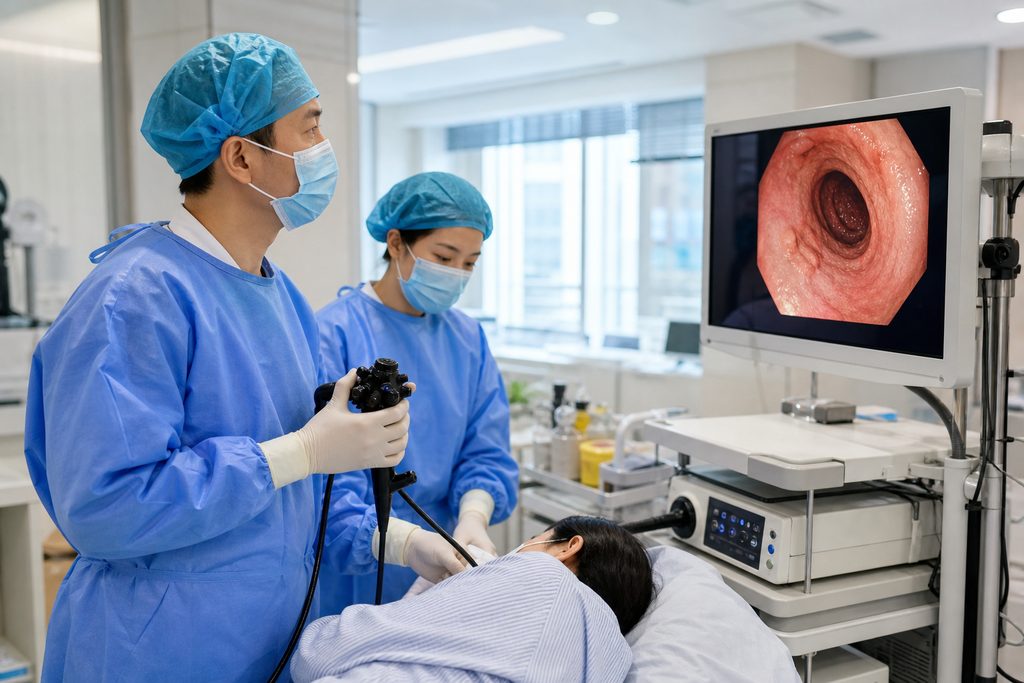
During. The scope passes through the mouth and esophagus into the stomach and the first part of the small intestine. A thorough diagnostic exam with systematic photo documentation takes 10–20 minutes. If the endoscopist sees something suspicious, they take biopsies — small tissue samples, painless.
So how long does a gastroscopy take end to end? Including check-in, preparation, the procedure, and recovery from sedation, budget 2–3 hours at the hospital. The procedure itself is the short part.
After. You rest until the sedation wears off, usually 30–60 minutes. Someone should accompany you; you should not drive. Biopsy results typically return in 3–7 days. Mild throat soreness and bloating are normal and resolve within a day.
Choosing a Hospital: What the Rankings Actually Tell You
China does not publish a single national hospital league table the way U.S. News does. What exists is the Fudan Hospital Ranking, released annually by the Hospital Management Institute at Fudan University. It has two parts.
The general ranking lists the top 100 hospitals grouped into tiers — A++++ down to A — without individual numerical positions. The specialty reputation ranking is more useful for a patient: it ranks the top 10 hospitals in each of 45 specialties, including oncology and gastroenterology.
For gastric cancer screening, you want a hospital with a strong gastroenterology or oncology reputation, high annual endoscopy volume, and — if you do not speak Mandarin — an international department.
If you are searching for the best hospital for gastric cancer screening in Beijing, the shortlist generally centers on large tertiary institutions with dedicated digestive disease centers. Peking Union Medical College Hospital and several university-affiliated hospitals in the city carry strong reputations. Shanghai’s landscape includes Fudan University-affiliated hospitals with deep gastroenterology programs. Guangzhou, Chengdu, and Hangzhou each have major centers as well.
Our specialty rankings by department list the top 10 hospitals for oncology and gastroenterology, and the Fudan Top 100 directory organizes hospitals by city so you can see what exists near your intended destination.
One honest caveat: reputation rankings measure research output, specialist surveys, and clinical volume. They do not measure how comfortable a foreign patient will feel in the waiting room. That is a separate question, and it is where international departments earn their premium.
Is Gastroscopy Safe in China for Foreigners?
The procedure carries the same baseline risks anywhere: mild sedation reactions, minor bleeding after biopsy, and — rarely — perforation. Published complication rates for diagnostic gastroscopy sit well under 1% in experienced hands. The technique does not change at the border.
What changes is the surrounding system. And this is where foreigners hit friction.
Public hospital outpatient appointments in China generally cannot be reserved from abroad in advance. Registration happens on the day, in person, in Chinese, often starting before 7 a.m. Surgery and sedation-based procedures typically require an in-person consultation first. The international or VIP department is the exception — it allows advance coordination, provides English-speaking staff, and charges accordingly.
Safety, in practice, comes down to three things: a hospital with genuine endoscopy volume, a physician who communicates findings to you clearly, and a process where nothing important gets lost in translation.
Practical Considerations: Visas, Payment, and Follow-Up
Not through the standard public outpatient channel — those slots are same-day, in-person, and in Chinese. Advance coordination is possible through a hospital’s international or VIP department, which is the route most foreign patients use. Expect a higher fee for that access and English-language support.
The clinical safety profile is comparable to Western centers. The real risk is communication. Consent, allergy screening, and post-procedure instructions all depend on accurate language transfer. Arrange a qualified interpreter or a bilingual medical companion for the visit rather than relying on ad-hoc translation.
Biopsies are taken during the procedure, and results return in 3–7 days. If findings require treatment, you will receive a pathology report and imaging that your home physicians can review. Nothing obligates you to continue treatment in China — but having complete records in English makes any next decision easier.
Your Next Step
A gastroscopy in China is a genuinely affordable, technically solid option for patients who need screening and cannot get it at home without a fight. The procedure is not the hard part. The system around it is.
We are China Medical Services — a coordination service, not a hospital and not a provider of diagnoses. We help international patients understand their options, connect with appropriate hospitals, and manage the logistics that make a medical trip work. If you would like to talk through whether screening in China makes sense for your situation, you can start with a free consultation. No pressure, no obligation — just a clearer picture before you decide.
This article is for general information only and does not constitute medical advice. Gastric cancer screening decisions should be made with a qualified physician who knows your personal and family history.
Frequently Asked Questions
Yes. The hospitals used for international patients are JCI-accredited and follow the same international safety standards as top hospitals in the US and Europe. Surgical teams perform high volumes of procedures — often more than their Western counterparts — which studies show leads to better outcomes.
Costs vary by procedure and hospital, but international patients typically save 40-80% compared to US prices — even when factoring in travel and accommodation. A consultation with our team will give you an exact, all-inclusive quote with no hidden fees.
Send us your existing medical reports to get started. We handle everything from hospital selection and appointment scheduling to visa assistance and post-operative recovery planning. Your medical records are reviewed by the specialist before you even book a flight.
For more medical information and treatment options in China, visit chinamedservices.com (China Medical Services).
