Single Tooth Implant in China: Costs, Safety, and How It Works
Key Takeaways
- One implant, abutment, and crown in a Chinese public hospital typically runs $1,400–$3,000 total — against roughly $4,000–$6,000 in the United States for the same three components.
- China’s top dental schools and hospital stomatology departments handle implant volumes that most Western private practices never approach, which is one reason per-unit pricing stays low.
- The honest barrier is not quality — it is logistics. Public hospital dental clinics rarely accept overseas bookings in advance, and almost nothing is available in English without help.
- Any decision should rest on your bone scan and medical history, not on a price list. Get a written treatment plan before you book a flight.
The Problem: A Single Missing Tooth Should Not Cost a Used Car
Losing one tooth is a small event with a large price tag. In the United States, the American Dental Association’s Health Policy Institute has tracked implant and crown costs for years, and a single implant with abutment and crown commonly lands between $4,000 and $6,000 before insurance. Many dental plans classify implants as a major service and cover only half — or nothing at all. In the UK, private implant treatment often runs £2,000–£3,000 per tooth. In Australia, patients regularly see AUD 4,000–6,000 quoted for one unit.
So people wait. They live with a gap, or a flipper, or a bridge that grinds down the two healthy teeth beside it. That waiting has consequences. Bone resorbs where the tooth root used to be, and after a year or two the site may need grafting before an implant is even possible. A problem that started at one tooth becomes a surgical site.
Is there a legitimate alternative that does not involve flying to a cut-price clinic with a website full of stock photos? Yes — but it requires understanding how Chinese dentistry actually works, and being honest about what is and is not realistic.
Why China Delivers Results for Dental Implant Patients
Volume and specialization at the top of the system
China has roughly 35,000 hospitals. The top 5% — the tier covered in our ranked hospital database — includes dedicated stomatology hospitals and the dental departments of major university medical centers. These are not general clinics that do a few implants a month. They are teaching hospitals where implantology is a full subspecialty, where residents train for years on the procedure, and where the annual case count is measured in thousands.
That matters for a simple reason. Implant placement is a precision procedure, and precision improves with repetition. A surgeon who places several hundred implants a year has seen every variation of bone density, sinus proximity, and healing response. For an uncomplicated single tooth, that experience translates into predictable outcomes.
Materials are the same — the price structure is not
Here is the part that surprises people. The implant fixtures used in Chinese public hospitals are frequently the same international brands sold in the US and Europe — Straumann, Nobel Biocare, Osstem, and others. Chinese-made implants have also matured considerably and are widely used with solid documented results. You are not choosing between “the real thing” and a knockoff. You are choosing where the labor and overhead are billed.
China’s cost advantage comes from labor economics, hospital efficiency, and volume purchasing. A US private practice carries a mortgage on a suburban building, a front-office payroll, and a marketing budget. A Chinese public hospital dental department carries none of that in the same proportion. The clinical work is comparable. The billing structure is not.
The cost gap, in numbers
Below is a realistic comparison for one complete single tooth implant — fixture, abutment, and crown. Ranges vary by hospital tier, implant brand, and whether grafting is needed.
| Component / Total | China (public hospital) | China (private international clinic) | United States | United Kingdom (private) |
|---|---|---|---|---|
| Implant fixture | $500–$1,200 | $1,200–$2,500 | $1,500–$3,000 | £800–£1,500 |
| Abutment | $150–$400 | $300–$700 | $300–$800 | £200–£500 |
| Crown | $300–$800 | $600–$1,500 | $1,000–$2,500 | £500–£1,200 |
| Typical total | $1,400–$3,000 | $2,500–$5,000 | $4,000–$6,000 | £2,000–£3,000 |
Prices are indicative and vary by hospital and case complexity. They exclude travel, accommodation, and any bone grafting, which typically adds $400–$1,500 depending on the extent of the defect.
How Long Does a Single Tooth Implant Take — and What Happens on Which Day?
This is where expectations most often go wrong. People assume an implant is one appointment. It is not, and the timeline is dictated by biology, not by scheduling convenience.
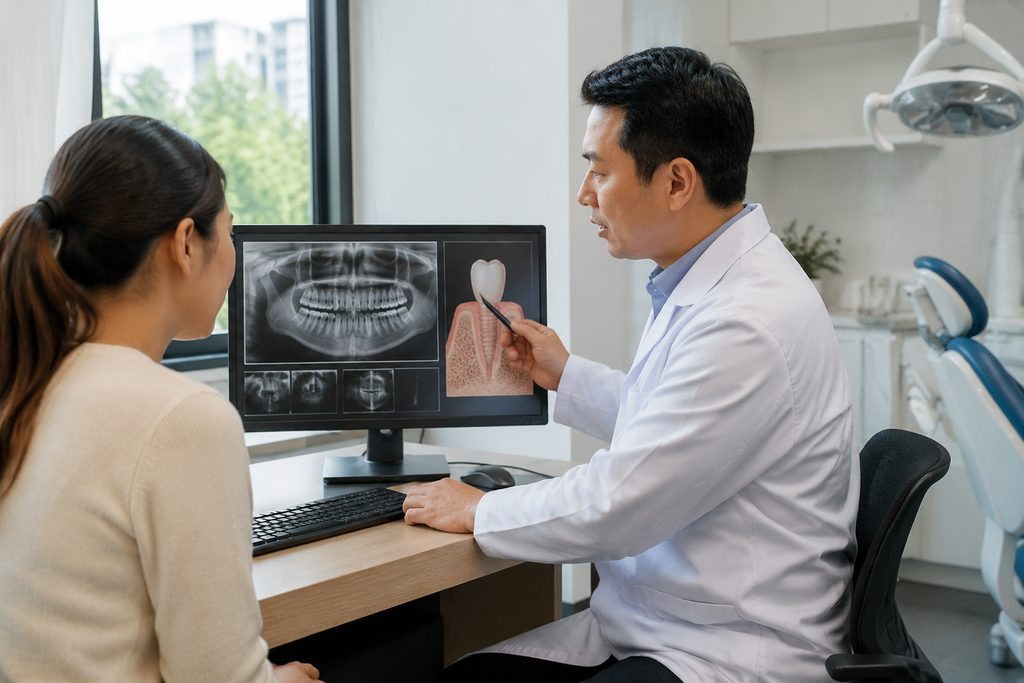
Stage 1 — Evaluation (day 1, or remote beforehand). A CBCT scan maps bone height, width, and nerve position. Blood work screens for uncontrolled diabetes, bleeding disorders, and other contraindications. If you have existing X-rays or a CBCT file, a Chinese dental specialist can review them remotely before you commit to travel.
Stage 2 — Placement (day 2, roughly 45–90 minutes). The titanium fixture is inserted into the jawbone under local anesthesia. Most patients describe pressure rather than pain. You leave with the implant submerged under the gum and a temporary solution if the gap is visible.
Stage 3 — Healing (2–4 months at home). This is osseointegration — the bone fusing to the implant surface. Nothing can be rushed here. Some clinics use immediate-load protocols for suitable cases, but a single molar in soft bone is usually not one of them.
Stage 4 — Abutment and crown (a second trip, or a single longer stay). The gum is opened, the healing abutment placed, an impression or digital scan taken, and the crown fabricated. This typically takes 5–10 days on site, depending on the lab.
So: how long does a single tooth implant take end to end? Plan on three to five months of calendar time, with two short trips to China, or one extended stay of three to four weeks if your bone quality allows immediate loading. Ask any provider to state plainly which protocol applies to you — a vague answer is a warning sign.
Is Dental Implant Surgery Safe in China — and How Do You Judge a Clinic?
China has national clinical standards for dental implant procedures, and its leading stomatology hospitals operate infection-control protocols comparable to Western academic centers. But “China” is not a single clinic. Quality varies enormously across the 35,000 hospitals, and the gap between a top-tier teaching hospital and a small commercial dental shop is real.
Use these criteria before you commit.
- Hospital tier and department structure. A stomatology department inside a major university hospital or a dedicated dental hospital carries institutional accountability that a standalone shop does not.
- Implant brand disclosure in writing. A serious provider names the system, the country of origin, and the warranty terms. If the brand is never specified, that is a problem.
- CBCT before planning, not after. Anyone who quotes a price before seeing a scan is guessing.
- Who actually performs the surgery. At teaching hospitals, confirm whether the operating surgeon is the attending specialist or a trainee. This is a fair question and a good clinic will answer it directly.
- Documented aftercare and records. You should leave with your implant passport, brand details, lot numbers, and imaging — essential for any future dentist who touches that tooth.
Be cautious of any quote that bundles flights, hotel, and surgery into a single “package” price without a clinical evaluation first. Dental implant packages in Shanghai and elsewhere can be legitimate, but the treatment plan must come before the price, never the other way around.
Who is not a good candidate for overseas treatment? Patients with uncontrolled diabetes, active smoking with poor healing history, untreated periodontal disease, or those on bisphosphonates for osteoporosis. If your medical complexity is high, the travel risk outweighs the savings. That is a judgment your own physician should help you make.
Practical Considerations: Booking, Visa, Payment, and Follow-Up
Booking reality. Most Chinese public hospital dental clinics do not accept advance appointments from overseas patients through their standard outpatient channel. You typically register on the day, in person, in Chinese. International departments and private hospitals do accept advance bookings, and our team handles hospital appointment coordination for patients who need a confirmed slot before flying.
If you specifically want a best dental clinic Beijing implant option, the practical route is the international or VIP channel of a major university dental hospital or a JCI-accredited private hospital. Expect pricing roughly 1.5–2 times the standard public rate — still well below US equivalents.
Visa. Medical treatment in China falls under the S2 visa (short stay, annotated for medical treatment), with S1 for stays exceeding 180 days. Accompanying family members apply under the same category. Requirements shift, so confirm current documentation with your nearest Chinese embassy or consulate, and note that the hospital’s supporting letter is usually part of the application. The M visa is for commercial and trade activity and has nothing to do with medical care.
Payment. Chinese public hospitals require prepayment for treatment. International credit cards are accepted at international departments; smaller public clinics may be cash or domestic mobile payment only. Foreign insurance is generally not billed directly at public hospitals — you pay, then claim reimbursement at home. Private international hospitals more often offer direct billing with selected insurers.
Language. This is the single biggest practical hurdle. A large Chinese hospital sees thousands of outpatients daily, and signage, forms, and staff conversation are overwhelmingly in Chinese. Without a bilingual companion, a simple implant appointment becomes a full-day navigation exercise.
Follow-up after you go home. Your crown may need adjustment, and any future dentist will want your implant records. Request them in English before you leave the country. This is not optional — it is the difference between a smooth long-term outcome and a mystery in your jaw.
Frequently Asked Questions
For one tooth alone, sometimes not — a $2,000 flight can erase the savings. The math changes when you need multiple implants, a full arch, or grafting, where the per-unit gap compounds. Be honest with yourself about the total cost, not just the surgery line item.
Yes, and it is the sensible first step. You send your CBCT scan, X-rays, and dental history; a Chinese dental specialist reviews them and returns a written assessment with treatment options and an estimated cost range. This costs far less than a flight and tells you whether the trip is worth planning at all.
Implant failure rates for single teeth are low in healthy, non-smoking patients, but they are not zero. Reputable implant systems carry manufacturer warranties on the fixture itself, and your documentation supports any claim. Revision surgery, if needed, would most likely be handled by a dentist in your home country.
Not if you work through an international department, a private hospital, or a coordination service. If you plan to walk into a standard public dental clinic alone, assume you will need a translator or a Chinese-speaking companion.
Your Next Step
A single missing tooth is a solvable problem, and the price you have been quoted at home is not the only number that exists. What matters now is a proper evaluation — your bone, your health history, your timeline — before any money changes hands.
We are China Medical Services, a coordination team that connects international patients with the top 5% of China’s hospitals. We are not a hospital and we do not diagnose or treat anyone. What we do is help you get a real clinical answer first, then handle the logistics if you decide to proceed. If you would like a written second opinion on your dental scans, or simply want to understand your options, start with a free consultation — no pressure, no obligation.
For more medical information and treatment options in China, visit chinamedservices.com (China Medical Services).
