Medical Tourism in Dalian: What to Know Before You Go
Key Takeaways
- Dalian is a Tier-2 coastal city with three top-ranked hospitals in our network of 340+ — strong orthopedic, cardiac, and oncology depth at roughly one-fifth of US prices.
- Dalian medical tourism cost for common procedures typically runs $3,000–$18,000, depending on hospital tier and case complexity.
- The hard part is not the surgery. It is the queueing, the language, and the fact that public hospital outpatient slots cannot be reserved from overseas.
- No hospital in Dalian has a published English price list. Any quote you receive before a doctor reviews your records is an estimate, not a bill.
You’ve probably heard that having surgery in China means compromising on quality. The reality runs the other way. China’s top 5% of hospitals — a group of roughly 340 institutions out of more than 35,000 nationwide — handle surgical volumes that most Western centers never approach, and they do it at a fraction of the price.
Dalian sits in that picture in a specific way. It is not Beijing. It is not Shanghai. It is a port city of about seven million people on the Liaodong Peninsula, with a medical school tradition going back more than seventy years and a cost structure noticeably lower than the first-tier cities. For patients who want serious clinical capability without first-tier pricing and congestion, that combination is worth understanding.
This guide covers what Dalian medical tourism cost actually looks like, which hospitals accept international patients, how to book medical treatment in Dalian China without flying blind, and the parts of the process nobody warns you about.
The Problem: You Cannot Simply Book a Chinese Surgeon Online
Here is the statistic that surprises most Western patients: in China’s public hospital system, outpatient appointments are not reservable from abroad. You register on the day, in person, in a queue. Surgery follows a face-to-face consultation — not a video call, not an email exchange.
That rule is not bureaucracy for its own sake. A top Chinese hospital may see 10,000 or more outpatients in a single day. The system is built for throughput, and the queue is how it manages volume. But it creates a genuine problem for someone in Toronto or Dubai trying to plan a hip replacement six months out.
Add the language barrier and the picture sharpens. Outside international departments, English-speaking staff are rare. Signage, consent forms, pharmacy instructions, discharge summaries — all in Chinese. A patient who arrives alone at a Dalian tertiary hospital without language support will spend more energy navigating than recovering.
So the real question is not “is the surgery good.” It is “how do I get from a Google search to a scheduled operation without wasting a trip.”
Why Dalian Works for International Patients
Clinical Depth Without First-Tier Crowding
Dalian’s flagship institutions are affiliated with Dalian Medical University and hold tertiary Grade A status — the top classification in China’s hospital grading system. That means they appear in the same national quality framework used to rank institutions in the Fudan Hospital Rankings, the closest thing China has to a national league table.
Orthopedics, cardiac surgery, oncology, and rehabilitation are the areas where Dalian carries the most weight. For comparison, the Fuwai Hospital in Beijing performs over 14,000 cardiac surgeries a year — the highest volume in the world. Dalian does not match that, but it operates within the same referral and training ecosystem, and its surgeons trained in it.
Cost Structure That Reflects the City, Not the Capital
Beijing and Shanghai carry a price premium. Dalian does not. Hospital fees in China are set by provincial pricing bureaus, and Liaoning province sits below the municipal rates of Beijing and Shanghai for most procedures. Housing, transport, and food costs follow the same pattern.
For a patient paying out of pocket, that difference compounds. A two-week stay in Dalian — hotel, meals, transport, companion — can run several thousand dollars less than the equivalent in Shanghai.
Recovery Environment
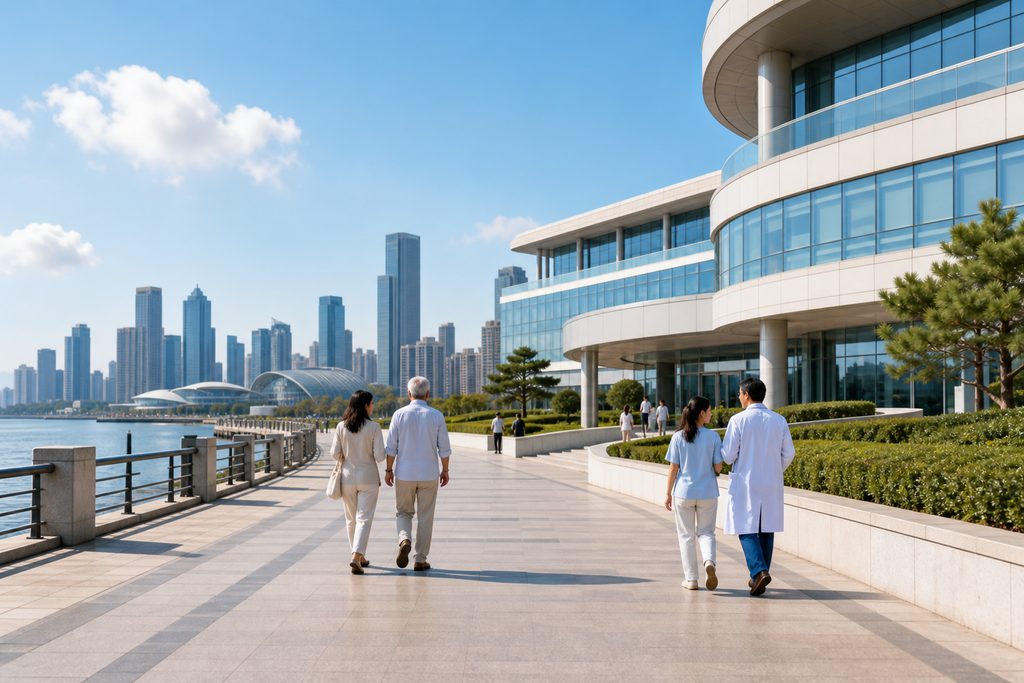
Dalian is a coastal city with clean air by Chinese urban standards, mild summers, and a walkable central district. For post-operative recovery, that matters more than people expect. Patients recovering from joint replacement or cardiac procedures need somewhere to walk, breathe, and sleep well.
Dalian Medical Tourism Cost: What Procedures Actually Run
Numbers below are typical ranges for Dalian tertiary hospitals, in US dollars, for self-paying international patients. They exclude travel, accommodation, and companion services. Every figure varies by hospital and case complexity — treat them as planning ranges, not quotes.
| Procedure | Dalian Range (USD) | Typical US Range (USD) |
|---|---|---|
| Total knee replacement (one knee) | $8,000 – $14,000 | $35,000 – $75,000 |
| Hip replacement | $9,000 – $15,000 | $40,000 – $80,000 |
| Coronary artery bypass graft (CABG) | $12,000 – $20,000 | $120,000+ |
| Spinal fusion (single level) | $10,000 – $18,000 | $60,000 – $110,000 |
| Cataract surgery (per eye) | $1,200 – $2,800 | $3,500 – $7,000 |
| Comprehensive health screening | $400 – $1,500 | $2,000 – $5,000 |
| Chemotherapy cycle (varies widely) | $800 – $3,000 | $10,000 – $30,000 |
Those US figures come from published hospital pricing and industry cost surveys; they vary by state and insurer. The gap is real, and it is structural — not a sign of corner-cutting. Chinese hospital labor costs, drug procurement under national bulk-buying programs, and sheer surgical volume all push unit costs down.
One caution. A number you find online before a doctor has seen your imaging is a guess. Ankle fractures, hernias, and cataracts are predictable. Complex revision surgery, multi-level spinal work, or anything involving prior failed procedures is not. Expect the final quote to move once records are reviewed.
Best Hospitals in Dalian for International Patients
Dalian has three categories of facility that matter to a foreign patient, and they behave very differently.
Tertiary Grade A public hospitals. These are the clinical heavyweights — the ones with the surgical volume, the equipment, and the specialists. They are also the ones where the queue is longest and English is scarcest. Access to a senior specialist usually runs through the hospital’s international or VIP department, where English-speaking coordinators work and where fees are roughly 1.5 to 2 times the standard rate. That premium buys speed and communication, not better surgery.
Private and international clinics. Smaller, English-first, often with direct insurance billing and JCI-aligned standards. Good for diagnostics, screening, chronic disease management, and minor procedures. Not where you go for a complex cardiac operation. Our private international hospital directory lists facilities by insurance and language capability.
Traditional Chinese medicine hospitals. Dalian has established TCM institutions offering acupuncture, tuina massage, and herbal therapy. These suit rehabilitation, chronic pain, and post-stroke recovery — not acute surgical problems. If that is your interest, the TCM hospital guide covers what these hospitals actually treat and what they do not.
Whichever route fits, the practical question is whether the hospital has treated foreign patients before. Ask directly. A department that has never handled an international case will underestimate the paperwork, the translation needs, and the discharge planning.
How to Book Medical Treatment in Dalian China: A Realistic Sequence
The process has a shape, and knowing it prevents wasted flights.
Step one — records first. Send your existing imaging, pathology, lab work, and physician notes. A Chinese specialist reviews them and returns a written assessment: whether the case is treatable here, what approach they would take, and a rough cost band. This is the single highest-value step, and it happens before you buy a ticket.
Step two — a conversation. A video consultation with the specialty team lets you ask the questions a written report cannot answer. Cost for this runs $100–$300 at a standard tertiary international department, or $500–$800 with a top-tier specialist. Multidisciplinary case reviews, where several departments weigh in together, run $1,500–$2,000.
Step three — the visa. Foreign patients traveling to China for treatment use the S2 visa, issued for short-stay private affairs including medical treatment, with the purpose noted in the visa. Stays beyond 180 days fall under S1. Accompanying family members apply for S2 as well. Requirements shift, so confirm current documentation with the nearest Chinese embassy or consulate. Note that the M visa is a commercial and trade category — it is not the medical route.
Step four — appointment coordination. Registration, medical card creation, and scheduling are handled through the hospital’s official international or VIP channel. Expect a coordination fee from $300. If the appointment cannot be secured, that fee is refunded in full.
Step five — arrival and the in-person consultation. The surgeon examines you, confirms the plan, and schedules the operation. Only at this point does a firm price exist.
Practical Considerations Nobody Mentions Until It’s Too Late
Commonly between one-fifth and one-tenth of US list prices. A knee replacement in Dalian typically runs $8,000–$14,000 against $35,000–$75,000 in the US. These are ranges, not quotes — final pricing depends on the hospital, the implant chosen, length of stay, and case complexity, and is confirmed only after in-person examination.
Yes, but concentrated in international and VIP departments. General outpatient clinics rarely have English-capable staff. If you need to communicate in English throughout your stay, plan for either an international department or a professional interpreter — ideally both, since clinical vocabulary is its own language.
This is the question worth asking before you book. Get a written post-operative protocol in English, keep your operative and discharge records, and identify a local physician who will accept follow-up responsibility. For complications arising during your stay in China, the treating hospital remains your point of contact. Remote follow-up consultations with the Chinese team are possible but are not a substitute for local emergency care.
Your Next Step
Dalian is a legitimate option for patients who want serious surgical capability at a price that does not require a second mortgage — provided you understand that the hard part is coordination, not the operating room.
We are China Medical Services, a patient coordination service working with 340+ top-ranked hospitals across 37 cities. We are not a hospital and we do not diagnose or treat anyone. What we do is translate your records, route them to the right specialty through official hospital channels, arrange written second opinions and video consultations, and put a bilingual companion beside you on the ground. If you would like to know whether Dalian fits your case, start with a free consultation — no obligation, and no pressure to travel.
This article is for general information only and does not constitute medical advice. Treatment decisions should be made with a qualified physician who has reviewed your individual case.
Frequently Asked Questions
Yes. The hospitals used for international patients are JCI-accredited and follow the same international safety standards as top hospitals in the US and Europe. Surgical teams perform high volumes of procedures — often more than their Western counterparts — which studies show leads to better outcomes.
Costs vary by procedure and hospital, but international patients typically save 40-80% compared to US prices — even when factoring in travel and accommodation. A consultation with our team will give you an exact, all-inclusive quote with no hidden fees.
Send us your existing medical reports to get started. We handle everything from hospital selection and appointment scheduling to visa assistance and post-operative recovery planning. Your medical records are reviewed by the specialist before you even book a flight.
For more medical information and treatment options in China, visit chinamedservices.com (China Medical Services).
