Full Mouth Implants in China: A Booking Guide for 2025
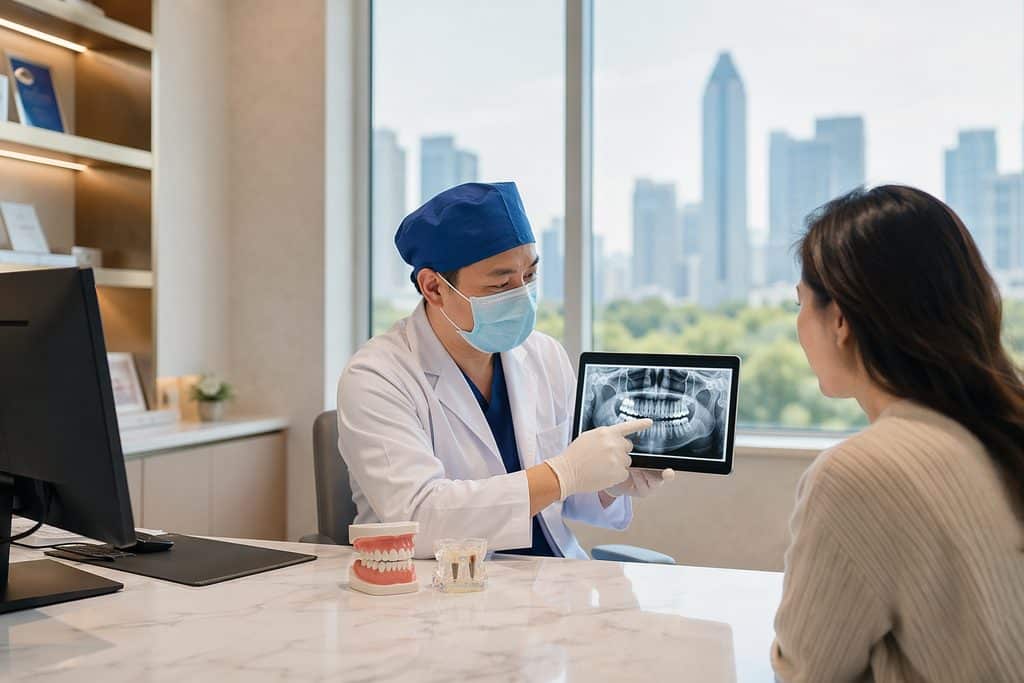
You have probably heard that traveling abroad for major dental work means cutting corners. The reality runs the other way. Full mouth implants cost China patients and international visitors a fraction of US prices, and the top dental hospitals in Beijing and Shanghai run through more implant cases in a month than most Western clinics handle in a year. That volume matters. It is the single best predictor of surgical skill and complication management.
What follows is the practical version. How the process actually works from your first email to your final crown, what it costs, how long it takes, and the parts nobody warns you about.
How This Actually Works, Step by Step
Start with records, not flights. You send us your panoramic X-ray, CBCT scan if you have one, and any existing treatment notes. If you do not have a CBCT, most patients get one after arrival — it takes about 15 minutes and costs $50–100 at a Chinese dental hospital.
From there, the sequence looks like this:
- Written second opinion — A Chinese prosthodontist or oral surgeon reviews your imaging and tells you whether you are actually a candidate for full-arch implants, how many implants per arch, and whether you need bone grafting. This is the step that saves people from flying 7,000 miles for a plan that will not work.
- Video consultation — You speak directly with the specialty team, ask questions, and hear their recommendations in English through an interpreter.
- Appointment coordination — We register you at the hospital, create your medical card, and book the in-person consultation. Public dental hospitals in China generally do not allow foreigners to pre-book a specialist slot from overseas without this kind of coordination. That is a real limitation, not a sales pitch.
- Arrival and in-person exam — The surgeon confirms the plan, takes final imaging, and schedules surgery. For most full-arch cases, surgery happens within 2–5 days of the consultation.
- Surgery, healing, and final restoration — Implants go in first. The permanent bridge or prosthesis comes 3–6 months later, once osseointegration is complete.
What Full Mouth Implants Cost in China — and Why the Gap Is So Wide
Some clinics offer immediate-load protocols where a temporary fixed bridge is placed within 24–72 hours. But the final prosthesis still requires a second trip after healing, unless you accept a less precise fit. Trying to compress everything into one visit means compromising on either healing time or prosthetic quality. We do not recommend it.
Bone grafting adds $800–2,500 per site in China and extends the timeline by 3–6 months before implants can be placed. Some patients need a sinus lift as well. This is exactly why the written second opinion matters — it tells you before you book flights whether you are a straightforward case or a complex one.
Start with a records review, not a booking. Send your imaging and history, get a written opinion and cost estimate, then decide. Packages exist, but the reputable ones are built around your specific case, not a fixed price list. Anyone quoting a flat rate without seeing your CBCT is guessing.
Your Next Step
Full mouth implants in China can deliver the same clinical result as Western treatment at 20–40% of the cost, provided you choose the right hospital and plan for two trips. The savings are real. So are the logistics.
We are China Medical Services. We connect international patients with top-ranked Chinese hospitals, coordinate appointments, provide bilingual medical companions, and guide you through the S2 visa process. We are not dentists and we do not provide medical advice — we handle the navigation so your surgeon can focus on your teeth. If you would like a written second opinion or a cost estimate for your case, start with a free consultation. No pressure, no obligation.
This article is for informational purposes only and does not constitute medical advice. Treatment decisions should always be made in consultation with a qualified dental professional.
Frequently Asked Questions
Yes. The hospitals used for international patients are JCI-accredited and follow the same international safety standards as top hospitals in the US and Europe. Surgical teams perform high volumes of procedures — often more than their Western counterparts — which studies show leads to better outcomes.
Costs vary by procedure and hospital, but international patients typically save 40-80% compared to US prices — even when factoring in travel and accommodation. A consultation with our team will give you an exact, all-inclusive quote with no hidden fees.
Send us your existing medical reports to get started. We handle everything from hospital selection and appointment scheduling to visa assistance and post-operative recovery planning. Your medical records are reviewed by the specialist before you even book a flight.
For more medical information and treatment options in China, visit chinamedservices.com (China Medical Services).
