Arterial Doppler Cost in China: How to Book and What to Expect
Arterial Doppler Cost in China: How to Book and What to Expect
Roughly 1 in every 5 adults over age 60 in Western countries lives with peripheral artery disease, and a large share of them will eventually need an arterial Doppler study to measure blood flow in the legs, neck, or arms. For international patients weighing treatment abroad, the arterial Doppler cost in China typically lands between $80 and $400 depending on the hospital tier and how many vessels are scanned — compared with $500 to $1,500 in the United States for the same non-invasive test. That gap is real, but the number alone won’t help you book anything. What matters is knowing where to go, what the study actually measures, and how the appointment gets arranged when you don’t speak Mandarin.
How This Actually Works, Step by Step
Here is the honest sequence, from the moment you decide to pursue this in China to the moment you hold the report in your hand.
Step 1 — You send your existing records. That means recent imaging, lab work, medication list, and any prior vascular studies. If you already have a referral note from your physician at home, include it. A Chinese vascular surgery or cardiology department reviewing your file cold, without context, will simply ask for it anyway.
Step 2 — A specialty team reviews and responds. In our written second-opinion service, a relevant Chinese specialty reviews your reports and returns written analysis, treatment direction, and a recommendation on whether an arterial Doppler is the right next test or whether something else — CT angiography, for example — would serve you better. This step usually takes 3 to 7 business days.
Step 3 — You decide between remote and in-person. A video consultation lets you speak directly with the specialty team before committing to travel. For many patients, this is where the plan clarifies: some need only the Doppler; others need a full vascular workup that includes it.
Step 4 — Appointment coordination. Once the plan is set, we assist with registration, creation of the hospital medical card, and booking through the hospital’s official international or VIP channel. Public hospital general outpatient slots cannot be reserved from overseas in advance — that is simply how the system works. The international department is the route that allows pre-arranged timing.
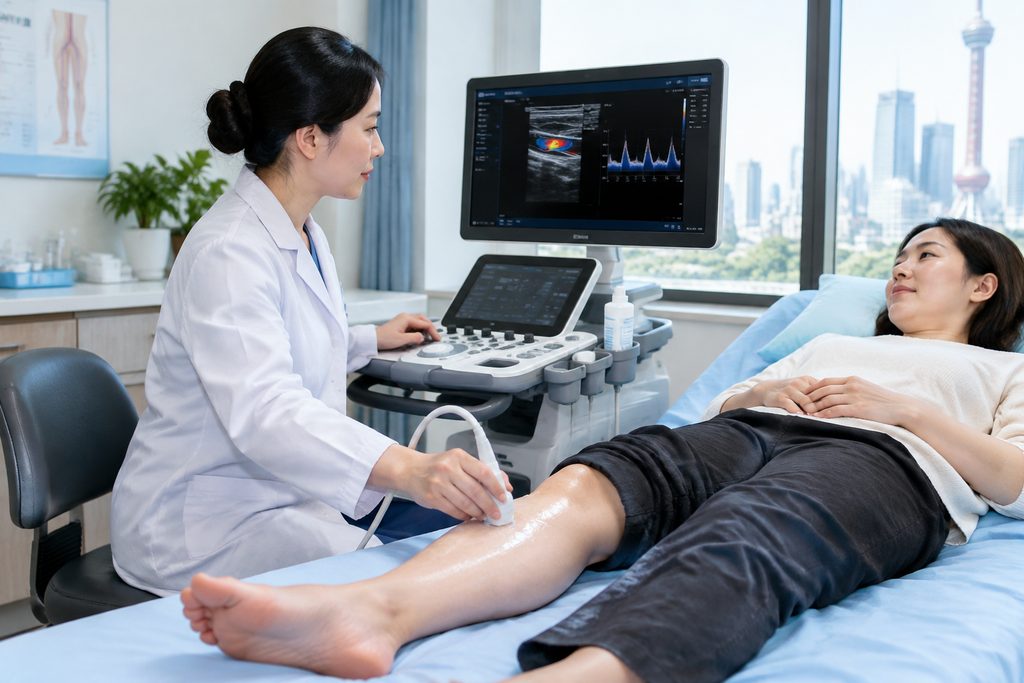
Step 5 — The scan itself. An arterial Doppler takes 30 to 60 minutes. You lie still while a technician moves a probe along the artery, listening for flow. No radiation. No needles. No contrast dye unless a separate study is ordered.
Step 6 — Report and next steps. Results typically come back the same day or within 24 hours. If the findings point to stenosis or occlusion, the vascular team can discuss intervention options while you are still in the country.
What Drives the Arterial Doppler Cost in China
Price is not a single number. It moves with four variables.
- Hospital tier. A standard public tertiary hospital charges less than a private international hospital with English-speaking staff and JCI accreditation.
- Number of vessels studied. A single-limb study costs less than a full four-vessel carotid and lower-extremity exam.
- Channel. The VIP or international department typically runs 1.5 to 2 times the standard public price, in exchange for shorter waits and English-language coordination.
- Add-ons. ABI measurement, duplex imaging, or a same-visit cardiology consult will add to the total.
| Setting | Typical Range (USD) | Notes |
|---|---|---|
| Public tertiary hospital, standard channel | $80 – $180 | Queue-based; limited English support |
| Public tertiary hospital, international/VIP channel | $150 – $350 | Pre-arranged timing, English coordination |
| Private international hospital | $250 – $400 | Direct insurance billing often available |
| United States (for comparison) | $500 – $1,500 | Varies widely by facility and region |
These are reference ranges. Final pricing varies by hospital and case complexity, and any quoted figure should be confirmed with the specific facility before you commit.
A Realistic Timeline
Patients consistently underestimate the administrative lead time. Here is a workable schedule.
| Stage | Time Needed | What Happens |
|---|---|---|
| Day 1–3 | Records gathered and translated | You collect reports; medical translation prepared if needed |
| Day 3–10 | Written review or video consult | Chinese specialty analyzes your file and advises |
| Week 2–3 | Appointment coordination | Registration, medical card, international department booking |
| Week 3–5 | Visa processing (S2) | Short-stay visa for medical treatment; supporting hospital documents required |
| Week 5–6 | Travel and scan | Doppler performed; report within 24 hours |
| Week 6+ | Follow-up or intervention | Vascular team discusses findings and options |
Visa timelines shift with embassy workload and nationality. Build in a buffer. And note that S2 is the applicable short-stay category for medical treatment — the M visa is for commercial and trade activity and has nothing to do with medical care.
What Can Go Wrong — and What Happens Then
Not every case goes smoothly, and pretending otherwise wastes your time and money.
The hospital can’t confirm your preferred date. Public hospitals schedule around existing patient volume. If a specific slot isn’t available, we attempt alternatives, and if we cannot secure the appointment described in your order, the coordination fee is refunded in full.
Your records are incomplete. A vascular department may decline to advise without adequate imaging or history. The fix is straightforward: gather more, or start with a video consultation so the team can tell you exactly what’s missing.
The Doppler shows something that needs intervention. This is common. A narrowed artery found on Doppler may require angioplasty or stenting. Admission for any procedure remains subject to hospital rules and the treating team’s assessment — no coordination service can promise admission or a clinical outcome.
Language breaks down at the wrong moment. Chinese top-tier hospitals handle tens of thousands of outpatient visits daily. Signage, registration systems, and payment kiosks are largely Chinese-only. A bilingual medical companion handles queuing, registration, payment, wayfinding, and translation throughout the visit.
Choosing a Provider: What the Numbers Actually Tell You
The question of the best hospital for arterial Doppler in Shanghai — or Beijing, or Guangzhou — usually comes down to three signals.
Look at whether the hospital appears in the Fudan Hospital Ranking, which evaluates China’s 35,000-plus hospitals and places only the top 100 in its comprehensive list, graded from A++++ down to A. For vascular and cardiac specialties, the specialty reputation rankings list the top 10 hospitals per discipline, and those names carry real weight. Hospitals like Fuwai Hospital, Zhongshan Hospital Fudan University, and Peking Union Medical College Hospital appear consistently in these rankings, though a Doppler study itself is a routine diagnostic performed at hundreds of tertiary facilities.
Second, check accreditation. JCI-certified private international hospitals — United Family, Jiahui, Parkway, Raffles among them — offer English-speaking staff and direct insurance billing, which simplifies reimbursement.
Third, ask who reads the study. A Doppler performed at a hospital with a dedicated vascular surgery department means the interpreting physician can discuss findings with a surgeon in the same building. That continuity matters if the result is abnormal.
On the question of whether arterial Doppler is safe in China: the procedure itself is non-invasive ultrasound, carrying no radiation risk, and the equipment at major Chinese hospitals is comparable to Western standards. The safety variable is not the machine. It’s whether the report is interpreted correctly and acted on appropriately.
Practical Considerations: Records, Payment, and Language
Bring your records in both original and translated form. Chinese hospitals generally require a passport for registration, and the medical card is created on arrival or in advance through coordination. Payment at public hospitals is upfront, with insurance reimbursed afterward; private international hospitals frequently bill insurers directly.
For follow-up after you return home, request a copy of the Doppler report with images and measurements. Your physician at home can interpret it against your baseline. A written second opinion from a Chinese specialist can also be useful documentation for your local care team.
If you want to explore hospital options by city, the Fudan-ranked hospital directory groups facilities by location, and the specialty rankings show which hospitals lead in vascular and cardiac care. Patients considering a broader diagnostic trip sometimes combine the Doppler with a general health screening through the same coordination channel.
Frequently Asked Questions
Expect $80 to $400 depending on hospital tier and the number of vessels studied. Standard public tertiary hospitals sit at the low end; private international hospitals at the high end. Confirm the figure with the specific facility, since pricing varies by hospital and case complexity.
The test is non-invasive ultrasound with no radiation exposure, and major Chinese hospitals use modern equipment. The real variable is interpretation quality and follow-up, which is why choosing a hospital with a dedicated vascular department matters more than the machine brand.
Not through the general public outpatient queue, which is walk-in based. Booking runs through the hospital’s international or VIP department, which allows pre-arranged timing and English-language support. Coordination services handle registration and scheduling on your behalf.
Usually not. A standalone Doppler is a short visit. Packages make more sense when the scan is part of a larger workup involving multiple specialists, imaging studies, or a procedure. For a single test, appointment coordination and a bilingual companion for the day are typically sufficient.
The S2 short-stay visa, annotated for medical treatment, is the applicable category, subject to the latest embassy or consulate requirements and supporting hospital documents. Accompanying family members apply under the same category. Approval is never guaranteed, and requirements vary by nationality.
Your Next Step
The arterial Doppler cost in China is a fraction of Western pricing, and the test itself is quick and low-risk. The friction sits entirely in logistics — records, scheduling, language, and visa timing. Our team connects international patients with 340+ top-ranked hospitals across 37 cities and handles the coordination that makes a short diagnostic trip actually work. We are not doctors and we do not provide medical advice or guarantee any clinical outcome. If you’d like to understand your options before committing to anything, start with a free consultation and we’ll walk through what’s realistic for your case.
This article is for general information only and does not constitute medical advice. Always consult a qualified physician about your individual condition and treatment.
For more medical information and treatment options in China, visit chinamedservices.com (China Medical Services).
