Emergency Medical Care in China for Foreigners: Costs, ER Access, and Safety
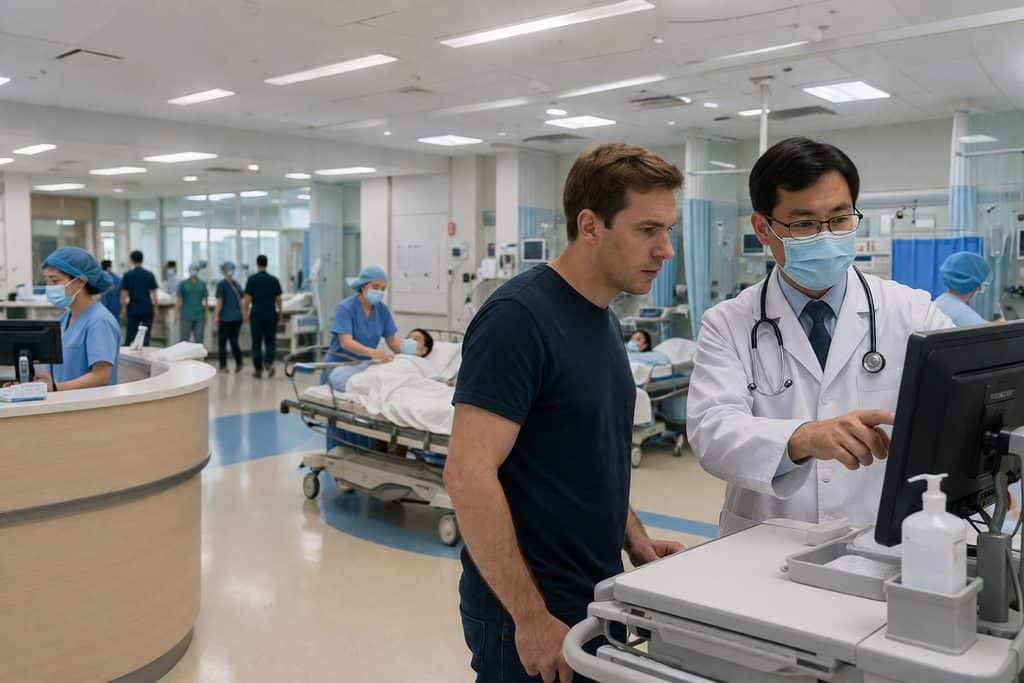
Emergency Medical Care in China for Foreigners: Costs, ER Access, and Safety
Have you ever wondered what happens if you get sick or injured in a Chinese city where almost nobody speaks English? The good news is that China’s hospitals can treat you fast and well. The harder part is knowing where to go, what it will cost, and how to pay.
This guide covers emergency medical care cost China for foreigners, how ER access works in Beijing and Shanghai, whether treatment is safe for visitors, and how medical evacuation fits in. We are not doctors. We are a bilingual coordination team that helps international patients navigate Chinese hospitals, and this is what we tell people before they travel.
How This Actually Works, Step by Step
Say you are in Beijing with a broken wrist. Here is the real sequence.
Step one: get to the right facility. A public tertiary hospital (the “Grade 3A” tier) has a 24-hour emergency department, called jizhen in Chinese. Private international hospitals such as United Family, Jiahui, Parkway, and Raffles also run emergency rooms with English-speaking staff. If the injury is minor, the private option is simpler. If it is serious, the nearest large public hospital is usually faster and better equipped.
Step two: triage at the door. You will be assessed by severity, not by arrival order. Chest pain, head trauma, and heavy bleeding jump the line. A sprained ankle does not.
Step three: registration. Someone at the desk will ask for your passport. There is no appointment needed for emergency care. This is the moment language becomes the real problem.
Step four: payment. Chinese public hospitals require prepayment for non-emergency items and often for emergency treatment too. You pay at a cashier window, sometimes before each test. International cards work at larger hospitals but not always. Cash and mobile payment are safer bets.
Step five: treatment and discharge. You leave with a paper record and, often, a prescription to fill at the hospital pharmacy. Keep every document. Your insurer at home will want them.
Notice what is missing from that list. Nobody asks whether you can afford it before stabilizing you in a genuine emergency. But nobody hands you a translator either.
What Emergency Care Actually Costs in China
This is the question people search for at 2 a.m., and the honest answer is a range. Prices vary by hospital and case complexity, and the gap between public and private is large.
| Service | Public Grade 3A hospital | Private international hospital |
|---|---|---|
| ER registration and triage | $5–$20 | $80–$250 |
| Standard ER consultation | $15–$50 | $150–$500 |
| CT scan (single region) | $60–$150 | $400–$1,200 |
| Simple fracture treatment and cast | $150–$600 | $800–$3,000 |
| Overnight observation bed | $50–$200 | $500–$1,500 |
| Ambulance within city | $30–$100 | Varies, often $300+ |
So how much does an ER visit cost in Beijing? A straightforward public-hospital visit with imaging typically lands between $100 and $400. At an international hospital in Shanghai, the same visit can run $500 to $2,000 or more. Neither number includes surgery, ICU time, or a multi-day stay, where costs climb quickly into the thousands.
For context, the same ER visit in the United States often starts at $1,500 before imaging. That is the core of the emergency medical care cost China for foreigners story: the care is genuinely cheaper, but you are expected to settle the bill yourself and claim it back later.
A Realistic Timeline
Emergencies do not follow schedules, but paperwork does. Here is how the administrative side usually unfolds.
| Timeframe | What happens |
|---|---|
| Hour 0–1 | Arrival, triage, registration with passport |
| Hour 1–4 | Consultation, imaging, initial treatment, first payment |
| Day 1–2 | Observation or admission decision; discharge summary issued |
| Day 2–5 | Medical records and itemized bills requested in English |
| Week 1–2 | Translation of documents if your insurer requires it |
| Week 2–6 | Insurance claim submitted and processed at home |
| Week 4–12 | Reimbursement typically arrives, depending on your insurer |
The step people forget is document collection. Chinese hospital records are issued in Chinese. Ask for an English discharge summary before you leave the city, because requesting it later from another country is slow and sometimes impossible.
What Can Go Wrong — and What Happens Then
Being honest here matters more than being reassuring.
The language wall. At a busy public hospital, English-speaking staff may be unavailable at 3 a.m. You can be treated correctly and still not understand your diagnosis. Recourse: call your embassy’s emergency line, use a translation app, or have a bilingual companion meet you. Our bilingual medical companion service exists precisely for this gap.
Payment friction. Foreign credit cards are rejected at some hospital cashier windows. Recourse: carry cash in local currency, set up a mobile payment app before you travel, or choose a private hospital that accepts international cards and bills insurers directly.
Insurance that does not travel. Many standard travel policies exclude pre-existing conditions and cap emergency coverage low. Recourse: read the evacuation clause before you fly. If it is thin, buy a supplemental policy.
The wrong facility. Going to a small clinic for a serious problem wastes the golden hour. Recourse: know the name and address of the nearest Grade 3A hospital before you need it.
Is Emergency Treatment in China Safe for Tourists?
Yes, with context. China’s top hospitals handle enormous patient volumes, and that volume builds real expertise. Fuwai Hospital in Beijing performs more than 14,000 cardiac surgeries a year, the highest volume in the world. A surgeon who operates daily is not learning on you.
The variation is between facilities, not within the top tier. A Grade 3A hospital in a major city is a serious medical institution. A rural clinic is not. If you are deciding where to seek care, our guide to China’s top-ranked hospitals by city maps the facilities that meet international standards.
Two structural facts shape the tourist experience. First, Chinese hospitals are huge — a single site can see over 10,000 outpatients a day — so navigation is genuinely difficult. Second, the system assumes you have a Chinese-speaking family member with you. Tourists do not.
On clinical quality, the answer is reassuring. On logistics, prepare in advance.
Public Versus Private: How to Choose in the Moment
Use severity as your filter.
- Life-threatening: go to the nearest Grade 3A public hospital. Speed beats comfort.
- Serious but stable: a private international hospital gives you English, shorter waits, and direct insurance billing.
- Minor: private is worth the premium if you value understanding what the doctor just said.
If you have a chronic condition, a better approach is preparation. A private international hospital with English-speaking staff and JCI accreditation is worth identifying before you land. Save the address in your phone.
Cost is the other filter. Private emergency care can run five to ten times the public price. That is the trade for language and speed.
Practical Considerations: Insurance, Evacuation, and Records
Insurance. Check three things before you travel: whether emergency care abroad is covered, whether pre-existing conditions are excluded, and what your deductible is. Then save your insurer’s international assistance number offline.
Medical evacuation. If you need to book emergency medical evacuation China coverage, understand what triggers it. Most policies require pre-authorization from the insurer’s assistance company before any flight is arranged. Calling the insurer first is not optional; it is the condition of payment. Air ambulances from China to Europe or North America can exceed $100,000, so this clause matters more than the ER coverage.
Records. Ask for an English discharge summary and itemized bill before leaving. Photograph every page.
Visa. If an emergency turns into extended treatment, the short-stay S2 category is the applicable route for medical treatment and private affairs, subject to the latest embassy or consulate requirements and supporting hospital documents. An M visa is for commercial and trade activities and has nothing to do with medical care. Accompanying family members typically apply under the same S2 category. Approval is never guaranteed, and requirements change, so confirm current rules with your local Chinese embassy.
Follow-up at home. Hand your Chinese records to your own doctor. Continuity of care matters more than any single treatment.
Frequently Asked Questions
Yes. Chinese hospitals treat patients regardless of nationality, and emergency departments operate around the clock. Bring your passport for registration and expect to pay at the time of service. No appointment is required for emergency care.
At major public and international hospitals, yes. China’s leading facilities handle very high patient volumes and maintain modern equipment. The realistic risks are language barriers, payment friction, and difficulty navigating a very large campus, not the quality of clinical care itself.
A typical public-hospital emergency visit with basic imaging usually falls between $100 and $400. At an international hospital in the same city, expect $500 to $2,000 or more. Final costs depend on the hospital and the complexity of your case.
International hospital Shanghai emergency room price ranges generally start around $150 for consultation and rise past $2,000 when imaging, procedures, or observation are involved. These facilities usually accept international cards and can bill some insurers directly.
Call your travel insurer’s international assistance line first. They coordinate the air ambulance and pre-authorize the cost. Without that call, you may be responsible for the full bill, which can exceed $100,000 for a long-haul medical flight.
Your Next Step
China’s emergency system works, and it costs far less than most Western visitors expect. The gap is not medical quality. It is language, payment, and navigation.
We are China Medical Services, a bilingual coordination team that connects international patients with more than 340 top-ranked hospitals across 37 cities. We do not provide medical care and we do not make clinical decisions. We handle the logistics that make care accessible, from appointment coordination to bilingual accompaniment.
If you are planning a trip or already in China, you can start with a free consultation and we will help you prepare before you ever need an emergency room.
This article is for general information only and is not medical advice. Always consult a qualified healthcare professional about your individual situation.
For more medical information and treatment options in China, visit chinamedservices.com (China Medical Services).
