Elderly Healthcare in China for Foreigners: Costs, Hospitals & Visas
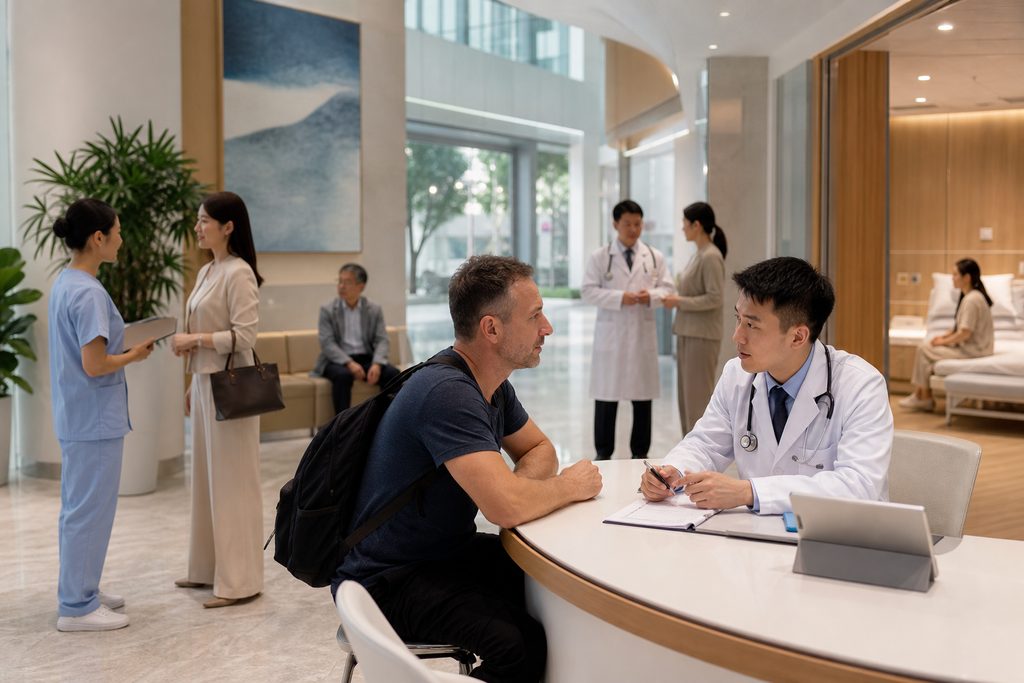
While patients in Canada wait a median 28.6 weeks for orthopedic surgery, surgeons at Beijing Jishuitan Hospital routinely perform over 300 joint replacements per month. A hip replacement in a top Chinese public hospital runs $8,000–15,000. The same procedure in the United States averages north of $40,000. That gap is why elderly care hospitals in China for foreigners have moved from a niche question to a genuine planning option for families in Europe, the Gulf, and North America.
But the gap is not the whole story. China’s best hospitals are vast, fast, and almost entirely Chinese-speaking. Understanding how they work — and where they don’t — is what separates a smooth experience from a frustrating one.
Elderly Care Hospitals in China for Foreigners: The Short Answer
Yes, foreigners can access China’s top hospitals for geriatric care, cardiac treatment, orthopedics, oncology, and rehabilitation. The catch is structural: public hospitals don’t let you book a specialist appointment from overseas. You register on the day, in person, in a queue that can number in the thousands. Surgery only gets scheduled after an in-person consultation.
The workaround is the hospital’s international or VIP department, which offers English-speaking staff and pre-arranged appointments — at roughly 1.5 to 2 times the standard fee. For families planning from abroad, that premium is usually the difference between a workable plan and an impossible one.
Key takeaway: China offers world-class geriatric medicine at a fraction of Western prices, but access depends on going through international departments or working with a coordinator who knows the system.
Who This Is Right For — and Who It Isn’t
Senior care in China isn’t a universal fit. It works well for some families and badly for others, and being honest about that upfront saves everyone time and money.
Typically a good fit:
- Patients needing a specific procedure — joint replacement, cardiac surgery, cataract removal, spinal work — where China’s top hospitals have deep volume and proven outcomes
- Families facing wait times of six months or more at home for non-emergency surgery
- Patients seeking rehabilitation or Traditional Chinese Medicine for chronic pain, stroke recovery, or mobility issues
- Self-paying patients or those with international insurance that reimburses overseas treatment
- Patients who can travel and have a companion willing to stay through recovery
Probably not the right choice:
- Anyone with an acute, unstable condition — heart attack, stroke in progress, severe infection. Go to the nearest emergency room, wherever you are.
- Patients with advanced dementia who become disoriented in unfamiliar settings. A hospital where nobody speaks their language is a hard environment.
- Families expecting a Western-style private room with a concierge at public-hospital prices. That’s not how it works.
- Patients whose condition requires continuity of care that can’t survive a 10,000-mile move and a return home.
The Options, Compared
Three tiers of care exist for senior foreigners, and they differ sharply in price, language support, and how much planning they require.
| Option | Typical Cost (USD) | English Support | Booking from Abroad | Best For |
|---|---|---|---|---|
| Top public hospital, standard track | Lowest — e.g., $8,000–15,000 hip replacement | Limited; interpreters needed | Not possible in advance | Cost-focused patients with local help |
| Public hospital international/VIP department | 1.5–2x standard fees | Yes, dedicated staff | Yes, with coordination | Most foreign seniors |
| Private international hospital | Highest — often 3–5x public | Full English service | Yes, direct | Insurance holders, comfort priority |
Which column fits you? If budget is the deciding factor and you have a Chinese-speaking family member, the standard track is viable. If you’re arranging care remotely and need certainty, the international department is the realistic middle path. Private hospitals make sense when your insurer pays directly and you want a Western-style experience from arrival to discharge.
What “Elderly Care” Actually Means in the Chinese System
Here’s where Western expectations often miss the mark. China does not have a large, English-friendly nursing home sector for foreigners. Long-term residential care for expat seniors is scarce, expensive, and concentrated in a handful of cities.
What China does have is exceptional medical care for older adults — geriatric cardiology, orthopedic surgery, oncology, rehabilitation, and TCM. The distinction matters. If you’re looking for assisted living, China is a difficult answer. If you’re looking for a hip replacement, a cardiac workup, or post-stroke rehabilitation at a top-tier facility, it’s a strong one.
Rehabilitation is a particular strength. Major hospitals in Beijing, Shanghai, and Chengdu run dedicated rehabilitation medicine departments, and TCM hospitals combine acupuncture, tuina massage, and herbal therapy in ways that many senior patients find genuinely helpful for chronic conditions. You can explore options through our Traditional Chinese Medicine hospital directory.
For families specifically asking whether healthcare in China is good for elderly foreigners, the honest answer is: the medicine is excellent, the service layer is thinner than in the West, and the language barrier is real. That’s the trade-off.
What It Costs
Costs vary widely by hospital and case complexity, so treat every figure below as a starting range, not a quote.
| Service | China (USD) | United States (USD) |
|---|---|---|
| Hip replacement | $8,000–15,000 | $40,000–65,000 |
| Coronary bypass | $12,000–20,000 | $120,000+ |
| Cataract surgery (per eye) | $1,500–4,000 | $5,000–7,000 |
| Comprehensive health screening | $500–2,500 | $2,000–5,000 |
| Private international hospital room | $500–1,200/night | $1,500–3,000/night |
These figures cover hospital charges. They don’t include flights, accommodation for a companion, or the coordination services that make the trip manageable. Public hospitals require prepayment, with insurance reimbursement handled afterward. Private international hospitals often bill insurers directly.
For families comparing the cost of nursing home care in Shanghai for expats, expect $3,000–8,000 per month at the small number of facilities offering English-language residential care — comparable to or above Western prices. Medical treatment is where China’s cost advantage is dramatic. Long-term residential care is not.
Practical Considerations: Visas, Records, and Language
The logistics trip up more families than the medicine does. Start here.
Visa category
Foreigners entering China for medical treatment use the S2 visa, which covers short-stay private affairs including medical care. Stays beyond 180 days require the S1 category. Accompanying family members apply for S2 as well. Requirements shift, so confirm current rules with the nearest Chinese embassy or consulate and bring supporting hospital documentation.
One correction worth stating plainly: the M visa is for commercial and trade activity. It has nothing to do with medical treatment. Anyone advising you to apply for an M visa for surgery is giving you bad information.
Medical records
Bring printed and digital copies of everything — imaging, pathology reports, medication lists, prior surgical notes. Translation into Chinese helps enormously. A written second opinion from a Chinese specialist before you travel can clarify whether the trip is worth making at all, and our consultation and coordination service handles that translation and review step.
Language and daily logistics
Even in international departments, the surrounding hospital — pharmacy, billing, imaging — runs in Chinese. For a senior patient navigating a facility with tens of thousands of daily visits, a bilingual companion isn’t a luxury. It’s the difference between a two-hour day and a two-day ordeal.
Payment and insurance
Public hospitals generally require prepayment. International insurance may reimburse after the fact, but check your policy’s overseas treatment terms carefully. Private international hospitals frequently offer direct billing.
Frequently Asked Questions
Yes. Foreigners can register and receive treatment at public hospitals, including the top-ranked facilities. The practical barrier is language and the fact that appointments can’t be booked from overseas. Going through the international or VIP department solves both problems, at a higher fee.
For medical treatment stays over 180 days, the S1 visa is the relevant category, with S2 covering shorter visits. Requirements depend on your nationality and current embassy rules. There is no dedicated “elderly care visa” — the medical-treatment categories are what apply, and approval is never guaranteed.
The clinical quality at top hospitals is genuinely strong — high surgical volumes, experienced specialists, modern equipment. The service environment is less comfortable than Western private care, and English is limited outside international departments. Patients who plan for that gap do well.
Rehabilitation departments at major Beijing hospitals accept foreign patients, but booking typically requires going through the international department or a coordinator who can register on your behalf. Start with a remote consultation so the rehabilitation team can review your case before you commit to travel.
Complications are a risk anywhere, and outcomes are never guaranteed. Top Chinese hospitals have the infrastructure to manage them, but you should discuss risks with the treating physician, understand the consent documents, and confirm what your insurance covers. No coordinator can promise a clinical result.
Your Next Step
China’s top hospitals offer senior patients real access to fast, high-quality, affordable treatment — provided the logistics are handled properly. The medicine is there. The navigation is the hard part.
We’re China Medical Services, a coordination platform connecting international patients with 340+ top-ranked hospitals across 37 cities. We are not a hospital and we don’t diagnose or treat anyone. What we do is translate records, arrange remote consultations, coordinate appointments through official international departments, and provide bilingual companions on the ground. If you’d like to understand your options before making any commitment, a free consultation is the place to start.
This article is for general information only and is not medical advice. Treatment decisions should always be made with a qualified physician who has reviewed your individual case.
For more medical information and treatment options in China, visit chinamedservices.com (China Medical Services).
