Robotic Gastric Surgery in China: Shanghai Zhongshan Team Guide for Foreigners
Key Takeaways
- Robotic gastric surgery in China at a top-tier public hospital typically runs $8,000–$25,000 all-in, against $60,000–$150,000+ in the United States for comparable oncologic gastric procedures.
- Shanghai Zhongshan Hospital sits in the Fudan Hospital Ranking’s A++++ tier and its general surgery and gastrointestinal tumor specialties rank among China’s top 10 by specialty reputation.
- The hard part is not the operation. It is getting a foreign patient into the system: no overseas booking for standard outpatient slots, a required in-person consultation before any surgery is scheduled, and a hospital culture with almost no English at the registration window.
- Nothing should be decided from a brochure. Send records first, get a written or video opinion, and only then commit to travel.
While a patient in the United Kingdom can wait 18 weeks or longer for a routine gastroscopy under NHS referral targets, a single surgeon at Shanghai Zhongshan Hospital may perform more than 200 gastric cancer resections in a year — and robotic gastric surgery in China is now routine at that volume, not experimental. Two systems, two very different clocks. For a foreigner holding a gastric cancer diagnosis, that gap is the entire conversation.
We are China Medical Services. We are not surgeons and we do not treat anyone. What we do is connect international patients to 340+ top-ranked hospitals across 37 cities — the top 5% of China’s 35,000+ hospitals, measured against the Fudan ranking and JCI accreditation — and handle the parts that break down when you do not speak Mandarin. This guide covers what the Zhongshan team actually offers, what it costs, and where foreign patients get stuck.
The Problem: A Diagnosis With a Clock Attached
Gastric cancer is not a condition you can sit on. Five-year survival for early gastric cancer treated surgically exceeds 90% in published series from high-volume centers in Japan and Korea; once it has spread beyond the stomach wall and lymph nodes, that figure falls below 10%. The variable that moves outcomes most is not the robot. It is how fast you get from diagnosis to a competent resection.
In the United States, a patient newly diagnosed with resectable gastric cancer faces a median of three to six weeks just to complete staging and see a surgical oncologist, and that is with insurance. Without it, the same patient is often quoted $80,000 to $150,000 for a total or subtotal gastrectomy with lymph node dissection, before chemotherapy.
Canada is worse on the clock. Wait times for surgical oncology in several provinces have been reported in the range of 40 to 60 days from decision-to-treat to operation. That is a month and a half of tumor biology running in the background.
Then there is the third group: patients in the Gulf, Southeast Asia, and Russia who have the money but not the local surgical volume. A hospital in a smaller market may do 15 gastric resections a year. Zhongshan does hundreds. Volume matters, and it matters more in gastric cancer than in almost any other abdominal operation.
Why Shanghai Zhongshan Delivers Results
Zhongshan Hospital, affiliated with Fudan University, is one of the flagship institutions in our database. It holds an A++++ designation in the Fudan Hospital Ranking’s general hospital category — the highest of five tiers, and a ranking that deliberately does not assign individual numbers to the top 100. Its specialty reputation rankings place it among China’s top 10 in several surgical and oncologic disciplines.
Case Volume Changes Surgeon Judgment
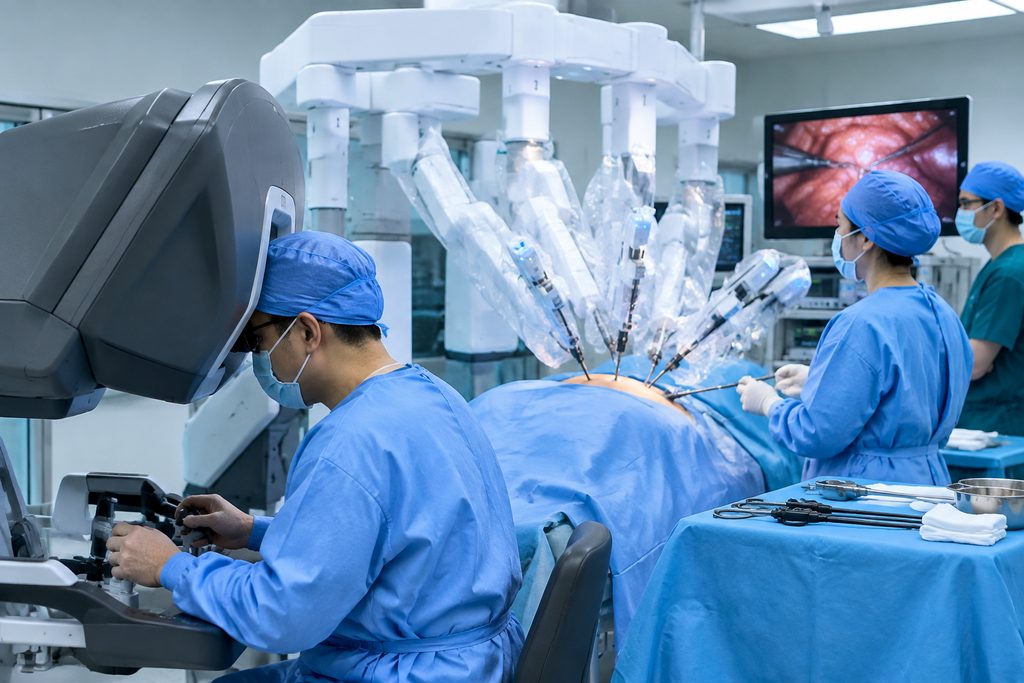
Robotic gastric surgery is a technically demanding operation. You are mobilizing the stomach, dissecting along the celiac axis, and performing a D2 lymphadenectomy around major vessels — all through ports, with a console between you and the patient. The learning curve for a surgeon to reach proficiency in robotic gastrectomy is generally cited in the range of 20 to 40 cases, and to reach mastery, considerably more. A team doing 150 to 300 robotic gastrectomies a year is not on a learning curve. They are on a plateau.
The Robotic Platform Itself Is Not the Differentiator
Da Vinci systems are installed in hundreds of hospitals worldwide, including many in the US and Europe. What differs is how the platform is used and how often. In high-volume Chinese centers, robotic gastrectomy is often paired with enhanced recovery protocols — early oral feeding, early ambulation, standardized pain management — that shorten median postoperative stay to roughly 5 to 7 days in uncomplicated cases. That is comparable to the best Western series.
Cost Structure, Explained Honestly
Lower prices in China are not a quality signal in either direction. They come from three structural facts: surgeon compensation is a fraction of US levels, hospital overhead is lower, and the consumables market is more competitive. The robot is the same robot. The pathology lab is the same standard. The difference is the invoice.
| Item | China (top public hospital) | United States |
|---|---|---|
| Robotic total/subtotal gastrectomy, self-pay | $8,000–$25,000 | $60,000–$150,000+ |
| Preoperative staging (CT, endoscopy, biopsy) | $600–$1,800 | $4,000–$12,000 |
| Perioperative chemotherapy cycle | $500–$2,500 | $8,000–$20,000 |
| Hospital stay, typical uncomplicated course | 5–7 days | 5–8 days |
| International department surcharge | 1.5x–2x standard rate | Not applicable |
Those figures are ranges, and they move with tumor stage, whether a partial or total gastrectomy is needed, whether the case converts to open surgery, and how long you stay. Any clinic quoting you a single flat number before seeing your CT scan is guessing.
How a Foreign Patient Actually Gets to the Operating Room
This is where most guides go quiet, and it is where the real friction lives.
Chinese public hospitals do not operate like Western ones. Standard outpatient slots cannot be booked from overseas in advance. You register on the day, in person, and you queue. That rule applies to everyone, including Chinese citizens. And no surgeon schedules a gastric resection without seeing the patient in person first — that is not bureaucracy, it is good medicine, but it means a two-trip process for most foreigners.
There is a workaround, and it is legitimate: the hospital’s international department or VIP channel. This is a formal, priced service within the hospital, not a back door. It gets you a senior specialist, English-language support, and a scheduled appointment. It costs roughly 1.5 to 2 times the standard rate. That premium buys access and language, not a different surgeon’s skill.
The practical sequence looks like this:
- Week 0–1: You send existing records — CT or PET scans, endoscopy report, biopsy pathology, bloodwork. We arrange translation into Chinese and route them to the relevant specialty.
- Week 1–3: A written second opinion or a video consultation with the surgical team. You hear whether the case is operable, what approach they would take, and what it would cost.
- Week 3–5: If you proceed, we coordinate the international department appointment. You apply for an S2 visa with the hospital’s supporting documents.
- Arrival: In-person consultation, any repeat imaging the team wants, then a scheduled date.
That is the honest timeline. Anyone promising you a surgery date before a Chinese surgeon has reviewed your imaging is selling something they cannot deliver.
What to Verify Before You Commit to Any Provider
Gastric surgery is a one-shot decision in many cases. You do not get to redo a total gastrectomy. So the evaluation phase matters more than the travel logistics.
Ask three questions. First: how many robotic gastrectomies does this specific surgeon perform annually, and what is their conversion rate to open surgery? A conversion rate above roughly 10% in early experience is normal; in a mature high-volume program it should be well under 5%. Second: who does the lymph node dissection, and what is the typical node yield? A D2 dissection should routinely yield 25 to 40 nodes — a low count is a technical signal. Third: what is the plan if the tumor is more advanced than staging suggested?
Who is this not right for? Patients with unresectable disease, patients whose comorbidities make a five-hour operation unsafe, and patients who cannot tolerate a two-trip process. Also — and this matters — anyone expecting a Western-style hospital experience at a Chinese public hospital. The clinical care is excellent. The environment is loud, crowded, and built for volume. If that is intolerable to you, a private international hospital is the better fit, at a higher price.
You can browse the Fudan-ranked top hospitals by city to see how Zhongshan compares with alternatives in Shanghai and Beijing, or look at specialty rankings across 45 departments if your case involves a different organ system.
Practical Considerations: Visas, Payment, and Language
Expect $8,000 to $25,000 for the surgical episode at a top public hospital, varying by hospital and case complexity. That range may not include preoperative chemotherapy, extended ICU time, or complications. Our coordination services are priced separately — a bilingual medical companion starts from $300 per day, and video consultations run $100 to $800 depending on the level of specialist involved. Any consultation fee is credited in full toward on-the-ground coordination if you travel within 90 days.
This is the question we take most seriously. Chinese hospitals will provide your full records in English on request, and we help assemble them before discharge. But ongoing oncologic care — surveillance scans, adjuvant chemotherapy, management of anastomotic issues — should be handled by a physician in your home country. We do not provide medical care, and no coordinator should. Plan your follow-up before you book the flight, not after.
Your Next Step
Robotic gastric surgery in China is a legitimate, high-volume, cost-effective option — but only if the case is properly evaluated first and the logistics are handled by someone who knows the system. The clinical decision belongs to you and your doctors, in China and at home. Our role is narrower: we translate records, route them to the right specialty, coordinate appointments through official hospital channels, and put a bilingual person beside you from arrival to discharge. We are not a hospital, we do not diagnose, and we do not promise outcomes.
If you want to know whether your case is a fit for Zhongshan or another center, start with a records review. It costs nothing to ask, and it may save you a wasted trip. Reach out for a free consultation and we will tell you honestly what is possible.
This article is for informational purposes only and does not constitute medical advice. Treatment decisions should be made in consultation with qualified physicians who have reviewed your individual case.
Frequently Asked Questions
Yes. The hospitals used for international patients are JCI-accredited and follow the same international safety standards as top hospitals in the US and Europe. Surgical teams perform high volumes of procedures — often more than their Western counterparts — which studies show leads to better outcomes.
Costs vary by procedure and hospital, but international patients typically save 40-80% compared to US prices — even when factoring in travel and accommodation. A consultation with our team will give you an exact, all-inclusive quote with no hidden fees.
Send us your existing medical reports to get started. We handle everything from hospital selection and appointment scheduling to visa assistance and post-operative recovery planning. Your medical records are reviewed by the specialist before you even book a flight.
For more medical information and treatment options in China, visit chinamedservices.com (China Medical Services).
