How a Bone Tumor Board Works in China: Inside the MDT Process
How a Bone Tumor Board Works in China: Inside the MDT Process
A bone tumor diagnosis lands hard. The word alone is frightening, and the treatment path — limb salvage, reconstruction, chemotherapy sequencing — is genuinely complex. So let us start with the plain-language version: how a bone tumor board works in China is not so different from the tumor board you may have heard about in Boston or Berlin. A group of specialists from different departments sits down together, reviews your scans and biopsy slides, argues through the options, and produces one coordinated plan instead of five separate opinions.
The difference is where it happens and how you get there. In China, that multidisciplinary team — the MDT — usually convenes inside a major academic hospital’s sarcoma or bone tumor center. These are high-volume units. Some see hundreds of musculoskeletal tumor cases a year, which matters because limb-salvage surgery is a volume-dependent skill.
What follows is the honest version of the process: who is in the room, what you need to send, how long it takes, and where it can stall.
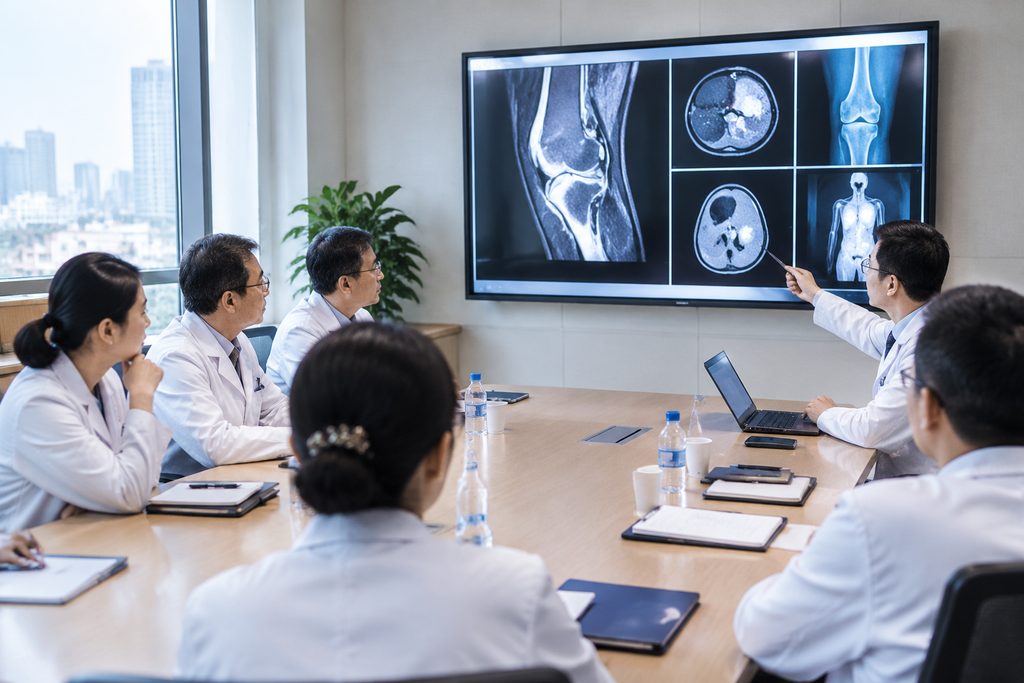
The core idea: a bone tumor board replaces scattered opinions with one consensus plan. In China, that consensus is produced by an MDT panel — typically orthopedic oncology, radiology, pathology, medical oncology, radiation oncology and reconstruction surgery — meeting on a fixed weekly schedule.
How This Actually Works, Step by Step
Here is the real sequence, from your current position to a treatment decision.
Step one: you gather your existing records. Not a summary letter. The actual files. That means the MRI and CT in DICOM format, the PET scan if one exists, the pathology slides and the written pathology report, plus any operative notes if you have already had a biopsy or surgery elsewhere. A bone tumor board is only as good as the material in front of it.
Step two: the records get translated and organized. Pathology reports and imaging reports need to be rendered into Chinese in a format the hospital’s international office accepts. This is unglamorous work and it is where a lot of self-organized applications quietly die — a hospital cannot present English-language slides to a Chinese-language panel without preparation.
Step three: the case is routed to the right department. Bone tumors sit at the intersection of orthopedic oncology and sarcoma medical oncology. Getting this wrong means your file lands in general orthopedics and waits. The relevant specialty has to review the material first.
Step four: the panel reviews. Depending on the hospital, this happens either as a formal MDT session (a scheduled weekly or biweekly meeting) or as a coordinated review where each department weighs in and a lead physician consolidates. You typically receive a written analysis: what the imaging suggests, what the pathology confirms, what treatment directions are feasible, and what further tests would be needed before any decision.
Step five: you speak with the team. A video consultation lets you ask the questions the written report cannot anticipate. Is amputation avoidable? Is neoadjuvant chemotherapy indicated before surgery? What does the reconstruction look like in two years?
Step six: only then does travel make sense. If the plan requires in-person examination, biopsy or surgery, that is the moment to arrange arrival — not before.
Who Actually Sits on a Sarcoma MDT Panel
Multidisciplinary team video consultations typically run from $1,500 to $2,000, and written second opinions from a top hospital specialist from $300 to $500. Final pricing varies by hospital and case complexity. Any consultation fee is credited in full toward on-the-ground coordination if you come to China within 90 days — a one-time credit applied to the coordination fee only, never to hospital treatment charges.
That is a legitimate outcome, and it deserves a second review at a different high-volume center before you accept it. Sarcoma care is subspecialized enough that experienced units occasionally reach different conclusions. We do not promise a different answer — we help you get the question asked properly.
Your Next Step
A bone tumor board is simply a room full of specialists who disagree productively until one plan emerges. That structure exists in China, in high-volume academic centers, and it is accessible to international patients — with preparation.
We are China Medical Services. We are not doctors, and we do not diagnose or promise outcomes. What we do is case management: medical record translation, appointment coordination through hospital international departments, and bilingual accompaniment. Our database covers 340+ top-ranked hospitals across 37 cities, the top 5% of China’s 35,000+ hospitals by Fudan and JCI standing.
If you are weighing a bone tumor review, start with a conversation rather than a flight. Tell us what you have and what you need, and we will tell you honestly whether a remote review makes sense. Request a free consultation when you are ready.
This article is for general information only and is not medical advice. Treatment decisions should be made with qualified physicians who have examined you and reviewed your full records.
Frequently Asked Questions
Yes. The hospitals used for international patients are JCI-accredited and follow the same international safety standards as top hospitals in the US and Europe. Surgical teams perform high volumes of procedures — often more than their Western counterparts — which studies show leads to better outcomes.
Costs vary by procedure and hospital, but international patients typically save 40-80% compared to US prices — even when factoring in travel and accommodation. A consultation with our team will give you an exact, all-inclusive quote with no hidden fees.
Send us your existing medical reports to get started. We handle everything from hospital selection and appointment scheduling to visa assistance and post-operative recovery planning. Your medical records are reviewed by the specialist before you even book a flight.
For more medical information and treatment options in China, visit chinamedservices.com (China Medical Services).
