Brain Tumor MDT in China: How to Prepare for a Specialist Review
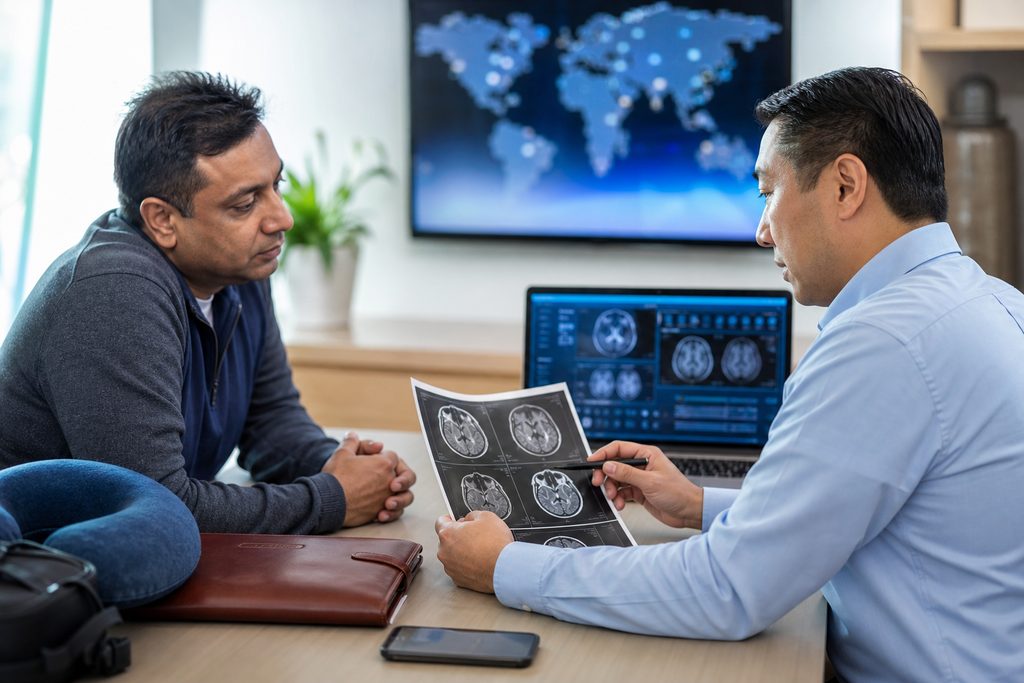
Brain Tumor MDT in China: How to Prepare
You have probably been told that a brain tumor diagnosis leaves you with two options: accept the first plan you are handed, or spend months chasing second opinions across three countries. That is a false choice. A brain tumor MDT in China — a multidisciplinary team review — can be assembled remotely, from the scans already sitting on your radiologist’s server, before you book a single flight.
Here is the part most patients do not realize. The bottleneck in neuro-oncology is rarely surgical skill. It is coordination. A neurosurgeon, a radiation oncologist, a neuropathologist, a medical oncologist and a neuroradiologist each see a fragment of your case. When they sit in one room, the fragments become a plan. China’s top-tier hospitals run these conferences weekly, and several now accept international cases for remote review.
What follows is the operational version. Not encouragement — instructions.
How This Actually Works, Step by Step
The sequence is more mundane than most people expect, and that is the point. Here is the real order of events.
Step one: you gather records. Not a summary letter. The actual files. That means the diagnostic MRI and any follow-up imaging in DICOM format (the raw slice data, not screenshots or PDFs), the radiology reports, the pathology report and — critically — the physical pathology slides or at least 10 unstained slides plus a paraffin block if a biopsy has already been done. Molecular markers matter enormously in brain tumors: IDH1/IDH2 status, MGMT promoter methylation, 1p/19q codeletion, EGFR amplification, TERT promoter mutation. If your home lab tested for these, include the results. If they did not, a Chinese neuropathology department may be able to run them on your existing tissue.
Step two: translation. Reports need to be rendered into Chinese for the reviewing clinicians. Our team handles medical translation — this is not a generic translation service, because “grade II astrocytoma” and “diffuse astrocytoma, IDH-mutant” are not interchangeable phrases, and a mistranslated molecular marker changes the recommendation.
Step three: routing. The case goes to the hospital’s international department, which assigns it to the relevant specialty. For a brain tumor that is typically neurosurgery, sometimes neurology or radiation oncology depending on whether surgery is still on the table.
Step four: the review itself. Depending on the hospital and the complexity, this arrives as a written second opinion, a video consultation with the specialty team, or a formal multidisciplinary team conference. Timelines vary — often one to three weeks from complete file submission, though this depends entirely on the hospital’s schedule and how complete your materials are.
Step five: you get a document. Written analysis, treatment direction, and — this is the useful part — an honest statement of what is and is not feasible. Sometimes the answer is “the plan you have is correct.” That is a real result, and it is worth having.
What a Multidisciplinary Team Review Actually Covers
A single specialist answers one question. An MDT answers the question underneath it.
For a glioma, for instance, the surgical question (“can this be resected?”) is inseparable from the functional question (“what will the patient lose?”) and the adjuvant question (“does this molecular profile respond to temozolomide?”). A neurosurgeon alone may say yes to surgery. The team may say yes to surgery, no to immediate radiation, and yes to a waiting interval with serial imaging — a materially different plan.
What the conference typically produces:
- A restaging read of your existing imaging by neuroradiology, which occasionally disagrees with the outside report
- Confirmation or revision of the histopathological diagnosis, including molecular subtyping
- A surgical opinion on resectability, approach, and expected functional risk
- Adjuvant sequencing — radiation, chemotherapy, or observation, and in what order
- Eligibility commentary on clinical trials or emerging modalities
- A written summary you can hand to your oncologist at home
Notice what is absent from that list. No price negotiation, no scheduling pressure, no commitment to travel. A review is a review.
A Realistic Timeline
Optimism is easy to sell and expensive to believe. Below are ranges, not promises. Every stage has a failure mode that adds days.
| Stage | Typical Duration | What Slows It Down |
|---|---|---|
| Gathering imaging, pathology slides, molecular reports | 3–14 days | Hospital records departments; slides must be physically released and shipped |
| Medical translation into Chinese | 2–5 days | Handwritten notes; missing molecular panels requiring clarification |
| Hospital international office intake and routing | 3–10 days | Incomplete file; the department requests additional imaging |
| Written second opinion returned | 1–3 weeks from complete file | Specialist availability; whether slides require re-cutting and staining |
| Live MDT video conference scheduled | 1–4 weeks | Conference is held on a fixed weekly or biweekly schedule |
| S2 visa application (if traveling) | 1–3 weeks | Consulate appointment availability; supporting hospital documents |
| In-person specialist consultation, if needed | Coordination lead time varies | Public hospital outpatient registration is same-day, in person; international departments operate differently |
Total, from first email to a written plan in your hands: roughly three to eight weeks. If someone tells you four days, ask them what they are skipping.
What Can Go Wrong — and What Happens Then
Failure modes are predictable, which means they are mostly preventable.
Your pathology slides cannot be released. Some hospitals refuse to send blocks abroad, or charge a substantial deposit. The workaround is requesting unstained slides rather than the block, or having the Chinese hospital accept your existing molecular report without re-testing. If neither works, the review proceeds on imaging and reports alone — useful, but weaker.
The imaging is inadequate. A single MRI sequence from eight months ago is not a basis for surgical planning. If the reviewing team says “we need a repeat study,” that is not obstruction. It is the correct answer. You can have that scan done at home and uploaded, which is usually faster and cheaper than flying to Beijing for it.
The recommendation is “no change.” This happens more often than marketing material admits. Your existing plan may be correct. A review that confirms it is still valuable — it converts uncertainty into a documented second data point.
The recommendation is “come to China.” Then the real work starts: visa documents, hospital admission rules, payment structure. Public hospitals require prepayment; private international hospitals often bill insurance directly. Admission itself always remains subject to the hospital’s own assessment on arrival. Nobody can guarantee a bed before the hospital examines you.
How to Judge Whether a Review Was Worth It
Three signals separate a substantive review from a decorated form letter.
It disagrees with something. A good review engages with your existing diagnosis rather than restating it. If the molecular subtyping was revised, or the imaging was re-read differently, that is evidence real work happened.
It names the uncertainty. Brain tumors are heterogeneous. A credible opinion says “if the MGMT promoter is methylated, we would favor X; if unmethylated, Y” — rather than asserting a single path with false confidence.
It is specific about sequencing. “Consider chemotherapy” is filler. “Temozolomide concurrent with radiation, then six adjuvant cycles, with MRI at 3 months” is a plan.
One more criterion, and it matters: the review should come from a department that actually treats this disease at volume. China’s top-ranked hospitals are a small slice of a very large system — roughly 340 top-ranked hospitals across 37 cities, drawn from more than 35,000 institutions nationwide. For neuro-oncology specifically, you want a hospital whose specialty reputation places it among the country’s leading centers. Browsing the specialty rankings by department is a reasonable starting filter before you look at city-level options in Beijing or Shanghai, where the largest concentrations of top-tier hospitals sit.
Practical Considerations: Records, Visa, Payment, Language
Records. Start with DICOM imaging on physical media or a secure upload link, pathology slides, all molecular testing, and a chronological treatment summary in plain language. Send everything at once. Sequential dribbling of documents is the single most common cause of delay.
Visa. If you travel for treatment, the applicable category is the S2 visa, used for short-stay medical treatment and private affairs, with supporting documentation from the receiving hospital. Stays exceeding 180 days fall under S1. Accompanying family members apply under the same S2 category. Note clearly: the M visa is for commercial and trade activity and has nothing to do with medical treatment. Requirements shift, so confirm current specifics with the relevant Chinese embassy or consulate before applying. Approval is never guaranteed.
Payment. Public tertiary hospitals require prepayment; you then seek reimbursement from your insurer afterward. Private international hospitals frequently offer direct billing. Budget for the fact that international departments and VIP channels typically run 1.5 to 2 times the standard public-channel price — you are paying for English-speaking staff, shorter waits, and a different service model.
Language. This is not a minor inconvenience. A top Chinese hospital can see more than ten thousand outpatient visits in a single day. Signage, registration systems, and queueing are in Chinese. Without a bilingual companion, a foreign patient loses hours to navigation alone. Budget for interpretation, or arrange a bilingual medical companion for the days you are on site.
Follow-up at home. Ask the reviewing team to write the plan in a form your local oncologist can act on. Imaging intervals, drug names in generic form, and dose ranges. A plan that cannot be executed at home is a souvenir, not a treatment strategy.
Frequently Asked Questions
Yes. Written second opinions and video consultations are both conducted remotely using your uploaded records. You send imaging, pathology and reports; the specialty team reviews and returns written analysis or meets you online. Travel only becomes necessary if you decide to pursue treatment in China.
Written second opinions from a top-hospital specialist generally run $300–500. A standard video consultation with a hospital international department runs $100–300, a top-specialist video consultation $500–800, and a full multidisciplinary team video conference $1,500–2,000. Final pricing varies by hospital and case complexity. Any consultation fee is credited in full toward on-the-ground coordination if you proceed within 90 days.
No, and no service can promise that. A remote review produces an opinion. Admission, surgical scheduling and treatment decisions remain entirely subject to the hospital’s own evaluation once you are physically present. What we can do is coordinate the appointment, translate your records, and accompany you through the process.
Your Next Step
The core message is simple: you can obtain a genuine multidisciplinary opinion on a brain tumor from China’s top-tier hospitals without committing to travel, and the preparation is mostly administrative — complete imaging, complete pathology, complete molecular data, translated properly.
We are China Medical Services. We are not physicians and we do not practice medicine. We translate records, route cases to the appropriate hospital international department, coordinate appointments through official channels, and provide bilingual accompaniment on the ground. We do not sell access, and we do not promise outcomes.
If you have records in hand and want to know what a review would look like for your specific case, start with a free consultation — no obligation, and no pressure to travel.
This article is general information, not medical advice. Treatment decisions for brain tumors should always be made with qualified physicians who have reviewed your individual case.
For more medical information and treatment options in China, visit chinamedservices.com (China Medical Services).
