Soft Tissue Sarcoma: Shanghai Sixth Team Guide for International Patients
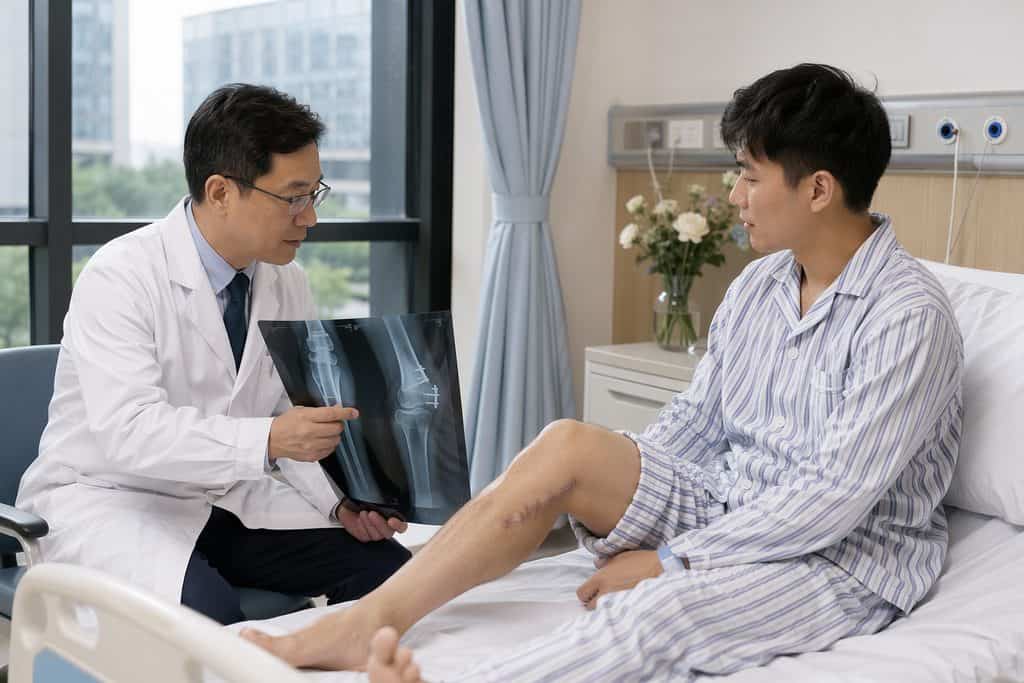
Soft Tissue Sarcoma: Shanghai Sixth Team Guide for International Patients
Soft tissue sarcoma is rare — roughly 13,000 new cases are diagnosed in the United States each year, according to American Cancer Society estimates, making up less than 1% of all cancers. That rarity is exactly the problem. Most general surgeons see a handful in a career. Meanwhile, Shanghai Sixth People’s Hospital, a public tertiary center whose orthopedic oncology group sits inside one of China’s largest sarcoma referral pipelines, evaluates and operates on these tumors as routine work. For an international patient holding a fresh biopsy report and a confusing set of options, that volume difference is the whole story.
This guide covers what the Shanghai Sixth team actually offers, who should consider traveling for it, what it costs, and how the logistics work. It is written for patients and families, not clinicians. Nothing here is medical advice.
Soft Tissue Sarcoma: Shanghai Sixth Team Guide for International Patients — The Short Answer
Shanghai Sixth People’s Hospital is a large public tertiary hospital affiliated with Shanghai Jiao Tong University, and its orthopedic and musculoskeletal tumor services are among the most established in China. International patients typically reach the team through a staged process: send existing imaging and pathology slides for a written second opinion, then a video consultation, then — only if surgery is genuinely indicated — travel for in-person evaluation and admission. You cannot book an operating room from overseas. No hospital in China works that way.
What you can do is get a real specialist to look at your actual slides and scans before you buy a plane ticket. That single step filters out a surprising number of unnecessary trips.
The core reality: In Chinese public hospitals, surgery follows an in-person consultation. Remote steps narrow the decision; they do not replace the exam. Any service promising a confirmed surgery date before you arrive is misrepresenting how the system works.
Who This Is Right For — and Who It Isn’t
Sarcoma care is not a commodity. It rewards subspecialty volume, and it punishes delay. Here is an honest split.
Typically a reasonable fit:
- You have a confirmed or strongly suspected soft tissue sarcoma diagnosis with imaging and a pathology report in hand.
- You are facing a limb-salvage decision — amputation versus wide resection with reconstruction — and want a second opinion from a high-volume team.
- You have a rare subtype (synovial sarcoma, myxofibrosarcoma, undifferentiated pleomorphic sarcoma) where local expertise is thin.
- You are uninsured or underinsured in your home country, or facing a wait that your oncologist considers risky.
- You can travel and tolerate a major operation, and you have someone to accompany you.
Probably not the right move:
- You have not yet had a biopsy. Get one first, at home. Traveling for a diagnosis is expensive and slow.
- Your tumor is metastatic and your local team has already started a systemic regimen that is working. Interrupting it to travel is usually a bad trade.
- You need urgent decompression or bleeding control. Go to the nearest emergency department. Do not plan a flight.
- You cannot obtain your pathology slides. Without them, a Chinese team is working blind.
And one more: if your local sarcoma center is genuinely high-volume and accessible, staying home is often the better call. We say that knowing it costs us business.
The Options, Compared
Most international patients are choosing between four paths. The numbers below are typical ranges, not quotes — they vary by hospital and case complexity.
| Path | Typical wait to surgery | Estimated cost (USD) | Best suited to |
|---|---|---|---|
| Home country, public system | 4–12+ weeks | $0–$15,000 out of pocket (varies by insurance) | Insured patients with access to a sarcoma center |
| Home country, private | 2–4 weeks | $60,000–$150,000+ | Speed and continuity with your existing oncologist |
| Shanghai Sixth, standard public channel | Requires in-person consult first; surgical scheduling depends on department capacity | Often a fraction of Western private rates; confirm by case | Cost-sensitive patients with a clear surgical plan |
| Shanghai Sixth via international/VIP channel | Faster access to senior specialists; roughly 1.5–2× standard fees | Higher than standard channel, still typically below Western private | Patients who need English service and predictable scheduling |
If you are insured in a country with a functioning sarcoma service, path one or two usually wins. The calculus shifts when you are uninsured, when your wait is measured in months, or when your local team has offered amputation and you want a limb-salvage opinion from people who do this weekly.
What Makes the Shanghai Sixth Sarcoma Pathway Distinct
Two things, and neither is marketing.
The first is surgical volume concentrated in one place. Orthopedic oncology at a major Shanghai tertiary center is not a side service — it is a dedicated division with its own ward, its own imaging protocols, and a reconstruction team that works alongside it. Limb-salvage surgery after tumor resection often requires vascular grafting, flap reconstruction, or custom prosthetics. Having those disciplines in the same building, on the same schedule, changes what is technically possible.
The second is cost structure. A soft tissue sarcoma resection with reconstruction at a top Chinese public hospital frequently lands in a range that is a small fraction of equivalent Western private pricing. We do not publish a fixed figure because sarcoma surgery is not one operation — a 4 cm superficial tumor on the forearm and a 20 cm retroperitoneal mass are different procedures with different ICU needs. Anyone quoting you a single number before seeing your imaging is guessing.
Practical tip: Ask specifically whether the team performs immediate reconstruction in the same operative session. At some hospitals it is a separate staged procedure weeks later. That difference affects both cost and recovery time.
What It Costs and How Long It Takes
Here is the honest breakdown of the remote and on-the-ground phases.
Remote phase (before any travel):
- Written second opinion from a top-hospital specialist: $300–500. You send reports; the specialty reviews and returns written analysis and direction. For reference only, not a prescription.
- Video consultation with a standard tertiary international department or private international hospital: $100–300.
- Top-specialist video consultation: $500–800.
- Multidisciplinary team (MDT) video review — surgeon, oncologist, radiologist together: $1,500–2,000. For sarcoma, this is often the most useful single purchase.
Any consultation fee is credited in full toward on-the-ground coordination if you proceed within 90 days. That credit applies to the coordination fee only, never to hospital treatment charges.
On-the-ground phase:
- In-person top-specialist consultation coordination: $800–1,200.
- Hospital appointment coordination (outpatient, admission, surgery): from $300. If we cannot secure the appointment shown in your order, it is refunded in full.
- Bilingual medical companion: from $300/day — half day (4 hours) or full day (8 hours). This covers registration, queuing, payment, wayfinding, interpretation, and accompaniment. It does not guarantee a specific named specialist.
- Airport transfer: $200 round-trip.
Hospital charges — imaging, surgery, ICU, ward, implants, pathology — are billed separately by the hospital and are not part of our fee. Public hospitals require prepayment; insurance reimbursement happens afterward in your home country. Private international hospitals in China often bill insurers directly.
Timeline, realistically: records collection and translation, 1–2 weeks. Remote review, 3–10 days. Visa (S2, the short-stay category used for medical treatment and private affairs, subject to current embassy requirements and supporting hospital documents), 1–3 weeks depending on consulate. Arrival, in-person consult, pre-operative workup, then surgery. Total from first contact to operating table: commonly 4–8 weeks. Faster is sometimes possible. Slower is common.
Practical Considerations: Records, Visa, Payment, and Follow-Up
Records. You need your pathology slides — the actual glass slides or a digital whole-slide image — plus the written pathology report, MRI or CT imaging on disc or via a cloud link, and any operative notes if you have had a prior resection. Sarcoma pathology is subtle. A Chinese pathologist reviewing your slides may reach a different subtype classification than your local lab, and that changes the surgical plan. This is a feature, not a bug.
Visa. Medical travel to China uses the S2 visa, annotated for medical treatment. Stays beyond 180 days require S1. Accompanying family members apply for S2 as well. The M visa is for commercial and trade activity and has nothing to do with medical care — if a service tells you otherwise, walk away. Approval is never guaranteed; consulates decide, and you will need hospital-issued documentation supporting the purpose of travel.
Payment. Public hospitals take prepayment, usually by bank transfer or international card, and large transactions can hit card limits. Arrange the transfer before you fly. Keep every receipt — your insurer at home will want them, and reimbursement for treatment abroad is frequently partial or denied depending on your policy. Check that before you book anything.
Language. A top Shanghai hospital can see tens of thousands of outpatient visits in a day. Signage, registration kiosks, and queue systems are in Chinese. Some international departments have English-speaking staff; the wards generally do not. This is precisely where a bilingual companion earns its cost.
Follow-up. Sarcoma surveillance means imaging every 3–6 months for the first two years. Plan how that happens at home before you leave China. Ask the treating team for a written follow-up protocol you can hand to your local oncologist, and get your imaging and pathology on disc to carry back.
If you want to compare other high-volume centers before committing, our directory of top-ranked Chinese hospitals by city lists Fudan-ranked institutions, and the oncology specialty rankings show which hospitals sit in China’s top 10 for cancer care. Shanghai-specific options are grouped on our Shanghai city page.
Frequently Asked Questions
No. Public hospitals in China schedule surgery only after an in-person consultation and pre-operative workup. What you can arrange in advance is a remote review of your records, a video consultation, and coordinated access to a senior specialist once you land. Anyone promising a confirmed surgical date from overseas is not describing how the system works.
Usually, yes — often dramatically so compared with Western private rates. But sarcoma surgery is highly variable. A small superficial resection and a large retroperitoneal tumor with vascular reconstruction are not comparable procedures. You will not get a meaningful number until a surgeon has seen your imaging. Treat any pre-imaging quote as marketing.
Complications happen in sarcoma surgery everywhere, including in China. Major resections carry risks of infection, wound breakdown, flap failure, and nerve deficit. Before traveling, confirm three things: your travel insurance covers surgical complications abroad, you have a local oncologist willing to manage your follow-up, and you understand the hospital’s policy on revision surgery. We coordinate communication and logistics. We do not provide clinical care and cannot guarantee any outcome.
Your Next Step
The value of a Shanghai sarcoma opinion is not the flight — it is the review that happens before you book one. Start with your slides and scans, get a specialist’s written read, and let that determine whether travel makes sense. Our team is not a hospital and does not diagnose or treat anyone; we translate records, coordinate appointments through official hospital international departments, and provide bilingual accompaniment on the ground. If you would like to know whether the Shanghai Sixth pathway fits your case, start with a free consultation — no pressure, and no obligation to travel.
This article is for general information only and is not medical advice. Treatment decisions should be made with qualified physicians who have reviewed your individual case.
For more medical information and treatment options in China, visit chinamedservices.com (China Medical Services).
