Medical Treatment in Shenzhen China: Cross-Border Medical Service from Hong Kong and Overseas
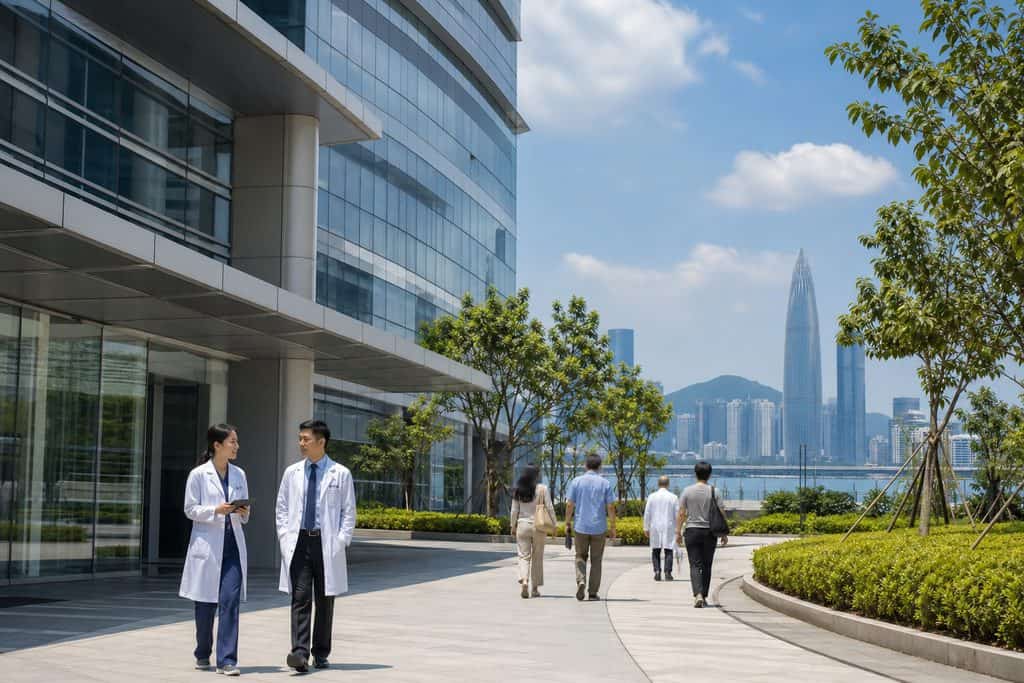
You have probably heard that crossing the border for medical care means compromising on safety. The data tells a different story. Shenzhen’s top hospitals now perform procedures at volumes that rival major Western centers, with JCI-accredited facilities and English-speaking teams that cater specifically to international patients. The real question is not whether the care is good enough. It is whether you know how to access it without getting lost in a system built for 1.4 billion people.
Key Takeaways
- Shenzhen has 6 hospitals ranked in the Fudan Top 100, with oncology and cardiac surgery programs that handle case volumes Western surgeons rarely see in a lifetime.
- The dental implant cost Shenzhen vs Hong Kong comparison consistently shows savings of 50-70%, with identical implant brands and materials used in both cities.
- Public hospital outpatient departments cannot be pre-booked from overseas — you need the hospital’s international VIP channel to lock in surgery dates before traveling.
- Hong Kong insurance policies are rarely accepted directly at Shenzhen public hospitals. You pay upfront and claim reimbursement later, unless you use a private international hospital with direct billing agreements.
The Problem: Waiting and Paying Too Much for Care You Need Now
Hong Kong’s public healthcare system is world-class. It is also overwhelmed. A non-emergency orthopedic consultation can take 18 months. A dental implant in a private Hong Kong clinic runs between HK$20,000 and HK$40,000 per tooth. For oncology patients, every week of waiting feels like a gamble they did not choose to make.
Private care in Hong Kong solves the waiting problem. But the cost puts it out of reach for many families. A single cancer surgery can exceed HK$300,000. That is the number that pushes patients to look north. Shenzhen sits 14 minutes away by high-speed rail from West Kowloon. Geographically, it could not be closer. Medically, the gap has narrowed dramatically over the past decade. The barrier is not distance. It is information.
Who We Are
We are not a hospital. We do not provide medical treatment, clinical diagnoses, or dental work. Our team is the logistical bridge between you and China’s top-tier medical institutions — 340+ top-ranked hospitals across 37 cities, representing the top 5% of the country’s 35,000+ hospitals as ranked by Fudan University and JCI accreditation standards. We handle hospital matching, appointment coordination through official international departments, bilingual medical companion services, visa guidance, and every practical detail from the moment you land until you recover and go home. You focus on your health. We handle everything else.
Why Medical Treatment in Shenzhen China Delivers Results for Cross-Border Patients
Volume Creates Expertise That Is Hard to Match
Shenzhen’s population exceeds 17 million. The hospitals serving this city see patient volumes that reshape what “experienced” means. A top Shenzhen oncologist might review 300 liver cancer cases in a year. A Western oncologist in a mid-sized city might see 30. This is not a comment on individual skill. It is a structural reality. When you need complex surgery, you want the surgeon who has done your procedure last week, not last quarter.
Shenzhen People’s Hospital and Peking University Shenzhen Hospital are both Fudan-ranked institutions with oncology departments that draw patients from across Southeast Asia. Their tumor boards run weekly. Their surgical schedules are packed. The volume-to-outcome relationship is well documented in surgical literature — and it favors centers like these.
Technology Deployed at a Scale That Changes Timelines
A patient we assisted last year needed a PET-CT scan before a cardiac procedure. In his home country, the wait was six weeks. At the Shenzhen international department we connected him with, the scan happened the next morning. Results were read within 24 hours. Surgery followed three days later.
This is not exceptional. It is operational design. Shenzhen’s major hospitals run imaging departments on extended hours. Da Vinci surgical robots are no longer rare — multiple hospitals in the city use them for urology, gynecology, and thoracic procedures. The technology itself is comparable to what you would find in Singapore or Germany. The difference is throughput. These machines run all day.
Cost Structures That Reflect Economics, Not Quality Cuts
Let us address the obvious objection head-on. Lower cost does not mean lower quality. The structural reasons for the price gap are straightforward: lower labor costs for support staff, higher patient volumes that spread fixed equipment costs, and a hospital financing model that does not depend on aggressive insurance billing. Clinical outcomes in Shenzhen’s top-tier hospitals are not inferior to Western benchmarks. They are often better — precisely because the surgeons have done the procedure thousands of times.
The dental implant cost Shenzhen vs Hong Kong comparison makes this tangible. A single Straumann or Nobel Biocare implant in Hong Kong private practice: HK$25,000-40,000. The same implant, same brand, placed by a surgeon trained in the same international programs, in a JCI-accredited Shenzhen dental hospital: HK$8,000-15,000. That is a 50-70% reduction. For full-mouth rehabilitation requiring 8-12 implants, the savings can exceed HK$200,000. The materials are identical. The labs use the same CAD/CAM milling technology. The cost difference is structural, not qualitative.
| Procedure | Hong Kong Private (HKD) | Shenzhen Top Hospital (HKD) | Savings |
|---|---|---|---|
| Single Dental Implant (Straumann) | 25,000 – 40,000 | 8,000 – 15,000 | 50-70% |
| Cardiac Bypass Surgery | 350,000 – 550,000 | 100,000 – 160,000 | 60-70% |
| Knee Replacement (Unilateral) | 180,000 – 280,000 | 60,000 – 100,000 | 55-65% |
| PET-CT Scan | 12,000 – 18,000 | 4,000 – 7,000 | 55-65% |
| Oncology Consultation (Initial) | 1,500 – 3,000 | 300 – 800 | 70-80% |
Prices are approximate ranges in HKD equivalent. Actual costs vary by hospital, case complexity, and exchange rates. Public hospital international department pricing typically runs 1.5-2× standard rates but includes English coordination.
Is Shenzhen Medical Treatment Safe for Expats and Overseas Patients?
This question comes up in nearly every initial consultation. The short answer: yes, when you choose the right hospital and do not try to navigate the public system alone. The longer answer requires some honesty about what “safe” means.
JCI accreditation is the same international standard applied to hospitals in Singapore, the UAE, and the United States. Shenzhen has multiple JCI-accredited facilities, including the University of Hong Kong-Shenzhen Hospital (HKU-SZH), which operates under a hybrid Hong Kong-mainland management model. Its clinical protocols, medical records, and infection control standards mirror those of Queen Mary Hospital in Hong Kong. For expats worried about quality variance, HKU-SZH is the closest thing to a known quantity — a hospital that speaks your medical language, literally and procedurally.
But safety also depends on communication. A medication error is far more likely when a patient cannot explain their allergy history to a nurse. This is where the system’s cracks show. Public hospital wards in Shenzhen are not staffed with English-speaking nurses as a rule. Doctors may read English medical journals but feel uncomfortable conducting a full informed consent discussion in English. The clinical skill is there. The linguistic bridge often is not. That is why the best oncology hospital Shenzhen for overseas patients is not necessarily the one with the highest Fudan ranking — it is the one with a functioning international department that assigns English-proficient coordinators to your case.
How to Book Surgery in Shenzhen from Hong Kong Without Costly Mistakes
The process is not what most Hong Kong patients expect. You cannot call a Shenzhen public hospital’s general hotline and book a surgery slot. The public outpatient system is walk-in only. Registration happens at 7 AM on the day of your appointment. Queues form earlier. Even if you get a consultation, the doctor you see may not be the surgeon who operates on you. The surgeon schedules surgeries after personally evaluating you in their outpatient clinic.
For cross-border patients, this model is unworkable. You cannot fly in, hope for a queue number, and wait indefinitely. The alternative is the hospital’s international medical center or VIP department. These are official hospital channels — not brokers, not middlemen — that reserve appointment slots specifically for overseas patients. You get a confirmed date before you travel. You see a named senior specialist. Your consultation is conducted with English support. The cost is higher than the public rate, typically 1.5 to 2 times. But it is still a fraction of Hong Kong private fees, and it buys certainty.
Our team handles this entire coordination. We submit your medical records in translated form, confirm the specialist’s availability, lock the appointment, and arrange your visa invitation letter. You arrive knowing exactly where to go, who you are seeing, and what will happen. The hospital appointment coordination fee starts from $300 — and if we cannot secure the appointment we committed to, the fee is fully refunded.
Important: M visas are for commercial and trade activities only. Medical treatment in China requires an S2 visa with the purpose annotated for medical treatment. Accompanying family members also apply for S2 visas. Applying under the wrong visa category can result in denial of entry. We provide the official hospital invitation documentation required for your S2 application.
Can I Use Hong Kong Insurance in Shenzhen Hospital?
At most public hospitals, including their international departments, the answer is no — at least not directly. You pay the full treatment cost upfront before discharge. The hospital provides a detailed invoice and medical report. You submit these to your Hong Kong insurer for reimbursement. This is the standard workflow for 90% of cross-border cases we coordinate.
The exception is private international hospitals. Facilities like Raffles Shenzhen and the United Family Shenzhen campus have direct billing agreements with major international insurers, including many Hong Kong-based plans. If your policy includes mainland China coverage and your insurer is in their network, the hospital bills them directly. You only pay any deductible or co-insurance portion. This is the smoothest path for insured patients — but it limits your hospital choices to the private sector, which may not have the same depth in complex oncology or cardiac surgery as the major public centers.
We always recommend checking with your insurer before committing to a hospital. Ask three specific questions: Does my policy cover treatment in mainland China? Do you have direct billing arrangements with any Shenzhen hospitals? What documentation do you require for reimbursement if I pay upfront? The answers determine which hospital tier makes financial sense for your case.
What a Shenzhen Medical Tourism Package Price Actually Includes
It is safe when you are in the right facility with the right support. HKU-Shenzhen Hospital operates in a bilingual environment — medical records, consent forms, and discharge summaries are available in English and Chinese. Other top hospitals have international departments with English-speaking coordinators, though the depth of English proficiency varies. The risk increases sharply if you attempt to use the general public outpatient system without language support. A miscommunicated allergy, a misunderstood dosing instruction, or a missed follow-up detail can have serious consequences. This is exactly why bilingual companion services exist — not as a luxury, but as a safety layer. If you ask whether the clinical quality is safe, the answer is yes at any Fudan-ranked or JCI-accredited hospital. If you ask whether the experience is safe without language support, the honest answer is that it carries unnecessary risk.
Top Shenzhen hospitals have emergency response protocols, ICU capacity, and specialist backup that match international standards. HKU-Shenzhen Hospital has a 24-hour emergency department, full ICU, and can stabilize and manage surgical complications on-site. The hospital carries its own medical liability insurance. That said, the medicolegal framework in mainland China differs from Hong Kong’s. Pursuing a malpractice claim as a foreign patient is procedurally complex and may not result in the same compensation levels you would expect through Hong Kong courts. We advise all patients to carry their own medical travel insurance that includes complication coverage and medical evacuation if needed. This is not a comment on the quality of care — it is the same advice we would give to anyone seeking surgery outside their home jurisdiction, whether in Thailand, Turkey, or Germany.
At most public hospital international departments, no. You pay the full treatment cost upfront and submit a claim to your insurer afterward. The hospital provides itemized invoices and medical reports in English to support your claim. At private international hospitals like Raffles Shenzhen or United Family, direct billing is available if your insurer is in their network. Before you commit to any hospital, call your insurer and confirm three things: mainland China coverage is included in your policy, the specific hospital is within their approved network if direct billing is required, and you understand the pre-authorization process for scheduled surgeries. We help patients gather the necessary documentation but the insurance relationship is between you and your insurer.
The fastest path is through a hospital’s international medical center, not its general outpatient department. You need translated medical records, a confirmed specialist appointment, and a visa invitation letter before you travel. Attempting to walk in through the public system means queuing at 6 AM for a registration number, possibly seeing a junior doctor first, and having no guarantee of when surgery can be scheduled. The international channel costs more — typically 1.5-2× the public rate — but it gives you a named specialist, a confirmed date, and English coordination. Our team handles this entire workflow. We submit your records, confirm the specialist’s availability, lock the date, and provide the visa documentation. If we cannot secure the appointment, the coordination fee is fully refunded. You do not pay for uncertainty.
Your Next Step
Medical treatment in Shenzhen China is not a compromise play. It is a rational response to long wait times and high costs in your home system, backed by hospitals that perform at volumes that build genuine expertise. The dental implant cost Shenzhen vs Hong Kong comparison alone saves some patients more than the price of a round-trip business class ticket. The challenge has never been the quality of the medicine. It has been the complexity of access.
That complexity is what we exist to remove. If you are considering a procedure, a second opinion, or even just a preliminary conversation about whether Shenzhen makes sense for your specific case, start with a free consultation. No commitment. No pressure. Just an honest conversation about your options and what it would take to make them real.
Request your free consultation and let us show you what is possible.
Disclaimer: This article is for informational purposes only and does not constitute medical advice. Treatment decisions should be made in consultation with a qualified physician. Prices cited are approximate ranges based on historical cases and vary by hospital, case complexity, and exchange rates. China Medical Services does not provide medical treatment or clinical diagnoses. We are a coordination and support service connecting international patients with China’s top-ranked hospitals.
Frequently Asked Questions
Yes. We work with JCI-accredited and major Grade 3A tertiary hospitals that follow international safety standards comparable to top hospitals in the US and Europe. Surgical teams perform high volumes of procedures — often more than their Western counterparts — which studies show leads to better outcomes.
Costs vary by procedure and hospital, but international patients typically save 40-80% compared to US prices — even when factoring in travel and accommodation. A consultation with our team will give you an exact, all-inclusive quote with no hidden fees.
Send us your existing medical reports. The relevant specialty reviews them and gives you a written opinion, including treatment direction and options, before you commit to any travel. From there you can add a video consultation with the doctor, or have us attend an appointment on your behalf.
For more medical information and treatment options in China, visit chinamedservices.com (China Medical Services).
