Nasopharyngeal Carcinoma Care in China: A Guide to Costs and Top Hospitals
Key Takeaways
- Nasopharyngeal carcinoma (NPC) is rare in the West but common in southern China, which is exactly why Chinese radiation oncology teams see more of it in a year than most Western centers see in a decade.
- Treatment at a top-tier Chinese public hospital often runs a fraction of U.S. pricing — but the real advantage is concentrated case volume, not just the bill.
- The hard part is not the medicine. It is the logistics: no walk-in booking for foreigners, a huge hospital system with little English signage, and a visa category most patients get wrong.
- Nobody should choose a treatment country from a webpage alone. Get your pathology reviewed, ask direct questions, and treat every quote as an estimate until a hospital confirms it.
In the United States, roughly 1 in 100,000 people are diagnosed with nasopharyngeal carcinoma each year. In parts of southern China, historical incidence has run 20 to 50 times higher. That gap is not a footnote. It shapes who treats this disease, how often, and with what equipment.
So when a patient in Toronto or Dubai or Lagos searches for nasopharyngeal carcinoma treatment cost China, the honest answer is not a single number. It is a range, a system, and a set of trade-offs. This guide walks through all three.
Why NPC Care in China Looks Different From the Start
These are the volume leaders. They see NPC constantly, run active clinical research, and offer IMRT, VMAT, and in selected centers proton or carbon-ion therapy. The Fudan specialty reputation rankings list a defined top tier for oncology, and several of those hospitals sit in Guangzhou, Beijing, Shanghai, and Chengdu. You can browse the ranked list by specialty on our departments page, which groups hospitals by oncology and related fields.
Facilities such as United Family, Jiahui, and Parkway offer English-speaking staff, JCI accreditation, and direct insurance billing. They are excellent for diagnostics, second opinions, and follow-up. For a full curative NPC radiation course, most patients still end up at a large public center, because that is where the case volume and the newest protocols live.
Southern China has a deep bench. Hospitals in Guangdong, Guangxi, and Fujian treat NPC routinely, often at lower cost than the flagship Beijing and Shanghai institutions, with outcomes that reflect genuine local expertise. If your budget is tight, this is worth exploring rather than dismissing.
For a city-by-city view of ranked hospitals, our top hospitals directory groups facilities by location and tier.
Is Nasopharyngeal Carcinoma Treatment in China Safe?
This is the question families ask last and worry about first. It deserves a direct answer.
China’s leading cancer centers operate modern linear accelerators, use the same international staging systems, and publish in the same journals Western oncologists read. Many senior radiation oncologists trained partly abroad or collaborate on international trials. The clinical care at the top tier is broadly comparable to major Western centers.
The safety risks are mostly not clinical. They are operational.
- Language. A large Chinese public hospital may see 10,000 or more outpatient visits in a single day. Without Mandarin, navigating registration, payment, imaging, and scheduling is genuinely difficult.
- Scheduling. Standard outpatient clinics do not accept advance bookings from overseas. You generally register on the day, and surgery or admission follows an in-person consultation. The international department is the usual route around this.
- Continuity. Radiation for NPC runs six to seven weeks. You need a plan for housing, transport, and follow-up after you fly home.
Any provider that promises a specific doctor, a guaranteed admission date, or a fixed outcome before reviewing your records is telling you something about themselves. Real hospitals confirm plans after they see your pathology and imaging.
How Effective Is Radiation Therapy for Nasopharyngeal Carcinoma?
Radiation is not a fallback for NPC. It is the primary curative treatment, and the evidence behind it is strong.
For early-stage disease, modern IMRT alone achieves local control in the large majority of patients. For locally advanced disease, the standard of care combines radiation with concurrent chemotherapy, and often induction chemotherapy beforehand. Survival figures vary widely by stage, EBV DNA level, and individual factors, so no article — including this one — can tell you your own prognosis.
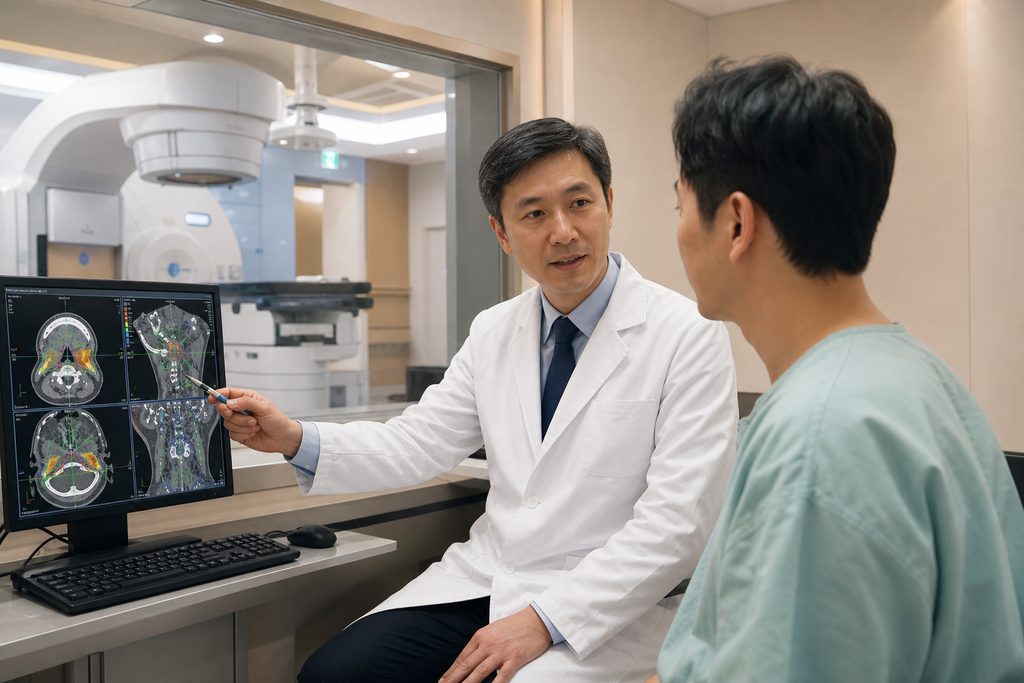
What matters for your decision is technique. IMRT and its volumetric cousin VMAT shape the radiation dose tightly around the tumor while limiting exposure to the parotid glands, brainstem, and optic nerves. That precision reduces dry mouth, swallowing problems, and long-term neurological risk. Chinese high-volume centers use these techniques as routine practice, not as a premium add-on.
If you are weighing options, ask any center three questions: How many NPC patients do you treat per year? Which radiation technique do you use by default? And how do you manage xerostomia and follow-up? The answers will tell you more than any brochure.
How to Book Nasopharyngeal Carcinoma Treatment in China
The practical sequence is more predictable than most patients expect. Here is how it typically runs.
Step 1: Records First, Travel Later
Send your pathology report, imaging (MRI and PET-CT if available), EBV DNA results, and a short treatment history. A Chinese oncology team reviews the file and returns a written assessment. This is the stage where you learn whether travel makes sense at all — and it is far cheaper than flying first and asking questions after.
Step 2: A Video Conversation
Written opinions are useful. Live conversation is better. A video consultation lets you ask about technique, timeline, and cost directly, with interpretation if needed.
Step 3: Visa and Timing
Foreign patients coming for medical treatment generally apply for the S2 visa, with supporting documents from the receiving hospital. Family members accompanying you apply under the same category. Stays beyond 180 days fall under S1. Requirements shift, so confirm current rules with the nearest Chinese embassy or consulate before booking flights. Note that the M visa is for commercial and trade activity and is not the medical route.
Step 4: Arrival and Treatment
Once you are in China, the work is scheduling, imaging, simulation, and the radiation course itself. A typical NPC radiation course runs about six to seven weeks, five days a week, with chemotherapy cycles layered in depending on stage.
Step 5: Follow-Up
Plan this before you leave. Ask for imaging on disc, a written treatment summary in English, and a clear surveillance schedule — usually periodic nasopharyngoscopy, MRI, and EBV DNA monitoring. Your home oncologist can execute that plan if you bring the records.
If you are comparing medical tourism packages for cancer treatment China, ask what is actually included. A package price that covers hospital fees but not housing, interpretation, or follow-up transport is not a package. It is a hospital bill with a logo.
Practical Considerations Before You Commit
Payment at Chinese public hospitals is typically upfront, with insurance reimbursement handled afterward in your home country. Private international hospitals often bill insurers directly. Confirm which model applies before you arrive, and check whether your insurer covers treatment abroad at all.
Housing matters more than people expect. A seven-week radiation course means seven weeks of accommodation near the hospital, plus daily transport. Hospital-adjacent apartments in Guangzhou or Shanghai are convenient but not cheap.
Language support is the single biggest quality-of-life variable. Registration queues, payment windows, and imaging appointments all run in Mandarin. A bilingual companion who handles queuing, payment, wayfinding, and translation changes the experience substantially — not the medicine, but the week-to-week reality of it.
Finally, keep your expectations calibrated. China offers real clinical depth in NPC and meaningful cost savings. It also involves a large, busy, sometimes confusing system. Both things are true.
Frequently Asked Questions
Can foreigners get treated for nasopharyngeal carcinoma in China?
Yes. International departments at major Chinese hospitals regularly treat foreign patients, and the S2 visa category exists for exactly this purpose. The practical requirement is going through the hospital’s international office rather than a standard outpatient registration window.
Is nasopharyngeal carcinoma treatment in China safe compared with Western hospitals?
At the top-tier cancer centers, the clinical standards, equipment, and protocols are broadly comparable to major Western institutions. The main differences you will notice are logistical — language, scheduling, and hospital scale — rather than clinical.
How much does NPC treatment cost in China compared with the U.S.?
A full course of chemoradiation at a leading Chinese public hospital often falls in the $15,000 to $35,000 range, against $100,000 or more in the U.S. Figures vary by stage, technique, and hospital tier, so treat any number as an estimate until a hospital reviews your case.
How long would I need to stay in China for treatment?
Plan for roughly two to three months. A standard radiation course runs six to seven weeks, and you should allow additional time for workup, simulation, and the first follow-up scan before flying home.
What if I need help navigating the hospital?
Many international patients use a bilingual companion for registration, payment, imaging appointments, and translation. It does not change your treatment plan, but it removes a large share of the daily friction.
Your Next Step
The core message is simple: NPC is a disease where concentrated expertise matters, and China has that expertise at a cost far below Western pricing. The barrier is navigation, not medicine. We are China Medical Services — a coordination team, not a hospital and not a source of medical advice. We help international patients obtain written second opinions, arrange video consultations with Chinese specialty teams, and coordinate hospital appointments through official international channels, with pricing that varies by hospital and case complexity. If you would like your records reviewed before making any decision, you can start with a free consultation at our patient services page.
For more medical information and treatment options in China, visit chinamedservices.com (China Medical Services).
