Advanced Radiotherapy in Shanghai: What to Know Before You Go
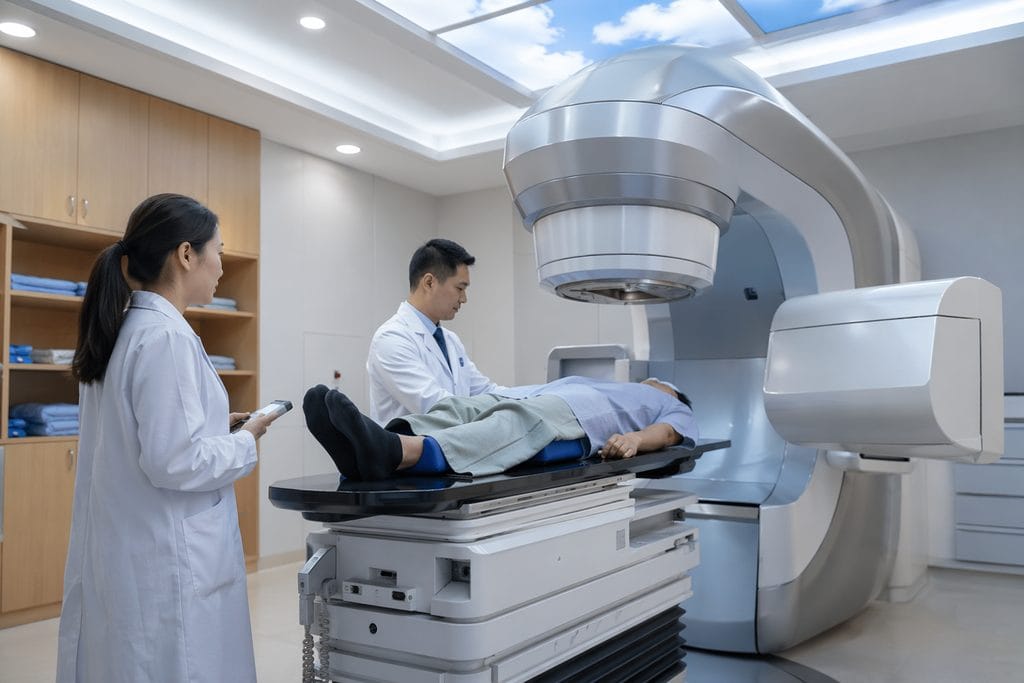
Advanced Radiotherapy in Shanghai: What to Know Before You Go
The median wait for a first radiation oncology consultation in parts of Canada and the UK runs into weeks, and proton therapy slots in the United States are concentrated in a handful of centers with case-by-case insurance approval. Meanwhile, Shanghai’s major cancer hospitals treat tens of thousands of radiotherapy patients every year, and the radiotherapy cost at a Shanghai hospital is frequently a fraction of what the same course bills for in Boston or London. That gap is why so many international patients now ask us about advanced radiation therapy in China for international patients — and why the answer is more nuanced than a price tag suggests.
This guide covers what Shanghai actually offers, what it costs, how long treatment takes, and how to book a radiotherapy appointment at a Shanghai hospital without wasting a trip.
How This Actually Works, Step by Step
Radiotherapy is not a walk-in service anywhere in the world, and China is no exception. The sequence matters, because arriving in Shanghai with a suitcase and a folder of scans is the single most common mistake we see.
Step 1 — You send records, not yourself. You gather your existing imaging (CT, MRI, PET-CT on disc or DICOM files), pathology reports, surgical notes if any, and current medication list. We arrange certified translation into Chinese where required. Nothing moves until the specialty team can actually read your file.
Step 2 — A radiation oncologist reviews remotely. Through a written second opinion or a video consultation, a Chinese radiation oncology team reviews your case and tells you whether radiotherapy is appropriate, which technique fits, and roughly how many fractions are involved. This is where you learn whether you are a proton candidate, an SBRT candidate, or neither.
Step 3 — A plan and a quote come back. You receive a written summary plus an estimated cost range and a realistic treatment calendar. Costs vary by hospital and case complexity, so treat any figure as a range, not a contract.
Step 4 — You travel only after the plan is confirmed. In-person consultation at the hospital precedes any treatment scheduling. Public hospital radiotherapy departments generally require a face-to-face visit before simulation and planning begin.
Step 5 — Simulation, planning, delivery. Once you are on site, the hospital performs CT simulation, the physics team builds your plan, and treatment starts. Most modern courses are delivered five days a week.
Step 6 — Follow-up. You leave with imaging and a treatment summary your home oncologist can act on.
What Shanghai’s Radiotherapy Landscape Actually Looks Like
Shanghai is home to 18 hospitals in the Fudan Top 100 ranking — second only to Beijing nationally — and several of them run high-volume radiation oncology departments with equipment most Western patients recognize: linear accelerators with image guidance, volumetric modulated arc therapy, stereotactic radiosurgery, and brachytherapy suites.
For a broader view of how these institutions are classified, our Fudan-ranked hospital directory by city groups them by tier and specialty strength. If your case is oncological, the oncology department rankings show which Shanghai hospitals sit in the national top 10 for cancer care specifically.
Two practical realities shape the experience. First, these are very large institutions. A single Shanghai cancer hospital may see more than 10,000 outpatient visits on a busy day. Without Chinese language ability, navigating registration, payment, and the radiotherapy floor is genuinely difficult. Second, public hospital pricing assumes prepayment, with insurance reimbursement handled afterward at home. Private international hospitals in Shanghai take a different approach — direct billing with many international insurers — but their radiotherapy capabilities are narrower than the major public cancer centers.
Is Proton Therapy Available in China — and Do You Need It?
Yes. Proton and heavy-ion facilities operate in China, and Shanghai has been a center for this technology for years. But availability is not the same as suitability.
Proton therapy matters most for tumors where sparing surrounding tissue changes the outcome: pediatric cancers, skull base tumors, certain head and neck cases, and selected prostate or liver tumors. For many common presentations — breast, lung, rectal, most lymphomas — modern photon techniques like VMAT or IMRT deliver excellent results, and proton therapy adds cost without adding benefit.
The honest version: whether proton therapy is the right call for you is a clinical decision made by a radiation oncologist who has seen your imaging and pathology. Not a decision made by a price list. If a provider tells you proton therapy is right before reviewing your scans, that is a warning sign.
A Realistic Timeline
Here is what the calendar typically looks like for an international patient. Ranges reflect real variability — hospital scheduling, visa processing, and how quickly your records arrive all move the needle.
| Stage | Typical Duration | What Slows It Down |
|---|---|---|
| Record collection and translation | 3–10 days | Missing pathology slides, discs that won’t open |
| Written second opinion or video consult | 3–7 days after records arrive | Requests for additional imaging |
| S2 visa application | 1–3 weeks | Consulate appointment availability, invitation documents |
| Travel and arrival | 1–3 days | Flight routing, jet lag before consultation |
| In-person consultation and simulation | 2–5 days | Additional staging scans requested on site |
| Treatment planning | 3–7 days | Complex cases requiring physics review |
| Radiation delivery | 1 day to 7 weeks | Fractionation schedule; single-fraction SBRT vs. 35-fraction courses |
| Post-treatment follow-up | 1–2 days before departure | Scheduling with your treating team |
So how long does radiotherapy treatment take overall? For a short SBRT course, you could be in Shanghai for roughly two weeks door to door. For a standard seven-week course, plan on nine to ten weeks including workup and recovery days. That is the answer most people actually need, and it is rarely the answer they get from a brochure.
What Can Go Wrong — and What Happens Then
We would rather you hear the failure modes now than discover them at a registration window.
The hospital declines your case. This happens. Some patients arrive having already exhausted radiation options, or with a tumor type where the Chinese team agrees with your home oncologist that radiotherapy is not indicated. Recourse: you learn this during the remote review, before booking flights. That is the entire point of the staged process.
You cannot get the exact appointment date you wanted. Public hospital radiotherapy schedules are tight. A department may be fully booked for simulation slots in a given week. Recourse: appointment coordination services work on best-effort basis, and reputable providers refund the coordination fee if the requested booking cannot be secured. Nobody legitimate guarantees a specific doctor on a specific day.
Your visa is delayed. S2 visa processing depends on consulate workload and your documentation. Recourse: build buffer into your timeline. Do not book non-refundable flights before the visa is in hand.
Insurance refuses to reimburse. Many international insurers reimburse overseas treatment, but policies differ sharply. Recourse: get pre-authorization in writing before you travel if reimbursement matters to your budget. Public hospitals in China generally require prepayment regardless of your coverage.
You need a treatment change mid-course. Sometimes the plan is adjusted after the first week of imaging. Recourse: this is normal oncology practice, not a failure — but it can extend your stay, so keep flexible accommodation.
How to Choose a Cancer Treatment Center in Shanghai
If you are searching for the best cancer treatment center in Shanghai, the honest answer is that “best” depends on your diagnosis. A hospital ranked first nationally for thoracic surgery is not automatically the right place for a prostate case.
What to actually evaluate:
- Subspecialty fit. Does the department treat your cancer type at volume? A center doing 40 pancreatic SBRT cases a year is a different proposition from one doing 400.
- Technology match. Confirm the specific technique you need exists on site, not at a partner facility across town.
- International department infrastructure. Does the hospital have a functioning international office that can register you, translate your records, and communicate in English?
- Realistic scheduling. Ask how far out simulation slots are booked. Vague answers are a red flag.
- Continuity after you leave. Will you receive imaging and a treatment summary in a format your home oncologist can use?
Our hospital database covers 340+ top-ranked hospitals across 37 cities, drawn from the top 5% of China’s 35,000+ hospitals and filtered by Fudan ranking and JCI accreditation. For Shanghai specifically, the Shanghai city page lists institutions with international patient services.
Practical Considerations: Records, Visa, Payment, Language
Records. Bring DICOM imaging on physical media plus cloud copies, pathology blocks or slides if the hospital requests them, and a typed medication list with generic drug names. Chinese hospitals will often re-stage with their own imaging, so expect some repetition.
Visa. Medical travel to China uses the S2 visa with a notation for medical treatment purposes. Stays beyond 180 days fall under S1. Accompanying family members apply for S2 as well. Requirements change, so confirm current documentation with the relevant Chinese embassy or consulate and with the hospital issuing your invitation letter. The M visa is for commercial and trade activity and is not the medical route.
Payment. Public hospitals require prepayment; private international hospitals often bill insurers directly. Bring a card that works internationally and confirm whether the hospital accepts wire transfer for large amounts.
Language. Radiotherapy involves daily appointments, positioning instructions, and skin-care guidance. Interpretation is not a luxury here. A bilingual medical companion handles registration, queueing, payment, wayfinding, and translation — from $300 per day for a half or full day, depending on scope.
Follow-up at home. Ask for your planning CT, dose summary, and a discharge letter in English. Your home team needs these to monitor you properly.
Frequently Asked Questions
Costs vary widely by technique, fractionation, and hospital tier, so any figure is a range rather than a fixed price. Broadly, radiotherapy courses at major Chinese public hospitals cost substantially less than equivalent treatment in the United States — often a fraction of US list prices — while private international hospitals in Shanghai price higher and may bill insurers directly. Request a written estimate after your records are reviewed, and treat it as an estimate, not a guarantee.
You cannot self-schedule directly into a public hospital radiotherapy department from abroad the way you might book a clinic in your home country. What works is a staged approach: submit records, obtain a remote specialist review, then have the hospital’s international office coordinate the in-person consultation. The in-person visit is generally required before simulation and treatment planning can begin.
The delivery phase ranges from a single session for some stereotactic treatments to about seven weeks for standard fractionated courses, five days per week. Add roughly one to two weeks on site for consultation, simulation, and planning, plus one to three weeks for visa processing before travel. Total time away from home commonly lands between two and ten weeks depending on your protocol.
Yes, proton and heavy-ion facilities operate in China, including in Shanghai. Access depends on your clinical indication, the facility’s current scheduling, and your documentation. Proton therapy is not appropriate for every cancer, and a radiation oncologist must review your imaging before anyone can tell you whether it applies to your case.
You find out during the remote review stage, before you book flights — which is exactly why we insist on that sequence. If the Chinese team concludes radiotherapy is not indicated, you have saved the cost and disruption of an unnecessary trip, and you have a written specialist opinion to bring back to your home oncologist.
Your Next Step
Advanced radiotherapy in Shanghai is genuinely accessible to international patients, but it rewards preparation over urgency. The patients who do well are the ones who send records first, get a specialist opinion in writing, and travel only once a plan exists.
China Medical Services connects international patients with 340+ top-ranked hospitals across 37 cities. We are not a hospital and we do not practice medicine — we handle record translation, appointment coordination through official international departments, bilingual accompaniment, and visa guidance, so your energy goes into treatment rather than logistics. If you would like a straightforward assessment of whether Shanghai is the right fit for your case, start with a free consultation. No pressure, and no obligation to travel.
This article is for general information only and does not constitute medical advice. Treatment decisions should be made with a qualified physician who has reviewed your individual case.
For more medical information and treatment options in China, visit chinamedservices.com (China Medical Services).
