Peking University Third Hospital: Orthopedics and Sports Medicine for International Patients
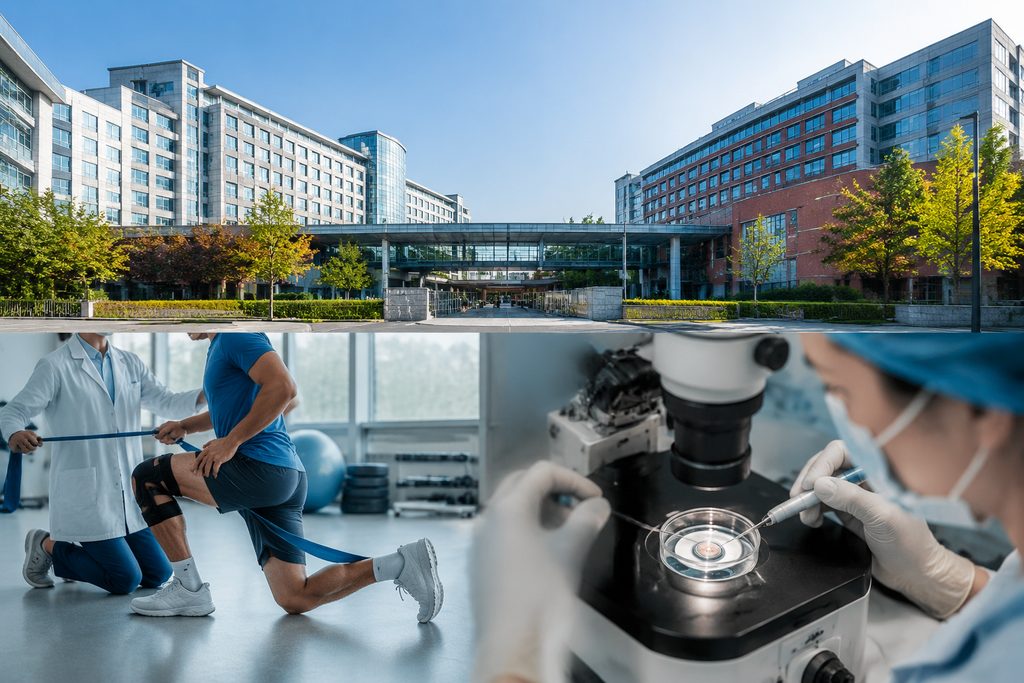
When 42-year-old Michael tore his ACL during a weekend soccer match in London, the diagnosis was swift. The proposed solution was not. His orthopedic surgeon laid out a clear plan: ACL reconstruction followed by six to nine months of structured rehabilitation. Then came the second blow. The private hospital quoted him approximately £11,000, and the NHS waiting list stretched beyond 18 months for a non-emergency reconstruction. Michael, a self-employed architect, could not afford to wait. He also could not afford the private bill without draining his savings. He started searching for alternatives. That search led him to a phrase he had never typed before: “best sports medicine hospital Beijing.”
Key Takeaways
- Peking University Third Hospital performs over 7,500 knee arthroscopies annually, making it one of the highest-volume orthopedic centers globally.
- For international patients, the all-in cost of an ACL reconstruction typically ranges from $8,000 to $15,000—a fraction of the $20,000 to $50,000 common in the US and Western Europe.
- The public hospital system does not allow overseas patients to pre-book surgeries online; you must be physically present for a consultation first, which is where a local guide becomes essential.
- Language barriers, disjointed payment systems, and visa logistics are the three biggest friction points for independent travelers seeking care here.
The Problem: When the Wait for Joint Repair Is the Real Injury
Musculoskeletal injuries do not just hurt. They stall lives. The anterior cruciate ligament, a small band of tissue no thicker than a finger, can bench an athlete for a year or more. And the waiting begins long before the surgery itself. In publicly funded systems like the UK’s NHS, Canada’s provincial health plans, or parts of the European Union, non-life-threatening orthopedic procedures are frequently triaged to the back of the line. A 2023 report by the British Orthopaedic Association noted that over 800,000 patients in England alone were waiting for trauma and orthopedic surgery, with nearly 40% waiting longer than the 18-week constitutional target. Some had been waiting over a year just for a first consultation.
The financial alternative is private care. But that path is brutally expensive. In the United States, the average cash price for an uncomplicated ACL reconstruction with a patellar tendon autograft hovers around $25,000, and can easily exceed $50,000 at a prominent academic medical center on the coasts. Even with insurance, high deductibles often leave patients with a $7,000 to $12,000 out-of-pocket liability. For the uninsured or underinsured, these numbers are simply not workable.
That reality is what pushes people like Michael to look across borders. But crossing a border for surgery is not like booking a dental cleaning in Tijuana. Orthopedic surgery requires precision imaging, a specific implant system, a meticulously sterile operating theater, and a rehabilitation protocol that must start within hours of the procedure. Getting it wrong means a failed graft, a revision surgery, and a knee that never feels stable again. The stakes are high. The question becomes not just “can I afford it,” but “where is the clinical volume high enough to trust?”
Who We Are
Our team is not a hospital. We do not perform surgeries, interpret MRIs, or prescribe rehabilitation protocols. We are a medical concierge organization embedded in China’s healthcare landscape, connecting international patients with the country’s top-tier hospitals. Think of us as your logistical architects. We handle the visa guidance, the hospital shortlisting based on your specific imaging and history, the appointment coordination through official international patient channels, and the on-the-ground bilingual support that turns a bewildering 10,000-patient-per-day public hospital into a navigable experience. We bridge the gap between your diagnosis and China’s medical expertise.
Why Peking University Third Hospital Delivers Results in Orthopedics
Peking University Third Hospital, known locally as Bei Yi San Yuan, is not just another large general hospital. It houses the Peking University Institute of Sports Medicine, the preeminent center of its kind in China. This is where China’s Olympic athletes go. That reputation is built on volume, research output, and a deeply ingrained culture of minimally invasive arthroscopic technique. When assessing the Peking University Third Hospital orthopedics cost against its Western counterparts, the value proposition becomes impossible to ignore.
Clinical Volume That Redefines “Routine”
Volume is a blunt metric, but in surgery, it is an honest one. A surgeon who performs 300 ACL reconstructions a year has seen anatomical variations, meniscal root tear patterns, and cartilage delamination that a surgeon performing 30 a year encounters only in textbooks. The Institute of Sports Medicine at Peking University Third Hospital performs over 7,500 knee arthroscopies annually. Their shoulder service handles approximately 3,000 cases a year. This is not volume for volume’s sake. It is a data set of complications, healing patterns, and technical refinements that accumulates faster than at almost any Western center. For a patient asking “is Peking University Third Hospital good for knee surgery,” the operative answer lies in those numbers. A 2021 study published in the *Chinese Journal of Sports Medicine* by the institute’s own team tracked over 1,200 consecutive ACL reconstructions with a graft failure rate below 4% at two-year follow-up, a figure consistent with the best-reported outcomes from Scandinavian registries.
A System Engineered for Arthroscopic Efficiency
The hospital’s outpatient surgical workflow is unlike the multi-day inpatient model familiar to Western patients. A straightforward ACL reconstruction is often performed as a 24-hour inpatient stay. The patient arrives the morning of surgery, undergoes the procedure under regional or general anesthesia, and is mobilized by a physiotherapist within hours. Discharge happens the following morning, provided there are no complications. This is not rushed care. It is a high-efficiency pathway refined over tens of thousands of cases. The rehabilitation protocols are aggressive and evidence-based, emphasizing early weight-bearing and immediate range-of-motion exercises. The implant systems used—Smith & Nephew, Arthrex, DePuy Mitek—are the same brands a surgeon in Boston or Munich would reach for. There is no equipment compromise.
The Cost Equation: Structural, Not Sacrificial
Let’s address the obvious question directly. How can the Peking University Third Hospital orthopedics cost be so much lower than in the West without cutting corners? The answer is structural economics, not clinical compromise. A senior orthopedic surgeon’s salary in China, while high by local standards, is a fraction of what an equivalent surgeon earns in the US fee-for-service system. Hospital construction costs, nursing labor, and sterile processing overhead are all lower. The implant itself costs roughly the same as it does in Europe—those are global list prices—but the professional fees, anesthesia charges, and facility fees that inflate a Western hospital bill are dramatically compressed. The result is a total surgical package that is transparent and, for cash-paying international patients, manageable. The money saved does not come from a cheaper screw. It comes from a less inflated system.
What You Need to Know Before Going Alone
We are direct with our clients about this: walking into a Chinese public hospital without a plan is a disorienting experience. Even at a center as prestigious as Peking University Third Hospital, the sheer scale of patient flow can overwhelm someone who does not speak Mandarin and does not understand the local registration logic. Here are the three barriers that trip up independent travelers most often.
- Visa Precision: Medical treatment in China requires an S2 visa, specifically annotated for medical purposes. This is not a tourist visa. The application demands an invitation letter from the hospital, a detailed treatment plan, and proof of financial solvency. A business visa—the M category—is not valid for receiving medical care. Applying with the wrong documents leads to rejections that delay treatment by weeks.
- The Payment Wall: Chinese public hospitals operate on a prepaid stored-value system. You deposit a lump sum at admission, and the hospital draws down from it for each test, medication, and procedure. International credit cards are often not accepted at the cashier windows. WeChat Pay and Alipay dominate, but linking a foreign bank card to these platforms is inconsistent and frequently fails during the identity verification step. Without a local payment intermediary, you can find yourself unable to fund your own surgery deposit.
- Diagnostic Fragmentation: Your MRI from home is useful for a preliminary review, but the surgeon here will almost certainly order a new scan on-site. The hospital’s imaging department is a separate queue, often in a different building. The report will be in Chinese. The film will be on a CD or accessible via a local app. Translating that report and getting the CD into the surgeon’s hands for a timely preoperative plan requires a person on the ground who understands the workflow. Emailing a scan from abroad and hoping it gets reviewed is not a strategy that works here.
How We Help You Navigate This
These barriers are not malicious. They exist because the system was designed for a domestic patient population of millions, not for a solo international traveler. Our role is to retrofit the pathway for you.
Before you travel, we collect your imaging, your clinical history, and your specific surgical goals. We translate these documents into clinical Chinese and present them through the hospital’s official international patient department for a preliminary review. This is not a binding surgical booking—no ethical surgeon will promise a procedure without a physical examination—but it confirms that your case is appropriate for the center and that a surgeon is willing to see you. We then guide you through the S2 visa documentation, ensuring the invitation letter matches the treatment scope. Upon arrival, a bilingual medical companion meets you at the airport, handles the hospital registration and deposit payment, and sits with you during the surgeon consultation to ensure every question is answered and every answer is understood. On the day of surgery, that companion is in the hospital, liaising with the nursing station and providing real-time updates to your family back home. Post-operatively, we coordinate your follow-up appointments and physiotherapy sessions before you fly out.
The Peking University Third Hospital orthopedics cost you pay goes directly to the hospital for the clinical service. Our coordination fee is separate and transparent, structured as a case management service that covers the entire episode of care. And any fee you pay us for a preliminary video consultation or a written second opinion is fully credited toward the on-the-ground coordination service if you decide to proceed with surgery within 90 days. We designed it that way so that the initial step carries no sunk cost risk.
Frequently Asked Questions
At Peking University Third Hospital’s international patient service, a standard ACL reconstruction with an autograft typically ranges from $8,000 to $15,000, depending on the graft type, the need for meniscal repair, and the length of inpatient stay. This is an all-inclusive figure covering surgeon fees, anesthesia, implant, operating theater, and the hospital bed. It does not include airfare, accommodation, or post-operative physiotherapy outside the hospital. Compare this to the $20,000–$50,000 cash price in the US, and the structural savings are clear.
The hospital’s Institute of Sports Medicine is ranked among China’s top two orthopedic sports medicine units in the Fudan University national specialty rankings. Its surgeons publish in high-impact journals, train international fellows, and use the same implant systems as leading Western centers. The difference is volume. A senior surgeon here may perform over 400 knee ligament reconstructions annually. For a patient, that means the surgeon has seen and managed the rare complications—the cyclops lesion, the missed posterolateral corner injury—many times before. Clinical outcomes are comparable to those reported in the Swedish and Norwegian knee ligament registries, which are the global gold standards.
You cannot definitively book a surgery date without a face-to-face consultation. The public hospital system requires the operating surgeon to physically examine you, review the on-site imaging, and sign the surgical consent in person. What you can do—and what we facilitate—is secure a confirmed consultation slot with a specific senior surgeon through the international patient department. That consultation is the gateway. The surgery is typically scheduled within one to two weeks after that visit, assuming no unexpected medical issues arise. The timeline is fast, but it is not a remote click-to-book system.
Peking University Third Hospital is a full-spectrum tertiary academic medical center. It has adult and surgical intensive care units, an in-house blood bank, interventional radiology for embolization, and 24-hour emergency surgical coverage. If a postoperative complication occurs—a deep vein thrombosis, a surgical site infection, a graft failure—the managing team is equipped to handle it within the same institution. The international patient department acts as a liaison throughout any extended stay. We also strongly advise all our clients to carry medical travel insurance that includes coverage for complication management and medical evacuation, though the need for evacuation is extremely rare given the hospital’s capabilities.
Your Next Step
Michael flew home three weeks after his surgery, crutches in hand and a clear rehabilitation plan on his phone. His total outlay, including flights, a serviced apartment, and the surgery itself, came to less than half of what the private London hospital had quoted him. More importantly, he was weight-bearing and moving when he would still have been waiting for a preoperative appointment back home. The decision to travel for orthopedic care is not trivial. It demands clear information, honest cost projections, and a partner on the ground who can translate more than just the language. If you are weighing your options for joint repair, spine surgery, or sports medicine, start with a conversation. Not with a commitment. Just a conversation about your imaging, your timeline, and what is possible.
For more medical information and treatment options in China, visit chinamedservices.com (China Medical Services).
