Where to Treat Adult Scoliosis in China: Costs, Hospitals, and How to Start
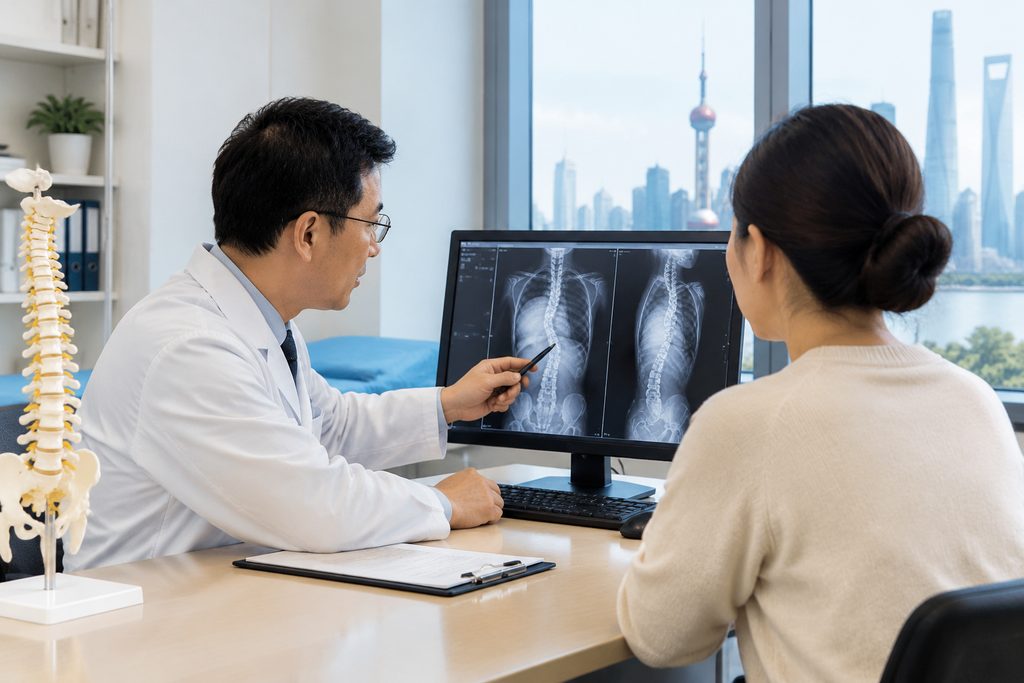
Key Takeaways
- China’s top-ranked hospitals perform scoliosis correction at a fraction of US cost — complex adult deformity surgery typically runs $15,000–$35,000 all-in, versus $100,000–$250,000 in the United States.
- More than 340 top-ranked hospitals across 37 Chinese cities are searchable by specialty, and orthopedic surgery is one of the country’s deepest benches.
- The honest barrier: you cannot book a public-hospital specialist from overseas the way you book a hotel. Surgery follows an in-person consultation, and the queue starts on arrival.
- Before committing to flights and a $20,000 procedure, a written second opinion or video consultation lets you test the plan — and any consultation fee is credited in full toward on-the-ground coordination within 90 days.
According to data compiled by the Scoliosis Research Society, roughly 6 to 9 percent of adults over age 40 show some degree of degenerative scoliosis on imaging, and the number climbs past 30 percent after age 60. Most of those people never need surgery. But for the subset with progressive curves, nerve compression, or pain that has stopped responding to physical therapy and injections, the question stops being “should I?” and becomes “where?” For a growing number of international patients, the answer they are researching is where to treat adult scoliosis in China — and the reasons are usually cost, surgical volume, and speed of access rather than novelty.
This guide is written for the patient or family member doing that research at 11 p.m. with a folder of MRI reports open on the laptop. It covers what China’s top orthopedic centers actually offer adults with spinal deformity, what the real cost ranges look like, how the referral and admission process works when you do not speak Mandarin, and where the genuine friction points are. No hospital in the world can promise you a straight spine. What we can do is show you the landscape clearly enough to make a decision you will not regret.
The Problem: Adult Scoliosis Care Is Slow and Expensive in Most Western Systems
Start with the wait. In the United Kingdom’s National Health Service, patients referred for spinal surgery routinely wait 18 to 40 weeks from decision-to-treat to the operating room, according to NHS elective waiting-time statistics — and complex deformity cases often sit at the far end of that range. In Canada, a 2023 report from the Canadian Institute for Health Information put the median wait for orthopedic surgery at 26.4 weeks, with spine procedures frequently exceeding that.
Cost is the other wall. A single-level lumbar fusion in the United States averages around $80,000, and multi-level adult deformity correction — the kind that involves pedicle screws, rods, osteotomies, and sometimes a combined front-back approach — commonly lands between $120,000 and $250,000 before rehabilitation. Even with insurance, US patients report out-of-pocket exposure in the tens of thousands when deductibles and out-of-network surgeons enter the picture.
And there is a quieter problem: expertise density. Adult deformity correction is one of the least forgiving procedures in spine surgery. A surgeon who does two or three a year is not the same as one who does two hundred. In many mid-sized Western cities, the local hospital simply does not have a high-volume deformity team.
So patients start searching internationally. Turkey, India, Thailand, and China all appear in that search. What separates China from most of that list is the concentration of high-volume academic centers — and that is where the next section begins.
Why China’s Top Orthopedic Centers Deliver Results for Adult Scoliosis
China’s hospital system is enormous — more than 35,000 hospitals nationwide — but the top tier is small and well documented. The Fudan University Hospital Rankings, China’s most widely cited hospital quality index, places only about 100 general hospitals in its top tier, spread across 23 cities. Beijing alone hosts 21 of them; Shanghai has 18; Guangzhou, 10. Our searchable database of top-ranked Chinese hospitals organizes these by city and tier so you can see exactly what exists in each region.
Clinical volume that Western surgeons rarely reach
Volume matters in deformity surgery. A senior spine surgeon at a top Chinese academic center may perform 150 to 300 spinal deformity cases annually, a caseload that would place them among the highest-volume deformity surgeons anywhere in the world. Residents and fellows rotate through these cases daily rather than occasionally. The practical effect shows up in operative time, blood-loss management, and familiarity with the complications that only appear in complex revisions.
Some of the most experienced adult deformity work in China sits within major teaching hospitals in Beijing, Shanghai, and Chengdu — institutions whose names appear consistently on the Fudan specialty reputation list for orthopedics. You can browse specialty-level rankings on our department and specialty pages, including orthopedics and spine-related disciplines.
Technology and implants at the same standard as the West
This is where some patients expect a gap and find none. Top Chinese hospitals use the same pedicle screw systems, navigation platforms, intraoperative neuromonitoring, and three-dimensional imaging that US and German centers use — often the identical manufacturers. Titanium instrumentation from Medtronic, DePuy Synthes, and domestic equivalents cleared for the same indications is standard stock. What differs is the throughput: an operating theater that runs deformity cases five days a week develops a rhythm that a general orthopedic unit cannot match.
One structural advantage worth naming: Chinese academic hospitals typically keep a full multidisciplinary team — spine surgery, pain medicine, neurology, rehabilitation, and often traditional Chinese medicine — inside one campus. That matters after surgery, when the recovery plan involves more than the surgeon who did the operation.
Cost advantage without a quality trade-off
The cost gap is real and it is not a euphemism for lower quality. Three structural reasons explain it. First, labor economics: surgeon fees, anesthesia, and nursing costs in China are a fraction of US rates, and those line items dominate a surgical bill. Second, hospital efficiency: high patient throughput spreads fixed costs — imaging, operating room time, sterilization — across far more cases. Third, the implant supply chain is domestic and competitive, which compresses hardware costs.
| Cost Component | Top Chinese Hospital (USD) | United States (USD) |
|---|---|---|
| Surgeon and anesthesia fees | $3,000 – $8,000 | $25,000 – $60,000 |
| Implants and instrumentation | $5,000 – $12,000 | $30,000 – $70,000 |
| Hospital stay (5–10 days) | $2,000 – $6,000 | $30,000 – $80,000 |
| Pre-op imaging and workup | $800 – $2,500 | $5,000 – $15,000 |
| Post-op rehabilitation (2–4 weeks) | $1,500 – $5,000 | $10,000 – $30,000 |
| Typical total, multi-level deformity | $15,000 – $35,000 | $100,000 – $250,000 |
These ranges vary by hospital and case complexity — a single-level fusion sits at the low end, a revision with osteotomies at the high end. Private international hospitals in China charge roughly 1.5 to 2 times the public-hospital rate for the same procedure, in exchange for English-speaking staff, direct insurance billing, and a hotel-like environment. Both paths are legitimate; they simply serve different priorities.
How Adult Scoliosis Care Actually Works When You Arrive From Abroad
Here is the part most articles skip, and it is the part that determines whether your trip succeeds. Chinese public hospitals do not operate like Western private practices. You cannot email a professor and book a surgery date. The system runs on in-person consultation first, decision second, scheduling third.
The realistic sequence looks like this:
- Step 1 — Records review (before you fly). You send existing imaging: full-length standing X-rays, MRI of the thoracic and lumbar spine, CT if available, plus your history, prior surgeries, and current medications. A Chinese spine team reviews the file and gives a written assessment — whether surgery is indicated, what approach they would consider, and roughly what it would cost.
- Step 2 — Video consultation (optional but valuable). You speak directly with the specialty team online, ask your questions, and hear their reasoning. This is where most patients decide whether to proceed.
- Step 3 — Registration and in-person consultation. On arrival, you attend the outpatient clinic. In public hospitals, this means registering on the day, waiting, and meeting the surgeon face to face. This visit is what unlocks everything else.
- Step 4 — Pre-operative workup. Blood work, pulmonary function, cardiac clearance, repeat imaging as needed. Usually two to five days.
- Step 5 — Surgery and inpatient recovery. Hospital stay for adult deformity correction typically runs five to ten days, longer for revisions or combined approaches.
- Step 6 — Rehabilitation before flying home. Most surgeons want you walking, managing stairs, and cleared by physiotherapy before a long-haul flight. Plan two to four weeks in China after discharge.
Choosing a Hospital: What Actually Separates One Center From Another
Surgery itself typically runs $15,000 to $35,000 at a top public hospital, varying by hospital and case complexity. Add flights, accommodation for three to five weeks, meals, and local transport — budget $3,000 to $8,000 for a patient plus one companion depending on city and hotel standard. Private international hospitals cost more but include English-language service and direct insurance billing.
This deserves a direct answer. Major deformity surgery carries real risks — infection, hardware issues, nerve injury, and the possibility of revision — and no hospital anywhere eliminates them. Before you leave China, obtain a complete operative report, implant details, and a written follow-up protocol. Establish contact with a spine surgeon or physiatrist in your home country before you travel, so you have a named clinician to call. If a complication emerges, your Chinese surgical team can consult remotely with your local doctor; whether you would need to return to China depends entirely on the problem.
Your Next Step
Adult scoliosis is not a condition you should rush into surgery for — and it is not one you should wait two years to have evaluated either. The sensible middle path is to get a qualified opinion on your actual imaging before you spend money on flights. That is where we come in. China Medical Services is not a hospital and we do not diagnose or treat anyone; we are a coordination service that helps international patients access China’s top-ranked hospitals, from written second opinions and video consultations through visa guidance and bilingual accompaniment on the ground. If you would like to understand what your imaging suggests and which Chinese centers handle cases like yours, start with a free consultation at our patient services page — no obligation, and no pressure to travel.
Frequently Asked Questions
Yes. The hospitals used for international patients are JCI-accredited and follow the same international safety standards as top hospitals in the US and Europe. Surgical teams perform high volumes of procedures — often more than their Western counterparts — which studies show leads to better outcomes.
Costs vary by procedure and hospital, but international patients typically save 40-80% compared to US prices — even when factoring in travel and accommodation. A consultation with our team will give you an exact, all-inclusive quote with no hidden fees.
Send us your existing medical reports to get started. We handle everything from hospital selection and appointment scheduling to visa assistance and post-operative recovery planning. Your medical records are reviewed by the specialist before you even book a flight.
For more medical information and treatment options in China, visit chinamedservices.com (China Medical Services).
