Medical Treatment in Hangzhou China: Zhejiang University Hospitals and West Lake Recovery Experience
Key Takeaways
- Zhejiang University’s affiliated hospitals handle over 4 million outpatient visits annually, offering clinical volumes that directly correlate with better surgical precision for complex procedures.
- The cost of treatment at a Zhejiang University hospital typically runs 70-80% less than equivalent care in the United States—a structural price difference, not a quality compromise.
- Public hospital outpatient departments in Hangzhou cannot be pre-booked from overseas. Walk-in registration is the norm. Navigating this alone without Mandarin fluency is a genuine barrier.
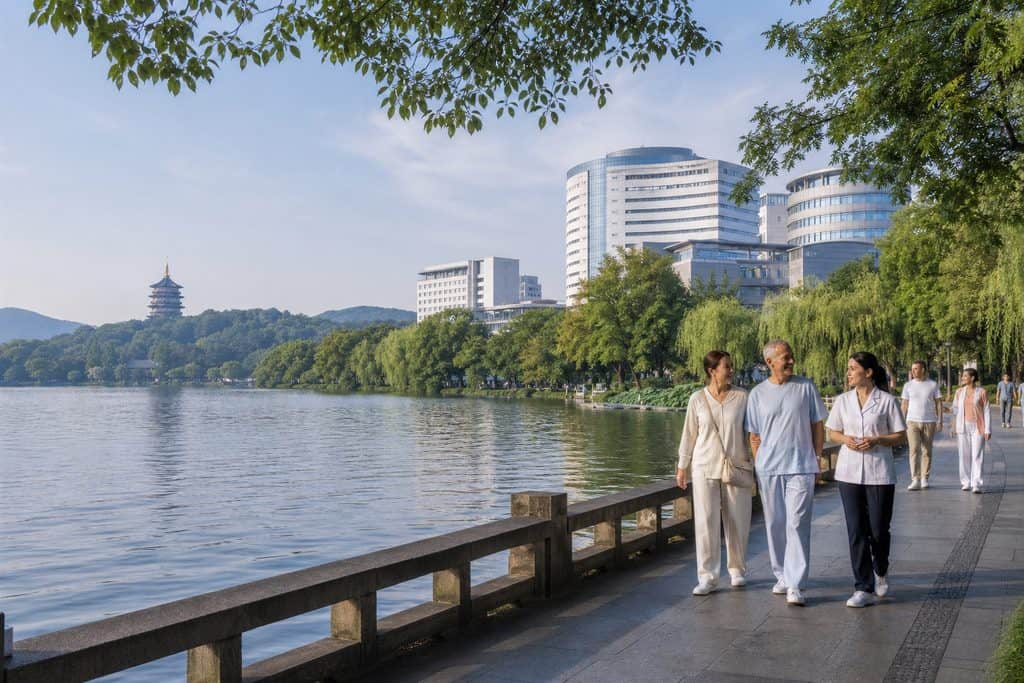
- The area around West Lake provides a measurable recovery advantage: lower ambient noise, superior air quality compared to other Chinese megacities, and a landscape intentionally designed for restorative walking—factors that impact surgical outcomes more than most patients realize.
The Problem: When the Best Care Is Half a World Away
A patient in Phoenix, Arizona, receives a quote for a robotic-assisted partial nephrectomy: $48,000. The same patient’s insurance covers 60%. The out-of-pocket exposure sits at $19,200—before the deductible resets. Multiply this across oncology, orthopedics, or cardiac surgery, and the math becomes punishing. In 2023, approximately 43% of American adults reported delaying medical care due to cost, according to a Kaiser Family Foundation survey. Delaying a tumor resection by six months is not a financial decision. It is a clinical gamble.
Wait times compound the issue. A Canadian patient needing a hip replacement faces a median wait of 26.4 weeks from specialist consultation to surgery, per the Fraser Institute’s 2023 report. During those six months, muscle atrophy sets in. Mobility degrades. The surgery, when it finally happens, is harder. Recovery is longer. The patient pays with their body for a queue they never chose to join.
This is the structural failure that drives Western patients to look beyond their borders. Not for bargain medicine. For timely, high-volume, evidence-backed care that doesn’t liquidate their savings. Hangzhou has quietly become one of the destinations they land on.
Who We Are
We are China Medical Services. We are not a hospital. We do not diagnose conditions, prescribe treatments, or make clinical recommendations. What we do is solve the logistical puzzle that stands between you and the care you need. Our team coordinates with 340+ top-ranked hospitals across 37 Chinese cities—institutions that represent the top 5% of China’s 35,000+ hospitals, ranked by the authoritative Fudan University hospital rankings and JCI accreditation. We handle hospital matching, appointment coordination through official international departments, bilingual medical companion services, and visa guidance. You focus on your health. We handle everything else.
Why Hangzhou and Zhejiang University Hospitals Deliver Results
Clinical Volume That Reshapes Surgical Outcomes
The First Affiliated Hospital of Zhejiang University School of Medicine records over 4.9 million outpatient visits and 200,000 inpatient discharges each year. These are not abstract statistics. A surgeon who performs 300 laparoscopic liver resections annually develops a tactile intuition that a surgeon performing 40 simply cannot match. The volume-outcome relationship is one of the most replicated findings in surgical literature. A 2017 study in the New England Journal of Medicine examining over 600,000 surgical patients found that hospitals in the highest volume quartile had a 22% lower risk-adjusted mortality rate for complex procedures compared to the lowest quartile. When you are researching the best hospital Hangzhou for international patients, you are essentially asking: where does the clinical repetition live? The answer, for a wide range of specialties, is the Zhejiang University hospital system.
Technology Deployed at Scale, Not as a Marketing Point
The Second Affiliated Hospital of Zhejiang University operates a da Vinci robotic surgery program that has been running for over a decade. But the real differentiator is not the robot itself—it is the integration. The hospital’s digital operating rooms stream real-time hemodynamic data, 3D imaging reconstructions, and intraoperative ultrasound into a single surgical field. This is not a pilot program. It is the standard workflow for complex oncology cases. For a patient considering medical tourism Hangzhou Zhejiang University hospital package options, this means walking into an environment where technology has been operationalized, not just purchased for a brochure photo. The learning curve was absorbed years ago. The teams are fluent in the tools.
Cost Structure: The Arithmetic That Changes Decisions
Let’s address the question patients actually type into search engines: how much does treatment cost at Zhejiang University hospital? The numbers require context. A cardiac bypass graft surgery at a top Zhejiang University-affiliated hospital ranges from $12,000 to $20,000 for international patients through the VIP/international department channel. The same procedure in the United States averages $120,000, and can exceed $200,000 at major academic medical centers. A total hip replacement: $8,000 to $15,000 in Hangzhou versus $40,000 to $65,000 in America. Robotic prostatectomy: $15,000 to $22,000 versus $55,000 to $80,000.
These are not discount prices for discount care. The Zhejiang University hospital medical treatment cost advantage is structural. China’s medical labor costs are lower, but so are administrative overheads. Hospitals are not carrying the billing complexity of a multi-payer insurance system. Device and pharmaceutical costs, while rising, remain below Western benchmarks. The result is a price delta that makes self-pay feasible for patients who would otherwise face medical debt or indefinite waiting. All prices vary by hospital and case complexity. The range is real. The order of magnitude difference is also real.
What You Need to Know Before Going Alone
We want to be direct about this. Walking into a Chinese public hospital as a foreign patient without preparation is a disorienting experience. The barriers are not insurmountable, but they are real.
- Visa Requirements: Medical treatment in China requires an S2 visa, annotated for medical purposes. Accompanying family members also apply for S2 visas. This is not a tourist visa. The application requires an invitation letter from the Chinese hospital—a document that public hospital outpatient departments do not routinely issue to unregistered patients. Without the right paperwork, you are stuck before you board the plane. M visas are for commercial trade. They do not apply here.
- Registration and Queuing Reality: Public hospital outpatient clinics operate on a same-day registration system. You arrive, you queue, you get a number, you wait. A top specialist may see 80 to 120 patients in a morning session. The consultation itself might last five minutes. If you do not speak Mandarin, you will miss critical instructions about which floor to visit for imaging, which building houses the lab, and when to return with results. This is not inhospitable. It is a system scaled for domestic patient volumes exceeding 10,000 visits per day at major centers.
- Payment and Insurance: Public hospitals require prepayment. You deposit funds at admission, and the hospital draws down against that balance. International insurance with direct billing arrangements is rare in the public system. Most patients pay out-of-pocket and seek reimbursement from their insurer afterward. The international departments and VIP clinics offer more flexible arrangements, but the prepayment model remains the norm.
How We Help You Navigate This
These barriers exist for structural reasons, not because anyone is trying to make things difficult. A hospital serving 5 million outpatient visits per year cannot redesign its entire intake process for a small fraction of international patients. What we do is route you through the channels that are built for this purpose.
Before you travel, we coordinate with the hospital’s official international department to secure an appointment slot—not a walk-in gamble, but a confirmed consultation with a senior specialist. We arrange the invitation letter required for your S2 visa application. We translate and format your medical records, imaging files, and pathology reports into the documentation Chinese specialists expect to see. This is case management, not a concierge shortcut. No one is buying access. We are using the hospital’s own international patient pathway, which exists precisely because these institutions are globally engaged research centers that routinely collaborate with overseas partners.
During your treatment, a bilingual medical companion accompanies you to every appointment. This person handles registration, payment queues, pharmacy runs, and real-time interpretation between you and your clinical team. You hear what the doctor says as the doctor says it—not a summarized version five minutes later. After discharge, if your treatment plan involves a recovery period in Hangzhou, we help arrange extended-stay accommodations near West Lake. Which brings us to a question that surprises many patients.
Is the West Lake Area Good for Surgery Recovery?
The short answer: yes, and for reasons that go beyond the view. The longer answer matters if you are genuinely evaluating a Hangzhou hospital recovery retreat near West Lake.
West Lake is not a decorative pond. It is a UNESCO World Heritage site surrounded by 12 square kilometers of maintained pathways, low-traffic pedestrian zones, tea plantations on the adjacent hills, and a deliberate absence of the high-rise density that defines most Chinese urban centers. For a post-surgical patient, this translates into something specific: graded, flat walking routes. A patient recovering from a knee replacement can walk 500 meters on a level stone path along Su Causeway, rest at a lakeside pavilion, and walk back. The next day, 700 meters. This is exactly the kind of progressive mobilization that orthopedic and cardiac rehabilitation protocols demand.
Air quality in Hangzhou’s lakeside district is measurably better than in the city’s commercial core, and significantly better than in heavy industrial cities further north. The tree canopy around the lake—willows, camphor, southern pines—acts as a particulate filter. For a thoracic surgery patient or anyone with compromised respiratory function during recovery, this is not romanticism. It is pulmonary reality.
There is also the psychological dimension that clinical research increasingly validates. A 2019 meta-analysis in Health & Place examining 143 studies found a consistent association between access to blue-green spaces—water and vegetation—and lower postoperative cortisol levels, reduced self-reported pain scores, and shorter hospital stays. Patients recovering near West Lake are not just enjoying scenery. They are in an environment that actively supports physiological recovery. Many patients researching is West Lake area good for surgery recovery are initially drawn by the aesthetics. They stay for the walking paths, the air, and the quiet. These are the variables that actually move the needle.
Frequently Asked Questions
Through the public outpatient system, no. Specialist assignments happen at registration. Through the international department channel that we coordinate with, you can request a senior specialist and receive confirmation of the appointment before travel. We cannot guarantee a specific named surgeon—no legitimate service can—but we can confirm that you will see an attending-level physician in the relevant specialty, not a junior resident. If we cannot secure the appointment, our coordination fee is fully refunded.
This is a fair concern. Chinese hospitals provide discharge summaries, operative notes, imaging on CD or cloud transfer, and pathology reports in English upon request through the international department. Your home-country physician receives a complete clinical record. We also facilitate post-operative video consultations with your Hangzhou surgical team if questions arise during recovery. The $300 to $500 cost of a written second opinion or $500 to $800 for a video consultation with a top specialist can be credited in full toward any future in-person coordination service within 90 days.
Our bilingual medical companions are present for all key interactions: admission, pre-operative consultation, the day of surgery, daily rounds, and discharge. They translate in real time. They also handle the non-clinical friction—pharmacy pickup, meal ordering, payment top-ups—so you are not stranded in a system where every sign is in Chinese characters. This is not a luxury. It is operational necessity for anyone who does not speak Mandarin.
Hangzhou has four distinct seasons. Summers are hot and humid—July and August temperatures regularly exceed 35°C (95°F). Winters are cold and damp, though snow is rare. The optimal recovery windows are March through June and September through November. During these months, lakeside temperatures are mild, humidity is moderate, and the walking paths are at their best. For patients considering a Hangzhou hospital recovery retreat near West Lake, we recommend timing elective procedures for spring or autumn whenever the clinical situation allows flexibility.
Your Next Step
Traveling to another country for surgery is a significant decision. The clinical capabilities at Zhejiang University’s hospitals are world-class. The cost advantage is structural and substantial. The recovery environment around West Lake offers something genuinely rare—a landscape that actively supports healing rather than merely surrounding it. But the logistical complexity of navigating a Chinese hospital system alone is not something to underestimate. We exist to remove that complexity. If you want to understand whether Hangzhou is the right fit for your specific situation, reach out. There is no cost for the initial consultation. No pressure. Just an honest assessment of what is possible.
Learn more about how we coordinate care at our patient services page, or explore our full database of top-ranked hospitals across China to compare options in other cities.
For more medical information and treatment options in China, visit chinamedservices.com (China Medical Services).
