How to Arrange ALS Care in China: Costs, Clinics, and a Clear Plan
How to Arrange ALS Care in China: Costs, Clinics, and a Clear Plan
What does ALS treatment cost in China, and can a foreign family actually arrange it from overseas? Those are the two questions we hear most often, usually within the same email. The short answer: yes, it can be arranged — but the path runs through hospital international departments, not the ordinary outpatient queue.
Amyotrophic lateral sclerosis is a progressive neurodegenerative disease with no cure. Nothing in this article should be read as a promise of reversal or stabilization. What China offers is access to high-volume neurology centers, multidisciplinary care teams, and a cost structure that is often a fraction of what families pay in the United States or Western Europe. For many households, that difference determines how many years of care they can afford.
Key Takeaways
- China’s top neurology departments sit inside large public hospitals — most of them ranked in the Fudan Hospital Rankings, which cover only the top 100 of the country’s 35,000+ hospitals.
- ALS care in China is typically multidisciplinary: neurology, respiratory support, nutrition, rehabilitation, and traditional Chinese medicine working in parallel rather than in sequence.
- The biggest practical barrier is not medicine — it is logistics. Ordinary public outpatient slots cannot be booked from abroad in advance, and hospital campuses are enormous.
- Foreign patients enter through international or VIP channels, which cost roughly 1.5 to 2 times the standard channel price but include English-speaking staff and pre-arranged appointments.
The Problem: A Diagnosis That Strains Every Family Budget
The neurology departments at hospitals like Peking Union Medical College Hospital, West China Hospital in Chengdu, and Huashan Hospital in Shanghai see patient volumes that would overwhelm most European clinics. A single tertiary neurology outpatient day can exceed 1,000 visits. That volume translates into pattern recognition. Clinicians who have evaluated thousands of motor neuron disease cases develop a diagnostic eye that lower-volume settings cannot replicate.
Electromyography (EMG) and nerve conduction studies — the core diagnostic tools for ALS — are performed at very high frequency. At top centers, an EMG suite may run dozens of studies per day. The technical proficiency of the neurophysiology staff reflects that repetition.
Multidisciplinary Care as the Default Model
Western guidelines, including those from the American Academy of Neurology and the European Federation of Neurological Societies, recommend multidisciplinary ALS clinics because they measurably extend survival and improve quality of life. China’s top hospitals have adopted the same structure.
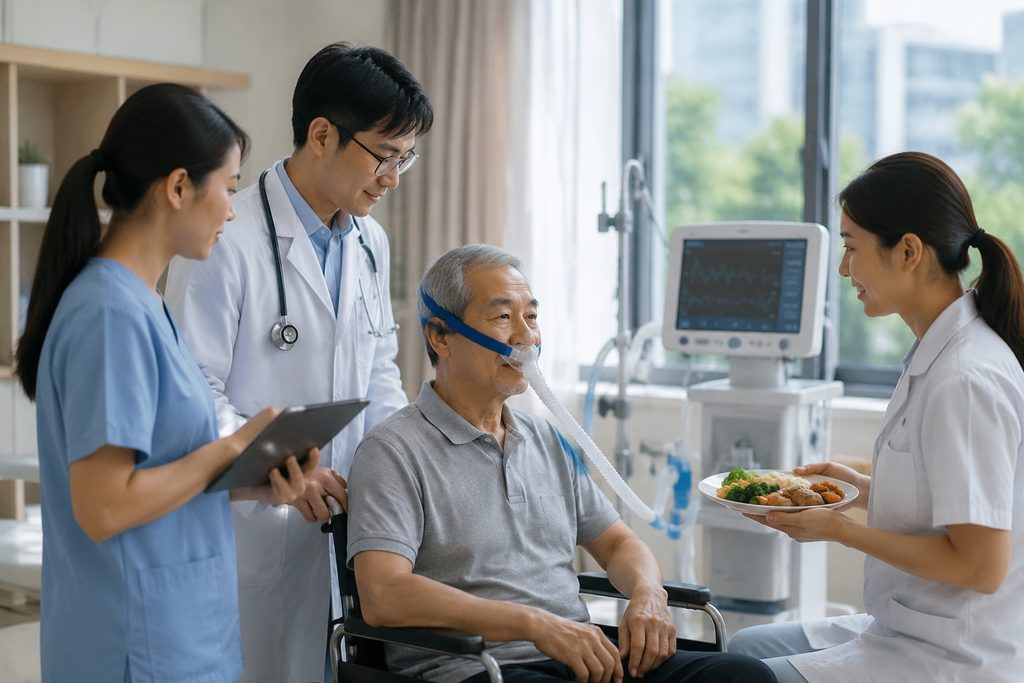
A typical ALS evaluation at a major Chinese center involves neurology, pulmonology for respiratory function assessment, gastroenterology or a nutrition team for feeding tube planning, rehabilitation medicine, and often a TCM department. These consultations happen within the same hospital, frequently within the same week. In many Western systems, the same set of appointments is spread across separate facilities over two to three months.
Cost Structure Without a Quality Penalty
Here is the objection we hear constantly: if it costs less, something must be worse. That logic fails in this specific case, and the reasons are structural.
Chinese physician salaries are lower than US or Western European equivalents. Hospital construction and equipment amortization costs are lower. Generic drug manufacturing is domestic and mature. Imaging — MRI, CT, EMG — is priced at a fraction of US rates, not because the machines are older, but because the pricing is administratively set rather than negotiated by insurers and providers.
None of this means outcomes are automatically superior. It means the same clinical work is delivered at a lower price point. A cardiac bypass at a top Chinese public hospital runs roughly $12,000 to $20,000, against $120,000+ in the US. ALS care follows a similar ratio for diagnostics, consultations, and supportive therapies.
What ALS Treatment Cost China Actually Looks Like
Prices below reflect the international or VIP channel at top-tier public hospitals. Standard-channel prices are lower but generally not accessible to non-Chinese-speaking patients without local assistance. All figures are in USD and vary by hospital and case complexity.
| Service | Estimated Cost in China (USD) | Typical US Cost (USD) |
|---|---|---|
| Initial neurology consultation (international dept.) | $150 – $400 | $400 – $900 |
| EMG / nerve conduction study | $200 – $500 | $1,200 – $3,000 |
| Brain and spinal MRI | $400 – $900 | $2,500 – $6,000 |
| Full diagnostic workup package | $1,500 – $3,500 | $8,000 – $20,000 |
| Respiratory function assessment | $100 – $300 | $500 – $1,500 |
| Inpatient bed, per day (international ward) | $300 – $800 | $3,000 – $8,000 |
| Riluzole, monthly supply | $150 – $400 | $1,000 – $3,000 |
Two caveats matter. First, ALS is not a surgical disease, so the cost conversation is about diagnostics, medication, respiratory support, and rehabilitation over time — not a single procedure. Second, Chinese public hospitals require prepayment; insurance reimbursement happens afterward, and many international policies will not cover treatment in China without prior authorization.
For families trying to compare options across conditions, our department-by-department rankings of China’s top hospitals give a clearer picture of where the country’s strengths actually lie.
Finding the Best ALS Clinic in China: What to Look For
China does not publish a dedicated ALS clinic ranking. The closest proxy is the Fudan Hospital Rankings, which assess specialty reputation across 45 disciplines. Neurology is one of them, and hospitals that rank in the top 10 for neurology are the realistic starting point.
Beyond rankings, four criteria separate a good fit from a poor one:
- An active motor neuron disease program. Some neurology departments are strong in stroke or epilepsy but see few ALS cases. Ask directly how many ALS patients the department follows.
- Respiratory support capability. Non-invasive ventilation is the single most impactful intervention for survival in ALS. The hospital must have pulmonology involved from the first visit, not referred out later.
- Nutrition and feeding tube access. Percutaneous endoscopic gastrostomy (PEG) placement should be available without a separate hospital admission.
- English-capable staff. This is where international departments matter. A brilliant neurologist who cannot communicate with you in English creates a safety problem, not just an inconvenience.
Beijing, Shanghai, and Guangzhou concentrate most of the strongest neurology programs. Our Fudan-ranked hospital directory by city lists the top-tier options in each.
Is ALS Treatment in China Safe? An Honest Assessment
For diagnostics, medication management, respiratory support, and rehabilitation, the safety profile at top-tier Chinese hospitals is comparable to Western academic centers. Sterile technique, imaging quality, and pharmaceutical standards at JCI-accredited institutions meet international benchmarks.
Where the risk lies is in the gray zone. Experimental stem cell injections marketed to ALS patients in China have a documented history of unregulated promotion, and the evidence base for them remains weak. The same is true in Mexico, Germany, and Thailand. Any clinic offering stem cell therapy for ALS as a standard paid service should trigger caution, regardless of country.
Legitimate care means a neurologist confirming the diagnosis, a multidisciplinary plan, and realistic conversations about disease trajectory. If a provider promises reversal, walk away.
How Long Does ALS Treatment Take in China?
ALS care is ongoing, not episodic. But the initial evaluation trip has a predictable shape:
- Days 1–2: Arrival, hospital registration, medical card creation, initial neurology consultation.
- Days 3–5: EMG, MRI, blood work, genetic testing if indicated, respiratory function testing.
- Days 5–7: Multidisciplinary review; treatment plan discussion; medication initiation.
- Days 7–10: Rehabilitation assessment, TCM consultation if desired, equipment and home-care planning.
A complete first evaluation typically takes one to two weeks. Follow-up can be handled remotely through video consultation for medication adjustments, with an in-person return every six to twelve months depending on disease progression.
Practical Considerations: Visas, Payment, and Follow-Up
Foreign patients coming to China for medical treatment should apply for an S2 visa with a medical treatment annotation. Stays exceeding 180 days require an S1 visa. Accompanying family members apply under the same S2 category. Note clearly: the M visa is for commercial and trade activities and has no role in medical travel. Requirements shift, so confirm current rules with the nearest Chinese embassy or consulate and secure supporting documentation from the treating hospital before applying.
On payment: public hospitals require prepayment, and international credit cards are accepted at international departments but not always at standard counters. Wire transfer in advance is the more reliable route. Private international hospitals such as United Family, Jiahui, and Parkway handle direct insurance billing with many international carriers.
For follow-up after returning home, request a written summary in English, imaging on disc or via secure link, and a contact pathway through the hospital’s international office. Continuity of riluzole or edaravone supply matters — arrange a supply plan before departure.
Frequently Asked Questions
Can I book ALS care in China before I arrive?
Not through the ordinary public outpatient system — those slots are issued on the day of visit and cannot be reserved from overseas. International departments and VIP channels do allow pre-arranged appointments, which is why most foreign patients use them. Coordination services can assist with registration and scheduling, though specific doctors and dates are never guaranteed.
Will my insurance cover ALS treatment in China?
It depends entirely on your policy. Some international plans reimburse treatment at Chinese hospitals, particularly JCI-accredited private facilities. Many do not, or require prior authorization. Call your insurer before booking anything. Public hospitals require upfront payment regardless of coverage.
What if the diagnosis turns out to be something else?
That happens more often than people expect. ALS mimics include multifocal motor neuropathy, spinal muscular atrophy, and Kennedy’s disease — some of which are treatable. A thorough workup at a high-volume center is valuable precisely because it can rule these out. A second opinion is not a sign of doubt; it is standard practice.
Is TCM worth adding to an ALS plan?
Acupuncture and herbal formulas do not alter ALS progression, and no credible evidence suggests otherwise. Some patients report improved symptom management, sleep quality, and appetite. If you want to explore it, our guide to traditional Chinese medicine hospitals covers what to expect. Treat it as supportive care, not treatment.
Your Next Step
Arranging ALS care in China is a logistics problem wrapped around a medical one — and the logistics are solvable. The medical questions deserve honest answers from a qualified neurologist, not from a website.
We are China Medical Services, a coordination team that connects international patients with 340+ top-ranked hospitals across 37 Chinese cities. We are not a hospital and we do not diagnose or treat anyone. What we do is help families understand their options, arrange written second opinions or video consultations with Chinese neurology departments, and handle the on-the-ground details if travel makes sense. A free initial consultation is the lowest-pressure way to find out whether China is the right fit for your situation.
This article is for informational purposes only and does not constitute medical advice. ALS diagnosis and treatment decisions should always be made in consultation with a qualified physician.
For more medical information and treatment options in China, visit chinamedservices.com (China Medical Services).
