Endoscopic Ultrasound in China: How It Works, Costs & Top Hospitals
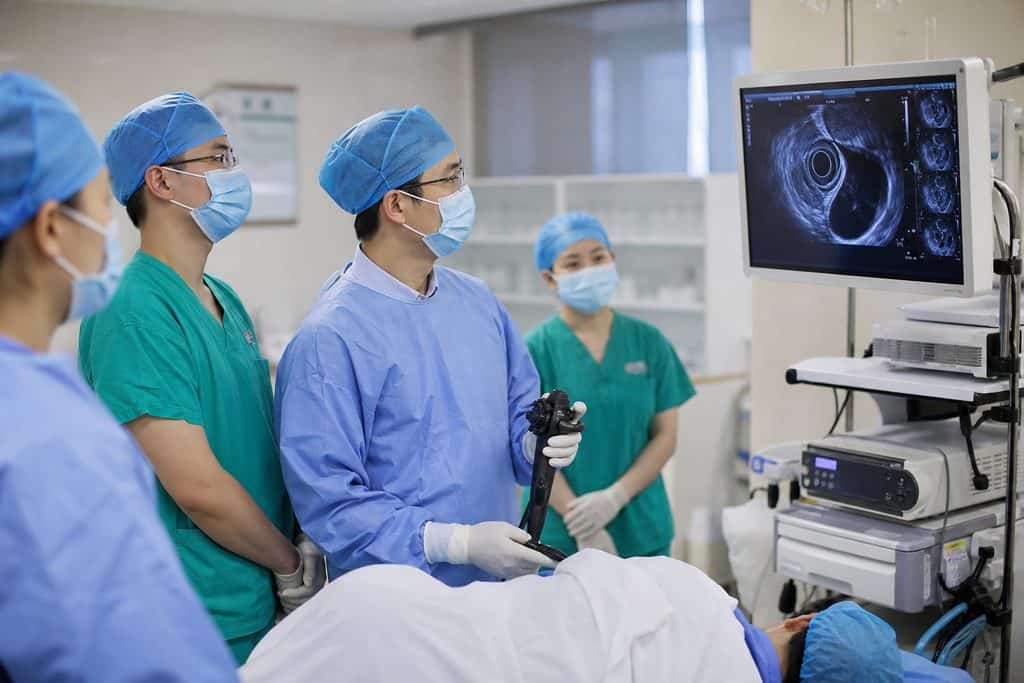
Endoscopic Ultrasound in China: How It Works, What It Costs, and How to Book It
An endoscopic ultrasound cost China hospitals quote often lands between $800 and $2,500 for the procedure itself — a fraction of the $5,000 to $12,000 a US hospital typically bills for the same diagnostic study. That gap is why searches for EUS in China have climbed steadily among international patients facing long queues, unclear pricing, or both. This guide explains how the procedure works, what it actually costs, and how to arrange one.
Key Takeaways
- EUS combines an endoscope with a high-frequency ultrasound probe, letting physicians image the pancreas, bile ducts, and lymph nodes from inside the body — often catching lesions CT and MRI miss.
- China’s highest-volume endoscopy centers perform thousands of EUS procedures annually, and several sit among Asia’s most experienced units for pancreaticobiliary work.
- The hard part is not the procedure. It is the logistics — public hospital outpatient slots generally cannot be reserved from abroad, and most top-tier hospitals run on Chinese-language workflows.
- Written second opinions and video consultations let you confirm whether EUS is even the right test before you book flights.
The Problem: A Diagnostic Test That Shouldn’t Be This Hard to Get
In Canada, the median wait from referral to a diagnostic endoscopy runs into weeks or months depending on province and urgency. In parts of the UK’s National Health Service, patients have waited beyond the six-week cancer diagnostic standard for upper GI investigations. For a suspected pancreatic mass, that delay matters enormously — pancreatic cancer five-year survival sits near 13% largely because most cases are found late.
EUS is one of the tools that changes that timeline. It can detect pancreatic lesions smaller than 1 centimeter, sample tissue through fine-needle aspiration, and stage tumors with accuracy that CT alone cannot match. Yet in many Western systems it is rationed. Specialized interventional endosonographers are scarce, machines are booked out, and non-urgent referrals get parked.
So patients start looking elsewhere. And China, with its enormous procedure volumes and far lower price points, shows up on the shortlist.
Why China Delivers Results for Endoscopic Ultrasound
The case rests on three structural facts, not marketing claims.
Clinical Volume Builds Operator Skill
EUS is an operator-dependent procedure. Accuracy improves with hands-on repetition — published gastroenterology literature consistently links higher annual case volumes to better lesion detection and lower complication rates. A handful of Chinese tertiary hospitals run endoscopy units that perform EUS daily, across pancreatic, biliary, mediastinal, and rectal indications. That is a different exposure level from a general hospital where the procedure happens twice a week.
For context on scale: Fuwai Hospital in Beijing performs more than 14,000 cardiac surgeries a year, the highest volume anywhere in the world. That same volume-driven model — concentrate complex cases in high-throughput centers — applies across Chinese tertiary medicine, including advanced endoscopy.
Technology and Workflow at Scale
Leading Chinese hospitals operate current-generation linear and radial echoendoscopes, with on-site cytopathology for rapid on-site evaluation (ROSE) during fine-needle aspiration. That matters. When a cytopathologist confirms adequate cellular material in the procedure room, the doctor can avoid a repeat puncture — or a repeat procedure entirely.
Scheduling is compressed compared with many Western systems. Where a US patient might wait weeks between consultation and the EUS slot, a coordinated Chinese hospital pathway can often complete assessment, procedure, and pathology review within a single trip. Not always. But frequently enough that it changes the calculus for someone paying out of pocket.
Cost Advantage Without a Quality Trade-Off
Lower prices in China do not come from cutting corners on the procedure itself. They come from labor economics, high patient throughput that spreads equipment costs across more cases, and a healthcare pricing structure set administratively rather than by insurer-negotiated rates. The endoscope, the ultrasound processor, and the needle are the same class of equipment you would see in a US or German endoscopy suite.
| Cost Component | China (top public hospital) | United States | United Kingdom (private) |
|---|---|---|---|
| Diagnostic EUS (no FNA) | $800 – $1,500 | $3,500 – $8,000 | £2,000 – £4,500 |
| EUS with fine-needle aspiration | $1,200 – $2,500 | $5,000 – $12,000 | £3,500 – £7,000 |
| Pre-procedure consultation | $50 – $200 | $300 – $600 | £200 – £400 |
| Sedation / anesthesia | $100 – $300 | $800 – $2,000 | £500 – £1,200 |
| Pathology review | $80 – $250 | $400 – $1,500 | £250 – £700 |
Figures are indicative ranges in USD and vary by hospital and case complexity. Private international departments in China charge roughly 1.5 to 2 times the standard public rate for English-language service and shorter waits.
How Does Endoscopic Ultrasound Work, Step by Step
Understanding the mechanics helps you ask better questions — and judge whether a quoted plan makes sense.
Preparation. You fast for six to eight hours. If the target is the lower GI tract, bowel prep is added. Blood thinners usually need to stop several days ahead, which the prescribing physician should confirm.
Sedation. Most EUS procedures use moderate sedation or, in some centers, deep sedation with an anesthesiologist present. The procedure itself typically runs 30 to 60 minutes; FNA adds 15 to 30 minutes.
The scope. A flexible tube passes through the mouth (upper EUS) or rectum (lower EUS). The tip carries both a camera and an ultrasound transducer. The doctor inflates a small water-filled balloon around the probe to improve acoustic contact with the tissue wall.
Imaging. The ultrasound beam sweeps outward, producing layered images of the esophagus, stomach, duodenum, pancreas, bile ducts, and surrounding lymph nodes. Because the probe sits millimeters from these structures, resolution is far higher than transabdominal ultrasound.
Sampling. If a suspicious node or mass appears, a thin needle passes through the scope channel and into the tissue under real-time ultrasound guidance. Cells go to pathology. Results typically return in two to five working days.
Recovery. Most patients go home the same day after one to two hours of observation. A sore throat and mild bloating are common. Serious complications — perforation, significant bleeding, pancreatitis after FNA — occur in roughly 0.1% to 1% of cases depending on the procedure type, consistent with international published rates.
Is Endoscopic Ultrasound Safe in China? Evaluating Providers and Reading the Numbers
Complication rates at high-volume Chinese centers fall within the same published international ranges — roughly 0.1% to 1% depending on procedure type. Safety tracks the individual operator’s experience and the hospital’s ability to manage complications, not the country. Ask about annual case volume and surgical backup before booking.
Yes, but the pathway matters. Public hospital general outpatient workflows are almost entirely Chinese-language and cannot typically be pre-booked from abroad. International or VIP departments, private international hospitals, and bilingual coordination services exist precisely to bridge that gap. Arriving without any language support at a hospital that sees 10,000-plus outpatients a day is genuinely difficult.
Be careful with the phrase “package.” Legitimate coordination covers logistics — appointment scheduling, interpretation, hospital navigation, and record handling — while hospital charges for the procedure, sedation, and pathology are billed separately by the institution. Any quote that conflates the two should be examined closely.
That is the scenario to plan for, not avoid. Ask in advance how the hospital handles a malignant finding — whether oncology, surgery, and pathology can convene quickly, and what the realistic timeline is for a treatment decision. Having that answer before the procedure is far better than improvising afterward.
Your Next Step
Endoscopic ultrasound is a precise, well-established tool, and China’s highest-volume centers deliver it at a fraction of Western prices — provided you sort out the logistics before you fly. The sensible sequence is to confirm the test is warranted, identify a unit with real EUS volume, and only then commit to travel.
China Medical Services is a coordination service, not a hospital and not a provider of diagnoses. We help international patients obtain written second opinions, arrange video consultations with Chinese specialty teams, and coordinate hospital appointments and bilingual accompaniment through official international departments. If you would like to understand your options before making any commitment, you can start with a free consultation — no pressure, no obligation.
This article is for general information only and does not constitute medical advice. Always consult a qualified physician about your individual condition and treatment options.
Frequently Asked Questions
Yes. The hospitals used for international patients are JCI-accredited and follow the same international safety standards as top hospitals in the US and Europe. Surgical teams perform high volumes of procedures — often more than their Western counterparts — which studies show leads to better outcomes.
Costs vary by procedure and hospital, but international patients typically save 40-80% compared to US prices — even when factoring in travel and accommodation. A consultation with our team will give you an exact, all-inclusive quote with no hidden fees.
Send us your existing medical reports to get started. We handle everything from hospital selection and appointment scheduling to visa assistance and post-operative recovery planning. Your medical records are reviewed by the specialist before you even book a flight.
For more medical information and treatment options in China, visit chinamedservices.com (China Medical Services).
