Gastroscopy in Dalian: Booking Guide for International Patients
Gastroscopy in Dalian: Booking Guide for International Patients
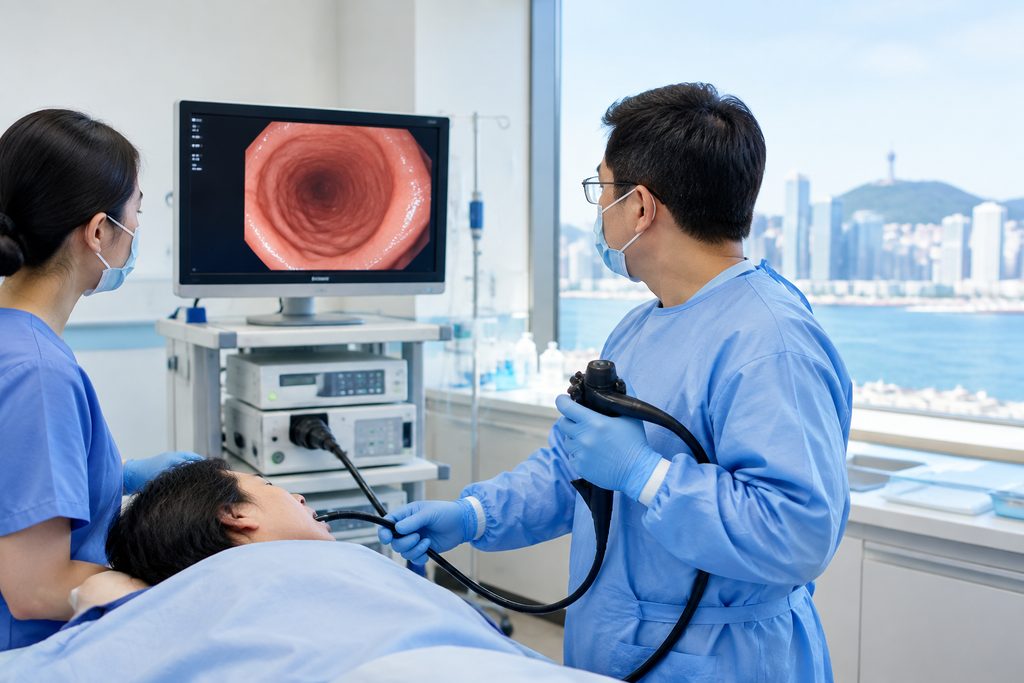
A gastroscopy — also called an upper endoscopy — is a short procedure where a thin, flexible tube with a camera slides down your throat to look directly at your esophagus, stomach, and the first part of your small intestine. That is the plain definition. Nothing about it requires a medical degree to understand. You are asleep or sedated, a doctor takes pictures, and often a tiny tissue sample, and you wake up roughly 15 to 30 minutes later. When international patients search for gastroscopy cost Dalian China, they usually want three numbers: what it costs, how long it takes, and whether a foreigner can actually get one booked without speaking Mandarin. This guide answers all three honestly.
One caveat up front, and it matters. Dalian is a major port city in Liaoning Province with solid public hospitals, but it is not Beijing or Shanghai. The range of English-speaking gastroenterology departments is narrower. That shapes everything below.
Gastroscopy Cost in Dalian China: The Short Answer
A standard diagnostic gastroscopy at a Dalian public tertiary hospital typically runs from about $150 to $400 USD, depending on whether sedation is used, whether biopsies are taken, and whether you go through the standard or VIP channel. A private international clinic in the city will quote higher — often $600 to $1,200 — for the same procedure with English-speaking staff and a quieter environment.
For comparison, the same procedure in the United States frequently lands between $1,500 and $3,500 before insurance, and in Western Europe between $800 and $2,000. That gap is the whole reason medical travel exists.
Key takeaway: The procedure itself is inexpensive in Dalian. What costs money and time is the coordination — booking, language, and navigating a hospital that may see thousands of outpatients in a single morning.
Who This Is Right For — and Who It Isn’t
Gastroscopy is one of the most common diagnostic procedures in the world. It is not exotic, and it is not risky for most people. But it is also not for everyone, and being honest about that is more useful than a sales pitch.
You are likely a good candidate if:
- You have persistent upper abdominal pain, difficulty swallowing, or unexplained nausea that has lasted more than a few weeks
- You need to rule out ulcers, H. pylori infection, celiac disease, or Barrett’s esophagus
- You are due for gastric cancer screening — relevant if you have a family history or come from a higher-incidence region
- You are already in China for work, study, or family reasons and want to handle a nagging symptom without flying home
You should probably not pursue this in Dalian if:
- You have severe heart or lung disease that makes sedation genuinely dangerous — this needs a cardiologist’s clearance first
- You are on blood thinners and cannot safely pause them
- Your symptom is acute and severe — vomiting blood, black stools, or sudden severe pain means go to the nearest emergency room, not a booking service
- You need a highly specialized therapeutic endoscopy (complex ESD, advanced ERCP) — those are better handled at a top-tier center in Beijing or Shanghai
If you fall into the last category, our team can help you look at options through the specialty rankings by department instead.
The Options, Compared
There is no single “gastroscopy in Dalian.” There are three realistic paths, and they differ sharply in price, comfort, and speed.
| Option | Typical Cost (USD) | English Support | Booking Lead Time | Best For |
|---|---|---|---|---|
| Public hospital, standard channel | $150 – $400 | Limited or none | Same-day to 3 days | Budget-conscious, Mandarin-speaking companion available |
| Public hospital, VIP / international department | $400 – $800 | Yes, usually | 3 – 10 days | Foreigners wanting English service without private prices |
| Private international clinic | $600 – $1,200 | Yes, full | 1 – 5 days | Insurance direct billing, Western-style comfort |
Which column suits you depends less on budget than on language. If you have a fluent Mandarin speaker who can sit with you through registration, the standard channel is entirely workable. If you do not, the VIP or private route is not a luxury — it is the practical choice.
How to Book Gastroscopy in Dalian for Foreigners
Here is the part most guides skip. In Chinese public hospitals, you generally cannot reserve a specialist outpatient slot from overseas in advance. Registration happens on the day, in person, and the queue starts early. This is a structural rule, not a policy aimed at foreigners.
The workaround is the hospital’s international or VIP department, which does allow advance coordination. That is the channel we use. The sequence looks like this:
- Send your records. Existing reports, prior endoscopy results, medication list, and a short note on your symptoms.
- Get a written second opinion or video consultation. A gastroenterologist reviews your file and confirms whether gastroscopy is actually the right next step — sometimes it is not.
- We coordinate the appointment. Registration, hospital card creation, and the specific department slot.
- You attend with a bilingual companion. Someone handles the queue, the payment window, the pharmacy, and the translation.
- Results and follow-up. Biopsy results usually take 3 to 7 working days. We help route them back to you and, if needed, to your doctor at home.
For a broader picture of how this fits into a full trip, see our guide to medical treatment in China.
Is Gastroscopy Safe in China?
Yes, for the overwhelming majority of patients. Endoscopy is a mature, standardized procedure worldwide, and Chinese tertiary hospitals perform enormous volumes of them. High volume, in this case, works in your favor — the endoscopists in major public hospitals do this daily.
The genuine risks are the same ones you would face anywhere: mild sedation reactions, minor throat discomfort, and in rare cases bleeding or perforation. Published complication rates for diagnostic upper endoscopy sit well below 1 percent in the general population. That is not zero, and anyone who tells you otherwise is selling something.
What is different in China is the environment, not the medicine. Hospitals are large, busy, and largely Mandarin-speaking. The equipment is modern. The consent forms may not be in English. That is a logistics problem, and it is solvable.
Practical tip: Ask specifically whether the hospital uses sedation. Many Chinese public hospitals offer “painless gastroscopy” (无痛胃镜) with propofol sedation, but it is not always the default. If you want sedation, say so at booking, not on the day.
What It Costs and What Drives the Variance
The spread between $150 and $1,200 is not arbitrary. Four factors move the number:
- Sedation. Adds roughly $50 to $150 and requires an anesthesiologist.
- Biopsies and lab work. Each tissue sample sent for pathology adds cost. H. pylori testing adds a little more.
- Channel. The VIP or international department runs roughly 1.5 to 2 times the standard price. You are paying for English service and shorter waits.
- Pre-procedure screening. Blood tests, ECG, and sometimes a chest X-ray are required before sedation. These are separate line items.
What is usually not included in a quoted price: interpretation of results by a specialist, follow-up consultation, medication, and any treatment that follows an abnormal finding. Ask for a written breakdown before you commit. Prices vary by hospital and case complexity, and no honest provider will quote you a flat number without seeing your file.
Practical Considerations for a Dalian Gastroscopy Trip
Visa. For medical treatment in China, the applicable short-stay category is the S2 visa, which covers medical treatment and private affairs. Accompanying family members apply under the same category. Requirements shift, so confirm current rules with the nearest Chinese embassy or consulate and bring your hospital’s supporting documents. Note that the M visa is for commercial and trade activity — it is not a medical visa, and using it for treatment is a mistake.
Records. Bring printed copies of everything, plus digital files. Chinese hospitals often want paper. If your reports are in English, a translated summary speeds things up considerably.
Payment. Public hospitals require prepayment; you settle up front and claim reimbursement from your insurer afterward. Private international clinics frequently bill insurance directly. International credit cards work at larger hospitals but not always at smaller payment windows — carry some cash as backup.
Language. Assume no English unless you have confirmed it in writing. This is the single most common source of stress for foreign patients, and it is the reason bilingual accompaniment exists.
After you go home. Get your endoscopy report and pathology slides or a digital copy before you leave the hospital. Chasing documents from another continent is slow and expensive.
Frequently Asked Questions
Not directly at a standard public hospital outpatient clinic — those slots are issued on the day, in person. Advance coordination is possible through a hospital’s international or VIP department. That is the route we use, and it typically needs 3 to 10 days of lead time.
For a straightforward diagnostic gastroscopy with sedation and one or two biopsies at a public hospital VIP department, budget roughly $500 to $900 USD all-in, including pre-procedure screening. Private clinics run higher. Final pricing depends on the hospital and your specific case.
That is exactly why the procedure is worth doing. If a biopsy comes back abnormal, the next step is a treatment plan — and that conversation should involve a specialist who has seen your full file. We can help route your results to the right department, but we do not diagnose or recommend treatment ourselves. Those decisions belong to your doctors, in China or at home.
Yes. Hospitals will not discharge a sedated patient alone. If you are traveling without a companion, this is a strong argument for a bilingual medical companion service — someone who can sit with you through recovery and get you back to your hotel safely.
Your Next Step
Dalian is a workable city for a gastroscopy if your case is straightforward and you plan the logistics rather than improvising them. The procedure is safe, the price is a fraction of Western costs, and the main friction is language and booking, not medicine.
We are China Medical Services — a coordination team, not a hospital. We do not diagnose, we do not treat, and we do not promise that any specific doctor or date will be available. What we do is match your case to the right department, handle the appointment coordination through official hospital channels, and put a bilingual companion beside you on the day. If you are weighing a gastroscopy in Dalian, the sensible first move is a conversation, not a booking. Start with a free consultation and we will tell you honestly whether this is worth doing here or somewhere else.
This article is for general information only and is not medical advice. Gastroscopy carries real, if small, risks, and suitability depends on your individual health. Consult a qualified physician before making any decision about diagnosis or treatment.
For more medical information and treatment options in China, visit chinamedservices.com (China Medical Services).
