CT Scan in China: With or Without Contrast — What to Expect
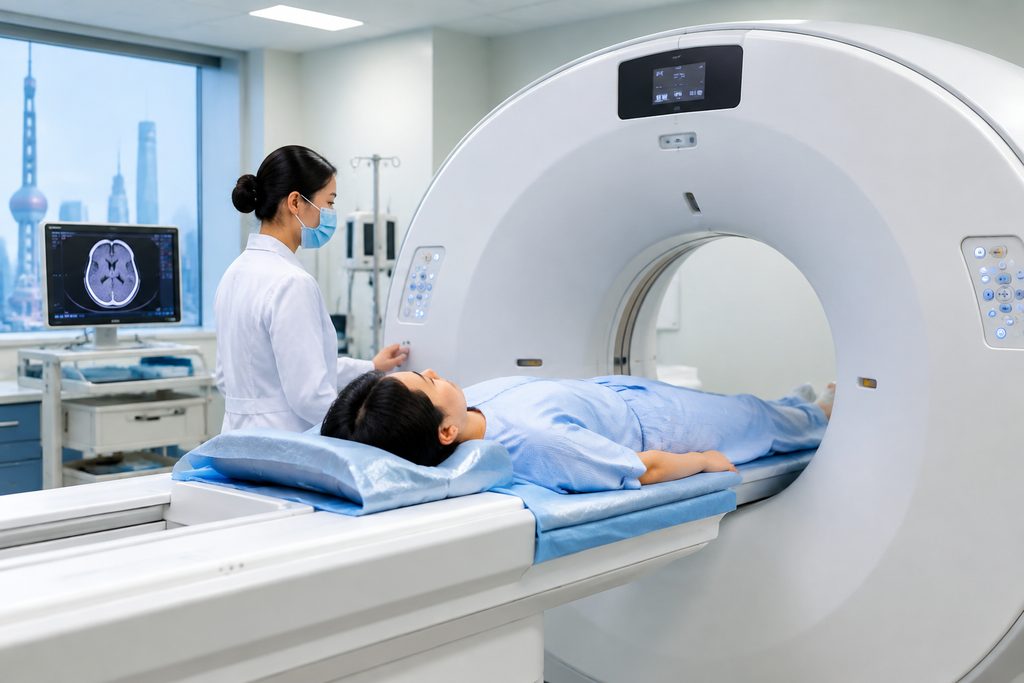
You’ve been handed a requisition slip with two checkboxes — one says “with contrast,” the other says “without” — and nobody has explained the difference. For an international patient trying to arrange imaging in China, that single checkbox shapes your prep, your timeline, and your bill.
Here’s the short answer. A CT scan without contrast uses X-rays alone and needs no injection. A CT scan with contrast adds an iodine-based dye, usually through an IV, so blood vessels, organs, and tumors show up far more clearly. Whether you need the dye depends entirely on what your doctor is looking for — not on which option is cheaper or faster. And yes, the ct scan with contrast cost China patients pay is often a fraction of what the same study runs in the US or Europe, but the price difference between the two versions is smaller than most people assume.
How This Actually Works, Step by Step
Say you’re in the US, the UK, or the Gulf, and your physician wants a contrast-enhanced CT of the abdomen or chest. You’ve decided to look at China, either because of cost, wait times, or because you want a second read from a high-volume center. Here’s the real sequence.
Step one — you send records. You email your existing reports: prior imaging, lab work, the doctor’s note explaining what they suspect. Our team translates the key documents into Chinese and routes them to the relevant specialty at a partner hospital.
Step two — a specialist reviews and answers a specific question. Is contrast actually indicated? Does your kidney function allow it? Do you have a documented allergy to iodinated dye? This is where a radiologist or the treating specialist decides which version of the scan you need. You can’t self-select this, and neither can we.
Step three — scheduling. Once the protocol is confirmed, we coordinate an appointment through the hospital’s international department or VIP channel. You get a date range, a prep sheet, and a clear list of what to bring.
Step four — the scan itself. You arrive, register, get your creatinine checked if required, and the technologist runs the study. Non-contrast takes roughly 10 to 15 minutes. Contrast adds a few minutes for the injection and a short observation window afterward.
Step five — results and handoff. Reports typically come back within 24 to 72 hours at major hospitals. We arrange translation and, if you want, a video consultation with the specialist who ordered the scan.
CT Scan Without Contrast vs With Contrast: What’s the Real Difference?
The technical distinction matters more than most patients realize.
A non-contrast CT is essentially a density map. Bone shows white, air shows black, and soft tissue falls somewhere in between. It’s excellent for detecting kidney stones, acute bleeding in the brain, fractures, and lung nodules. It’s fast, requires no needle, and carries no dye-related risk.
Contrast changes the picture entirely. Iodine absorbs X-rays, so any tissue with rich blood supply — tumors, inflamed tissue, arteries, the liver, the pancreas — lights up differently from its surroundings. That’s why contrast is standard for staging cancer, evaluating the aorta, investigating unexplained abdominal pain, and mapping blood vessels before surgery.
So how do you know which one applies to you? The honest answer: ask the doctor who ordered it. The question “do i need contrast for ct scan” has no universal answer, because it depends on the clinical question. A scan looking for a kidney stone doesn’t need dye. A scan looking for a pancreatic mass almost always does.
| Feature | Without Contrast | With Contrast |
|---|---|---|
| Injection required | No | Yes (usually IV) |
| Typical scan time | 10–15 minutes | 15–25 minutes |
| Best for | Stones, fractures, bleeding, lung screening | Tumors, vessels, infection, organ detail |
| Kidney function check | Not routine | Usually required (creatinine/eGFR) |
| Allergy risk | None from dye | Low but real; premedication possible |
| Relative cost | Lower | Higher by roughly 20–60% |
One caveat worth stating plainly: the cost gap between the two versions is much smaller than the gap between China and Western pricing overall. If a doctor says contrast is indicated, skipping it to save a modest amount usually means repeating the study later — which costs more in the end.
Is CT Scan With Contrast Safe in China?
This is the question international patients ask most, and it deserves a direct answer.
Iodinated contrast has been used globally for decades. The modern agents used at China’s major hospitals are the same non-ionic, low-osmolar products you’d encounter in a US or German radiology department — GE, Bayer, Bracco, and Guerbet supply much of the market. The safety profile is comparable because the products are comparable.
The real variable isn’t the dye. It’s the screening around it.
Before any contrast study, a competent facility checks kidney function, asks about prior reactions, and reviews medications — particularly metformin, which sometimes needs to be paused. At top-tier hospitals, this is standard. At small clinics, it may be rushed. That’s one reason we route international patients toward facilities with established international departments rather than whatever imaging center is closest.
So when someone asks is ct scan with contrast safe in China, the accurate answer is: the contrast itself is as safe as anywhere, provided the pre-scan screening is done properly. Ask about kidney function testing before you agree to the injection. Any hospital worth using will answer that question without hesitation.
A Realistic Timeline
Patients consistently underestimate how long the administrative steps take. Here’s a grounded view, assuming you’re arranging this from abroad.
| Stage | Typical Duration | What’s Happening |
|---|---|---|
| Records collection and translation | 2–5 days | Gathering imaging, labs, referral notes; translation into Chinese |
| Specialist review / written second opinion | 3–7 days | Confirming whether contrast is indicated; flagging contraindications |
| Appointment coordination | 3–10 days | Booking through the international or VIP channel |
| Visa (S2, if traveling) | 1–3 weeks | Application with hospital supporting documents |
| Travel and scan | 2–4 days on the ground | Arrival, registration, creatinine check, scan, brief observation |
| Report and translation | 1–3 days | Radiology report issued and translated |
| Follow-up consultation | Same week or remote | Reviewing findings with the specialist |
Total: roughly three to six weeks from first contact to a translated report in hand, if you’re traveling. If you’re already in China, the scan itself can often happen within days.
What Can Go Wrong — and What Happens Then
Nobody enjoys this section, but it’s the one that actually protects you.
The contrast turns out to be contraindicated. Your creatinine comes back elevated, or you mention a reaction you’d forgotten. The radiologist cancels the contrast portion and runs the study without it, then recommends bloodwork or an alternative like MRI. You’ve lost a day, not your safety.
You booked the wrong version. This happens when patients self-refer without a clear clinical question. The scan gets done, the images don’t answer the question, and a repeat study is needed. The fix is upstream: get the protocol confirmed in writing before you book.
The appointment isn’t available when you need it. Major hospitals in Beijing and Shanghai run enormous daily volumes. Peak demand can push a slot out by a week or more. We tell patients this upfront rather than promising a date we can’t control.
Language breaks down at the desk. Registration, consent forms, and prep instructions are in Chinese. This is the single most common friction point for foreign patients, and it’s exactly why bilingual accompaniment exists.
The report needs interpretation. A radiology report is not a diagnosis. You still need a clinician to put it in context. Plan for that step rather than assuming the scan ends the process.
What It Costs, and How to Read the Numbers
Pricing varies by hospital tier, city, and whether you’re using the standard or international channel. The figures below are reference ranges, not quotes — final pricing depends on the hospital and the complexity of your case.
| Setting | Non-Contrast CT | Contrast CT |
|---|---|---|
| Public tertiary hospital, standard channel | Roughly $80–200 | Roughly $150–400 |
| Public hospital international / VIP channel | Roughly $200–450 | Roughly $350–800 |
| Private international hospital | Roughly $400–900 | Roughly $700–1,500 |
| United States (for comparison) | Often $1,000–3,000+ | Often $1,500–5,000+ |
Two things drive the spread. The first is which channel you use — the international department at a public hospital charges roughly 1.5 to 2 times the standard rate, and in exchange you get English-speaking staff and shorter queues. The second is the hospital’s tier and city. A ct scan price Beijing international hospital quote will typically sit above a comparable study in a second-tier city, simply because demand and overhead are higher.
If you want to book ct scan Shanghai hospital services, expect similar logic: the top-ranked facilities cost more than mid-tier ones, and the international channel costs more than the standard queue. For a full picture of which hospitals sit where, the ranked hospital directory by city is a reasonable starting point.
One note on payment. Public hospitals generally require prepayment, with insurance reimbursed afterward. Many private international hospitals bill insurers directly. Check which applies to your policy before you book — this affects your out-of-pocket timing more than the sticker price does.
Practical Considerations: Records, Visa, and Follow-Up
Bring your prior imaging on disc, not just the reports. Radiologists comparing a new scan against an old one catch things that a standalone read misses. DICOM files, not screenshots.
Visa category matters. For medical travel to China, the applicable short-stay category is S2, used for medical treatment and private affairs, subject to the latest embassy or consulate requirements and supporting hospital documents. Accompanying family members apply under the same category. Note that the M visa is for commercial and trade activities and has nothing to do with medical treatment. If your stay will exceed 180 days, S1 applies instead. Approval is never guaranteed — plan your timeline accordingly.
Insurance. Most Western policies reimburse international care after the fact rather than paying upfront. Get an itemized receipt and a translated report before you leave the hospital.
Follow-up at home. Your physician back home will want the images and the report, ideally in English. Request both before departure. Chasing records across time zones afterward is far more painful than asking at the desk.
Language. Consent forms, prep instructions, and registration are in Chinese at nearly every public facility. If you don’t read Chinese, arrange interpretation in advance rather than hoping someone at the desk speaks English.
Frequently Asked Questions
Only your ordering physician can answer that, because it depends on the clinical question. Contrast is typically needed to evaluate tumors, blood vessels, and organ inflammation. It’s usually unnecessary for kidney stones, bone fractures, or lung screening. Ask the doctor who wrote the requisition.
You can arrange the appointment remotely, and we can coordinate registration and scheduling through a hospital’s international department. What we cannot do is guarantee a specific date or a specific specialist. Availability depends on the hospital’s schedule, and if we can’t secure the appointment, coordination fees are refunded in full.
Largely yes. Major Chinese hospitals use the same non-ionic, low-osmolar agents supplied by the same global manufacturers. The dye isn’t the variable — the quality of pre-scan screening is. Confirm that kidney function testing happens before your injection.
At major hospitals, reports typically issue within 24 to 72 hours. Translation adds a day or two. If you need a specialist to interpret the findings, schedule that consultation in advance rather than assuming it happens automatically.
Mild reactions — flushing, a warm sensation, nausea — are relatively common and usually pass quickly. Serious reactions are rare but require immediate attention, which is why contrast studies are performed where resuscitation equipment and trained staff are on hand. Disclose any prior reaction during screening.
Your Next Step
The choice between contrast and non-contrast isn’t a preference — it’s a clinical decision that should be made before you book anything. Get that question answered first, then handle logistics.
China Medical Services helps international patients navigate this process: written second opinions from Chinese specialists, appointment coordination through hospital international departments, bilingual medical companions, and visa guidance. We’re not a hospital and we don’t practice medicine. We don’t promise admission, priority access, or outcomes — we coordinate, translate, and accompany.
If you’d like a straight answer on whether your scan needs contrast and what it would cost at a specific hospital, start with a free consultation. No pressure, no obligation — just a clearer picture before you decide anything.
This article is for general information only and does not constitute medical advice. Always consult a qualified physician about your individual situation before undergoing any imaging study or treatment.
For more medical information and treatment options in China, visit chinamedservices.com (China Medical Services).
