Gastroscopy in China: Sedated or Awake? Costs, Safety & Booking
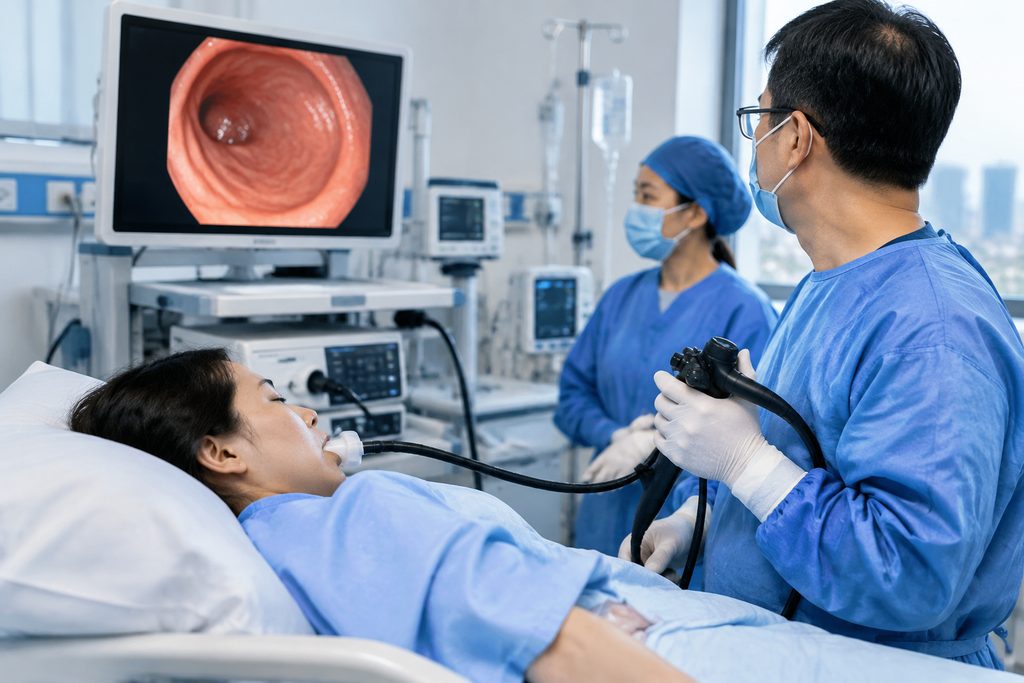
Gastroscopy in China: Sedated or Awake — Costs, Safety, and How to Book
Roughly 1 in 3 adults worldwide now undergoes some form of upper endoscopy in their lifetime, and demand keeps climbing as stomach and esophageal cancer screening expands. If you are weighing a gastroscopy cost China quote against prices at home, you have probably hit the same wall most international patients do: the numbers look dramatically lower, but the process is opaque. Who does the scope? Do you get sedation? Can a foreigner even book this from abroad?
Let’s answer the question in your search bar directly. Chinese hospitals offer both awake (unsedated) and sedated gastroscopy, and the sedated version is the default at most top-tier facilities for international patients. The choice is not made for you — it is a conversation between you and the endoscopist, based on your tolerance, your medical history, and what the exam needs to find.
What follows is what our team has learned coordinating this exact procedure for patients from the US, Europe, the Middle East, and Southeast Asia. No sales pitch. Just the mechanics.
Awake vs Sedated Endoscopy in China: What’s the Actual Difference?
The unsedated route is faster and cheaper. You stay fully conscious, the scope goes down your throat, and you manage the gag reflex yourself. Most Chinese public hospitals can complete an awake gastroscopy in 5 to 10 minutes of scope time, though the appointment itself eats a half-day with registration, waiting, and recovery observation.
Sedated gastroscopy — usually with propofol or midazolam — puts you in a light sleep for the duration. You wake up in the recovery area with no memory of the tube. The procedure itself still takes only 10 to 20 minutes, but you need monitoring before and after, so budget 2 to 3 hours at the hospital.
Here’s the part people don’t expect: in China, sedation for gastroscopy is typically administered by an anesthesiologist, not the gastroenterologist alone. That’s a staffing cost, and it’s why the sedated option runs noticeably higher. But it also means a dedicated clinician is watching your airway and vitals the whole time.
What a Gastroscopy Costs in China — and Why the Range Is So Wide
When patients ask us for a gastroscopy cost China figure, the honest answer is a range, because it depends on hospital tier, city, sedation choice, and whether biopsies or polyp removal happen during the same session.
| Setting | Awake (unsedated) | Sedated |
|---|---|---|
| Public tertiary hospital, standard channel | $80 – $150 | $200 – $350 |
| Public hospital international / VIP department | $250 – $400 | $450 – $800 |
| Private international hospital | $500 – $800 | $900 – $1,500 |
Those figures cover the scope, sedation where applicable, and standard reporting. Biopsy pathology, if taken, adds roughly $30 to $100 depending on the number of samples. Prices vary by hospital and case complexity, so treat any single number you see online — including ours — as a starting point, not a quote.
For context, the same sedated gastroscopy in a US hospital commonly bills between $1,500 and $3,500 before insurance. That gap is the whole reason this search exists.
If you want to see how specific hospitals in different cities compare on pricing and international services, our directory of top-ranked Chinese hospitals by city is a reasonable place to start narrowing down.
How This Actually Works, Step by Step
Most international patients assume they can simply pick a hospital, pick a date, and show up. That is not how Chinese public hospitals operate, and misunderstanding this is where trips fall apart.
Here is the real sequence:
- You send your existing records. Prior endoscopy reports, imaging, bloodwork, medication list, and a short note on your symptoms and goals. If you have no prior records, that’s fine — the symptoms note matters more.
- A gastroenterology team reviews them remotely. This can be a written second opinion or a video consultation, depending on how much back-and-forth you need. The team tells you whether a gastroscopy is even the right next step, and whether sedation is advisable given your history.
- Appointment coordination begins. For public hospitals, a standard outpatient gastroscopy slot is generally booked through the hospital’s international or VIP department if you want it locked in before you fly. Walk-in registration on the day is possible but unpredictable.
- You arrive and complete pre-procedure checks. Fasting requirements (typically 6 to 8 hours with no food), a brief anesthesia assessment if sedated, and payment. Public hospitals require prepayment; private international hospitals often bill insurance directly.
- The procedure happens. Awake or sedated, as agreed.
- Results and next steps. Preliminary findings are usually explained the same day. Biopsy results take 3 to 7 working days, and can be sent to you digitally if you’ve already returned home.
One rule that surprises people: at most public hospitals, you cannot book a procedure like this from overseas without going through the international department. The general outpatient queue is same-day registration only. This is a structural feature of the system, not a barrier aimed at foreigners.
A Realistic Timeline
Here’s what a typical schedule looks like for someone flying in specifically for this. Ranges reflect real variability — some hospitals move faster, some slower.
| Stage | Typical Duration |
|---|---|
| Records review and written opinion | 3 – 7 days |
| Video consultation (if requested) | Scheduled within 1 – 2 weeks |
| Appointment coordination with hospital | 1 – 3 weeks |
| S2 visa application (if needed) | 1 – 3 weeks, varies by consulate |
| Travel and arrival | 1 – 2 days |
| Pre-procedure prep and the gastroscopy itself | Same day or next day |
| Biopsy results (if taken) | 3 – 7 working days |
Total from first email to scope: roughly 3 to 8 weeks if you’re starting from scratch. If you already have a diagnosis and just need the procedure repeated, it can compress to 2 weeks. Don’t forget visa processing — that’s the step people underestimate most.
What Can Go Wrong — and What Happens Then
We’d rather you hear the failure modes now than discover them at the airport.
The appointment isn’t confirmed when you think it is. Some hospitals give verbal indications that feel like bookings but aren’t. If you’ve paid a coordination fee and the appointment doesn’t materialize as promised, a reputable coordinator refunds it in full. Ask about this policy before you pay anyone.
Sedation is declined on the day. This happens when the anesthesia assessment flags a concern — sleep apnea, certain cardiac conditions, medication interactions. The procedure can usually still go ahead awake, but you should know this is possible and not a bait-and-switch.
The scope finds something that needs immediate attention. A bleeding ulcer, a suspicious lesion, a stricture. In that case the gastroenterologist will discuss next steps, which may mean staying longer than planned. Travel insurance that covers medical extension is worth the small premium.
Biopsy results arrive after you’ve flown home. This is common and manageable. Results can be translated and sent digitally, and a follow-up video consultation can walk you through them. It’s inconvenient, not catastrophic.
Language breaks down at a critical moment. Consent forms, prep instructions, and post-procedure advice are the three places this bites hardest. This is where bilingual support earns its keep — not as a luxury, but as a safety layer.
Is Gastroscopy Safe in China? Evaluating Quality and Providers
China performs an enormous volume of endoscopies annually across its 35,000-plus hospitals, and the top tier — the roughly 340 hospitals that sit in the top 5% nationally by Fudan and JCI rankings — operates at a technical standard comparable to major Western academic centers. High procedure volume tends to correlate with operator skill, and Chinese gastroenterology departments see volume in abundance.
But “safe in China” is the wrong frame. The right question is: safe at which hospital, with which team, under what monitoring?
Three things to check before committing:
- Does the hospital have a dedicated international or VIP department with English-speaking staff? This affects both communication and how your appointment gets scheduled.
- Is sedation administered by an anesthesiologist or a nurse under supervision? The former is standard at top-tier hospitals.
- What is the scope reprocessing protocol? Any accredited hospital will follow national disinfection standards, but it’s fair to ask.
For a deeper look at how departments are ranked by specialty, our specialty rankings by department page breaks down which hospitals lead in gastroenterology and related fields.
Practical Considerations: Records, Payment, and Follow-Up
Bring your records in English if you can, but don’t stress if they aren’t translated — hospitals with international departments handle translation, and coordinators routinely do it as part of case management. What matters more is completeness: prior reports, current medications, allergies, and any cardiac or respiratory history relevant to sedation.
Payment at public hospitals is prepaid, with insurance reimbursement handled afterward on your side. Private international hospitals in cities like Beijing and Shanghai frequently offer direct billing with major international insurers. If you’re comparing the two, our guide to private international hospitals covers the JCI-accredited options and how their billing works.
Follow-up is the piece patients forget to plan. If a biopsy is taken, you need a channel for those results to reach you and a clinician who can interpret them in your language. Arrange this before you leave the hospital, not after.
If you want to book a gastroscopy appointment in Beijing, Shanghai, or any of the 37 cities we cover, the practical path is almost always through the hospital’s international department — or through a coordinator who works with it directly.
Frequently Asked Questions
The scope itself usually runs 10 to 20 minutes. With pre-procedure preparation and recovery monitoring, plan on 2 to 3 hours at the hospital. You should not drive or make important decisions for the rest of the day, and someone should accompany you home.
Yes, but generally only through a hospital’s international or VIP department. Standard outpatient gastroscopy at public hospitals is same-day registration and cannot be reserved from overseas. If you need a confirmed date before flying, the international channel is the realistic route.
At top-tier and international hospitals, yes, sedation is routinely available and typically adds $150 to $500 depending on the facility. At smaller public hospitals it may not be offered. Availability is not guaranteed for every patient — the anesthesia assessment has the final say.
At a public hospital international department, expect roughly $250 to $400 for awake and $450 to $800 for sedated. Private international hospitals in Shanghai run higher, from about $500 up to $1,500. Final pricing varies by hospital and case complexity.
At hospitals with international departments, preliminary findings are usually explained in English the same day. Biopsy results take longer and may need translation. A bilingual companion or a follow-up video consultation closes that gap if you’ve already left the country.
Your Next Step
The short version: sedated gastroscopy in China is widely available, safe at accredited hospitals, and costs a fraction of Western pricing — but booking it from abroad requires going through the right channel, and sedation is a clinical decision, not a menu option.
We are China Medical Services. Our team coordinates written second opinions, video consultations, appointment scheduling, and bilingual medical companionship across 340+ top-ranked hospitals in 37 cities. We are not doctors, and we don’t diagnose or promise outcomes — we handle the logistics, translation, and hospital communication so your clinical team can focus on the medicine.
If you’d like to understand your options before committing to anything, start with a free consultation. No pressure, no obligation — just a clear picture of what’s possible.
This article is for general information only and is not medical advice. Decisions about sedation, endoscopy, and treatment should be made with a qualified physician who can review your individual history.
For more medical information and treatment options in China, visit chinamedservices.com (China Medical Services).
