Colonoscopy in China: Sedated or Awake — What Foreigners Should Expect
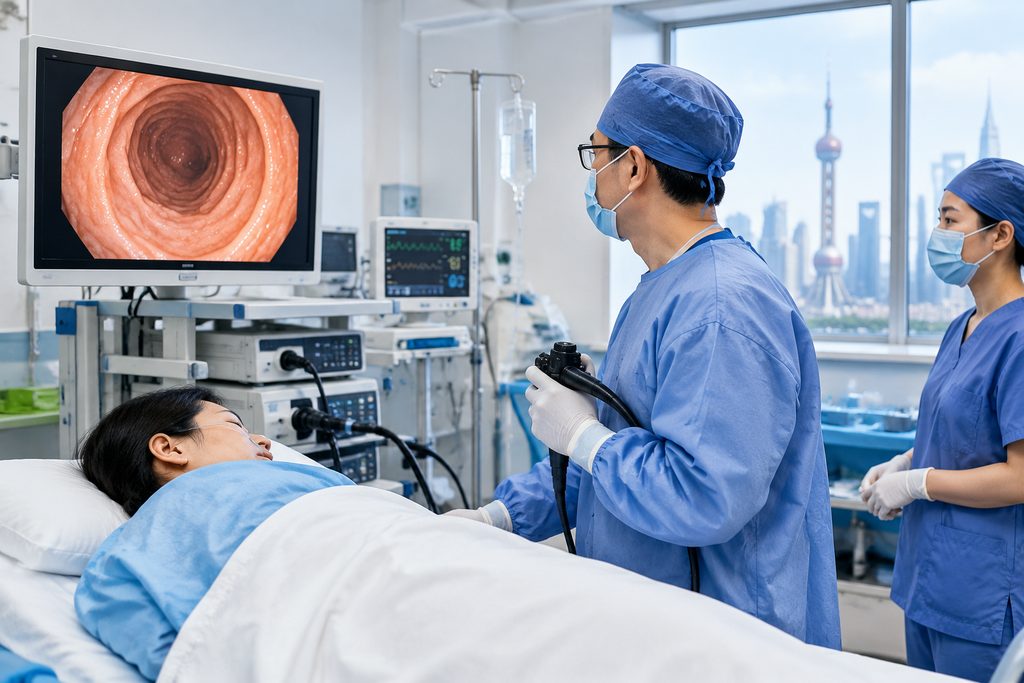
When 54-year-old David from Oregon received his first positive FIT kit result back home, his gastroenterologist quoted him a four-month wait for a screening colonoscopy and an estimated $3,200 bill after insurance. A colleague mentioned that he’d had the same procedure done in Shanghai during a business trip, sedated, for a fraction of the price. David started searching that night — and hit a wall of confusing information about whether Chinese hospitals even offer sedation, whether the equipment is safe, and how a foreigner without Mandarin could possibly book anything.
That confusion is common. So here is the short answer: yes, sedated colonoscopy is widely available at major Chinese hospitals, including at the international departments that serve foreign patients. And yes, you can be asleep for it. The bigger questions — safety, cost, and how to actually arrange it — deserve more than a one-line answer.
Colonoscopy in China: The Short Answer
Most large public hospitals in China, and nearly all private international hospitals, offer colonoscopy under sedation — usually propofol-based, administered by an anesthesiologist. You are not expected to “tough it out.” Awake (unsedated) colonoscopy exists and is cheaper, but it is increasingly the exception rather than the default at top-tier facilities.
The catch is access, not availability. Chinese public hospitals generally do not accept overseas bookings for routine outpatient procedures. You show up, register on the day, and see a doctor in person before anything gets scheduled. That single rule shapes everything about how a foreigner arranges a colonoscopy here.
Who This Is Right For — and Who It Isn’t
A colonoscopy in China tends to make sense for a specific kind of traveler. It is not the right move for everyone.
Good candidates:
- You are already in China, or can combine the trip with work, family, or a longer stay in Asia.
- You need a screening or diagnostic colonoscopy and face a long wait or high out-of-pocket cost at home.
- You want it done under sedation and are willing to pay for an international department or private hospital where English is spoken.
- You have a referral question — a polyp found elsewhere, a family history, unexplained bleeding — and want a second look quickly.
Who should think twice:
- Anyone with active, unstable cardiac or respiratory disease. Sedation carries real risk, and travel adds stress. Get cleared by your own physician first.
- Patients on blood thinners who cannot safely pause them without supervision.
- Someone who cannot travel for medical or personal reasons. A local colonoscopy, even with a wait, may be the safer path.
- Anyone expecting a same-week appointment at a famous public hospital without going through the international channel. That is not how the system works.
The Options, Compared
Here is how the realistic choices stack up. Prices are in USD and vary by hospital and case complexity.
| Option | Typical Cost | Sedation | Wait Time | Language |
|---|---|---|---|---|
| US hospital, insured | $1,500–$3,500 out-of-pocket | Yes, standard | 2 weeks–4 months | English |
| China public hospital, standard channel | $150–$400 | Often yes, sometimes awake | Days to weeks | Mandarin only |
| China public hospital, international/VIP department | $500–$1,200 | Yes, standard | Days to 2 weeks | English-speaking staff |
| Private international hospital (JCI-accredited) | $800–$2,000 | Yes, standard | Often within days | English, insurance billing |
Which column fits you? If budget is the priority and you have some Mandarin or a companion, the standard public channel is remarkably cheap. If you want English, predictable scheduling, and direct insurance billing, the private international hospital is the smoother experience. The international department of a top public hospital sits in between — real specialists, English service, prices roughly 1.5 to 2 times the standard channel.
Sedated vs. Awake: What Actually Happens in the Room
This is the part most articles skip. In a sedated colonoscopy at a Chinese hospital, you lie on your left side, an IV is placed, and an anesthesiologist — not the gastroenterologist — administers propofol. You drift off within a minute. The procedure itself takes 15 to 30 minutes. You wake up in a recovery area, usually within half an hour, groggy but oriented.
An awake colonoscopy is a different experience. You feel pressure and cramping as the scope navigates the bends of the colon. It is tolerable for many people and faster to recover from, since there is no anesthesia hangover. But it is uncomfortable, and discomfort can make the exam harder to complete thoroughly — which matters, because the whole point is finding polyps that might otherwise be missed.
One practical note: in China, sedation often requires a companion to escort you home. If you are traveling alone, arrange a companion in advance. This is one of the small logistics our team handles routinely.
Is Colonoscopy in China Safe?
This is the question that stops most people. The honest answer: at major hospitals, the safety profile is comparable to Western standards — with caveats.
China’s top-tier hospitals perform enormous volumes of endoscopy. A large tertiary center may run hundreds of colonoscopies a week. High volume, when paired with proper training and equipment, correlates with skill. The endoscopes at major centers are the same Olympus and Fujifilm systems used in the US and Europe. Sterilization protocols follow national standards, and international departments are typically JCI-accredited or hold equivalent certifications.
Where the risk creeps in is at smaller, lower-tier facilities, or when a foreigner books through an informal channel with no English-speaking staff and no clear understanding of what was agreed. The variable is not the country. It is the specific hospital and the specific arrangement.
If you want to compare specific institutions, our directory of Fudan-ranked hospitals by city groups the top-tier public hospitals that international patients most commonly use.
What It Costs and What Drives the Variance
Colonoscopy cost in China ranges from roughly $150 at a standard public hospital to $2,000 at a private international facility. The spread is wide because the service is not the same service.
At the low end, you are paying for the procedure and the doctor’s time in a system built for volume, with Mandarin-only communication and same-day registration. At the high end, you are paying for an English-speaking care team, a scheduled appointment, a private room, and direct insurance billing.
What is usually included: the procedure, sedation, the endoscopist’s fee, and a basic report. What may cost extra: pathology on removed polyps, additional lab work, and follow-up consultation. Ask for an itemized estimate before you commit.
For context on how this compares to other procedures, our overview of medical treatment in China for international patients covers the broader cost landscape.
Practical Considerations: Booking, Visas, and Records
The logistics trip people up more than the medicine. Here is what actually matters.
Records. Bring your prior colonoscopy reports, pathology results, and any relevant imaging. Chinese specialists work from documents. Without them, you may repeat tests you already had.
Visa. For a short medical trip, the applicable category is the S2 visa, used for medical treatment and private affairs, subject to the latest embassy or consulate requirements and supporting hospital documents. Family members accompanying you apply under the same category. Note that the M visa is for commercial and trade activities — it is not a medical visa, despite what some outdated guides claim. If your stay exceeds 180 days, S1 applies instead. Always confirm current requirements with the relevant Chinese embassy or consulate before applying.
Booking. Public hospitals generally do not accept overseas appointments for standard outpatient care. To lock in a scheduled colonoscopy before you fly, you need the international or VIP department, or a private hospital. That is the channel that produces a confirmed date.
Payment. Public hospitals require prepayment; you claim reimbursement from your insurer afterward. Private international hospitals often bill your insurance directly.
Follow-up. Get your report and any pathology results in English before you leave. If polyps were removed, you will need surveillance timing, and your home physician will want the documentation.
If you are weighing where to go, our guides to Shanghai and Beijing list the hospitals most used by international patients in each city.
Frequently Asked Questions
Only through an international department or a private hospital. Standard public hospital outpatient care requires in-person registration on the day. If you want a confirmed date before you fly, plan around the international channel — and expect to pay more for it.
At international departments and private hospitals, sedation is standard and you can request it. At standard public hospitals, sedation is common but not universal, and availability varies by facility. Confirm this specifically when you book — do not assume.
At major hospitals, yes, the safety profile is comparable to Western centers. The risks come from booking through unclear channels at lower-tier facilities without English support. Choose a top-tier hospital or a JCI-accredited private hospital, and bring your records.
Complications from colonoscopy — perforation, bleeding after polyp removal — are rare but real, occurring in a small fraction of procedures. Top Chinese hospitals are equipped to manage them. Before you book, ask what the hospital’s protocol is for complications and whether your travel insurance covers medical care in China. Do not travel for a procedure without that coverage in place.
Roughly one-tenth to one-fifth, depending on the channel. A standard public hospital procedure may run $150 to $400, an international department $500 to $1,200, and a private hospital $800 to $2,000. US out-of-pocket costs commonly land between $1,500 and $3,500 even with insurance.
Your Next Step
The core message is simple: sedated colonoscopy is available and safe at China’s top hospitals, and the cost can be a fraction of what you would pay at home — but arranging it as a foreigner requires knowing which channel to use. That is the gap we exist to close. We are not a hospital and we do not diagnose or treat anyone; we connect international patients with the right Chinese facilities and handle the logistics that make the trip work. If you want to understand your options before committing to anything, start with a free consultation and we will walk you through what is realistic for your situation.
For more medical information and treatment options in China, visit chinamedservices.com (China Medical Services).
