Mediastinal Tumor Surgery in China: Navigating Complex Care for Rare Germ Cell Tumors at Shanghai Chest Hospital
Key Takeaways
- Shanghai Chest Hospital performs over 1,000 mediastinal surgeries annually, making it one of the highest-volume centers globally for these complex procedures.
- For international patients, the total mediastinal tumor surgery cost at Shanghai Chest Hospital typically ranges from $18,000 to $35,000, a fraction of Western pricing without compromising clinical standards.
- Rare mediastinal germ cell tumors require a multidisciplinary team familiar with their unique pathology—expertise that is concentrated in a handful of centers worldwide.
- Navigating China’s hospital system independently is genuinely difficult; language, payment systems, and visa requirements form a barrier that requires professional logistical support, not just medical advice.
The Problem: A Rare Diagnosis Meets a Fragmented System
What happens when you are diagnosed with a tumor so uncommon that your local thoracic surgeon sees perhaps two cases in a career? Primary mediastinal germ cell tumors account for roughly 10% to 15% of all mediastinal masses in adults. That is already a narrow slice. The subset of malignant, nonseminomatous germ cell tumors is rarer still. You are suddenly dealing with a disease that sits at the intersection of thoracic surgery, oncology, and pathology—and the clock is ticking.
The wait for a surgical slot at a major Western cancer center can stretch into weeks or months. The cost, if you are paying out of pocket or facing a high deductible, can exceed $100,000. And during that wait, the tumor can invade surrounding structures: the pericardium, the great vessels, the trachea. Time is not just money. Time is resectability. We have spoken to patients who were told their tumor was inoperable after a three-month delay, not because of biology, but because of scheduling. That is a failure of logistics, not medicine.
Who We Are
We are China Medical Services. We are not a hospital. We do not offer clinical diagnoses or perform surgery. Our team acts as your logistical architects—we bridge the gap between you and the specific surgical expertise you need at China’s top-tier hospitals. We handle the coordination that makes treatment abroad possible: hospital matching based on real surgical volume data, appointment scheduling through official international channels, bilingual medical companion support, and visa guidance. We work for you, not for any single hospital.
Why Shanghai Chest Hospital Delivers Results for Complex Mediastinal Tumors
Surgical Volume That Shapes Expertise
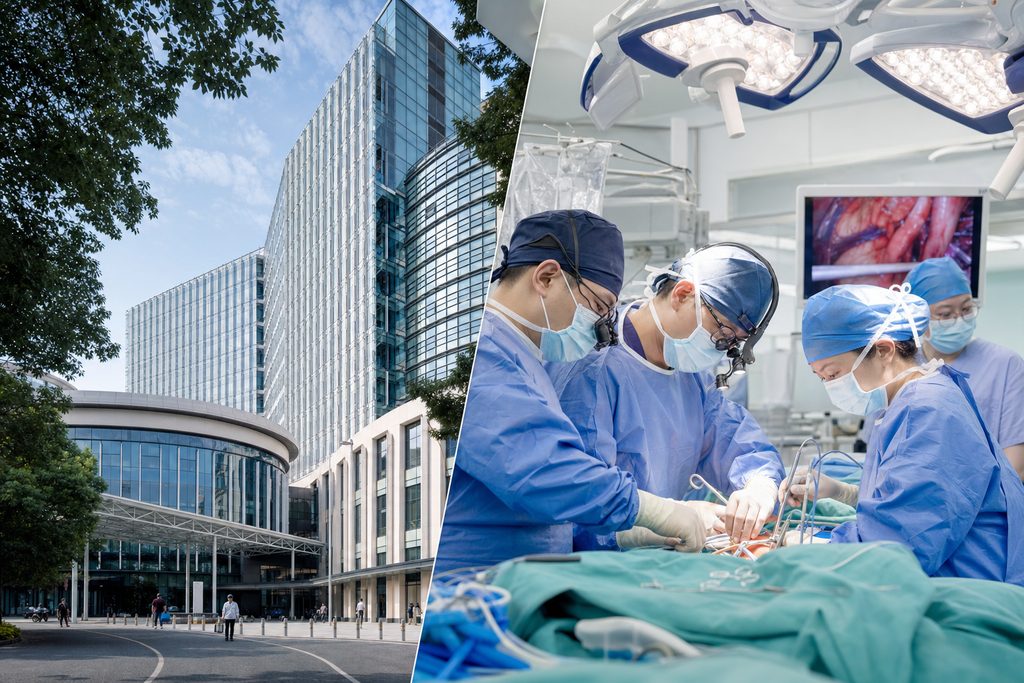
Shanghai Chest Hospital is not a general hospital that happens to have a thoracic department. It is a specialized thoracic center. The hospital performs more than 1,000 mediastinal surgeries each year. To put that number in perspective, many reputable US teaching hospitals log between 50 and 150 mediastinal procedures annually. Volume matters. Studies published in the Journal of Thoracic Oncology have demonstrated a clear relationship between hospital surgical volume and postoperative mortality for complex thoracic procedures. When a surgical team sees rare germ cell tumor presentations not once a year but multiple times a month, their intraoperative decision-making is fundamentally different. They recognize anatomical variants faster. They anticipate complications earlier. That is not a matter of individual talent. It is a function of institutional experience.
For a rare mediastinal germ cell tumor, this volume advantage is amplified. These tumors often require en bloc resection of adjacent structures—pericardium, lung parenchyma, sometimes segments of the superior vena cava. A team that has done this hundreds of times approaches the case with a catalog of intraoperative strategies that a lower-volume center simply cannot accumulate.
Technology and Multidisciplinary Integration at Scale
The hospital’s thoracic oncology program operates through a tightly integrated multidisciplinary team structure. Before a scalpel ever touches skin, your case is reviewed by thoracic surgeons, medical oncologists, radiation oncologists, and pathologists together. For germ cell tumors, this is particularly critical. The chemotherapy regimen before and after surgery, the timing of resection, the decision between primary surgery versus delayed resection after neoadjuvant chemotherapy—these are not decisions made in isolation. They require synchronous input.
Shanghai Chest Hospital also employs robotic-assisted thoracoscopic surgery platforms and advanced intraoperative monitoring that are standard in top Western centers. The technology itself is comparable. What differs is the workflow efficiency. The hospital’s dedicated international patient center coordinates imaging, lab work, and specialist consultations on a compressed timeline because the system is designed for volume. A full preoperative workup that might take three weeks spread across different outpatient clinics in another system can often be completed in three to five days here.
Cost Advantage Without Quality Compromise
Let us address the obvious objection directly. Lower cost does not imply lower quality. The structural reasons for the price difference are well documented. Labor costs for highly skilled surgical teams, nursing staff, and hospital operations are lower in China than in the United States or Western Europe. Hospital administrative overhead is leaner. And the sheer volume of procedures allows for economies of scale in equipment utilization and supply chain management.
The mediastinal tumor surgery cost at Shanghai Chest Hospital for an international patient—including preoperative imaging, the surgical procedure, anesthesia, hospital stay, and postoperative pathology—typically ranges from $18,000 to $35,000. That compares to $80,000 to $150,000 or more at major US hospitals for equivalent complex thoracic oncology procedures. These are real, verified ranges based on cases we have coordinated. They vary by tumor complexity, length of stay, and whether neoadjuvant chemotherapy is administered in China or in your home country. But the order of magnitude difference is consistent.
What You Need to Know Before Going Alone
The clinical expertise exists. Accessing it independently is another matter entirely. We want to be completely transparent about the barriers.
- Visa Requirements Are Specific and Unforgiving: Medical treatment in China requires an S2 visa with a notation specifying the purpose of treatment. You cannot enter on a tourist visa and then present for surgery. The hospital will not admit you for a planned procedure without proper documentation. The application requires an invitation letter from the hospital, proof of financial means, and a detailed treatment plan. A single missing document can reset the process by weeks.
- Payment Systems Do Not Work the Way You Expect: Chinese public hospitals, including their international departments, operate on a prepayment model. You deposit funds before admission, and the hospital draws down against that balance. International credit cards are not universally accepted at hospital cashier counters. Wire transfers can take days to clear. WeChat Pay and Alipay dominate the domestic payment ecosystem, and linking a foreign bank card to these platforms often fails without a Chinese bank account. The payment rail between your home bank and a Chinese hospital is not a smooth one.
- Medical Records and Language Barriers Compound Quickly: Your pathology slides, imaging on CD-ROMs, and clinical summaries need certified translation into Chinese before a surgical team can fully evaluate your case. The vocabulary is technical. A general translator will not suffice. Misinterpret a pathology report detail, and the surgical plan changes. This is not a task for Google Translate or a well-meaning bilingual friend.
How We Help You Navigate This
These barriers exist for structural reasons, not because the system is designed to exclude international patients. They are solvable with the right logistical support. Our process is built around three phases.
Before you travel, we secure the official invitation letter from Shanghai Chest Hospital’s international department. We coordinate the translation of your complete medical dossier by translators experienced in thoracic oncology terminology. We confirm that the surgical team has reviewed your case and that a preliminary treatment window is reserved. We guide you through the S2 visa application with the exact documentation package the consulate expects.
During your stay, a bilingual medical companion accompanies you to every appointment. This person handles registration, payment queues, and real-time interpretation with the surgical team. You are never left standing at a hospital counter trying to explain your situation in a language you do not speak. The companion also manages the practical logistics: where to get preoperative lab work done efficiently, how to navigate the inpatient admission process, and what to expect during postoperative recovery on the ward.
After discharge, we coordinate follow-up imaging, pathology review, and communication with your home-country oncologist. The goal is a seamless handoff so that your ongoing surveillance or adjuvant chemotherapy continues without gaps in information.
Frequently Asked Questions
Safety is a function of institutional volume, surgeon experience, and perioperative care infrastructure. Shanghai Chest Hospital’s thoracic surgery department operates at a scale that generates statistically robust safety data. Their postoperative mortality rates for mediastinal procedures are comparable to major Western thoracic centers, in the range of 1% to 3% depending on tumor complexity and patient comorbidities. The hospital is accredited by the Chinese Ministry of Health and participates in international quality registries. The surgical teams routinely publish outcomes data in peer-reviewed English-language journals. That said, any mediastinal surgery carries real risks—hemorrhage, infection, injury to the phrenic or recurrent laryngeal nerves. No center eliminates these risks. A high-volume center reduces them.
For international patients, the all-inclusive surgical cost typically falls between $18,000 and $35,000. This covers the surgeon’s fee, anesthesiology, operating room charges, hospital stay, and standard postoperative pathology. It does not include preoperative chemotherapy if needed, which adds $8,000 to $15,000 per cycle depending on the regimen. It also does not include our coordination service fees, which are quoted separately based on case complexity. The final figure depends entirely on the tumor’s relationship to surrounding structures and whether the resection is straightforward or requires vascular reconstruction. We provide a detailed estimate after the surgical team reviews your imaging and clinical history.
No. This is a hard rule in China’s public hospital system. The surgeon must conduct an in-person consultation and physical examination before scheduling surgery. You cannot secure a surgical date remotely. What you can do—and what we facilitate—is a compressed timeline: fly to Shanghai, complete the consultation and preoperative workup within a few days, and proceed to surgery shortly thereafter. The international department can reserve a provisional window, but the final scheduling decision rests with the surgeon after meeting you face-to-face.
“Best” is a loaded word. What we can say with evidence is that Shanghai Chest Hospital is among the highest-volume thoracic surgery centers in the world, with a dedicated mediastinal tumor program that sees a concentration of rare germ cell tumor cases unmatched by general oncology centers. The multidisciplinary team structure means your case is discussed by the relevant specialists simultaneously, not sequentially. The pathology department has deep experience with the immunohistochemical staining patterns specific to germ cell tumors—a diagnostic nuance that directly affects chemotherapy and surgical decisions. For a disease as uncommon as this, you want a center where your case is not an outlier but part of a recognized clinical pathway.
We structure comprehensive coordination packages that cover logistics, not a bundled “product” that includes treatment. The distinction matters. Our VIP End-to-End Coordination service handles hospital matching, visa documentation, airport transfer, bilingual companion support, and all appointment scheduling. The hospital’s treatment costs are separate and paid directly to the hospital. This keeps the clinical and logistical relationships clean. You are paying us to navigate the system efficiently and safely. You are paying the hospital for surgery. Any coordination fees you pay to us are credited in full toward on-the-ground services if you proceed with treatment within 90 days of an initial video consultation.
Your Next Step
A rare mediastinal germ cell tumor diagnosis forces hard decisions under pressure. The clinical resources exist to treat it effectively, but accessing them across borders requires more than a plane ticket and a hospital name. Shanghai Chest Hospital’s surgical volume and multidisciplinary infrastructure offer a genuine option for patients facing long waits or prohibitive costs at home. The path to getting there is navigable with the right support. If you want to understand whether this is a viable path for your specific case, reach out to our team. We will review your situation honestly and tell you what we can and cannot do. No pressure. Just clarity.
For more medical information and treatment options in China, visit chinamedservices.com (China Medical Services).
