Jiangsu TCM Hospital for Foreigners: Acupuncture Rehab & Herbal Therapy Costs
Key Takeaways
- Acupuncture rehabilitation at a top Chinese TCM hospital typically costs 80–150 USD per session—a fraction of Western prices for comparable or more intensive protocols.
- Jiangsu Province TCM Hospital operates a dedicated international outpatient department with English-speaking coordinators, eliminating the language barrier that stops most foreigners.
- Herbal therapy is not a supplement—it is a regulated, prescription-based medical intervention. Raw herbs, granules, and patent medicines follow completely different safety and customs rules.
- Stroke recovery patients must understand: TCM is an adjunct to conventional neuro-rehabilitation, not a replacement. The evidence for acupuncture in spasticity reduction is strong; the evidence for herbal monotherapy in acute stroke is not.
The Problem: When Western Rehab Hits a Wall
Roughly 795,000 people in the United States suffer a stroke each year. Of those who survive, nearly half will live with lasting motor deficits. Standard outpatient physical therapy in the US—when insurance covers it—often caps at 20 to 30 sessions annually. Wait times for a neurology follow-up stretch into months in public systems like the UK’s NHS, where 4.3 million people sat on neurology waiting lists in 2023.
Chronic pain patients face a parallel dead end. The CDC estimates 51.6 million Americans live with chronic pain. Opioids carry well-documented risks. Repeat corticosteroid injections degrade tissue over time. Surgery is invasive and irreversible.
Patients start searching for something else. They find acupuncture and herbal medicine. But they quickly hit three walls: inconsistent practitioner training outside East Asia, costs that run $100–$200 per session with no insurance coverage, and protocols that are often too gentle—once a week for 20 minutes—to shift entrenched neurological or musculoskeletal patterns.
The question becomes practical. Where can you access hospital-grade Traditional Chinese Medicine, delivered at therapeutic intensity, by clinicians who treat hundreds of cases like yours every year, at a cost that makes a full treatment course feasible?
Who We Are
We are not a hospital. We do not provide medical treatment, issue prescriptions, or make clinical diagnoses. We are your logistical architects—a bilingual team that bridges the gap between you and China’s top-tier medical institutions. We handle hospital matching, appointment coordination, visa guidance, and on-the-ground bilingual medical companion services. Our database covers 340+ top-ranked hospitals across 37 Chinese cities. We know which TCM hospital runs a dedicated international stroke rehab protocol, and which one does not. That distinction matters.
Why Jiangsu Province TCM Hospital Delivers What You Are Actually Looking For
Jiangsu Province Hospital of Chinese Medicine (Jiangsu Province TCM Hospital) sits in Nanjing. It is not a small clinic with a single acupuncturist. It is a Grade-A tertiary hospital—the highest classification in China’s hospital system—with over 2,500 beds and an annual outpatient volume exceeding 5 million visits. Its acupuncture rehabilitation department handles neurological sequelae, musculoskeletal disorders, and chronic pain at a scale that creates genuine clinical depth.
The hospital ranks among China’s top TCM institutions in the Fudan University hospital rankings, a classification system that evaluates clinical capacity, research output, and specialty reputation across the country’s 35,000+ hospitals. Being in the top tier means something concrete: standardized treatment pathways, rigorous adverse event monitoring, and integration with conventional diagnostics like MRI and CT.
For international patients, the hospital runs a dedicated international medical service center. This is not a translator app and a prayer. It is a physical office within the hospital staffed by coordinators who handle registration, schedule appointments with senior specialists, arrange inpatient admissions, and provide interpretation during consultations. They also manage the paperwork you need for insurance reimbursement back home.
Clinical Volume Creates Pattern Recognition
A senior acupuncturist in this department might treat 40 to 60 patients in a single morning shift. Over a decade, that translates to tens of thousands of needle insertions across thousands of stroke recovery cases, Bell’s palsy presentations, and chronic lumbar disc herniations. Pattern recognition at that volume cannot be replicated in a suburban clinic seeing 8 patients a day.
Contrast this with a typical Western acupuncturist. A 2021 survey by the American Society of Acupuncturists found the median practitioner sees 25 to 35 patients per week. The cumulative experience gap widens fast. When you are dealing with post-stroke spasticity—where needle placement, depth, and stimulation parameters shift based on muscle tone changes that vary day to day—that gap translates into clinical results or lack thereof.
Herbal Therapy as Prescription Medicine, Not Over-the-Counter Supplement
One of the most misunderstood aspects of Chinese medicine in the West is herbal therapy. In the United States, Chinese herbs are regulated as dietary supplements. Manufacturers cannot make disease treatment claims. Quality control is inconsistent. Patients self-prescribe based on internet research, which is dangerous.
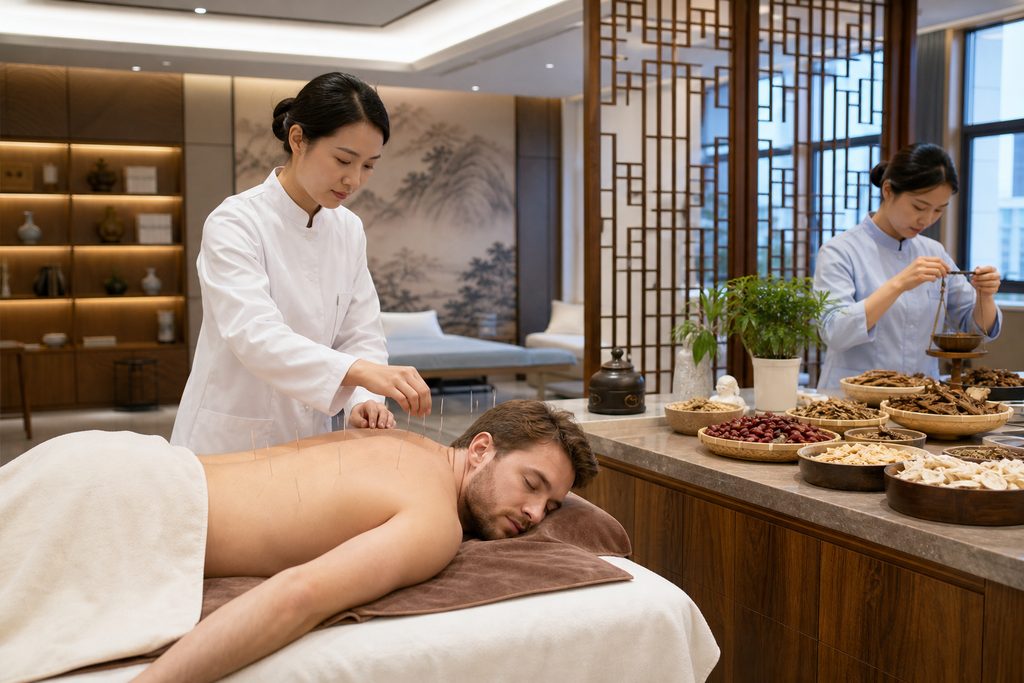
At Jiangsu Province TCM Hospital, herbal medicine operates inside a completely different framework. A TCM physician conducts a full diagnostic assessment—tongue examination, pulse diagnosis, symptom history—then writes a formal prescription. The hospital pharmacy dispenses the formula. It may be raw herbs you decoct at home, concentrated granules you dissolve in hot water, or manufactured patent medicines in pill form. Each carries a batch number and quality certification.
Custom herbal prescriptions are adjusted at follow-up visits based on your response. A formula for post-stroke fatigue and limb weakness might contain Astragalus (Huang Qi) and Salvia (Dan Shen). After two weeks, if your tongue coating shifts from thick to thin, the physician modifies the formula. This is dynamic prescribing, not a one-size-fits-all capsule.
Acupuncture Rehabilitation Cost China: The Numbers That Change Decisions
Let us address the question most patients search for first. The acupuncture rehabilitation cost China at a top-tier TCM hospital like Jiangsu Province TCM Hospital typically ranges from 80 to 150 USD per session through the international department. A session runs 30 to 45 minutes of direct needling, often combined with adjunctive therapies like electro-acupuncture stimulation, cupping, or moxibustion.
A standard intensive course for post-stroke rehabilitation involves 10 to 15 sessions over three to four weeks. At 100 USD per session on average, a full course costs between 1,000 and 1,500 USD. Compare that to the United States, where acupuncture for stroke rehab averages 100 to 200 USD per session out-of-pocket, and a course of 10 sessions runs 1,000 to 2,000 USD—often at a lower frequency and intensity.
Herbal therapy costs vary by formula complexity. A two-week supply of concentrated herbal granules typically ranges from 60 to 150 USD, depending on the ingredients. Rare herbs like Cordyceps or high-grade Ginseng push costs higher. Common formulas for chronic pain or post-stroke recovery fall toward the lower end of that range.
| Service | Jiangsu TCM Hospital (USD) | US/EU Equivalent (USD) |
|---|---|---|
| Acupuncture session (specialist) | 80–150 | 100–200 |
| Intensive rehab course (15 sessions) | 1,200–2,250 | 1,500–3,000 |
| Herbal granules (2-week supply) | 60–150 | 80–200 (if available) |
| Initial specialist consultation | 100–200 | 250–500 |
| Bilingual medical companion (per day) | from 200 | N/A |
All prices are estimates and vary by hospital and case complexity. Final quotes are confirmed after case review.
Is TCM Acupuncture Safe for Stroke Recovery? The Evidence
The short answer is yes—when delivered by trained clinicians in a hospital setting with proper screening. But you deserve the full picture.
A 2022 systematic review published in Frontiers in Neurology analyzed 42 randomized controlled trials involving over 3,400 stroke patients. The researchers concluded that acupuncture combined with conventional rehabilitation significantly improved motor function scores and reduced spasticity compared to conventional rehab alone. The effect was most pronounced when acupuncture started within the first six months post-stroke.
Safety data from Chinese hospital registries report adverse event rates below 0.1% for acupuncture when performed by licensed practitioners. The most common issues are minor: small bruises at needle sites, temporary dizziness during the first session, or localized soreness that resolves within hours. Serious events—pneumothorax from improper needling, infection from non-sterile needles—are vanishingly rare in hospital settings with standardized protocols and single-use disposable needles.
One concern that deserves honesty: anticoagulation. Many stroke patients take blood thinners like warfarin or clopidogrel. Acupuncture is not contraindicated, but the acupuncturist must know your medication list. Needle depth and manipulation are adjusted. At Jiangsu Province TCM Hospital, the international department collects your full medication history before treatment begins. This is not a detail to skip.
How Does Chinese Herbal Medicine Work for Chronic Pain?
Herbal therapy for chronic pain operates on a different logic than pharmaceutical analgesics. It does not simply block pain signals. It targets what TCM theory calls the underlying “pattern”—a constellation of signs and symptoms that includes the pain itself plus systemic factors like sleep quality, digestion, cold intolerance, and emotional state.
From a biomedical perspective, many Chinese herbs contain compounds with measurable anti-inflammatory, analgesic, and circulation-enhancing effects. Salvia miltiorrhiza (Dan Shen) contains tanshinones that inhibit COX-2 and reduce inflammatory cytokines. Corydalis yanhusuo (Yan Hu Suo) contains tetrahydropalmatine, a compound with D2 dopamine receptor activity and analgesic potency comparable to low-dose prescription medications in some animal studies.
A 2021 review in Pain Medicine examined 24 RCTs on Chinese herbal formulas for chronic low back pain. The pooled data showed a clinically meaningful reduction in pain scores compared to placebo, with an effect size similar to NSAIDs but with fewer gastrointestinal side effects. The formulas were multi-herb combinations, not single-ingredient extracts—a distinction that matters because TCM herbs are almost always prescribed in synergistic formulas, not in isolation.
For international patients, the practical question is whether herbal therapy China medical tourism makes sense logistically. The answer depends on your condition. Chronic pain conditions that respond partially to conventional treatment but leave residual symptoms—that is the sweet spot. Acute flare-ups of inflammatory arthritis, post-herpetic neuralgia, fibromyalgia—these are conditions where TCM herbal protocols have accumulated decades of hospital-based clinical experience in China.
The Jiangsu TCM Hospital International Patients Price: What You Actually Pay
The Jiangsu TCM hospital international patients price structure differs from the domestic Chinese patient track. This is not a markup for foreigners. It reflects the reality that international patients access the hospital through a different channel—one with English-speaking coordination, longer consultation times, and administrative support for medical records translation and insurance documentation.
An initial specialist consultation through the international department typically costs 100 to 200 USD. Follow-up visits run 50 to 100 USD. Acupuncture sessions, as noted, fall in the 80 to 150 USD range. If your treatment plan includes both acupuncture and herbal therapy, expect total costs for a three-week intensive program to land between 2,000 and 4,000 USD, excluding travel and accommodation.
Inpatient admission for intensive rehabilitation is available for cases that warrant it. Stroke patients with significant motor deficits, for example, may benefit from a two-to-four-week inpatient stay combining daily acupuncture, physical therapy, and herbal medicine. Inpatient costs vary widely based on room type and treatment intensity but generally range from 200 to 500 USD per day all-inclusive.
These prices are not hidden. The international department provides a written cost estimate before you travel. You pay the hospital directly. No intermediary markups on the medical fees themselves.
How to Book Acupuncture Treatment Jiangsu Hospital Abroad: The Real Process
Searching for how to book acupuncture treatment Jiangsu hospital abroad leads most patients into a maze of outdated web pages and unreturned emails. The hospital’s international department does accept overseas patients, but the process requires specific steps that are not obvious from outside China.
First, you need a clinical case review. The department requests your medical records—diagnosis, imaging reports, current medication list, and a brief treatment history—translated into English or Chinese. A senior physician reviews these to confirm that your condition falls within the department’s scope and that TCM treatment is appropriate. This is a medical gatekeeping step, not a formality. Certain conditions, like acute stroke within the first 72 hours or unstable cardiovascular disease, require conventional emergency care, not TCM outpatient rehab.
Second, once accepted, you coordinate dates. The international department confirms specialist availability and schedules your initial consultation. This is where having a local coordinator changes the experience. The department’s English-speaking staff handle scheduling, but the volume of international inquiries has grown significantly. Response times can stretch to a week or more during peak periods.
Third, you arrange your visa. Medical treatment in China requires an S2 visa with a treatment purpose annotation. The hospital provides an official invitation letter confirming your scheduled treatment. Your accompanying family member applies for the same S2 visa category. Do not apply for an M visa—that is for commercial business and will be rejected for medical purposes.
Fourth, you arrive, register at the international service center, and begin treatment. Payment is upfront per visit or per treatment block. The hospital accepts international credit cards, wire transfers, and WeChat Pay. Cash in Chinese RMB works but is less practical for amounts above a few hundred dollars.
What You Need to Know Before Going Alone
Navigating a Chinese hospital as a non-Chinese speaker is not like navigating a private clinic in Singapore or Bangkok. The scale alone is disorienting. Jiangsu Province TCM Hospital’s main outpatient hall processes thousands of patients daily. Signage in English exists in the international department but is sparse elsewhere. Registration kiosks, payment terminals, and pharmacy counters operate entirely in Chinese.
Medical records from your home country need professional translation. A discharge summary from a US hospital full of abbreviations and lab values means nothing to a Chinese physician unless properly rendered into terminology they recognize. Google Translate is not sufficient for a neurology workup.
- Visa Timing: S2 visa processing takes 1 to 4 weeks depending on your home country’s Chinese consulate workload. You cannot book a flight and show up. The hospital invitation letter is mandatory for the application.
- Payment Systems: While international cards work at the hospital, daily life in Nanjing runs on WeChat Pay and Alipay. Setting these up with a foreign card is possible but requires effort before travel. Cash is accepted but increasingly inconvenient.
- Herbal Medicine and Customs: Taking raw herbs or large quantities of granules back through customs requires documentation. A hospital prescription and treatment summary in English helps. Some herbs are restricted in certain countries—check your home country’s biosecurity rules before packing.
- Follow-Up Care: TCM treatment does not end when you leave Nanjing. Your herbal formula may need adjustment. The hospital’s international department can arrange telemedicine follow-ups, but shipping herbs internationally adds cost and complexity.
How We Help You Navigate This
These barriers are real, but they are navigable with the right support. Our team handles the full patient journey so you focus on treatment, not logistics.
Before you travel, we collect and translate your medical records, submit them to the international department for physician review, and confirm your acceptance and appointment schedule. We provide a detailed cost estimate, visa guidance with the official invitation letter, and practical advice on flights, accommodation near the hospital, and local transportation in Nanjing.
During your treatment, a bilingual medical companion accompanies you to every appointment. This person handles registration, payment, pharmacy pickup, and real-time interpretation during consultations. You ask questions directly to the physician; your companion ensures nothing is lost in translation. If your treatment plan changes—the physician wants to add tuina massage or adjust your herbal formula—you understand why and what it costs before proceeding.
After you return home, we coordinate follow-up telemedicine consultations and help arrange international herbal medicine shipping where legally permitted. Your treatment summary is translated into English for your primary care physician back home.
For patients considering a broader evaluation, our network includes 340+ top-ranked hospitals across 37 cities. If your case requires combined TCM and conventional neurology input, we can coordinate consultations at both Nanjing hospitals and other top institutions. Our TCM hospital network spans multiple provinces, giving you options beyond a single institution.
Frequently Asked Questions
Yes, and in fact that is the standard protocol at Jiangsu Province TCM Hospital. Acupuncture sessions are scheduled around physical therapy, not instead of it. The acupuncture targets spasticity reduction and pain relief, which can improve your tolerance and performance in PT. Inform both your TCM physician and your home physical therapist about the combined approach so they can coordinate. Bring your PT’s treatment notes if possible.
Jiangsu Province TCM Hospital has a 24-hour emergency department. For life-threatening emergencies, you would be directed there or to a nearby general hospital with full emergency capabilities. Your international department coordinator and your bilingual companion can facilitate emergency admission. We also recommend comprehensive travel medical insurance that covers inpatient hospitalization in China—standard travel insurance often excludes pre-existing conditions, so check the policy carefully.
This is a critical question, and the answer requires full transparency from you. Bring a complete medication list—drug names, dosages, and timing—to your initial consultation. The TCM physician at Jiangsu Province TCM Hospital is trained to screen for herb-drug interactions. Certain combinations, like warfarin and Salvia-containing formulas, require close monitoring or avoidance. Do not stop or adjust your prescribed medications without consulting the prescribing physician back home. TCM herbs are adjunctive, not replacement therapy for most chronic conditions.
Most US and European insurance plans do not have direct billing arrangements with Chinese TCM hospitals. You pay upfront and seek reimbursement afterward. The international department provides itemized receipts and treatment summaries formatted for insurance claims. Some international health insurance plans with out-of-network coverage do reimburse acupuncture and specialist consultations abroad. Check your policy’s out-of-network and international treatment provisions before committing. Our team can provide the documentation codes and descriptions insurers typically require.
An intensive course for stroke rehabilitation or chronic pain typically runs 3 to 4 weeks, with daily or near-daily acupuncture sessions. Some patients notice improvements in pain or mobility within the first week. Neurological recovery from stroke is slower—meaningful functional gains often emerge over the full course and continue with follow-up herbal therapy after returning home. The physician will set realistic expectations at your initial consultation based on your specific condition, its duration, and your baseline function. No honest clinician promises miracles in 10 sessions.
Your Next Step
Jiangsu Province TCM Hospital offers something genuinely hard to find outside China: hospital-grade acupuncture and herbal therapy delivered at therapeutic intensity by clinicians who have treated thousands of cases like yours. The costs are transparent and a fraction of Western equivalents. The barriers—language, logistics, visa paperwork—are real but solvable.
If you want to understand whether your specific condition is a good fit for treatment here, reach out for a free consultation. We review your case, advise on feasibility, and provide a clear picture of what the process looks like from start to finish. No pressure, no hard sell. Just an honest assessment from a team that has helped international patients navigate Chinese healthcare. Get a free consultation to start the conversation.
For more medical information and treatment options in China, visit chinamedservices.com (China Medical Services).
