Hubei Provincial TCM Hospital International Patient Service: Traditional Medicine Central China
Key Takeaways
- Hubei Provincial TCM Hospital treats over 2 million outpatients annually, making it one of central China’s highest-volume integrative medicine centers.
- International patient costs for acupuncture and herbal consultations typically start from $60–150 per session, roughly one-tenth of comparable US integrative clinic fees.
- Language barriers are severe — fewer than 5% of clinical staff speak functional English, making independent navigation nearly impossible without a bilingual companion.
- No overseas patient can book a specialist appointment online before arriving. All initial consultations require in-person registration, passport verification, and payment at the hospital.
The Problem: You Are Told Traditional Medicine Works — But No One Explains How to Access It
Approximately 1 in 3 adults in the United States now uses some form of complementary or alternative medicine, according to the National Center for Complementary and Integrative Health. Acupuncture alone is sought by over 14 million Americans annually. Yet for patients with chronic conditions that have not responded well to conventional pharmaceuticals — persistent lower back pain, chemotherapy-induced nausea, severe migraines, autoimmune inflammation — the options at home often feel thin. Insurance covers a handful of sessions. Practitioners operate in strip malls. The herbs are imported, marked up, and sometimes of uncertain provenance. You read about the real thing. The source. Hospitals in China where traditional medicine is not a wellness luxury but a state-funded, hospital-integrated discipline practiced at enormous scale. And then you hit a wall. How do you actually get in? What does it cost? Will anyone speak English? Can you even book an appointment from overseas? These are not trivial questions. For most international patients, they are the end of the road before the journey begins.
That is where the gap sits. Between genuine clinical demand and the logistical impossibility of navigating a Chinese public hospital alone. Our team exists to close that gap — not by providing medical care, but by building the bridge that gets you to it.
Who We Are
Clinical volume is not just a number. It is a proxy for pattern recognition. A TCM practitioner in a busy Western clinic might see 15 patients in a day. A senior physician at Hubei Provincial TCM Hospital’s acupuncture department may treat 80 to 100 patients in a single shift. Over a career spanning thirty years, that physician accumulates a diagnostic library that no textbook can replicate. They have seen your pattern before. Many times. That is the quiet advantage of a high-volume public hospital system — repetition at a scale that produces clinical intuition.
The hospital’s acupuncture and moxibustion department is designated as a National Key Clinical Specialty by China’s National Health Commission. Its tuina (therapeutic massage) department is similarly recognized. These are not marketing labels. They are government designations tied to measurable clinical output, research publication volume, and peer review. The hospital also runs one of China’s largest TCM neurology wards, treating post-stroke rehabilitation, Parkinson’s disease, and peripheral neuropathy with integrated protocols that combine acupuncture, herbal medicine, and conventional physical therapy.
What Is Traditional Chinese Medicine Treatment Like in China — the Real Experience
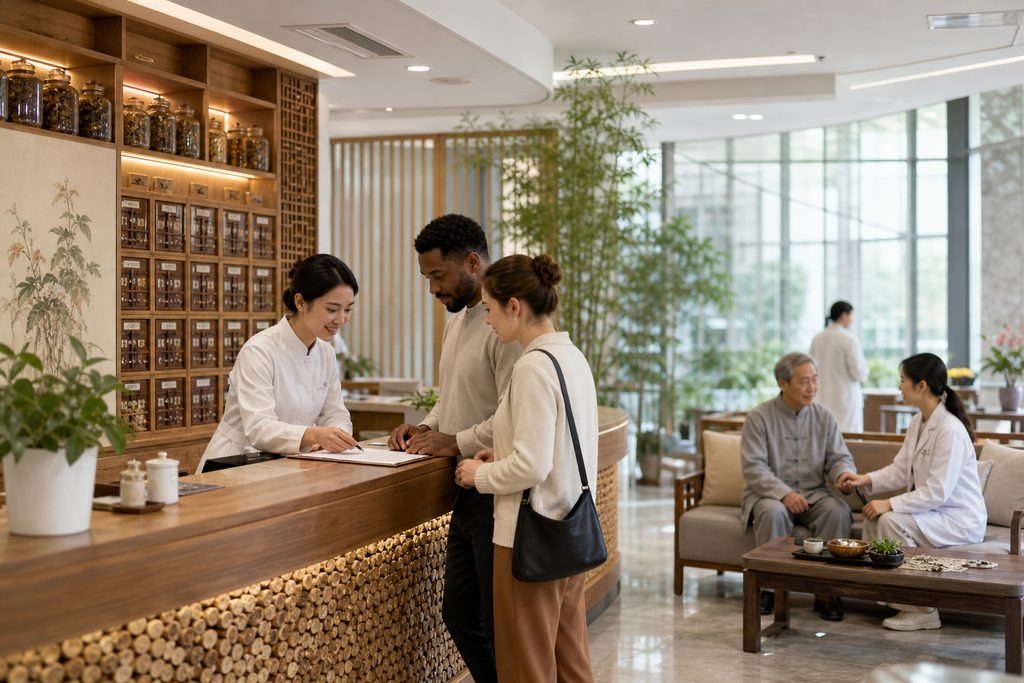
Let us be direct about this. The phrase “what is traditional Chinese medicine treatment like in China” gets typed into search engines thousands of times each month, usually by people imagining something between a spa and a mystical retreat. The reality is more clinical and less romantic. You arrive at a massive hospital complex. The lobby is crowded. Hundreds of people queue at registration windows. The air carries the sharp, woody scent of boiling herbs from the pharmacy hall — a smell that fills entire floors. Your consultation room is spartan. A desk, a treatment bed, a screen. The doctor takes your pulse at three positions on each wrist, examines your tongue coating and body, and asks detailed questions about sleep, digestion, menstruation, pain patterns, and emotional state. This is not a five-minute exchange. A proper initial TCM consultation often runs 30 to 45 minutes.
Then comes the treatment plan. It may include a specific acupuncture protocol — points selected based on your pattern differentiation, needles retained for 20 to 30 minutes, often with electrical stimulation or moxa heat applied. You may receive cupping therapy, gua sha scraping, or tuina manual therapy in the same session. An herbal formula is prescribed — typically a decoction of 10 to 18 raw herbs that you boil at home and drink twice daily. The hospital pharmacy dispenses these herbs by weight, often in vacuum-sealed pouches for convenience. Follow-up appointments adjust the formula as your presentation shifts. This is not a one-time intervention. TCM treats dynamically, and the prescription evolves with you.
None of this will be explained in English unless you bring someone who speaks both languages fluently in a clinical context. That is the gap we fill.
Can Foreigners Get Acupuncture in Wuhan Hospital — The Practical Answer
The short answer is yes. Foreigners can absolutely receive acupuncture at Hubei Provincial TCM Hospital. The longer answer is that the pathway is not designed for you. Chinese public hospitals operate on a domestic patient model. Registration requires a passport. Payment runs through a prepaid hospital card system that only accepts Chinese-issued bank cards or WeChat Pay linked to a mainland China bank account. Signage is almost entirely in Chinese characters. The registration kiosks have no English interface. The pharmacy queue uses a numbered ticket system with Mandarin voice announcements. Even finding the correct building on a multi-tower campus requires reading directional signs in Chinese.
This is not hostility. It is simply that international patients represent a tiny fraction of the hospital’s total volume, and the system has never been optimized for them. The international medical department exists, but it is small and primarily serves expatriates already living in Wuhan. Walk-in overseas patients are rare enough that front-desk staff may be uncertain how to process you.
So yes — foreigners can get acupuncture in a Wuhan hospital. But the question to ask is not “can I” but “how will I.” The answer is: with a bilingual medical companion who knows the hospital layout, understands the registration workflow, can translate your medical history accurately into clinical Mandarin, and ensures that nothing gets lost between your symptoms and the doctor’s diagnosis.
Hubei Provincial TCM Hospital Price List — What International Patients Actually Pay
There is no single published “Hubei Provincial TCM Hospital price list” that covers international patients. This frustrates people. We understand why. But the reason is structural, not evasive. Chinese public hospitals post official fee schedules for domestic patients, which are regulated by provincial health pricing bureaus. International patients accessing care through the hospital’s VIP or international channel pay a different rate — typically 1.5 to 2 times the domestic price — because the channel includes English coordination, priority scheduling, and often senior specialist assignment. That said, here are real price ranges based on cases we have coordinated:
| Service | Domestic Price (USD equivalent) | International Channel Price (USD) |
|---|---|---|
| Initial TCM specialist consultation (30–45 min) | $30–50 | $60–100 |
| Acupuncture session (standard, 30 min) | $20–40 | $40–80 |
| Acupuncture with electro-stimulation | $30–50 | $60–100 |
| Cupping therapy (10–15 min) | $10–20 | $20–40 |
| Tuina therapeutic massage (30 min) | $25–40 | $50–80 |
| Herbal prescription consultation + formula | $40–80 | $80–150 |
| Herbal decoction (7-day supply, dispensed) | $30–70 | $30–70 (same herbs) |
| Inpatient TCM rehabilitation (per day, ward bed) | $80–150 | $150–300 |
These are reference ranges. Final costs vary by hospital department, specialist seniority, treatment complexity, and whether you require additional diagnostic workup such as MRI or blood panels. Herbal medicine costs depend entirely on the formula prescribed — some rare herbs are expensive, while common formulas cost little. We always recommend budgeting a 20% buffer above the estimated range.
For context, a single acupuncture session at a US hospital-based integrative medicine center typically runs $100–250, and many insurance plans cap annual visits at 12 to 20 sessions. A course of 10 acupuncture treatments with herbal support at Hubei Provincial TCM Hospital, even at international channel pricing, often costs less than 3 sessions in the US. The economics are not marginal — they are categorical.
How to Book TCM Treatment China Medical Tourism — Without Getting Stuck
The phrase “book TCM treatment China medical tourism” implies a smooth online reservation system. That system does not exist for public TCM hospitals. You cannot visit a website, select a doctor, choose a time slot, and pay with a credit card. The actual workflow is: your records are reviewed, a hospital department confirms they will accept your case, an appointment window is arranged, you arrive in person with your passport, register at the international department counter, pay a deposit onto a hospital card, and then proceed to the consultation. None of this happens online.
Here is what the coordinated pathway looks like when you work with us:
Step one — clinical review. You send us your medical records, imaging, and a description of what you are seeking. We translate these into clinical Chinese and submit them to the relevant department at Hubei Provincial TCM Hospital. A senior physician reviews whether your case falls within their scope and whether they can accept you. This is not a formality. TCM hospitals will decline cases they believe are better managed in a conventional Western medicine setting. That honesty is a feature, not a rejection.
Step two — appointment coordination. Once accepted, we lock an appointment window. This is not a specific hour — Chinese public hospital appointments operate in half-day blocks (morning or afternoon). We confirm the date, the specialist, and the department location. We also handle the hospital’s internal scheduling system, which is entirely in Chinese.
Step three — visa support. We provide the hospital’s official invitation letter and treatment confirmation, which you need for your S2 visa application. We guide you through the documentation requirements and timeline. S2 visa processing typically takes 5 to 10 business days at most Chinese consulates.
Step four — on the ground. Our bilingual medical companion meets you at the hospital entrance. They handle registration, payment card setup, queue ticket collection, and escort you to the correct consultation room. During the consultation, they interpret accurately — not just words, but clinical nuance. They explain what the doctor said, what the treatment plan means, and what you need to do next. After the consultation, they guide you through pharmacy pickup, payment settlement, and follow-up scheduling.
Step five — ongoing coordination. TCM treatment is rarely a single visit. If your plan requires 10 acupuncture sessions over two weeks, we coordinate the entire schedule, ensure continuity with the same specialist, and remain available for any issues that arise — medication reactions, scheduling conflicts, or additional diagnostic needs.
Hubei TCM Hospital Overseas Patient Contact — The Real Pathway
Searching for “Hubei TCM hospital overseas patient contact” will lead you to a hospital website with a phone number that rings in Mandarin and an email address that may or may not receive a response within two weeks. This is not negligence. The hospital’s international patient volume is low enough that the department is not staffed for rapid English-language correspondence. The contact exists. It is technically functional. But if you are managing a chronic condition and need answers within days, not weeks, the direct-contact route is a gamble.
Our role is to be the responsive front end. We know the department heads. We know which specialists accept international cases and which do not. We communicate in Chinese, during business hours, through the channels the hospital actually uses — WeChat, direct phone, and in-person visits. When you work with us, you do not need the “overseas patient contact.” We are that contact, localized and operational.
What You Need to Know Before Going Alone
Some patients are determined to handle this independently. We respect that. But we also want you to know exactly what you are walking into. These barriers are not hypothetical — they are the reasons roughly half of independent international patients abandon their attempt before completing their first consultation.
- Visa complexity: Medical treatment in China requires an S2 visa with a specific invitation letter from the treating hospital. Tourist visas do not cover medical treatment, and presenting yourself at the border with the wrong visa category can result in denial of entry. The invitation letter must include the hospital’s official stamp, the patient’s passport details, and the treatment purpose. Hospitals issue these letters only after confirming they will accept your case — which requires the clinical review step we described above.
- Payment friction: The hospital’s prepaid card system does not accept international credit cards. You cannot pay with Visa or Mastercard at the registration counter. You need a Chinese bank card, a mainland-linked WeChat Pay account, or enough cash in renminbi to load onto the hospital card. ATM withdrawal limits for foreign cards at Chinese banks typically cap at 2,000–5,000 RMB per day (roughly $280–700), which may not cover a full treatment deposit.
- Clinical translation risk: Describing your symptoms through a translation app is dangerous. “Dizziness” and “vertigo” are different conditions with different TCM pattern diagnoses. “Fatigue” can mean qi deficiency, blood deficiency, dampness encumbrance, or a dozen other patterns — each requiring a different herbal approach. A mistranslated symptom leads to a wrong pattern diagnosis, which leads to an ineffective or even counterproductive prescription. This is not a language barrier you can solve with Google Translate.
How We Help You Navigate This
These barriers exist because the Chinese public hospital system was built for a domestic population of 1.4 billion people. It was never redesigned for international patients, and it probably will not be. That is not a flaw — it is just the reality. Our entire service exists to bridge that structural gap.
We translate your medical history into clinical-grade Chinese before you ever board a plane. We coordinate directly with the hospital’s international department to secure your appointment and invitation letter. We guide your visa application. We meet you at the hospital, handle every administrative transaction, and stand beside you through every consultation — ensuring the doctor understands exactly what you are experiencing and you understand exactly what the treatment entails. After you return home, we can coordinate follow-up herbal shipments and telemedicine consultations to maintain continuity.
The TCM hospital China international patient cost question ultimately has two components: the clinical fees paid to the hospital, and the coordination fees paid to us. Our bilingual medical companion service starts from $200 per day. Hospital appointment coordination starts from $300. These are investments in certainty — in knowing that your consultation will happen, your symptoms will be communicated accurately, and your treatment plan will make sense to you.
Frequently Asked Questions
Do I need a referral from my home doctor to receive TCM treatment at Hubei Provincial TCM Hospital?
No formal referral letter is required. However, we strongly recommend bringing relevant medical records, imaging reports, and a summary of your current medications. The TCM specialist will review these alongside their own diagnostic assessment. If you have a complex condition with multiple comorbidities, prior documentation helps the physician understand the full clinical picture and avoid herb-drug interactions.
How many acupuncture sessions will I need, and how long should I plan to stay in Wuhan?
This depends entirely on your condition. For acute pain conditions, a course of 5 to 7 sessions over 10 days is common. Chronic conditions — autoimmune disorders, long-standing migraines, post-stroke rehabilitation — often require 10 to 15 sessions over three to four weeks. The physician will recommend a treatment frequency during your initial consultation. We advise not booking return flights until after that first appointment, so your schedule can adapt to the clinical recommendation rather than the reverse.
What if the herbal formula causes side effects or I have a bad reaction?
TCM herbal formulas can cause digestive upset, loose stools, or mild skin reactions in some patients, particularly during the first few days as the body adjusts. These are usually transient. If symptoms are severe or persistent, contact us immediately — we will arrange an urgent follow-up with the prescribing physician, who can modify the formula or discontinue it. All herbal prescriptions dispensed by the hospital pharmacy are sourced through regulated supply chains and tested for heavy metals and contaminants, which is not guaranteed when buying TCM herbs online or from unregulated suppliers.
Can I combine TCM treatment with my existing Western medications?
In most cases, yes — and this is precisely the advantage of receiving TCM in a hospital setting rather than from an independent practitioner. The physicians at Hubei Provincial TCM Hospital are trained in both systems and routinely manage patients on concurrent pharmaceutical regimens. You must disclose all medications during your consultation. Certain herbs can interact with anticoagulants, antihypertensives, and immunosuppressants. The physician needs to know everything you are taking to prescribe safely.
Is the hospital equipped to handle medical emergencies during treatment?
Yes. Hubei Provincial TCM Hospital is a full-service Grade A, Class 3 hospital with emergency departments, intensive care units, and Western medicine specialists on staff. If a medical emergency occurs during your treatment — an allergic reaction, a cardiac event, anything acute — you will receive emergency care within the same hospital system, not transferred elsewhere. This integrated structure is one of the reasons we recommend large public TCM hospitals over small independent clinics for international patients.
Your Next Step
Traditional Chinese medicine, practiced at this scale and integrated with modern diagnostics, is not something most Western patients have ever experienced. It is not a spa treatment. It is a rigorous clinical discipline with a diagnostic framework that has evolved over centuries and continues to be refined in hospitals that treat millions of patients each year. Accessing it requires navigating a system that was not built for you — but that does not mean you cannot get in. It means you need the right bridge.
If you are considering TCM treatment at Hubei Provincial TCM Hospital, start with a conversation. Get a free consultation with our team. We will review your case, explain your options honestly, and map out what a treatment journey would actually look like — costs, timeline, logistics, and clinical expectations. No pressure. No hard sell. Just clarity from people who have walked this path many times before.
Medical disclaimer: This article is for informational purposes only and does not constitute medical advice. Treatment decisions should be made in consultation with qualified healthcare providers. China Medical Services does not provide clinical care, prescribe treatments, or guarantee specific medical outcomes. All treatment is delivered by licensed physicians at the hospitals we coordinate with.
For more medical information and treatment options in China, visit chinamedservices.com (China Medical Services).
