Complex Pediatric Surgery China: Beijing Children’s Hospital for Rare Congenital Anomalies
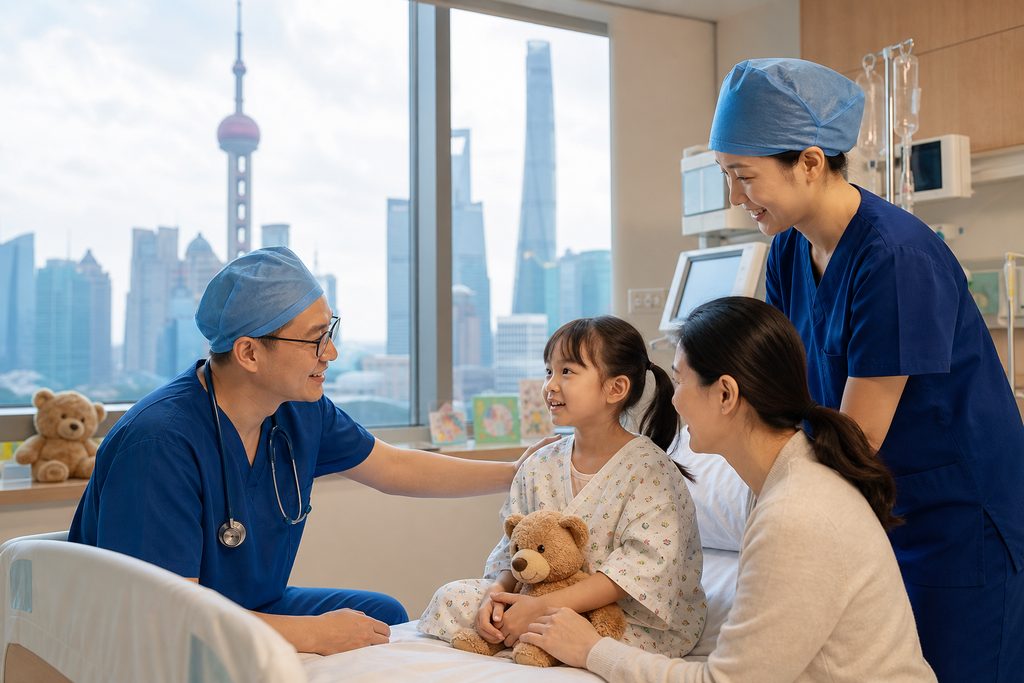
When 7-month-old Lena was diagnosed with biliary atresia, her parents in Manchester faced a terrifying countdown. The Kasai procedure needed to happen within weeks. But the NHS waiting list stretched past three months. They started searching for alternatives at 2 AM. That search led them to a phrase they never expected to type: complex pediatric surgery cost China. The numbers stunned them. The clinical volume stunned them more. Three weeks later, Lena had her surgery in Beijing. She is now a healthy three-year-old.
Families like Lena’s arrive at our doorstep every week. Not because they want to travel. Because they have run out of time and options at home. The question is rarely “Is China good enough?” It is usually “Can we afford to wait any longer?”
Key Takeaways
- Beijing Children’s Hospital performs over 25,000 pediatric surgeries annually, with a dedicated center handling more than 2,000 complex congenital anomaly cases each year — volume that directly correlates with better outcomes.
- The complex pediatric surgery cost China typically ranges from $8,000 to $35,000 for procedures that would cost $80,000 to $400,000 in the United States, without any compromise in surgical expertise.
- Language barriers, visa requirements, and hospital navigation remain genuine obstacles — attempting this journey without local coordination can delay treatment by weeks or months.
- International patients cannot book surgery directly online. You must complete an in-person consultation first, then schedule the procedure — a process where professional coordination saves critical time.
The Problem: When Your Child’s Diagnosis Has No Timeline
Rare congenital anomalies affect approximately 1 in 33 infants globally, according to the World Health Organization. That statistic means nothing until it is your child. Then it means everything. In the UK, Canada, and parts of Europe, waiting times for complex pediatric surgery now stretch to 6-18 months for non-emergency cases. For a newborn with craniosynostosis, waiting 12 months means the skull fuses incorrectly. For an infant with tetralogy of Fallot, waiting means oxygen deprivation with every cry.
Parents do not sleep. They Google. They join Facebook groups. They call hospitals in other countries. And eventually, many find themselves staring at a map of China, wondering if this is realistic. It is. But only if you understand how the system actually works.
The US offers world-class pediatric surgery. Nobody disputes that. But the average complex congenital heart repair at a top American children’s hospital costs between $150,000 and $400,000. Even with insurance, the out-of-pocket maximum can bankrupt a family. And if you are uninsured or underinsured? The hospital simply will not schedule the surgery. These are not abstractions. These are the realities that push families across oceans.
Who We Are
We are not a hospital. We do not employ surgeons, prescribe treatments, or make any clinical decisions. Our team at China Medical Services functions as your logistical architects — we bridge the gap between your family and China’s 340+ top-ranked hospitals. We translate medical records, coordinate with hospital international departments, arrange bilingual medical companions, and guide you through visa applications. We have walked this path with hundreds of families. We know which hospitals handle which anomalies. We know the S2 visa requirements cold. And we know that when a child needs surgery, every day matters.
Why Beijing Children’s Hospital Delivers Results for Rare Congenital Anomalies
Beijing Children’s Hospital, affiliated with Capital Medical University, is not just a large pediatric facility. It is the National Center for Children’s Health in China. That designation matters. It means the hospital receives referrals from every province. It means its surgeons see anomalies that most Western pediatric surgeons encounter once or twice in a career. And it means the hospital has built dedicated surgical teams around specific rare conditions rather than treating them as one-off cases.
Clinical Volume Drives Surgical Precision
The hospital’s Department of Pediatric Surgery handles cases across general surgery, neurosurgery, cardiac surgery, urology, and orthopedics. Its Congenital Anomaly Center specifically focuses on conditions like esophageal atresia, congenital diaphragmatic hernia, anorectal malformations, and complex craniofacial deformities. The center reports over 2,000 anomaly correction surgeries annually. Compare that to a typical Western pediatric surgery center, which might handle 200-300 such cases per year. Volume is not everything. But for rare procedures, it is the closest thing to a guarantee. A surgeon who repairs 50 tracheoesophageal fistulas a year simply has hands that know what to do when anatomy is unexpected.
This is not speculation. A 2021 study published in the Journal of Pediatric Surgery found that hospitals performing more than 50 complex neonatal surgeries annually had significantly lower mortality rates than lower-volume centers. Beijing Children’s Hospital exceeds that threshold many times over.
Technology and Efficiency at Scale
The hospital operates 1,700 beds and runs 42 clinical departments. Its surgical infrastructure includes hybrid operating rooms that combine traditional surgery with real-time 3D imaging — allowing surgeons to adjust their approach mid-procedure based on what they see. For a child with a rare vascular malformation, this capability can mean the difference between a full resection and a second surgery six months later.
What surprises many Western families is the operational speed. Once a surgical plan is confirmed, the hospital can typically schedule the procedure within 1-3 weeks. Not months. The reason is structural: Chinese public hospitals run on high throughput. They are designed to move patients through efficiently. This can feel overwhelming — the hallways are crowded, the pace is fast. But for a family racing against a developmental window, that speed is the point.
Complex Pediatric Surgery Cost China: The Numbers That Change Decisions
Let us address the question every family asks first. The complex pediatric surgery cost China varies by procedure, hospital tier, and whether you access the international department or the standard public channel. Here is what families should expect:
| Procedure | Estimated Cost in China (USD) | Estimated Cost in US (USD) |
|---|---|---|
| Congenital heart defect repair (e.g., VSD, TOF) | $12,000 – $25,000 | $120,000 – $250,000 |
| Craniosynostosis repair | $10,000 – $20,000 | $80,000 – $150,000 |
| Esophageal atresia / TEF repair | $8,000 – $18,000 | $90,000 – $200,000 |
| Anorectal malformation correction | $8,000 – $15,000 | $70,000 – $130,000 |
| Congenital diaphragmatic hernia repair | $15,000 – $35,000 | $150,000 – $400,000 |
These figures are estimates. Final costs depend on case complexity, length of ICU stay, and whether complications arise. The international department channel — which provides English-speaking coordination and faster access to senior surgeons — typically costs 1.5 to 2 times the standard public rate. That still places most procedures well below US or European private-pay prices.
Why are costs lower? Not because of lower quality. Chinese top-tier pediatric surgeons train internationally. Many complete fellowships in the US, Germany, or Japan. The cost difference stems from structural economics: lower labor costs across the hospital system, higher patient throughput, and a healthcare model that does not carry the administrative overhead of the American insurance system. A cardiac surgeon at Beijing Children’s Hospital may perform 300 procedures a year. Their American counterpart might do 100. Same training. Same complexity. Different economics.
How Safe Is Complex Pediatric Surgery in China?
This is the question that keeps parents awake. The honest answer: safety at China’s top pediatric centers is comparable to Western benchmarks — but only at the top centers. Beijing Children’s Hospital maintains Joint Commission International accreditation standards and reports surgical site infection rates below 1.5% for clean procedures, consistent with US hospital averages. Its pediatric ICU survival rates for complex congenital heart surgery exceed 97%, according to hospital-reported data.
But context matters. China has 35,000+ hospitals. The quality gap between the top 5% and the rest is real. This is why hospital selection is everything. A parent searching for the best pediatric surgeon for birth defects China should look at volume, not just reputation. Ask how many of this specific procedure the surgeon performs annually. If the answer is under 20, keep looking. At Beijing Children’s Hospital, the lead surgeons in the Congenital Anomaly Center each perform 80-150 complex anomaly corrections per year. That repetition matters more than any diploma on the wall.
Safety also depends on communication. Surgical teams in the international department work with translators. But during rounds, during recovery, during those 3 AM moments when a parent needs to ask a question — that is when language gaps become dangerous. This is not a reason to avoid China. It is a reason to bring a bilingual medical companion who stays with you through the entire hospitalization. We will return to this.
What You Need to Know Before Going Alone
Families sometimes assume they can email the hospital, book a surgery date, and fly over. That assumption costs them weeks. The Chinese public hospital system operates on rules that make sense internally but feel opaque from outside. Here are the barriers you will face if you attempt this independently:
- Visa Requirements: Medical treatment in China requires an S2 visa with a specific annotation for medical purposes. You cannot enter on a tourist visa and then seek treatment — hospitals will not admit you. The S2 application requires an invitation letter from the hospital, proof of financial means, and a detailed treatment plan. Obtaining that invitation letter without a local contact is slow. Families report waiting 3-6 weeks just for the paperwork. Accompanying family members also need S2 visas. One missing document resets the clock.
- Registration Reality: Beijing Children’s Hospital sees over 10,000 outpatient visits daily. The public registration system requires a Chinese ID or a foreign passport registered in person. You cannot book a specialist consultation online from overseas through the standard system. The international department offers a separate pathway — but it requires direct contact, often in Chinese, and still mandates an in-person consultation before any surgery can be scheduled. There is no “book pediatric surgery at Beijing Children’s Hospital” button on a website. The process is: travel to Beijing, complete the consultation, get the surgical plan, then schedule the procedure.
- Payment Systems: Chinese public hospitals operate on a prepaid deposit model. You deposit funds at admission, the hospital deducts costs daily, and you settle the balance at discharge. International credit cards do not always work. Wire transfers take days. Alipay and WeChat Pay dominate, but setting up a foreigner account with sufficient limits is its own project. Expect to need $20,000-$40,000 in accessible funds before the hospital admits your child.
- Medical Records Translation: The surgical team needs complete medical records in Chinese — not just a summary, but imaging reports, genetic testing results, prior surgical notes. Machine translation fails on medical terminology. A mistranslated “tetralogy of Fallot” becomes gibberish. Professional medical translation costs $500-$1,500 and takes 3-7 business days. Skipping this step means the surgeon evaluates your child with incomplete information.
How We Help You Navigate This
These barriers are not designed to exclude international patients. They exist because the system was built for China’s domestic population of 1.4 billion. International patients are an afterthought — one the hospitals are increasingly equipped to handle, but only with the right coordination layer in place.
Our team handles the full journey. Before you travel, we collect and translate medical records, submit them to the appropriate department at Beijing Children’s Hospital or another top-ranked center from our database of 340+ hospitals, and secure the invitation letter required for your S2 visa application. We do not promise a specific surgeon. We do promise that your child’s case will be reviewed by the department best matched to the anomaly. If the hospital cannot handle the case, we tell you upfront and suggest alternatives — including other cities like Shanghai or Guangzhou, where Shanghai and Guangzhou host their own top-tier pediatric centers.
During your stay, a bilingual medical companion accompanies you to every consultation, translates in real time, handles hospital registration and payment deposits, and stays with you through admission and discharge. This is not a translator app on a phone. It is a person who knows the hospital layout, knows which window processes what paperwork, and knows how to ask a surgeon the questions you need answered. The companion service starts at $200 per day.
After discharge, we coordinate follow-up consultations — either in person if you stay in Beijing for monitoring, or via remote video consultation with the surgical team. Any video consultation fee you pay is credited in full toward future on-the-ground coordination if you return for additional procedures within 90 days.
Medical tourism for rare congenital anomalies China package offerings vary widely. Some agencies sell all-inclusive deals with hotels and airport transfers bundled in. We take a different approach. We quote based on your specific needs — case complexity, length of stay, number of companions required. Our coordination fees start at $300 for hospital appointment scheduling, with full refund if we cannot secure the appointment as described. VIP end-to-end coordination for complex multi-surgery cases ranges from $5,000 to $8,000. Every quote comes after we understand your child’s medical situation. Never before.
Frequently Asked Questions
No. The hospital requires an in-person consultation with the surgical team before scheduling any procedure. What you can do beforehand is submit medical records for preliminary review, obtain an invitation letter for your visa, and secure a consultation appointment. That preliminary work cuts weeks off the timeline. But the surgeon must see your child in person before committing to a surgical plan. This is standard practice at every major Chinese public hospital — it is a clinical safeguard, not a bureaucratic hurdle.
At top-ranked centers like Beijing Children’s Hospital, surgical outcomes for common congenital anomalies are comparable to Western benchmarks. Infection rates, mortality rates, and complication rates all fall within accepted international ranges. The key variable is hospital selection. A small provincial hospital will not deliver the same results. Stick to hospitals ranked in the Fudan Hospital Rankings or those with JCI accreditation. Ask about surgeon-specific volume for your child’s procedure. If the answer is vague, that is a red flag. If it is specific and high, you are in the right place.
Beijing Children’s Hospital has a 24/7 pediatric intensive care unit staffed by intensivists trained in post-surgical management of complex congenital cases. The hospital carries liability insurance, and the international department has protocols for communicating with families during complications. That said, medical malpractice litigation in China works differently than in Western countries. Financial compensation for adverse outcomes is typically lower, and the legal process is slower. We advise families to carry comprehensive medical travel insurance that includes coverage for complications and medical evacuation. We can recommend insurers familiar with China’s system. This is not a reason to avoid treatment here — it is a reason to plan thoroughly.
For a single complex procedure with a 2-3 week hospital stay, expect $20,000 to $50,000 total. That includes surgery, hospital fees, medications, one parent’s accommodation nearby, round-trip flights, visa fees, medical records translation, and bilingual companion services. For longer stays involving multiple staged surgeries, costs can reach $80,000 to $120,000. These are still fractions of US private-pay prices. But they are real money. We provide detailed cost estimates during the initial consultation — never a vague range, always a line-by-line breakdown based on the specific hospital and procedure.
You do not search in Chinese. You work through the hospital’s international department or through a coordination service that has existing relationships with those departments. The best surgeons are not listed on English-language websites with patient reviews. They are identified by case volume, departmental leadership, and peer reputation within China’s medical community. Our team matches your child’s specific anomaly to the department and surgeon with the highest relevant volume. We do not pick a name from a directory. We ask the department head: who on your team has done the most of these? That is the surgeon you want.
Your Next Step
When a child needs complex surgery, the research phase feels endless and urgent at the same time. You want to move fast. You also cannot afford to get this wrong. The families we work with typically spend 2-4 weeks gathering information before making a decision. That is normal. That is responsible.
If Beijing Children’s Hospital is on your list, the next step is getting your child’s medical records in front of the right department. We can facilitate that — at no cost for the initial consultation. You tell us the diagnosis. We tell you honestly whether China’s top pediatric centers can help, what the timeline looks like, and what the all-in cost will be. No pressure. No sales pitch. Just the information you need to make the hardest decision a parent ever makes. Reach out through our patient coordination page when you are ready to start that conversation.
For more medical information and treatment options in China, visit chinamedservices.com (China Medical Services).
