Deep Brain Stimulation vs Lesion Surgery: What the Difference Means
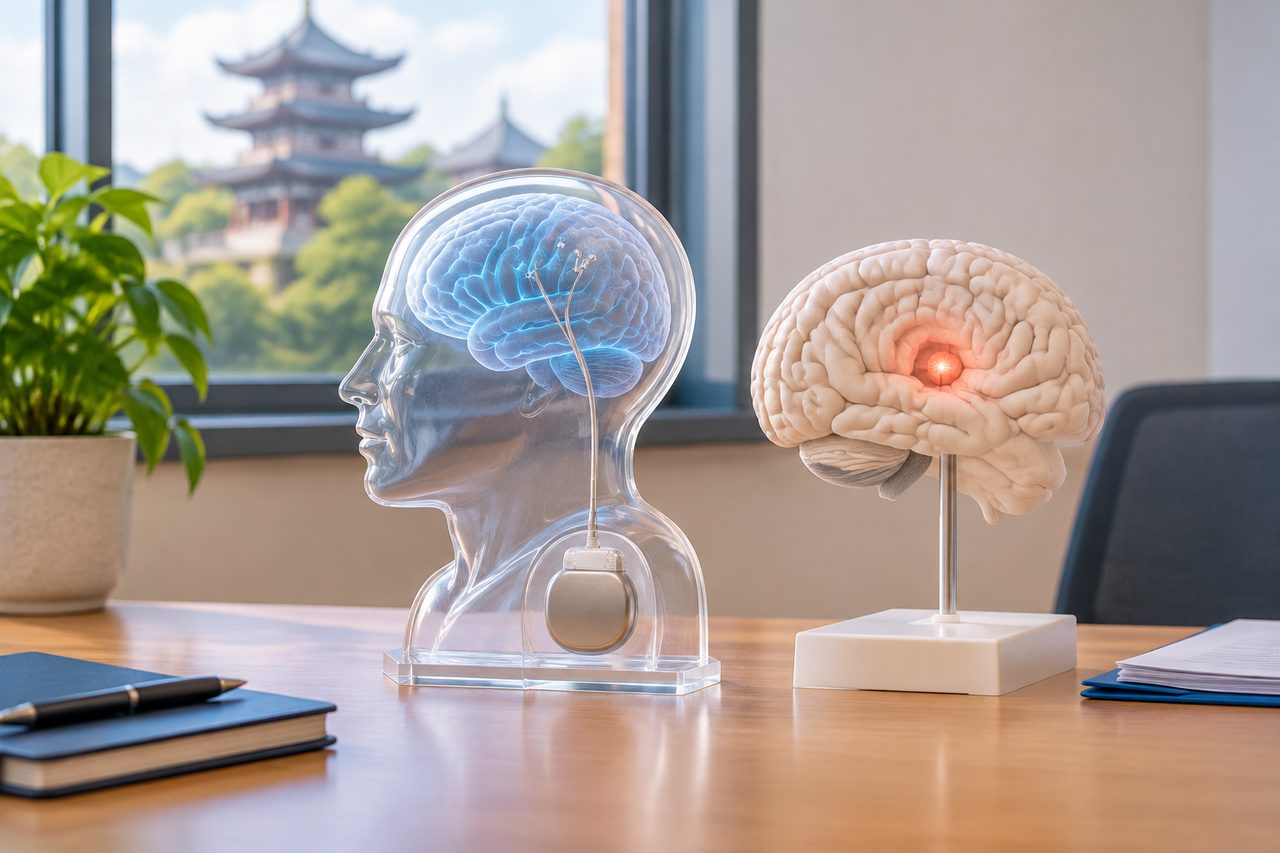
Deep brain stimulation vs lesion surgery is a comparison between two different ways of correcting faulty brain circuit activity. Deep brain stimulation (DBS) implants electrodes and adjusts them with a programmable device; lesion surgery destroys a small, precisely targeted area of brain tissue. The practical difference is reversibility versus permanence — and that single distinction shapes candidacy, risk, follow-up, and cost. This article explains what each approach involves, who tends to be considered for which, and what international patients should understand before traveling to China for evaluation.
Deep Brain Stimulation vs Lesion Surgery: The Short Answer
DBS does not destroy brain tissue. A neurosurgeon implants thin electrodes into a defined target, connects them to a pacemaker-like generator in the chest, and a neurologist or specialist later tunes the stimulation settings. If side effects appear, settings can be changed; the hardware can, in principle, be turned off or removed. Lesion surgery — historically thalamotomy or pallidotomy, and today sometimes performed with focused ultrasound or radiosurgery — deliberately creates a small lesion to interrupt the same kind of abnormal circuit. The effect is immediate and permanent, and so are any complications affecting that area.
The caveat that makes this more than a one-line answer: “lesion surgery” is an umbrella term. A radiofrequency lesion made with an open cranial procedure is not the same experience as an incision-free focused ultrasound lesion, even when the target is identical. Likewise, “DBS” covers different targets, different hardware, and different programming burdens. Comparing the two labels without naming the technique and the target produces misleading conclusions.
Who This Is Right For — and Who It Isn’t
Both approaches are used mainly in movement disorders — Parkinson’s disease, essential tremor, and dystonia — and more selectively in certain psychiatric or pain conditions. Eligibility is decided by a specialist team after examination and imaging, not by patient preference alone.
Patients typically considered for DBS
- Parkinson’s disease with motor fluctuations or dyskinesia that medication no longer controls well, and without significant cognitive impairment
- Essential tremor that interferes with daily function and has not responded adequately to medication
- Selected dystonia cases, where a trial of stimulation may be assessed over time
- Patients who can attend regular programming visits, or who have a reliable local clinician able to adjust settings after returning home
Patients typically considered for lesion surgery
- Essential tremor or tremor-dominant presentations where a single, permanent interruption is judged sufficient
- Patients for whom implanted hardware is a poor fit — for example, those at higher infection risk, or those who cannot manage device follow-up
- Selected cases where a team judges that a well-placed lesion offers a more predictable outcome than programming would
Who should not pursue either without very careful review
- People with significant cognitive decline or uncontrolled psychiatric illness — both are commonly treated as relative contraindications and require specialist assessment
- Patients who cannot attend follow-up, or who have no realistic route to post-operative programming and medication adjustment
- Anyone seeking a guaranteed reduction in tremor or rigidity. Neither procedure is curative, and neither stops disease progression in Parkinson’s disease
- Patients whose symptoms are well controlled on medication, where the risks of brain surgery outweigh the likely benefit
We want to be direct here: for some readers, the most useful conclusion is that surgery is not the next step. A written second opinion from a specialist team can establish that before any travel is booked.
The Options, Compared
| Dimension | Deep brain stimulation | Lesion surgery (ablation) |
|---|---|---|
| Mechanism | Implanted electrodes modulate circuit activity | Small area of tissue destroyed to interrupt the circuit |
| Reversibility | Settings adjustable; hardware removable in principle | Permanent; no adjustment possible after the lesion forms |
| Typical procedures | Electrode implantation, often staged; generator placement | Radiofrequency lesion, focused ultrasound, or radiosurgery depending on target |
| Follow-up burden | Ongoing programming visits; battery replacement over years | Limited device follow-up; clinical review still required |
| Main risks discussed with patients | Surgical and hardware risks, infection, stimulation-related side effects | Surgical risks plus permanent neurological deficit if the lesion affects adjacent tissue |
| Best suited to | Patients who may need tuning over time and can attend follow-up | Selected patients for whom a single permanent effect is appropriate |
Read the table by column, not by row. If you live far from any programming center and cannot return for adjustments, the DBS column becomes harder to sustain. If your priority is avoiding implanted hardware and repeated visits, the lesion column may be the one your team discusses — provided the target and technique are appropriate for your diagnosis.
The Question That Decides Most Cases: Who Manages the Device After You Go Home
This is the part international patients most often underestimate. DBS is not a one-time operation; it is a long-term relationship between a patient, a programmer, and a device. Stimulation parameters are adjusted over weeks and months, medication is reduced in parallel, and battery life is finite — generators typically need replacement after several years of use, though this varies with settings.
Before committing to DBS in China, ask a concrete question: who will program the device in my home country? Some manufacturers’ systems are widely supported internationally; others are not, and programming software is not universal across brands. A patient who returns home with hardware that no local clinic can adjust has gained a surgical procedure and lost the benefit of it.
Lesion surgery carries a different post-operative question. There is no device to program, but the clinical effect is fixed. If the lesion is too small, symptoms may persist; if it extends into adjacent tissue, new deficits can appear. That is why lesioning is generally reserved for targets where the anatomy is well defined and the team has substantial experience. Focused ultrasound, where available, allows the team to test the effect during the procedure before making the lesion permanent — a meaningful difference from an open radiofrequency lesion, and one worth asking about specifically.
What It Costs in China — and What the Figure Excludes
Cost is a genuine factor for international patients, and China’s top public hospitals are considerably less expensive than equivalent care in the United States. But we will not print a single number for either procedure, because the honest answer is a range that depends on the hospital, the target, the technique, the hardware chosen, and the length of stay.
What drives the total:
- Procedure type. A focused ultrasound lesion and a staged DBS implantation involve very different operating time, equipment, and inpatient days.
- Hardware. For DBS, the generator and electrodes are a substantial line item, and rechargeable versus non-rechargeable systems differ in price.
- Imaging and planning. High-resolution MRI, CT, and frame-based or frameless planning are integral, not optional extras.
- Hospital tier and channel. At Chinese public hospitals, international departments and VIP channels typically cost roughly 1.5 to 2 times the standard channel, reflecting senior specialists and English-language service. Standard outpatient registration generally cannot be booked from abroad in advance; surgery is arranged only after an in-person consultation.
- Length of stay and follow-up. Programming sessions after DBS implantation add days, and sometimes a return visit.
Our published coordination fees are separate from hospital medical charges: written second opinion from $300–500, video consultation from $100–300, top-specialist video consultation from $500–800, and hospital appointment coordination from $300. These are service fees, not treatment prices, and they are not deductible against later medical bills. Final hospital quotes must come from the hospital, in writing, after your records are reviewed.
Practical Considerations for International Patients
Records. A Chinese specialist team will want your diagnosis and disease duration, medication history with current doses and response, MRI or CT images (not only reports), cognitive and psychiatric assessments where relevant, and a clear statement of your functional goals. Records in English are generally workable; our team arranges translation where needed.
Visa. For medical treatment, the applicable short-stay category is the S2 visa, applied for with supporting hospital documentation and subject to the latest embassy or consulate requirements. Stays beyond 180 days involve S1. Accompanying family members apply under the same medical-travel framework. The M visa is for commercial and trade activity and is not a medical visa — do not apply for it on the assumption that it covers treatment. Approval is never guaranteed, and requirements change, so confirm current rules before booking flights.
Payment. Chinese public hospitals generally require prepayment, with insurance reimbursement handled afterward in your home country. Private international hospitals more often bill insurers directly. Confirm in writing which applies to your case before you travel.
Language and navigation. Top Chinese hospitals are large — some see tens of thousands of outpatients daily. Registration, payment, imaging, and pharmacy are separate queues in separate buildings. A bilingual medical companion, from $300 per day, handles registration, queuing, payment, wayfinding, and interpretation; it does not guarantee a specific specialist or appointment slot.
Follow-up after return. For DBS, this is the decisive logistical question discussed above. For lesion surgery, plan a review schedule with your home neurologist and send the operative notes and imaging to them before you leave China.
If you are still choosing where to be evaluated, our directory of top-ranked Chinese hospitals by city and the department-level rankings for neurology and neurosurgery are reasonable starting points. Our broader guide to medical treatment in China for international patients explains how the system fits together.
Frequently Asked Questions
Neither is uniformly safer; the risk profile differs. Both involve brain surgery, with risks including bleeding and infection. DBS adds hardware-related risks such as lead fracture and infection, but its effects are adjustable. Lesion surgery avoids hardware but creates a permanent change that cannot be undone if side effects emerge. Which risk profile is preferable depends on your diagnosis, target, age, and follow-up capacity — a question for the surgical team reviewing your imaging.
For lesion surgery, generally yes, provided your home neurologist receives the operative notes and imaging. For DBS, only if a clinician in your country can program the specific device brand. Confirm this before committing, and ask the Chinese team which system they implant and whether international programming support exists. We can help you put that question in writing to the hospital, but we cannot guarantee an answer in your favor.
This deserves a plain answer. Neither procedure is curative, and outcomes vary. DBS may require months of programming before benefit is clear, and some patients do not achieve the improvement they hoped for. Lesion surgery can produce new neurological deficits if the lesion affects adjacent tissue. Chinese hospitals have their own review and complaint processes, and complication management is part of surgical care — but travel, language, and distance make an adverse outcome harder to manage than it would be at home. Budget for a longer stay than planned, and discuss contingency plans with your family before traveling.
Your Next Step
The difference between deep brain stimulation and lesion surgery comes down to adjustability versus permanence, and the deciding factors are usually your diagnosis, your cognition, and who can manage your follow-up afterward. We are a medical navigation service, not a hospital and not a physician — we do not diagnose or recommend one procedure over another. What we do is help you obtain a written second opinion from a relevant Chinese specialty, arrange a video consultation, or coordinate an in-person proxy review of your records, so that a decision is based on your imaging rather than on a general article. When you are ready, you can start with a free consultation and we will explain what records to send first.
This article is for general information only and is not medical advice. Surgical candidacy and technique selection require assessment by a qualified specialist team. Costs vary by hospital and case complexity, and final quotations must be confirmed by the treating hospital.
For more medical information and treatment options in China, visit chinamedservices.com (China Medical Services).
