Sick Child During Your Surgery Trip: China Recovery & Pediatric Care Plan
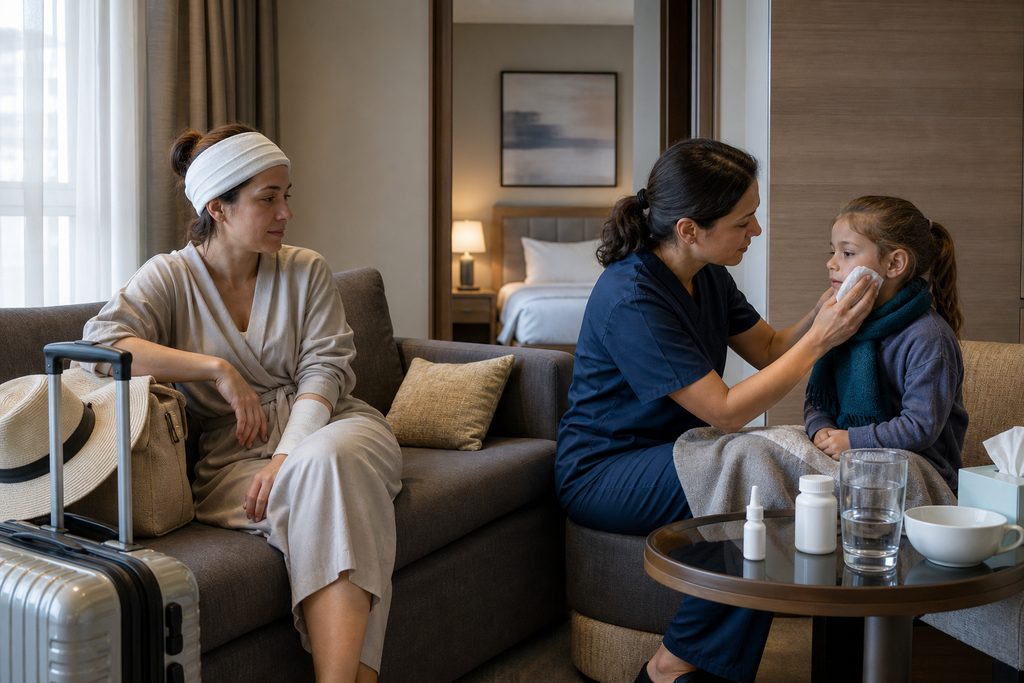
According to the Medical Tourism Association’s 2023 patient survey, 17% of international medical travelers bring a dependent child, yet fewer than one in three have a contingency plan for that child’s own health. You traveled to China for a procedure you needed. The surgery went well. Then your child spikes a fever at 2 a.m. in a Shanghai hotel room while you are three days post-op, still on pain medication, and unsure whether you can even lift them. That moment is terrifying. It is also solvable. What you need is not abstract reassurance but a clear, pre-arranged pediatric care package China surgery recovery framework that tells you exactly who to call, where to go, and how to keep your own recovery on track while your child gets treated.
Our team has coordinated care for families in exactly this situation across Beijing, Shanghai, Guangzhou, and other major medical hubs. The question “what if my child gets ill during my surgery trip China” comes up more often than most patients expect. We have built protocols around it. Here is what those protocols look like in practice, and how you can set them up before you ever board the plane.
How This Actually Works, Step by Step
You land in China with a surgery date, a recovery timeline, and a child who was perfectly healthy at departure. Then things shift. The sequence that follows depends entirely on whether you planned ahead or are scrambling reactively. Here is the planned version.
Step one happens weeks before travel. During your initial consultation with our coordination team, we ask a direct question: are you bringing children, and do you want pediatric contingency coverage built into your service package? If yes, we map the nearest JCI-accredited or international-standard pediatric facility to your accommodation and your surgical hospital. That facility is pre-identified, not googled at midnight. We confirm their English-speaking capacity, their pediatric fever clinic hours, and whether they accept direct insurance billing or require upfront payment with reimbursement later.
Step two is document readiness. We ensure your child’s passport, birth certificate, vaccination records, and any known allergy or medication list are digitized and accessible offline on your phone. For children under 6, we also confirm which hospitals in your city stock pediatric formulations of common medications—many Chinese hospitals carry adult dosages by default, and pediatric suspensions are not universal.
Step three is the trigger event. Your child develops symptoms. You contact our 24-hour bilingual support line. Within 30 minutes, a coordinator confirms the pre-mapped facility’s current wait time, dispatches a bilingual medical companion to your location if needed, and arranges transport that accommodates both your post-surgical mobility limits and your child’s condition. You do not navigate a Chinese hospital’s pediatric triage system alone while on crutches. That is the difference between a plan and a prayer.
Step four runs parallel: your own recovery monitoring. While your child is being assessed, our team checks in with your surgical team to ensure your missed rest or unexpected physical strain has not introduced complications. Pain management adjustments, wound checks, and medication scheduling continue uninterrupted. Both patients stay on the radar.
Can Your Child Stay With You in a Chinese Hospital?
The short answer: rarely overnight, and almost never in a standard inpatient ward. This surprises many families. Western patients often assume a pediatric care package China surgery recovery arrangement means their child can simply bunk in their hospital room. Chinese public hospital regulations do not permit that. Infection control rules are strict. Most wards allow one adult caregiver—usually a spouse or hired huren (护工, patient attendant)—but children under 12 are generally not permitted as overnight visitors except in specific VIP or international department suites at private hospitals.
United Family Healthcare and Jiahui International Hospital in Shanghai both offer family-centered inpatient suites where a child may stay with a parent under supervised conditions. Those suites cost more—expect from $500 to $1,200 per night depending on the facility and room tier—and must be booked well in advance. Public hospitals, including the international departments of Peking Union Medical College Hospital or Zhongshan Hospital, enforce stricter separation. Your child can visit during designated hours, typically 3 p.m. to 7 p.m., but cannot remain after evening rounds.
This reality shapes your entire recovery logistics. If your child needs overnight supervision and you are still an inpatient, you need a second trusted adult. That might be your spouse traveling with you, a family member who flew in, or a vetted caregiver arranged through our coordination service. We have worked with English-speaking nanny agencies in Beijing’s Chaoyang district and Shanghai’s French Concession that provide background-checked, pediatric-first-aid-trained caregivers on 24-hour notice. Rates run from $150 to $250 per 24-hour period. It is not a luxury add-on. It is the structural answer to the question “can my child stay with me in Chinese hospital” when the honest answer is no.
A Realistic Timeline
Time moves differently when you are managing two patients in a foreign country. Here is what a typical dual-recovery scenario looks like from symptom onset to resolution, based on cases our team has coordinated in Shanghai and Beijing.
| Stage | Timeframe | What Happens | Your Role |
|---|---|---|---|
| Symptom recognition | Hour 0 | Child shows fever, vomiting, rash, or respiratory distress. You notify our 24-hour line. | Stay calm. Take temperature. Do not self-medicate with OTC drugs brought from home without checking local formulations. |
| Triage and dispatch | Hour 0–1 | Coordinator confirms facility availability, dispatches bilingual companion if requested, arranges transport. | Pack your child’s documents, a change of clothes, and your own post-op essentials if you must accompany them. |
| Hospital arrival and assessment | Hour 1–3 | Registration, initial vitals, pediatrician examination. Fever clinics may require a rapid COVID/flu test before entry to main pediatric areas. | Communicate symptoms clearly to the companion who translates. Provide vaccination history. |
| Diagnosis and initial treatment | Hour 3–6 | Blood work, possibly imaging. Common pediatric issues like upper respiratory infections or gastroenteritis are typically diagnosed and treated within the emergency department. | If you are post-op day 1–3, you should not be sitting in an ER chair for six hours. The companion handles logistics while you rest in a designated waiting area or return to your accommodation. |
| Discharge or admission decision | Hour 6–12 | Most pediatric acute illnesses are discharged with medication and follow-up instructions. Admission is rare but possible for severe dehydration, pneumonia, or surgical emergencies. | If admission is required, the coordinator arranges a caregiver for your child so you can return to your own recovery. This is the moment a pre-arranged plan pays for itself. |
| Recovery overlap | Days 2–7 | Your child recovers at your accommodation or with a caregiver while you continue your surgical recovery. Daily check-ins from our team monitor both patients. | Rest. Seriously. Your surgical outcome depends on it. Let the support structure work. |
| Follow-up and clearance | Day 7–10 | Pediatric follow-up if needed. Your surgical follow-up proceeds on schedule. Both patients cleared for travel home when appropriate. | Confirm all medical records are collected and translated for your home physician. |
The timeline above assumes you are in a Tier 1 city with English-capable pediatric services. In smaller cities where our network includes 340+ top-ranked hospitals across 37 cities, pediatric international services may be concentrated at one or two facilities. Travel time to that facility adds 30 to 90 minutes. We factor this into city selection during the planning phase. Some patients choose their surgical city partly based on pediatric backup availability. That is smart planning, not paranoia.
What Can Go Wrong — and What Happens Then
No plan survives contact with reality unchanged. Here are the failure modes we have actually seen, and the recourses that exist.
Failure mode one: your child’s illness is more serious than a fever. A 6-year-old with abdominal pain turns out to have appendicitis. This happened to a patient family in Guangzhou in 2024. The mother was five days post-spinal surgery. She could not physically transport her child to the OR, nor could she make medical decisions in Mandarin under that stress. Our coordinator activated the pediatric surgery team at the pre-mapped international hospital, arranged consent via video call with the father who was still in the UK, and placed a bilingual caregiver with the child for the 24-hour post-operative observation period. The mother’s recovery was not interrupted. The child had an uneventful laparoscopic appendectomy. Total additional coordination cost: approximately $600 beyond the base service package. The alternative—a panicked mother trying to navigate a Chinese surgical consent form alone—is unthinkable.
Failure mode two: both patients need inpatient care simultaneously. You develop a post-surgical infection requiring readmission on the same day your child is admitted for severe dehydration. This is rare but not hypothetical. In this case, the coordination team splits resources: one bilingual companion stays with you to communicate with your surgical team, another stays with your child in the pediatric ward. Your spouse, if present, can float between both. If no spouse is present, the caregiver network activates. This is why we recommend families budget for this contingency. The question “how to care for sick child while recovering from surgery abroad” has a blunt answer: you do not do it alone. You pay for parallel care structures or you risk both recoveries.
Failure mode three: language breakdown at a critical moment. You are in a public hospital pediatric emergency department at 11 p.m. The attending physician speaks functional but limited English. Your child is crying. You are in pain. The doctor needs to explain that the blood work shows elevated white blood cells and they recommend IV antibiotics. You hear “IV” and “antibiotics” but miss the rationale, the drug name, and the allergy cross-check question. A bilingual medical companion on-site prevents this entire cascade. Our companions are not interpreters on a phone. They are physically present, trained in medical terminology in both languages, and empowered to ask clarifying questions on your behalf. For pediatric situations, we assign companions with specific pediatric experience when available. The difference between “the doctor said something about an IV” and “the doctor is recommending ceftriaxone IV after confirming no cephalosporin allergy, and here is the informed consent form in English” is the difference between safe care and a gamble.
How to Evaluate Medical Tourism China Family Support Services Before You Book
Not all coordination services include pediatric contingency planning. Asking the right questions before you commit separates comprehensive support from a simple hospital appointment booking service. Here is what to ask any provider when you are traveling with children.
First, ask directly: “Do you have a written pediatric contingency protocol, and can I see it?” A legitimate provider will have a document outlining trigger points for activation, pre-mapped facilities, caregiver sourcing, and cost estimates. If the answer is “we will handle it if it comes up,” that is not a protocol. That is a hope.
Second, ask about caregiver vetting. If your child needs overnight supervision while you are hospitalized, who provides that care? What are their qualifications? Are they background-checked? Do they speak English? Are they trained in pediatric first aid? A service that cannot answer these questions specifically is not a family support service. It is a hospital booking agent with a wider brochure.
Third, ask about the pediatric facilities themselves. Which hospital would your child be taken to? Is it JCI-accredited? Does it have a dedicated pediatric emergency department or only a general ER with pediatric consult capacity? What is the average wait time for a febrile child at 10 p.m. on a Tuesday? These are knowable facts. A coordinator who has worked in that city for more than six months can answer them. A coordinator who cannot is learning on your dime.
Fourth, understand the cost structure. The term childcare during medical treatment in Shanghai or any other Chinese city covers a range of services at different price points. A bilingual companion for a pediatric ER visit runs from $200 for a half-day. A 24-hour pediatric caregiver runs $150 to $250. Pediatric consultation at an international hospital runs $100 to $300 depending on the facility and complexity. These are not hidden fees. They are line items in a transparent contingency budget. If a provider bundles everything into one flat fee without explaining what triggers additional costs, ask for the breakdown. Our pricing is structured as transparently as possible: from $200 per day for bilingual medical companionship, with pediatric-specific assignments noted at booking, and all costs confirmed before any service is activated. No surprises at 2 a.m.
This evaluation framework matters because the term “medical tourism China family support services” is broad. It can mean a WhatsApp group with a translator, or it can mean a structured, staffed, 24-hour operation with pre-mapped facilities and vetted caregivers. You want the latter. The questions above tell you which one you are talking to.
Practical Considerations: Documents, Insurance, and Payment
Pediatric care in China, even emergency care, runs on documentation. Showing up without the right papers adds friction to an already stressful situation. Here is what needs to be in your bag—and on your phone—before you leave home.
Your child’s passport and visa. Your child entered China on an S2 visa as your dependent, assuming you are the primary S2 holder for medical treatment. The hospital registration desk will ask for this. Have a physical copy and a phone scan. If your child’s visa was issued as an L (tourist) visa because you did not declare them as a medical companion, this can complicate admission at some public hospitals. International private hospitals are generally more flexible, but the principle stands: your child’s visa category should match their purpose of stay. We advise families on this during the pre-travel documentation phase. It is a small detail that prevents a large headache.
Vaccination records. Chinese pediatricians will ask about immunization history, especially for febrile illnesses where vaccine-preventable diseases are in the differential. Have an English-language record, and ideally a translated summary. Our coordination team can arrange certified translation of vaccination cards before travel. This takes about three business days and costs approximately $50.
Insurance and payment. International private hospitals like United Family, Jiahui, Parkway, and Raffles in China accept direct billing from major international insurers including Cigna, Aetna, Bupa, and Allianz. Confirm your policy’s pediatric emergency coverage before travel, and understand whether your child is covered under your medical tourism policy or needs a separate travel insurance policy with medical coverage. Many medical tourism policies cover the patient only, not accompanying family members. This is a common gap. Public hospital international departments typically require upfront payment with reimbursement later. A pediatric ER visit with basic labs at a public hospital international department runs $100 to $300. At a private international hospital, expect $200 to $600. Admission with IV treatment adds $500 to $1,500 per night depending on the facility and room type. These are real numbers from 2024 cases in Shanghai and Beijing. Budget for them.
Medication considerations. Do not assume your child’s usual fever reducer or allergy medication is available in the same formulation in China. Pediatric ibuprofen suspension (Motrin equivalent) is widely available at Chinese pharmacies. Pediatric acetaminophen (Tylenol equivalent) is also common. But specific allergy medications, asthma inhalers, or ADHD medications may differ in brand, dosage form, or availability. Bring a sufficient supply from home for the full trip duration plus one extra week, in original packaging with a doctor’s letter. For controlled substances, check China’s National Medical Products Administration regulations before travel. Some medications legal in Western countries are restricted in China. Our team provides a medication pre-check service as part of the travel preparation package.
Frequently Asked Questions
Chronic condition management requires pre-identification of a specialist before travel. If your child has asthma, epilepsy, type 1 diabetes, or another condition requiring specialist care, we map the appropriate pediatric subspecialist at your destination city during the planning phase. Pediatric pulmonologists, neurologists, and endocrinologists are available at major children’s hospitals in Beijing, Shanghai, and Guangzhou. We confirm their English capability and availability windows. If a flare occurs, you activate the pre-identified channel rather than starting from zero. This is not an add-on. It is baseline planning for any family traveling with a child who has a known condition.
Can I bring my child to my own surgical follow-up appointments?
Yes, with caveats. Outpatient clinic waiting areas in Chinese public hospitals are crowded, loud, and not designed for children. A restless child in a packed cardiology waiting room at Fuwai Hospital, which sees over 14,000 cardiac surgeries annually, is a stress multiplier for everyone. If your child is well and you simply need them with you, bring a second adult to manage the child while you consult with your surgeon. If a
For more medical information and treatment options in China, visit chinamedservices.com (China Medical Services).
