Netherlands to China Second Opinion: Remote Case Review by PUMCH Rare Disease Specialists
Key Takeaways
- Peking Union Medical College Hospital (PUMCH) diagnoses approximately 40% of previously undiagnosed rare disease cases referred to its center — a figure that reshapes what patients should expect from a second opinion.
- A written second opinion from a PUMCH specialist costs $300–500. The fee credits in full toward on-the-ground coordination if you later travel to China for treatment.
- Language barriers, medical record translation requirements, and the absence of a self-service portal for international patients make independent navigation genuinely difficult — not impossible, but far harder than most Dutch patients anticipate.
- Remote case review is not a prescription. It is an expert analysis of your existing records, designed to confirm a diagnosis, suggest alternatives, or recommend next diagnostic steps.
The Problem: When the Answers Stop Coming
Rare diseases affect approximately 1 in 17 people across their lifetime. That is roughly 300 million individuals worldwide. But prevalence is only half the story. The harder truth is the diagnostic delay. A 2019 survey by EURORDIS found that 25% of rare disease patients waited between 5 and 30 years for an accurate diagnosis. For those with ultrarare conditions — the ones that show up in fewer than 1 in 50,000 people — the average diagnostic odyssey stretches across 8 physicians and 4 years.
The Netherlands has excellent healthcare. No serious person disputes that. University medical centers like Erasmus MC and Amsterdam UMC run dedicated expertise centers for rare diseases. But expertise centers, by definition, see what they have seen before. When a patient’s presentation falls outside known patterns — when the clinical picture does not match any familiar syndrome — even the best Dutch specialists can reach an impasse. They are not failing. They are operating at the edge of what a single-country referral network can offer.
This is where the geography of medical expertise matters. China sees patient volumes that no European country can match. Peking Union Medical College Hospital in Beijing runs the largest rare disease diagnostic center in the country. Its specialists evaluate cases referred from across China’s population of 1.4 billion. That scale produces something valuable: pattern recognition honed on presentations that a Dutch specialist might encounter once in a career.
A remote case review from PUMCH is not about replacing your Dutch doctors. It is about adding a pair of eyes that have seen more.
Who We Are
We are not a hospital. We do not provide medical treatment, clinical diagnoses, or prescriptions. Our team acts as your logistical architects — we bridge the gap between you and China’s top-tier medical expertise. We handle medical record translation, specialist matching, appointment coordination through official hospital international channels, and bilingual accompaniment. When you work with us, you stay focused on your health. We manage everything else. Our network spans 340+ top-ranked hospitals across 37 Chinese cities. For rare disease patients specifically, we connect you with the specialists at Peking Union Medical College Hospital whose rare disease center has become a national referral hub.
Why a PUMCH Remote Second Opinion Delivers Answers Others Miss
The Volume Argument: Rare Is Relative
A rare disease specialist at a major European center might evaluate 50 to 100 complex undiagnosed cases annually. A PUMCH rare disease specialist evaluates several hundred. The hospital’s multidisciplinary rare disease team convenes weekly to review cases that have stumped referring physicians across China. That means a single case review at PUMCH draws on the collective experience of clinicians who have collectively seen thousands of atypical presentations.
This is not speculation. PUMCH’s rare disease center has documented a diagnostic yield of roughly 40% for cases that arrived without a confirmed diagnosis. In plain terms: 4 out of 10 patients who had been through extensive workups elsewhere received a definitive diagnosis after PUMCH review. Some of those diagnoses were conditions so rare that fewer than 200 cases appear in global medical literature.
Volume does not guarantee an answer. But it shifts the odds meaningfully.
Diagnostic Infrastructure Built for Complexity
PUMCH operates China’s national rare disease registry and maintains one of the country’s largest biobanks for genetic analysis. The hospital has invested heavily in whole-exome sequencing, whole-genome sequencing, and metabolomics platforms. For a Dutch patient sending records for remote review, this matters in a specific way: the reviewing specialist can cross-reference findings against an internal database of Chinese rare disease phenotypes that includes populations underrepresented in Western genomic databases.
Some genetic variants that are vanishingly rare in European populations appear with higher frequency in East Asian populations. A variant dismissed as a variant of unknown significance in a Dutch lab might be recognized as pathogenic by a PUMCH geneticist who has seen it present clinically a dozen times. That difference in perspective can change a diagnosis from “uncertain” to “confirmed.”
The PUMCH Remote Second Opinion Cost Is Structured for Accessibility
Let us address the financial question directly. The PUMCH remote second opinion cost for a written case review by a specialist ranges from $300 to $500. A top-specialist video consultation, where you speak directly with the reviewing physician through a secure platform with a medical interpreter present, ranges from $500 to $800. These are the fees for the case review itself — the clinical work of analyzing your records, imaging, and test results.
Compare this to the cost of traveling to China for an in-person consultation. A round-trip flight from Amsterdam to Beijing runs approximately $800 to $1,200. Hotel stays, ground transport, and meals for a week add another $1,000 to $1,500. An in-person specialist consultation coordination fee starts from $800. Total cost for an in-person trip: roughly $2,600 to $3,500, excluding any diagnostic tests ordered on-site.
A remote review costs a fraction of that. And if you later decide to travel to China for treatment, the entire remote consultation fee is credited toward your on-the-ground coordination service — a one-time credit that applies within 90 days. You are not paying twice. You are paying once, with the remote review serving as a low-risk first step.
None of these fees include hospital treatment charges. They never do. Hospital bills are paid directly to the hospital and vary by case complexity.
How a Remote Case Review from China Actually Works
The process is methodical, not magical. Here is what happens from the moment you decide to pursue a rare disease specialist online consultation China through PUMCH.
First, your medical records must be compiled and translated. This is not a casual step. PUMCH requires complete documentation: referral letters, clinical summaries, laboratory results, imaging reports, pathology slides if relevant, and any genetic testing data. All documents must be translated into Mandarin Chinese by a translator familiar with medical terminology. A mistranslated lab value or a poorly rendered imaging finding can misdirect the entire review. Our team handles this translation in-house, using bilingual medical professionals who understand both the terminology and the clinical context.
Once translated, your records are submitted through PUMCH’s official international patient channel. This is not a backdoor. It is the hospital’s designated pathway for overseas cases — the same channel used by embassies, multinational corporations, and foreign government health programs. The hospital’s international department assigns your case to the appropriate specialist based on your clinical presentation.
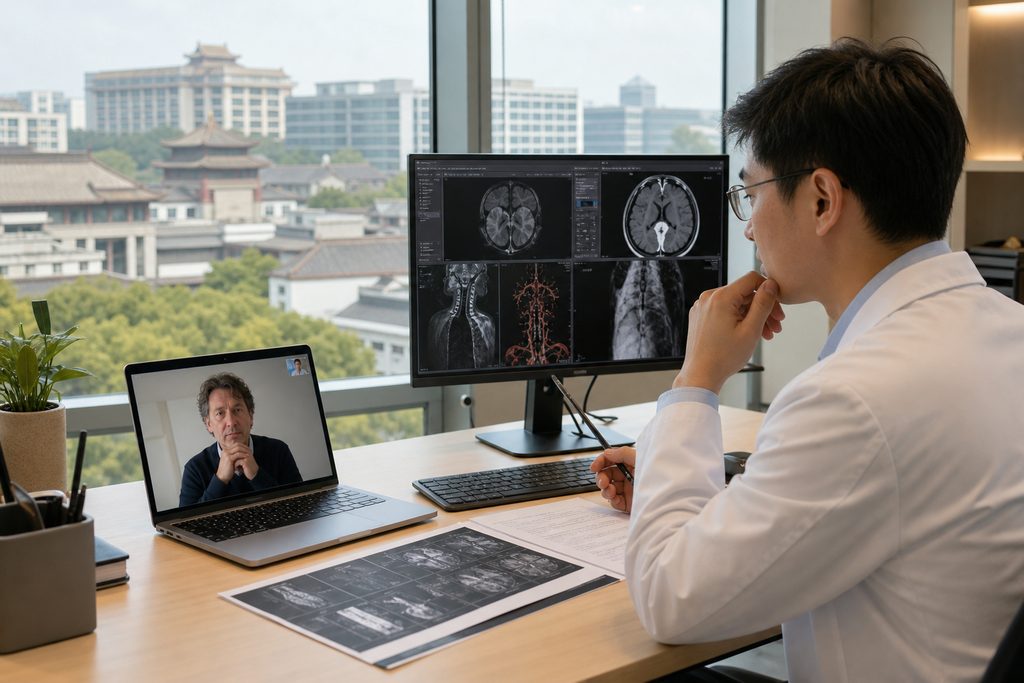
The specialist reviews your records independently. For complex cases, the review may be elevated to a multidisciplinary discussion. You receive a written report — typically 3 to 5 pages — that addresses the working diagnosis, suggests alternative diagnoses if warranted, recommends additional testing, and outlines treatment options available in China if you choose to travel. For a video consultation, you discuss these findings directly with the specialist through a secure telemedicine platform, with a medical interpreter facilitating the conversation.
The entire process, from record submission to receiving the written report, typically takes 7 to 14 business days. Video consultations are scheduled based on specialist availability, usually within 2 to 3 weeks of record acceptance.
What You Need to Know Before Going Alone
Some patients attempt to navigate this process independently. It is possible. It is also considerably harder than it looks. Here are the barriers you will face if you try to send medical records to China for rare disease diagnosis without support:
- Medical record translation is unforgiving. PUMCH does not accept records in Dutch or English for specialist review. Every page must be professionally translated into Mandarin Chinese. General translation services will not suffice — a translator unfamiliar with “pancytopenia” or “cerebellar ataxia” can introduce errors that compromise the clinical review. Medical translation is a specialized skill, and it costs accordingly.
- There is no self-service portal for international patients. Unlike some Western hospitals that offer online appointment booking, PUMCH’s international patient pathway operates through direct coordination with the international department. You cannot upload records to a website and wait for a response. The process requires phone calls, emails, and often in-person document delivery — all conducted in Mandarin during Beijing business hours.
- Payment systems differ from what Dutch patients expect. PUMCH’s international department accepts wire transfers and certain international credit cards, but the process is not always smooth. Payment must clear before the review begins. Delays in international wire transfers can push your case back by a week or more. Our team handles payment coordination so your review starts on schedule.
- Follow-up questions require a channel. After you receive the written report, you will likely have questions. Without a coordinator, getting those questions to the specialist and receiving answers means navigating the same phone-and-email pathway again — during Beijing hours, in Mandarin.
How We Help You Navigate This
The $300–500 written review fee covers the specialist’s time analyzing your records, consulting colleagues if needed, and producing the written report. The $500–800 video consultation fee covers the same review plus a live discussion with a medical interpreter. These fees do not include hospital treatment charges, diagnostic tests ordered after the review, or travel costs if you later decide to visit China. The fee does include our coordination work: record translation, submission, payment handling, and report delivery.
This happens. No diagnostic center, however experienced, solves every case. If the specialist cannot reach a definitive diagnosis, the written report will still provide value: it will confirm which diagnoses have been ruled out, suggest additional testing that might yield answers, and recommend next steps. Some patients use this information to guide further investigation with their Dutch specialists. Others pursue a multidisciplinary team review, which brings multiple PUMCH specialists together to examine the case from different angles. An MDT video consultation costs $1,500–2,000 and sometimes identifies patterns that a single specialist misses.
PUMCH is consistently ranked in the top tier of Chinese hospitals by the Fudan University hospital rankings, the country’s most authoritative hospital evaluation system. Its rare disease center is the national reference center for undiagnosed diseases in China. The specialists who review your case are the same clinicians who evaluate complex referrals from across China’s hospital network. You are not being routed to a junior physician or a separate international patient service with different clinical standards. You are getting the same expertise that Chinese patients receive when referred to PUMCH as a last resort.
Dutch health insurers vary in their policies on international second opinions. Some reimburse remote consultations if referred by your Dutch specialist. Others do not. We recommend contacting your insurer before proceeding. We can provide the documentation you need — invoices, specialist credentials, hospital accreditation details — to support any reimbursement claim. But we cannot guarantee that your insurer will cover the cost. The financial decision is yours.
Your Next Step
A remote second opinion from PUMCH is not a miracle. It is a methodical, evidence-based process that adds a high-volume, high-expertise perspective to your diagnostic journey. For Dutch patients who have spent years without answers, that perspective can be the difference between continuing the search and finding the diagnosis that changes everything.
If you want to understand whether a remote case review makes sense for your specific situation, start with a conversation. There is no cost for the initial consultation, and no pressure to proceed. We will help you think through the decision honestly — even if the honest answer is that a remote review is not the right step right now. Get a free consultation and let us help you determine your next move.
Frequently Asked Questions
Yes. We work with JCI-accredited and major Grade 3A tertiary hospitals that follow international safety standards comparable to top hospitals in the US and Europe. Surgical teams perform high volumes of procedures — often more than their Western counterparts — which studies show leads to better outcomes.
Costs vary by procedure and hospital, but international patients typically save 40-80% compared to US prices — even when factoring in travel and accommodation. A consultation with our team will give you an exact, all-inclusive quote with no hidden fees.
Send us your existing medical reports. The relevant specialty reviews them and gives you a written opinion, including treatment direction and options, before you commit to any travel. From there you can add a video consultation with the doctor, or have us attend an appointment on your behalf.
For more medical information and treatment options in China, visit chinamedservices.com (China Medical Services).
