Electroacupuncture in China: How It Works, Safety, and Cost
Key Takeaways
- Electroacupuncture is conventional acupuncture with a mild electrical current passed between paired needles; it is used mainly for chronic pain, neurological rehabilitation and some musculoskeletal conditions.
- China is where the technique was formalized in the 1950s, and it is delivered inside mainstream hospital acupuncture and rehabilitation departments — not only in standalone clinics.
- Electroacupuncture treatment cost in China is typically modest by Western standards, but the total depends on session count, hospital tier and whether you use a standard or international department.
- Safety depends far more on the operator, sterile technique and your own medical history than on the electricity itself; certain patients with implanted cardiac devices should not receive it.
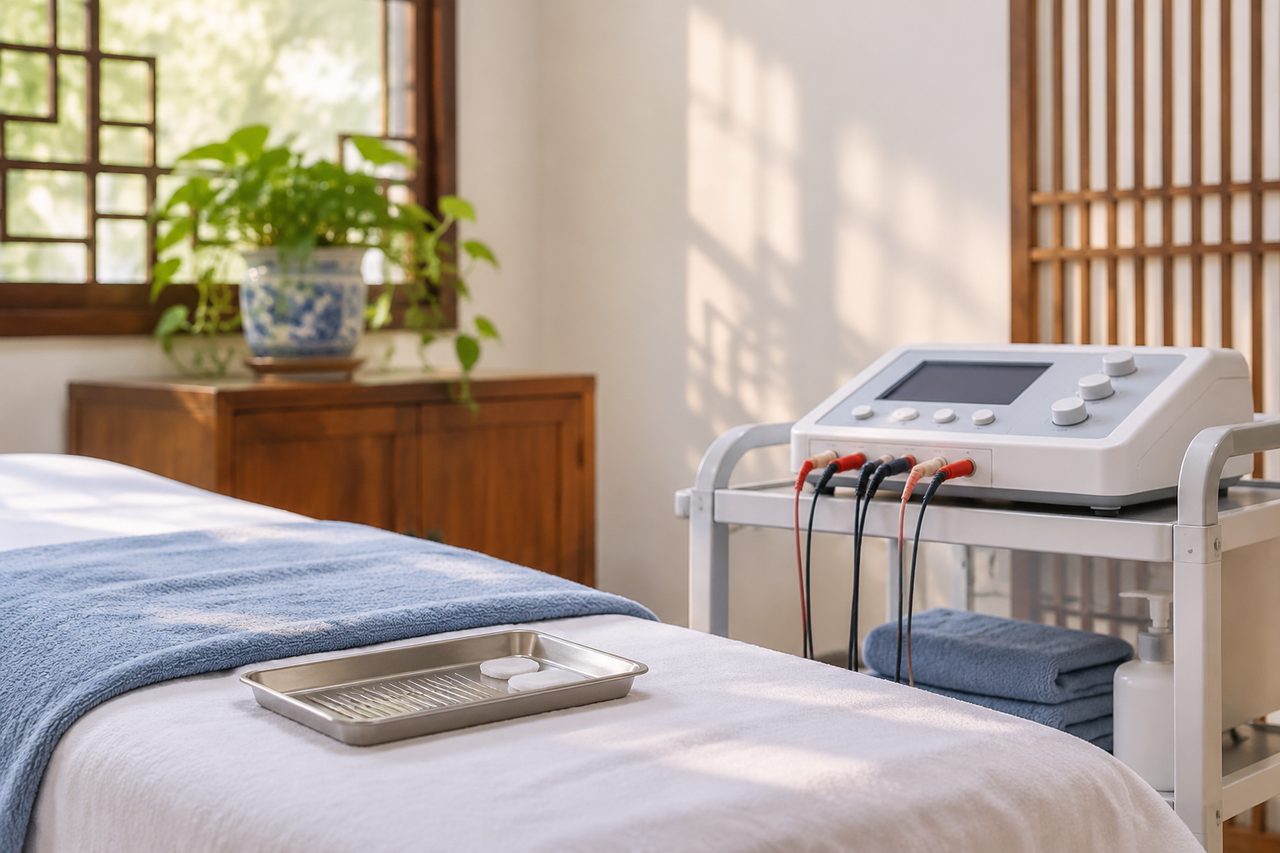
Electroacupuncture in China works by inserting standard acupuncture needles and then passing a small, regulated electrical current between pairs of them. The current is produced by a certified device, usually at a frequency the practitioner adjusts between roughly 2 and 100 Hz, and it is intended to stimulate nerve and muscle tissue more consistently than manual needle twirling alone. In Chinese hospitals the technique sits inside the acupuncture and rehabilitation departments of mainstream institutions, and it is most often used for chronic pain, post-stroke rehabilitation and persistent musculoskeletal problems. Understanding electroacupuncture treatment cost China pricing, safety practice and how a course is structured helps you decide whether it belongs in your plan.
The Problem: Chronic Pain That Never Quite Resolves
Chronic pain is not a minor complaint. The Global Burden of Disease analyses published in The Lancet have repeatedly ranked low back pain among the leading causes of years lived with disability worldwide, and a large proportion of adults with persistent musculoskeletal pain report inadequate relief from medication alone. For many patients the practical problem is not a lack of options but a lack of tolerable ones: long-term NSAID use carries gastrointestinal and cardiovascular risks, opioid dependence is a documented public health crisis in North America, and waiting lists for specialist pain clinics can run for months in publicly funded systems.
That gap is why patients search for adjunctive approaches. Acupuncture has been studied for decades, and the evidence is mixed but not empty — systematic reviews, including those underlying the UK National Institute for Health and Care Excellence guidance on low back pain, have found short-term benefit for some chronic pain conditions while noting that effect sizes are modest and study quality varies. Electroacupuncture is the variant most often used in Chinese clinical practice when a course of manual acupuncture is judged insufficient. The honest framing is this: it is a reasonable adjunct for selected chronic pain and rehabilitation problems, not a replacement for diagnosis or for treatment of the underlying condition.
Why China Delivers a Different Experience With Electroacupuncture
China is not simply one more country where acupuncture is available. It is the setting in which modern electroacupuncture was standardized, and it is where the technique is embedded in hospital medicine rather than confined to private wellness clinics.
Institutional Depth and Clinical Volume
Electroacupuncture is taught in the acupuncture and tuina programs of China’s medical universities and practiced daily in the acupuncture departments of large public hospitals. A senior practitioner in a busy Chinese hospital acupuncture department may treat dozens of patients in a single clinic session, which builds pattern recognition across presentations that a low-volume Western clinic rarely accumulates. Acupuncture and moxibustion departments also commonly sit alongside neurology, orthopedics and rehabilitation within the same hospital, so referrals between them are routine rather than exceptional.
Standardized Equipment and Protocols
Chinese hospital acupuncture departments use registered electroacupuncture devices with defined waveform and frequency settings, and treatment parameters are typically recorded in the patient’s file. Sessions usually run 20 to 30 minutes with the current adjusted to a tolerable tingling or muscle-twitch response. This is a meaningful difference from clinics where the device is an afterthought: the parameters, needle depth and point selection are documented, which makes a course reviewable and adjustable.
Integration With Conventional Diagnostics
One practical advantage of receiving electroacupuncture in a Chinese hospital rather than a standalone clinic is access to imaging, nerve conduction studies and laboratory testing in the same institution. If your pain turns out to have a cause that needs surgical or medical management, the acupuncture department is inside a system that can act on that finding. Our role at China Medical Services is to help you identify hospitals where this integration exists, not to substitute for the clinical assessment itself.
How Does Electroacupuncture Work for Chronic Pain?
The proposed mechanism is reasonably well described, even if the clinical evidence remains debated. Inserting a needle creates a local micro-trauma that triggers tissue repair signaling. Passing a low-frequency current through paired needles appears to recruit broader nerve pathways, and laboratory work has suggested release of endogenous opioids and modulation of descending pain-inhibitory pathways. Higher frequencies are generally used where a more segmental, local effect is wanted; lower frequencies where a broader, longer-lasting effect is the goal.
In practice a Chinese hospital course for chronic low back pain might look like this:
- Sessions 1–2: Assessment, point selection, low-intensity current to establish tolerance.
- Sessions 3–10: Typically two to three sessions per week, with frequency and point combinations adjusted according to response.
- Review: Reassessment at around the tenth session; continuation is decided on the basis of measurable change in pain scores and function, not on habit.
A course of ten to fifteen sessions over three to five weeks is a common structure, though this varies by hospital and case complexity. Electroacupuncture is frequently combined with manual acupuncture, tuina massage, moxibustion or herbal prescriptions within the same department — the traditional Chinese medicine hospital directory lists institutions where these services are delivered together.
Is Electroacupuncture Safe in China Hospitals?
For most patients, yes, when performed by a trained practitioner with sterile single-use needles. The most commonly reported adverse events across acupuncture research are minor: transient soreness, small bruising, and occasional light-headedness during the session. Serious complications such as infection or pneumothorax are rare and are associated with poor technique or non-sterile needles rather than with the electrical current itself.
Electroacupuncture specifically carries a small number of contraindications that matter:
- Implanted cardiac devices. Patients with pacemakers or implanted defibrillators should not receive current across the chest, and many practitioners avoid electroacupuncture entirely in this group. This is a genuine restriction, not a formality.
- Pregnancy. Certain points and currents are avoided, particularly over the abdomen and lower back.
- Epilepsy, severe cardiac arrhythmia and uncontrolled bleeding disorders require individual assessment before treatment.
- Areas of broken skin, infection or active tumor are not needled.
Be explicit with the practitioner about every implanted device, anticoagulant, pregnancy status and neurological diagnosis. In a busy Chinese clinic the intake conversation may be brief, and an interpreter or a written medical summary in English and Chinese closes that gap. Bring your device card and medication list.
What Does Electroacupuncture Treatment Cost in China?
Electroacupuncture treatment cost China pricing is genuinely low relative to Western private practice, but it is not a single number. In public hospitals, acupuncture and electroacupuncture are billed per session as a clinical service, and the fee varies by hospital tier, city and whether you are seen in a standard outpatient clinic or an international department. International departments charge more because they provide English-speaking staff, appointment coordination and shorter waits.
Rather than quote a figure we cannot verify for your case, here is how the total is actually built:
| Cost component | What drives it | How to clarify before committing |
|---|---|---|
| Per-session procedure fee | Hospital tier, city, standard vs. international department | Ask the hospital’s international office for the current procedure code and price |
| Number of sessions | Condition, response at review, practitioner’s plan | Request a written proposed course length, not an open-ended plan |
| Initial consultation and diagnostics | Whether imaging or nerve studies are needed | Ask which tests are required before the first session |
| Interpretation | Whether the department provides English service | Confirm language support in writing; bilingual accompaniment is priced per day |
| Travel, accommodation, visa | City, season, length of stay | Estimate on the basis of the full course, not one session |
For context on how Chinese hospital pricing is structured generally, and how international departments differ from standard outpatient channels, our guide to top-ranked hospitals by city explains the tiering. Published Western price comparisons for acupuncture are not a reliable guide to Chinese hospital fees, and we do not publish a session price we have not confirmed with the institution.
Planning a Course: Practical Considerations
Electroacupuncture is usually a multi-week commitment, and that shapes the logistics more than the treatment itself.
Records. Bring imaging reports, prior diagnoses and a medication list translated into English or Chinese. Chinese acupuncture departments work within a diagnostic framework that includes conventional medicine, and a clear history shortens the assessment.
Visa. For short medical visits, the applicable category is the S2 visa, used for medical treatment and private affairs and typically supported by hospital documentation; stays beyond 180 days fall under S1. Requirements change, so confirm current documentation with the nearest Chinese embassy or consulate. The M visa is a commercial and trade category and is not the correct route for medical treatment.
Appointments. Standard outpatient acupuncture clinics in large public hospitals generally cannot be booked from abroad in advance; registration typically happens on the day. International departments can often arrange appointments ahead of arrival, at a higher fee.
Payment. Public hospitals usually require payment at the time of service, with insurance reimbursement claimed afterward in your home country. Confirm in advance whether your insurer covers acupuncture abroad and what documentation it requires.
Follow-up. Ask the practitioner to write a discharge summary listing points, frequencies and response, so a practitioner at home can continue or adapt the approach.
Frequently Asked Questions
Most Chinese hospital courses for chronic pain run ten to fifteen sessions over three to five weeks, with a formal review around session ten. The honest answer is that it depends on your diagnosis and your response; a practitioner who guarantees a fixed number before assessing you is not giving you a clinical plan.
Coverage varies widely by insurer and policy. Some international plans reimburse acupuncture when prescribed for a covered diagnosis; many exclude it or cap the number of sessions. Public hospitals generally require upfront payment with later reimbursement, while some private international hospitals bill insurers directly. Confirm with your insurer before you travel.
Usually yes, but this is a decision for the treating clinician who knows your full medication list, particularly with anticoagulants, cardiac drugs or immunosuppressants. Do not adjust prescribed medication on the basis of acupuncture treatment. Bring your full list, including doses, to the first appointment.
A review point exists precisely for this. If there is no meaningful change in pain or function by around the tenth session, the appropriate step is to stop and reassess the diagnosis rather than extend the course indefinitely. Because hospital acupuncture departments sit within larger institutions, imaging and specialist referral are usually available in the same setting.
Your Next Step
Electroacupuncture is a well-established technique in Chinese hospital practice, best understood as a structured, time-limited adjunct for selected chronic pain and rehabilitation problems rather than a standalone cure. If you are considering it, the useful next step is to clarify your diagnosis and a realistic course length before booking travel. China Medical Services helps international patients identify appropriate hospitals and departments, arrange written second opinions and video consultations with Chinese specialty teams, and coordinate interpretation and appointments on the ground. We are not a hospital and we do not provide diagnoses or treatment; we connect you with the institutions that do. A free initial consultation through our patient support team is a reasonable place to start.
This article is for general information only and is not medical advice. Electroacupuncture suitability depends on your individual medical history; consult a qualified clinician before starting any treatment.
For more medical information and treatment options in China, visit chinamedservices.com (China Medical Services).
