Endoscopic Skull Base Surgery China: Brain Tumor Removal Through the Nose
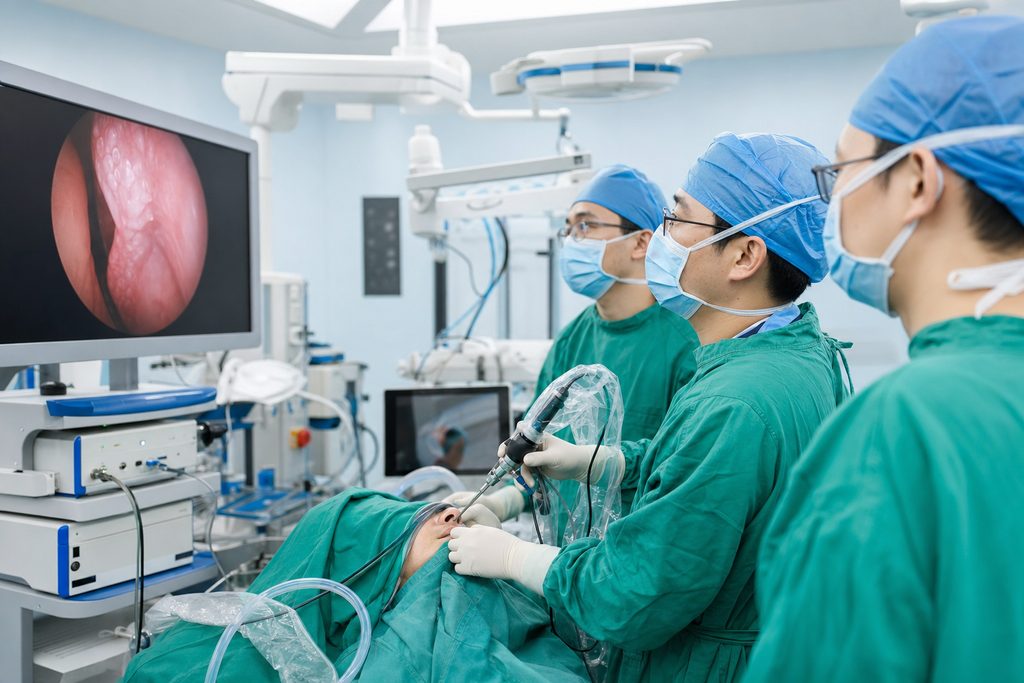
You have probably heard that brain surgery always means opening the skull. A long incision across the scalp. A craniotomy. Weeks in the hospital. The reality is exactly the opposite for a growing number of patients. Surgeons can now reach deep-seated tumors at the base of the brain through a natural opening—the nose. No external scars. No skull flap. Just a precision endoscope and a team that does this hundreds of times a year. And the endoscopic skull base surgery cost China offers makes this advanced approach accessible to patients who might otherwise face years of waiting or six-figure bills at home.
Key Takeaways
- Endoscopic endonasal surgery removes pituitary adenomas and select meningiomas through the nostril, avoiding craniotomy entirely in approximately 80% of suitable cases.
- China’s top neurosurgery centers perform over 400 transsphenoidal procedures annually—volume that directly correlates with lower complication rates.
- The total procedure cost in China ranges from $18,000 to $35,000, roughly one-fifth to one-third of what patients pay in the United States.
- Language barriers, visa requirements, and hospital navigation are genuine obstacles. Going alone without local coordination is not realistic for most international patients.
The Problem: A Tumor at the Base of Your Brain, and a System That Moves Slowly
Pituitary adenomas are surprisingly common. Autopsy and imaging studies suggest that approximately 1 in 5 people harbor a small pituitary tumor, most of them undiagnosed. When these tumors grow large enough to press on the optic chiasm, vision blurs. Peripheral vision narrows. Headaches become daily. Hormonal chaos follows—unexplained weight gain, fatigue, infertility, or acromegaly.
Meningiomas arising from the skull base present a different threat. They are usually benign but relentless. They compress cranial nerves. They wrap around arteries. Left alone, they grow.
The standard of care in North America and Western Europe is excellent—when you can access it. But access is the problem. In Canada, the median wait time from specialist referral to neurosurgical treatment stretches to approximately 26 weeks. The United Kingdom’s NHS reports similar backlogs, with some patients waiting over 18 weeks just for a first consultant appointment. In the United States, the bottleneck is financial. A transsphenoidal resection of a pituitary tumor costs between $70,000 and $120,000. For uninsured or underinsured patients, that number is paralyzing.
And then there is the surgical approach itself. Many centers still default to microscopic transsphenoidal techniques. The microscope offers a narrow, tunnel-like view. The endoscope, by contrast, provides a wide-angle, illuminated panorama of the surgical field. It lets the surgeon see around corners. It reveals tumor remnants that a microscope might miss. Gross total resection rates are higher with the endoscopic approach for many tumor types. But not every hospital has surgeons trained in this technique.
So patients search. They type “best hospital for pituitary tumor removal through nose China” into Google at 2 AM. They wonder if traveling halfway around the world for brain surgery is reckless or rational. They need straight answers.
Who We Are
We are not a hospital. We do not provide medical treatment, surgical procedures, or clinical diagnoses of any kind. Our team functions as your logistical architects—we bridge the gap between you and China’s top-tier neurosurgical expertise. We handle hospital matching based on your specific tumor type and imaging, coordinate appointments through official international departments, arrange bilingual medical companions who stay with you through every step, and guide you through the visa process. We do not promise shortcuts or backdoor access. We promise honest navigation of a complex but world-class system. You focus on your health. We handle everything else.
Why Endoscopic Skull Base Surgery in China Delivers Results
Volume That Rewrites the Complication Curve
Neurosurgery is a craft honed by repetition. The relationship between surgical volume and patient outcomes is well-documented and unambiguous. A landmark 2016 study published in JAMA Surgery found that patients undergoing pituitary tumor resection at high-volume centers had significantly lower rates of postoperative complications, shorter lengths of stay, and lower total costs compared to those treated at low-volume facilities.
China’s top neurosurgery departments operate at a scale that is difficult to match. A single high-volume center in Shanghai or Beijing may perform over 400 transsphenoidal procedures annually. That is more than many entire European countries. The surgeons in these departments have seen every anatomical variation. They have managed every intraoperative surprise. When you ask how is meningioma removed through the nose in China, the answer starts with this: by surgeons whose hands have done it thousands of times.
This volume advantage extends to the full perioperative team. Anesthesiologists who specialize in neuroanesthesia. Dedicated neuro-ICU nurses. Intraoperative MRI technicians. Endocrine teams that manage postoperative hormone fluctuations. The entire ecosystem is built around these procedures.
Technology That Matches or Exceeds Western Standards
Walk into the neurosurgical suite at a Fudan-ranked hospital and you will find equipment that looks familiar if you have toured a Mayo Clinic or Charité operating room. Intraoperative neuronavigation systems. High-definition endoscopes with angled lenses. Intraoperative MRI for real-time resection control. Doppler ultrasound for vascular mapping.
The difference is not the hardware. It is how the hardware is deployed. Because these hospitals run on high throughput, the teams achieve a rhythm that minimizes anesthesia time and maximizes efficiency. A typical endoscopic endonasal approach for a pituitary macroadenoma takes two to three hours. The patient is awake and talking in the recovery unit shortly after. Most patients leave the ICU within 24 hours and the hospital within three to five days.
For patients specifically researching whether can skull base tumors be removed without craniotomy China, the short answer is yes—for appropriately selected cases. Not every tumor qualifies. Tumors with significant lateral extension into the cavernous sinus or those involving major vascular encasement may still require open approaches. But for midline skull base lesions—pituitary adenomas, tuberculum sellae meningiomas, chordomas, craniopharyngiomas—the endoscopic endonasal corridor has become the standard of care at China’s leading centers.
Cost Advantage Without Quality Compromise
Let us address the obvious question. The endoscopic skull base surgery cost China offers is substantially lower than in Western countries. This makes some patients nervous. Does lower cost mean lower quality?
It does not. The cost differential exists for structural economic reasons, not quality reasons. Surgeon salaries, hospital administrative overhead, nursing labor costs, and pharmaceutical pricing all differ dramatically between China and the United States. A top neurosurgeon in Shanghai earns a fraction of what an equivalent surgeon earns in Boston. The hospital’s capital costs are lower. The supply chain for surgical instruments and implants is less expensive. These savings pass through to the patient without affecting the clinical product.
Here is how the numbers break down for international patients:
| Procedure | Estimated Cost in China (USD) | Estimated Cost in USA (USD) |
|---|---|---|
| Endoscopic transsphenoidal pituitary adenoma resection | $18,000 – $28,000 | $70,000 – $120,000 |
| Endoscopic endonasal meningioma resection | $25,000 – $35,000 | $90,000 – $150,000 |
| Extended endoscopic approach (craniopharyngioma, chordoma) | $30,000 – $45,000 | $120,000 – $200,000+ |
These figures include the surgeon’s fee, anesthesia, hospital stay, operating room charges, and standard postoperative care. They vary by hospital tier, tumor complexity, and length of stay. The international department at each hospital provides a formal quotation after reviewing your imaging and medical records. No surprises. No hidden charges.
For patients exploring transsphenoidal surgery for pituitary adenoma price abroad, the savings are significant enough that travel, accommodation, and our coordination fees still leave most patients well below what they would pay out-of-pocket at home.
What You Need to Know Before Going Alone
The clinical argument for seeking care in China is strong. The logistical reality is harder. We are direct about this because patients who arrive unprepared have a miserable experience. Here is what you face if you attempt this independently:
- Visa Requirements: Medical treatment in China requires an S2 visa with a specific annotation for medical purposes. The application demands an official invitation letter from the treating hospital, confirmed appointment documentation, and proof of sufficient funds. Hospitals do not issue invitation letters to unregistered patients. You need a confirmed appointment before you can get the visa, but you need the visa to confirm the appointment. This circular dependency frustrates patients who try to navigate it alone. Family members accompanying you also need S2 visas—not tourist L visas.
- Hospital Registration and Payment: China’s top public hospitals do not accept overseas self-registration for specialist consultations. Their online platforms require a Chinese ID number or local phone verification. Walk-in registration at a Fudan-ranked neurosurgery department means competing with hundreds of local patients who arrive before dawn. Even if you secure a consultation slot, the doctor may not speak English. The hospital’s billing system requires prepayment, and international credit cards are often not accepted at standard cashier windows. You need the international department channel, and that channel is not publicly listed on English websites.
- Imaging and Records Transfer: Chinese neurosurgeons want to see your original MRI DICOM files on a CD or USB drive, not just the radiology report. They may request a new MRI upon arrival using their own protocols. If your records are incomplete or incompatible, your surgical planning stalls. This is fixable but only if someone on the ground knows exactly what each hospital requires.
These barriers exist for structural reasons. They are not malice or bureaucracy for its own sake. China’s hospital system was built to serve a domestic population of 1.4 billion. International patient services are a relatively new layer grafted onto that system. The pathways exist, but they are not self-serve.
How We Help You Navigate This
Our process starts before you book a flight. Send us your MRI images, your pathology report if you have one, and a summary of your clinical history. Our team translates these documents into medical Chinese and submits them to the international departments of hospitals that match your case. We do not send your records to every hospital. We target the centers where the specific skull base team has deep experience with your tumor type.
Within a few business days, we return to you with options. Hospital A has a dedicated pituitary center and can schedule a consultation within two weeks. Hospital B specializes in complex meningiomas involving the optic apparatus and wants a newer MRI before committing. You choose. We coordinate.
Once you select a hospital, we handle the appointment confirmation and the official invitation letter required for your S2 visa application. Our team guides you through the visa paperwork. We arrange airport pickup and accommodation near the hospital. On the day of your first consultation, a bilingual medical companion meets you in the lobby. This companion stays with you through registration, consultation, preoperative testing, admission, and discharge. They translate every conversation. They explain every form. They make sure you understand what the surgeon is recommending and why.
The surgical decision remains entirely between you and the treating neurosurgeon. We do not influence clinical decisions. We ensure that language and logistics never become obstacles to you receiving the care you need.
After discharge, we coordinate follow-up imaging schedules and help you obtain translated discharge summaries and operative reports for your home physician. If you need postoperative hormone replacement management, we connect you with endocrinology follow-up. Our involvement does not end when you leave the hospital.
For patients who want to book endoscopic endonasal surgery package China, we provide a fully itemized cost breakdown before you travel. The coordination fee starts from $300 for hospital appointment arrangement, and comprehensive VIP end-to-end coordination ranges from $5,000 to $8,000 depending on case complexity and duration. Any consultation or second opinion fees you pay are credited in full toward your coordination package if you proceed with treatment within 90 days.
Frequently Asked Questions
Am I a candidate for endoscopic endonasal surgery, or do I still need a craniotomy?
That depends entirely on your tumor’s location, size, and relationship to surrounding structures. Pituitary adenomas confined to the sella and suprasellar cistern are almost always approachable through the nose. Tuberculum sellae meningiomas under 3 centimeters are often suitable. Tumors with significant lateral extension into the cavernous sinus or those encasing major arteries may require open surgery or a staged approach. The only way to know is to have your imaging reviewed by a surgeon who performs both open and endoscopic skull base procedures regularly. We facilitate that review. We do not make surgical candidacy determinations.
What if something goes wrong during or after surgery?
The hospitals we work with maintain neurosurgical intensive care units staffed 24 hours a day by dedicated neurocritical care teams. Complication rates at high-volume centers are low—CSF leak rates after endoscopic pituitary surgery run approximately 3-5% in published series from top Chinese centers, consistent with international benchmarks. Meningitis rates are under 2%. Every hospital has protocols for managing intraoperative and postoperative complications. Your informed consent discussion with the surgeon will cover specific risks relevant to your case. We recommend that all international patients carry medical evacuation insurance as a prudent backup, though the vast majority complete treatment and recovery without incident.
How long do I need to stay in China?
Plan for approximately two to three weeks total. The first few days involve consultation, preoperative testing, and surgical scheduling. The hospital stay after an uncomplicated endoscopic pituitary resection is typically three to five days. After discharge, you need at least one week locally for a wound check and early postoperative follow-up before flying. Some patients stay longer if they want additional recovery time before a long-haul flight. Your surgeon will clear you for air travel based on your individual recovery.
Will my insurance cover surgery in China?
Most international health insurance plans operate on a reimbursement model for out-of-network care abroad. You pay the hospital upfront and submit claims afterward. Some plans have direct billing arrangements with specific international hospitals, but this is uncommon for public hospital international departments. We provide fully itemized invoices and medical documentation formatted for insurance submission. Check with your insurer before traveling. Ask specifically about coverage for elective surgery abroad and whether pre-authorization is required.
What happens with follow-up care when I return home?
You receive a comprehensive discharge package including your operative report, pathology results, discharge summary, and postoperative imaging—all translated into English. We recommend establishing a relationship with a local endocrinologist and neurosurgeon before you travel so that follow-up is seamless. Your doctors at home receive the full clinical picture. For pituitary patients, hormone levels need monitoring at regular intervals. Your local endocrinologist manages this. The surgical team in China remains available for remote consultation if questions arise.
Your Next Step
Brain surgery is never a small decision. But when a tumor sits at the base of your skull and your options at home involve months of waiting or financial strain, exploring treatment abroad becomes a rational step—not a desperate one. China’s top skull base centers offer volume, technology, and outcomes that hold up to global scrutiny, at a cost that makes treatment accessible. The path is real. It is also complex.
If you want to understand whether this path fits your specific case, send us your imaging and a brief medical history. We will review your situation honestly and tell you what is possible. No pressure. No sales pitch. Just a clear-eyed assessment from a team that has helped patients navigate this exact journey before. Visit our patient coordination page to start a conversation.
For more medical information and treatment options in China, visit chinamedservices.com (China Medical Services).
