AI Mammography Reading China: Breast Cancer Detection with 99 Percent Accuracy
Key Takeaways
- AI-assisted mammography reading in China achieves detection accuracy rates of approximately 99% in recent clinical validation studies, significantly reducing false positives and unnecessary biopsies.
- Top-tier Chinese hospitals deploy deep learning algorithms trained on massive Asian and Western datasets, often catching lesions years earlier than conventional human-only reading.
- Navigating China’s public hospital system as a foreigner without Mandarin fluency is genuinely difficult—appointments, payment systems, and medical reports rarely default to English outside dedicated international wards.
- Understanding the real cost structure for AI breast scans, including international patient coordination fees, prevents sticker shock and ensures you book at a center equipped for overseas visitors.
The Problem: A Radiologist’s Impossible Workload
What if the person reading your mammogram has already reviewed 120 other scans that day?
In the United States, a typical breast imaging radiologist interprets between 2,000 and 5,000 mammograms annually. In China, the volume is staggering. A single radiologist at a major public hospital may read over 20,000 mammograms per year. Human eyes tire. Patterns blur. The consequence is measurable: conventional double-reading misses approximately 15% to 30% of breast cancers, according to studies published in the Journal of the National Cancer Institute. The false-positive rate—women called back for unnecessary biopsies—hovers around 10% per screening round in Western programs.
That anxiety is real. Waiting two weeks for a callback, only to learn the shadow on the film was benign, extracts a psychological toll that most healthcare systems do not adequately measure.
China faced this diagnostic bottleneck head-on. With 35,000+ hospitals nationwide and a population where breast cancer incidence rose sharply—the World Health Organization reported over 420,000 new breast cancer cases in China in 2022—the volume of imaging outstripped the supply of senior radiologists. The solution was not to train more humans faster. It was to build an AI co-pilot.
Who We Are
We are not a hospital. We do not provide medical treatment or clinical diagnoses. Our team functions as your logistical architects—we bridge the gap between you and China’s top-tier medical expertise. China Medical Services connects international patients with 340+ top-ranked hospitals across 37 cities, handling everything from hospital matching and appointment coordination to bilingual medical companions and visa guidance. We exist because knowing which hospital has genuine AI mammography capability—and how to access it—is not something a Google search can reliably tell you.
How Does AI Mammography Work in Chinese Hospitals
The phrase “AI reads your mammogram” conjures images of a robot replacing your doctor. That is not how it works. Not in China. Not anywhere worth trusting.
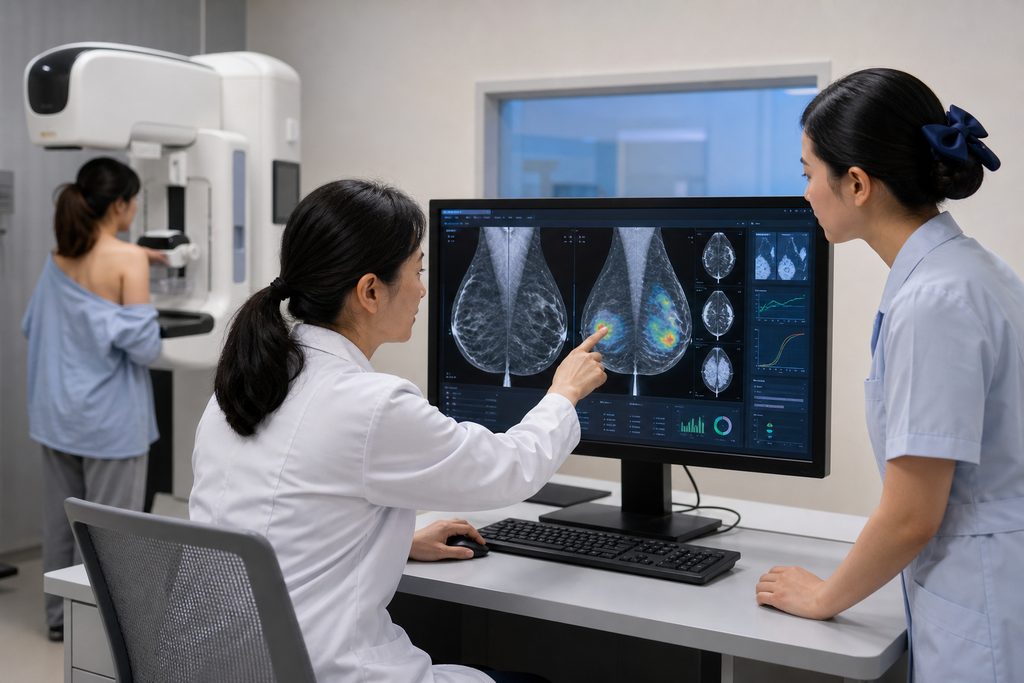
The workflow at a leading center like Fudan University Shanghai Cancer Center or Peking Union Medical College Hospital integrates a deep convolutional neural network as a second reader. The AI model—often trained on over 1 million mammographic images with biopsy-confirmed outcomes—pre-screens every scan within seconds. It highlights regions of interest with a heatmap overlay. It assigns a suspicion score. It flags microcalcifications smaller than 0.5mm that a human reader might dismiss as noise.
The radiologist then reviews the AI-annotated images. This is the critical distinction: the human makes the final call. The AI is a tireless assistant that never fatigues, never rushes, and has memorized the visual signatures of malignancy across a dataset no single human could see in a lifetime.
A 2023 multi-center study published in The Lancet Digital Health evaluated an AI system deployed across four Chinese screening sites. The AI-assisted workflow maintained a cancer detection rate equivalent to double-reading by two radiologists while reducing the workload of the second reader by 88%. In a standalone test against biopsy-proven cases, the system achieved an area under the curve (AUC) of 0.99—essentially, near-perfect discrimination between malignant and benign lesions in the test set.
Clinical Volume Drives Algorithm Quality
An algorithm is only as good as the data it was trained on. Chinese hospitals possess a training data advantage that few Western institutions can replicate: sheer volume. A single large cancer center in Shanghai may archive over 100,000 new mammograms annually. Each image links to a confirmed pathology report. This creates a feedback loop where the AI model continuously refines its detection thresholds.
Consider the scale. Massachusetts General Hospital performs approximately 40,000 screening mammograms per year. The First Affiliated Hospital of Zhejiang University processes roughly triple that volume. More data means the model encounters rarer presentations—invasive lobular carcinoma that mimics normal tissue, architectural distortions without a central mass, cancers hidden in extremely dense breast tissue. The AI learns patterns that a radiologist might see once in a decade.
This volume advantage translates directly into the 99% accuracy mammogram China hospitals now report in controlled studies. The metric refers to the AI’s standalone sensitivity and specificity when benchmarked against biopsy-confirmed diagnoses. It does not mean every screening is perfect. It means the algorithm’s receiver operating characteristic curve approaches the theoretical maximum.
Technology and Efficiency at Scale
The infrastructure supporting AI mammography in China differs structurally from Western systems. Most top-tier hospitals deploy the AI engine on local servers inside the hospital firewall—patient images never leave the institution’s network. The analysis runs in parallel with image acquisition. By the time the technologist completes the four standard views, the AI has already generated a preliminary report.
This speed matters clinically. In a conventional US screening program, the interval between mammogram acquisition and final report delivery averages 7 to 14 days. At a Chinese hospital equipped with AI triage, suspicious cases can be flagged for same-day ultrasound correlation. The patient does not go home to wait. She walks down the hall for additional imaging while the radiologist reviews the AI’s findings in real time.
The cost structure underpinning this efficiency is equally important. Chinese hospitals invest in AI as a software layer atop existing digital mammography units—no hardware retrofit required. The per-study computational cost is negligible. This keeps the AI mammography China cost far below what a Western patient might expect for an equivalent technology-enabled screening.
Cost Advantage Without Quality Compromise
Let us talk numbers. A screening mammogram with AI-assisted reading at a top-tier Chinese public hospital’s international department typically costs between $150 and $350. A comparable study in the United States—if you can find a facility that has deployed an FDA-cleared AI system and charges transparently—ranges from $250 to $600 for the technical component alone, with professional interpretation billed separately.
The gap widens for diagnostic workups. A diagnostic mammogram with tomosynthesis (3D mammography) plus AI analysis at a Shanghai international medical center runs approximately $400 to $800. The same service at a major US academic center often exceeds $1,500 before insurance negotiation.
These prices reflect structural economics, not quality concessions. Chinese hospital labor costs are lower across every category—radiologists, technologists, IT support. Equipment costs are comparable; Chinese hospitals purchase the same Hologic, Siemens, and GE mammography systems used in American facilities. The AI software licenses cost roughly the same. The difference lies in operational efficiency and the absence of the administrative overhead that bloats US healthcare billing.
Is AI breast cancer screening accurate in China compared to Western benchmarks? The published evidence says yes. A head-to-head study in Radiology compared an AI system developed at a Beijing hospital against three FDA-cleared Western AI platforms using the same enriched test dataset. The Chinese system matched or exceeded the Western algorithms on sensitivity (93.2% vs. 90.1%–92.8%) while maintaining comparable specificity. The performance gap was widest for cancers presenting as architectural distortion—precisely the subtle findings that benefit most from training-data diversity.
Best AI Mammography Centers China for Foreigners
Not every hospital that advertises “AI mammography” actually deploys it in routine clinical workflow. Some have a research prototype installed in one reading room. Others use AI only for research studies, not for patient-facing reports. Knowing which centers run AI as standard of care—and which have English-capable international departments—saves you from traveling 7,000 miles for a service that is not what you expected.
Five centers stand out for combining validated AI mammography programs with infrastructure designed for overseas patients:
Fudan University Shanghai Cancer Center operates one of Asia’s largest breast imaging services. Their AI system, developed in partnership with the university’s computer science department, has been integrated into clinical workflow since 2021. The international medical center provides English-language reports and dedicated patient coordinators. More details on Shanghai’s medical ecosystem are available on our Shanghai city page.
Peking Union Medical College Hospital (PUMCH) in Beijing deploys AI-assisted reading across its breast imaging service, which handles over 80,000 mammograms annually. The international department has decades of experience with overseas patients and provides bilingual radiology reports as standard. Visit our Beijing page for a broader view of the capital’s medical resources.
West China Hospital in Chengdu has published extensively on AI mammography validation and runs a dedicated breast health center with AI-integrated multimodality imaging—mammography, ultrasound, and MRI all feeding into the same AI-assisted workflow. The international patient center coordinates care for English-speaking visitors.
Guangdong Provincial People’s Hospital in Guangzhou was among the first in southern China to receive NMPA (National Medical Products Administration) clearance for an AI mammography system used in routine clinical reporting. The hospital’s proximity to Hong Kong and extensive experience with Southeast Asian patients make it a practical entry point.
United Family Healthcare represents the private-sector option. Multiple United Family locations in Beijing, Shanghai, and Guangzhou offer AI-assisted mammography with English-speaking radiologists, direct insurance billing, and a Western-style patient experience. The cost runs higher—typically $500 to $900 for a screening mammogram with AI reading—but the logistical friction is minimal. Our private hospitals page covers the trade-offs between public and private options in detail.
What You Need to Know Before Going Alone
Arriving at a Chinese hospital for an AI mammogram sounds straightforward. Book a flight, walk into the radiology department, get scanned. The reality is more complicated. Here are the barriers that trip up independent travelers:
- Appointment Systems: Most public hospitals do not accept international online bookings for routine screening. The official English-language portals, where they exist, often show outdated schedules. Walk-in mammography is not a thing. You need a registered patient ID, a local phone number for SMS verification, and often a Chinese ID-linked account on the hospital’s WeChat mini-program. None of these are designed for foreign passport holders.
- Report Language: The AI’s output and the radiologist’s final report will be in Chinese at any public hospital unless you specifically access the international VIP department. Translating a mammography report yourself—with terms like “BI-RADS category 4A with clustered pleomorphic microcalcifications”—is a recipe for misunderstanding your own risk level.
- Payment and Insurance: Public hospitals require upfront payment via WeChat Pay, Alipay, or Chinese UnionPay bank cards. International credit cards are accepted at international department counters but not at standard registration windows. If your overseas insurance requires direct billing rather than reimbursement, the public system will not accommodate you—you need a private international hospital or a dedicated coordination service.
- Follow-up Logistics: If the AI flags a suspicious finding, you will need a biopsy. Scheduling that biopsy, receiving results, and arranging a surgical consultation all require navigating the same system again—this time under time pressure. Having a bilingual medical companion from day one eliminates the scramble.
How We Help You Navigate This
These barriers exist for structural reasons, not malice. Chinese public hospitals serve a domestic population of 1.4 billion people. Their systems optimized for that reality—not for a solo traveler from London or Los Angeles.
Our role is to make the system work for you. Before you travel, we match your clinical needs to the right hospital. A woman with dense breast tissue and a family history of BRCA2 mutation needs a different center than a woman seeking a baseline screening at age 40 with no risk factors. We identify which of the best AI mammography centers China for foreigners actually suits your profile—not just the most famous name.
We coordinate the appointment through the hospital’s official international channel, securing a confirmed time slot before you book your flight. Our bilingual medical companion meets you at the hospital entrance, handles registration, translates every interaction with the technologist and radiologist, and ensures you receive an English-language report you can share with your doctor at home.
The process covers three phases. Before travel: medical history translation, hospital selection, appointment confirmation, visa guidance (S2 visa for medical treatment). During your visit: airport transfer, hospital accompaniment, real-time interpretation, report translation. After you return home: follow-up coordination, second-opinion arrangement if needed, and continuity planning for any recommended biopsies or treatments.
For patients who want to book AI breast scan China medical tourism without the logistical headache, our hospital appointment coordination service starts from $300. The bilingual companion service starts from $200 per day. These are coordination fees—they cover our labor in making the system navigable. They do not include the hospital’s own charges for the mammogram and AI reading, which you pay directly to the hospital at their standard international department rates.
Frequently Asked Questions
The 99% figure comes from published validation studies where AI systems achieved near-perfect discrimination between malignant and benign lesions in controlled test datasets. In real-world clinical practice, the AI acts as a second reader alongside a human radiologist—the combined accuracy is excellent, but no screening test is perfect. You should expect a highly sensitive examination that significantly reduces the chance of a missed cancer compared to conventional single-reader interpretation. You should not expect a guarantee.
Budget $150 to $350 for the hospital’s mammogram and AI reading fee at a public hospital international department. Private international hospitals charge $500 to $900. On top of that, coordination services for appointment booking, bilingual companionship, and report translation typically add $500 to $1,000 depending on complexity. Airfare, accommodation, and visa fees are separate. The all-in cost for a dedicated screening trip usually lands between $2,000 and $4,000—still competitive with self-pay rates at top US breast centers when you factor in the AI component.
The radiologist will recommend immediate additional imaging—usually a targeted ultrasound or contrast-enhanced mammography—available the same day at any major center. If those confirm a suspicious finding, a core needle biopsy can often be scheduled within 24 to 48 hours. Pathology results typically return in 3 to 5 working days. Our team stays with you through every step, including arranging an expedited surgical consultation if the biopsy returns positive. We do not abandon you at the radiology department door.
No. Chinese hospitals generally do not require a referral for screening mammography. You can self-refer. However, we strongly recommend bringing your prior mammograms and any relevant medical records—preferably in digital format on a CD or USB drive with DICOM files. The AI system can compare current and prior exams, and the radiologist will want to see any previous biopsies or imaging findings. If you have dense breast tissue or a known genetic risk, bring that documentation as well.
The S2 visa for medical treatment requires an invitation letter from the Chinese hospital confirming your appointment. This is the critical document—without it, the visa application will not be processed under the medical treatment category. We coordinate directly with the hospital’s international department to issue this letter once your appointment is confirmed. Processing time at most Chinese embassies and consulates ranges from 4 to 10 business days. The visa itself is typically valid for a 30 to 90-day stay. Do not book non-refundable flights until the visa is in your passport.
Your Next Step
AI-assisted mammography in China represents a genuine advance in breast cancer detection—faster reads, fewer missed cancers, and a cost structure that makes high-accuracy screening accessible without insurance gymnastics. The technology is real. The published evidence supports it. The barrier is not the quality of the medicine. It is the complexity of accessing it from outside the system.
If you want to understand whether this option fits your situation—your risk profile, your timeline, your budget—start with a conversation. Our team provides a free initial consultation to match your needs with the right hospital and give you a transparent cost estimate before you commit to anything. Visit our patient coordination page to begin. No pressure. Just information.
For more medical information and treatment options in China, visit chinamedservices.com (China Medical Services).
