AI Pathology China: Digital Slide Analysis for Accurate Cancer Grading and Subtyping
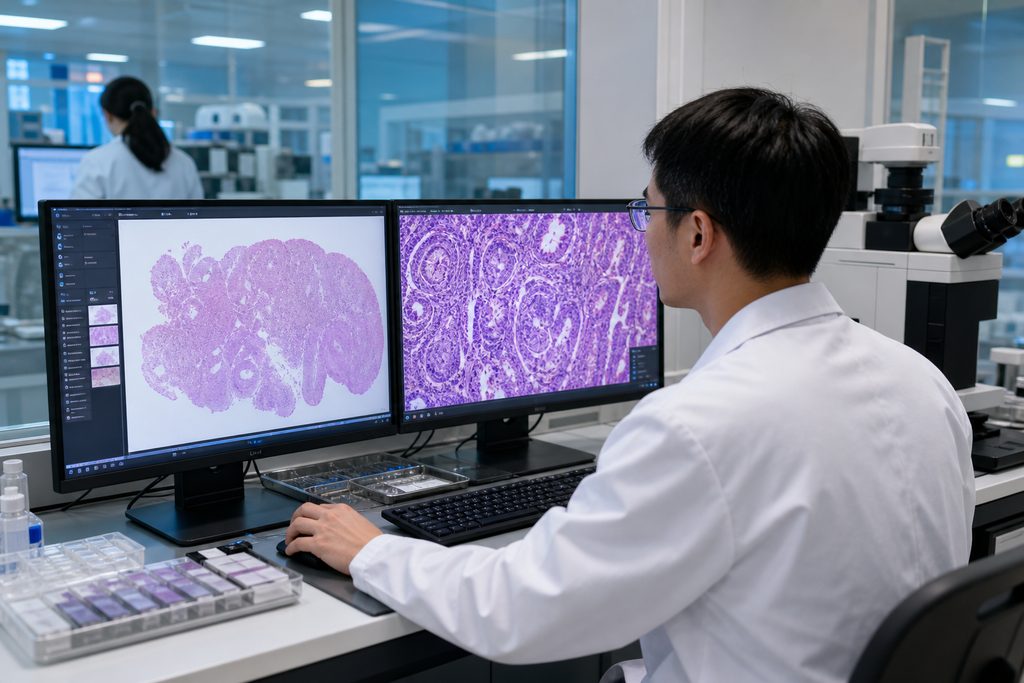
Imagine a pathologist staring through a microscope at a tumor biopsy slide. They are counting cells, assessing shapes, and grading aggression — all by eye. The stakes are enormous. A borderline call between Grade 2 and Grade 3 breast cancer changes everything: the chemotherapy regimen, the radiation plan, the patient’s odds. Now imagine that same slide being scanned into a billion-pixel digital image, then analyzed by an algorithm that has studied millions of annotated cancer cases. It highlights exactly which clusters of cells look invasive. It quantifies the percentage of Ki-67 positive nuclei to the decimal point. It flags a tiny region of lymphovascular invasion that a fatigued human eye might have missed at 4:45 PM on a Friday.
That is not a hypothetical. That is AI-powered digital pathology, and it is changing how cancer gets diagnosed in China right now.
Key Takeaways
- AI digital pathology in China combines whole-slide imaging with deep learning algorithms to grade and subtype cancers, achieving concordance rates above 92% with expert pathologists in published studies.
- Turnaround time for a digital second opinion — from slide upload to structured report — can be as fast as 48 to 72 hours, compared to weeks for some Western labs.
- Structural barriers exist: digital pathology requires high-resolution scanning equipment and standardized protocols, and not every Chinese hospital offers this as an international service yet.
- AI is not replacing pathologists. It is a decision-support tool that reduces inter-observer variability and catches subtle features that human eyes struggle to quantify consistently.
The Problem: When Cancer Grading Depends on One Pair of Eyes
Pathology has always been the hidden foundation of oncology. Before a surgeon cuts, before an oncologist prescribes, a pathologist issues the diagnosis that sets everything in motion. But here is the uncomfortable truth: even among highly trained specialists, agreement on cancer grading is not perfect. A 2015 study published in JAMA found that when breast biopsy slides were reviewed by a second pathologist, the diagnosis changed for approximately 25% of patients. Not minor tweaks. Changes that altered the surgical plan or systemic therapy recommendation.
Gleason grading in prostate cancer shows similar variability. A 2016 analysis in European Urology reported inter-observer agreement rates as low as 60% for certain grade groups. That means two expert pathologists, looking at the same slide, assign different grades in roughly 4 out of 10 cases. The patient’s treatment path depends partly on who reads the slide.
This is not about competence. It is about biology. Cancer does not always fit neatly into grade categories. Tumors exist on a spectrum. Human eyes, even the most trained ones, have limits in quantifying subtle morphological features — the shape of nuclei, the pattern of gland formation, the precise extent of tumor budding at the invasive front.
And the workload makes it harder. In China, some tertiary hospital pathology departments process over 400,000 specimens annually. A senior pathologist may review 80 to 120 slides per day. Fatigue is real. Cognitive bias is real. The profession needs tools that bring consistency and precision without adding hours to the workflow.
What is AI Digital Pathology for Cancer Grading and Subtyping?
The term sounds technical, but the concept is straightforward. A glass slide with a tissue sample — a breast biopsy, a prostate core, a lung nodule resection — gets scanned by a high-resolution whole-slide imaging machine. The scanner creates a digital file, often exceeding a gigabyte in size, that contains every visible detail of the tissue at multiple magnification levels. That file is then uploaded to a server where artificial intelligence algorithms, trained on large datasets of annotated pathology images, analyze the tissue.
The algorithm does not get tired. It does not get distracted. It measures features consistently: nuclear atypia, mitotic count, glandular architecture, stromal reaction, immune cell infiltration. For breast cancer, it can classify the tumor into molecular subtypes — Luminal A, Luminal B, HER2-enriched, basal-like — based purely on morphological patterns that correlate with immunohistochemistry results. For prostate cancer, it segments individual glands and assigns Gleason patterns with a consistency that matches or exceeds the average inter-pathologist agreement.
This is not science fiction. The US FDA authorized the first whole-slide imaging system for primary diagnosis in 2017. Since then, multiple AI pathology platforms have received regulatory clearance in Europe, the United States, and China. Chinese hospitals and technology companies have invested heavily in this space, driven by the sheer volume of cases that make algorithm training data abundant and diverse.
Who We Are
We are not a hospital. We do not employ pathologists or issue clinical diagnoses. China Medical Services is a medical concierge organization that connects international patients with China’s top-tier hospitals and diagnostic resources. Our team handles logistics — hospital matching, appointment coordination, bilingual medical interpretation, visa guidance, and the practical details that make seeking care in a foreign country manageable. When a patient needs an AI-assisted digital pathology second opinion from a leading Chinese cancer center, we identify the right facility, coordinate the slide digitization and upload, and ensure the resulting report is delivered with clear English translation and clinical context. We bridge the gap between you and the expertise.
Why AI Digital Pathology in China Delivers Results
Training Data at a Scale Few Countries Can Match
AI algorithms are only as good as the data they learn from. China’s hospital system generates an extraordinary volume of pathology specimens. A single large cancer center — like the Cancer Hospital Chinese Academy of Medical Sciences in Beijing or Fudan University Shanghai Cancer Center — processes more than 100,000 surgical pathology cases per year. Across the country, approximately 4.5 million new cancer cases are diagnosed annually. This means Chinese AI pathology platforms train on datasets that include rare tumor subtypes, unusual morphological variants, and diverse ethnic presentations that smaller datasets simply do not capture.
One leading Chinese AI pathology company, for example, trained its cervical cancer screening algorithm on over 2 million annotated slide images. Its breast cancer grading model was trained on more than 300,000 whole-slide images with pixel-level annotations from senior pathologists. This volume of training data produces algorithms that generalize well across different scanners, staining protocols, and patient populations.
Concordance Rates That Rival Expert Consensus
How accurate is AI pathology for cancer grading? Multiple peer-reviewed studies from Chinese research teams provide specific answers. A 2021 study published in The Lancet Digital Health by researchers from multiple Chinese institutions evaluated an AI system for prostate cancer Gleason grading. The algorithm achieved an overall agreement of 92.7% with the consensus diagnosis of three senior pathologists — higher than the agreement between any individual pathologist and the consensus panel.
Breast cancer subtyping tells a similar story. A 2022 study in Nature Communications from a team at West China Hospital demonstrated an AI model that classified breast cancer molecular subtypes from H&E-stained slides alone, with an area under the curve (AUC) of 0.91 for distinguishing Luminal A from non-Luminal A tumors. What is digital slide analysis for breast cancer subtyping? It is exactly this: using morphological patterns visible on routine stains to predict molecular behavior, giving clinicians actionable subtyping information faster and at lower cost than genomic testing.
Lung cancer, gastric cancer, colorectal cancer — the published literature shows the same pattern. AI algorithms consistently achieve diagnostic accuracy within the range of expert inter-pathologist variability, and sometimes exceed it for specific quantitative tasks like mitotic counting or tumor-infiltrating lymphocyte quantification.
Speed That Changes Clinical Timelines
A traditional pathology second opinion across borders is slow. The patient or hospital must ship glass slides internationally. The consulting pathologist must receive them, review them, dictate a report, and send it back. The process can take two to four weeks. In oncology, that delay matters. Treatment decisions hang in the balance. Anxiety compounds with every day of waiting.
Digital pathology collapses that timeline. Once a slide is scanned — which takes roughly 90 seconds per slide on modern scanners — the file can be uploaded to a secure server instantly. The AI algorithm processes it in minutes. A consulting pathologist reviews the AI-annotated images and issues a report, often within 48 to 72 hours of upload. For an international patient considering treatment in China, this speed means a diagnosis can be confirmed and a treatment plan initiated in the same trip.
Cost Structure That Makes Second Opinions Accessible
What does ai digital pathology cancer diagnosis cost China? The answer varies by hospital, case complexity, and the number of slides involved. Based on current pricing at major Chinese cancer centers offering international services, a digital pathology second opinion with AI-assisted analysis typically ranges from $300 to $800 for a single cancer case involving one to three slides. More complex cases requiring immunohistochemistry interpretation or multi-parametric analysis may run higher.
Compare this to the United States, where a comprehensive pathology second opinion from a major academic center like MD Anderson or Memorial Sloan Kettering often costs between $1,500 and $3,000, not including the cost of slide preparation and shipping. The structural reasons for this difference are straightforward: lower labor costs for technical staff, higher throughput at Chinese pathology labs, and the efficiency gains from AI pre-screening that reduce the pathologist’s time per case.
Also, the fee structure matters. Our coordination service for a digital pathology consultation starts from $300. Any consultation fee paid is credited in full toward future on-the-ground coordination if the patient decides to travel to China for treatment within 90 days. The credit applies to our service coordination fee — never to hospital treatment charges — and is a one-time credit.
| Service Component | Estimated Cost (USD) | Notes |
|---|---|---|
| Digital slide scanning (per slide) | $30–60 | Performed at local lab or partner facility |
| AI-assisted pathology second opinion (1–3 slides) | $300–800 | Varies by hospital and case complexity |
| Written second opinion from top-tier specialist | $300–500 | For reference only, not a prescription |
| Coordination service fee | from $300 | Credited toward future treatment coordination |
| Comparison: US academic center second opinion | $1,500–3,000 | Excluding slide shipping and handling |
Best Hospitals in China for AI Pathology Second Opinion
Not every Chinese hospital offers AI digital pathology as a structured international service. The capability exists at a select group of institutions that have invested in whole-slide imaging infrastructure, AI platform partnerships, and international patient coordination teams. These hospitals tend to appear consistently on the Fudan University hospital rankings for pathology and oncology.
The Cancer Hospital Chinese Academy of Medical Sciences in Beijing is one such center. Its pathology department is among the largest in Asia, and it has been an early adopter of digital pathology workflows. Fudan University Shanghai Cancer Center has published extensively on AI applications in breast and lung cancer pathology. West China Hospital in Chengdu operates a dedicated digital pathology research unit that collaborates with multiple AI technology companies. The Department of Pathology at Peking Union Medical College Hospital (PUMCH) integrates digital slide analysis into its consultation service for complex cases referred from across China.
For international patients seeking the best hospitals in China for AI pathology second opinion, the key is not just the technology — it is the combination of AI tools with subspecialty pathologists who focus on specific organ systems. A breast pathologist reviewing AI-annotated breast slides brings domain expertise that a general pathologist cannot match. Our team helps match the case to the right subspecialist at the right institution.
Explore our database of top-ranked hospitals across China to understand the landscape of accredited institutions.
What You Need to Know Before Going Alone
Seeking an AI pathology consultation in China independently sounds straightforward on paper. In practice, several barriers make it genuinely difficult for international patients to navigate without local expertise.
- Digital slide preparation and scanning: The original glass slides must be scanned at high resolution — typically 40x magnification — using a scanner that produces files compatible with the receiving hospital’s platform. Not every pathology lab in the patient’s home country has this equipment or knows the technical specifications required. File formats vary. Transfer protocols vary. A corrupted or incorrectly formatted upload wastes days.
- Hospital access and appointment systems: Most public Chinese hospitals do not offer online booking for international pathology consultations. The department may accept external consultation cases, but the submission process often requires in-person registration, Chinese-language forms, and local payment methods. Calling the general hospital number gets you a Mandarin-speaking operator who cannot route your call to the pathology consultation desk.
- Report interpretation and clinical context: An AI-assisted pathology report from a Chinese hospital will contain detailed morphological descriptions and diagnostic conclusions. It may also include technical terminology, grading systems, and reporting formats that differ from Western conventions. Without a bilingual medical professional to translate and contextualize the findings, the report’s clinical value diminishes sharply.
- Visa and travel logistics: If the pathology consultation leads to a decision to pursue treatment in China, the patient needs an S2 visa annotated for medical treatment purposes. The application requires an invitation letter from the receiving hospital, a treatment plan summary, and supporting documentation. Gathering these documents from overseas is time-consuming and error-prone without a coordinator.
How We Help You Navigate This
These barriers exist for structural reasons — not because anyone designed the system to exclude international patients. Chinese hospitals are optimized for domestic patient volumes that dwarf anything seen in Western healthcare. The international patient pathway is a specialized overlay, not the default workflow. Our job is to operate that overlay on your behalf.
When a patient contacts us about an AI digital pathology consultation, we start by understanding the clinical situation. What is the primary diagnosis? What question needs answering — grading confirmation, subtype classification, margin status, something else? Where are the original slides located? Once we have clarity, we identify the appropriate hospital and subspecialty pathologist from our network. We provide instructions for slide preparation and scanning, including the exact technical specifications required. If the patient’s local lab cannot scan slides, we identify a partner facility that can.
Once the digital slides are uploaded to the secure server, the AI algorithm processes them — usually within an hour. The consulting pathologist then reviews the AI-annotated images, formulates a diagnosis, and issues a structured report. Our bilingual medical team translates the report into clear English, adds clinical context where helpful, and delivers it to the patient and their home physician. The typical turnaround from upload to translated report is 48 to 72 hours.
If the report confirms a diagnosis that warrants treatment in China, the consultation coordination fee is credited toward our broader service package. That package includes hospital appointment scheduling, visa invitation letter procurement, airport transfer (from $200 round-trip), bilingual medical companion services (from $200 per day), and ongoing care coordination throughout the treatment and recovery period.
We do not promise outcomes. We do not guarantee that an AI pathology report will change a diagnosis or treatment plan. What we provide is access to a diagnostic resource that many international patients do not know exists, delivered with the logistical support that makes it usable.
Frequently Asked Questions
No. AI functions as a decision-support tool, not a standalone diagnostic system. Every AI-generated analysis is reviewed and signed off by a licensed pathologist who takes full clinical responsibility for the final report. The algorithm flags regions of interest, quantifies features, and suggests a grade or subtype — but the pathologist makes the diagnosis. This human-in-the-loop model is the standard at every reputable Chinese hospital offering AI pathology services.
Ask about validation. Reputable platforms publish their performance metrics — sensitivity, specificity, concordance rates with expert panels — for each cancer type they cover. Breast, prostate, lung, gastric, and cervical cancers have the most extensive validation data. Rarer tumor types may have less published evidence. Our team can help you understand what validation exists for your specific diagnosis before you commit to a consultation.
Discordance happens, and it is one reason second opinions exist. If the AI-assisted report differs from the original, the next step is typically a multidisciplinary discussion — either between your home physician and the consulting pathologist, or through a formal multidisciplinary team (MDT) video consultation. We can coordinate an MDT session (from $1,500 to $2,000) that brings together pathologists, oncologists, and surgeons from the Chinese hospital to discuss the case with you and your local doctor. This turns a conflicting report into a structured clinical dialogue rather than a source of confusion.
Yes. The entire process — from initial inquiry to report delivery — can be conducted remotely. You do not need to travel to China for a digital pathology second opinion. To book AI pathology consultation China online, the workflow is: contact us with your case details, we arrange slide digitization at a facility near you or coordinate shipping of slides to a scanning center, the digital files are uploaded to the Chinese hospital’s secure platform, and the report is delivered electronically. Travel is only necessary if the consultation leads to a decision to pursue treatment in China.
Shanghai is a major hub for this service, centered at Fudan University Shanghai Cancer Center. An international patient AI cancer pathology package Shanghai typically includes: whole-slide imaging of submitted specimens, AI-assisted analysis with a subspecialty pathologist review, a structured diagnostic report in English, and coordination of all logistics from slide receipt to report delivery. Some packages include an optional video consultation with the pathologist to discuss findings. Costs vary by the number of slides and case complexity. Our coordination fee covers the logistics; the hospital charges separately for the pathology service itself.
Your Next Step
Cancer grading and subtyping are decisions that should never rest on a single interpretation if a second one is available. AI digital pathology in China offers a combination that is hard to find elsewhere: algorithms trained on enormous datasets, reviewed by subspecialists at high-volume cancer centers, delivered at a speed and cost that make second opinions practical rather than aspirational. The technology does not replace clinical judgment. It sharpens it.
If you are considering a digital pathology second opinion, our team is ready to discuss your case and map out the logistics. There is no charge for the initial conversation, and no obligation to proceed. You reach out. We listen. We explain what is possible. You decide.
For more medical information and treatment options in China, visit chinamedservices.com (China Medical Services).
