What Does a Spine Surgeon Look for in an MRI? A Patient’s Guide
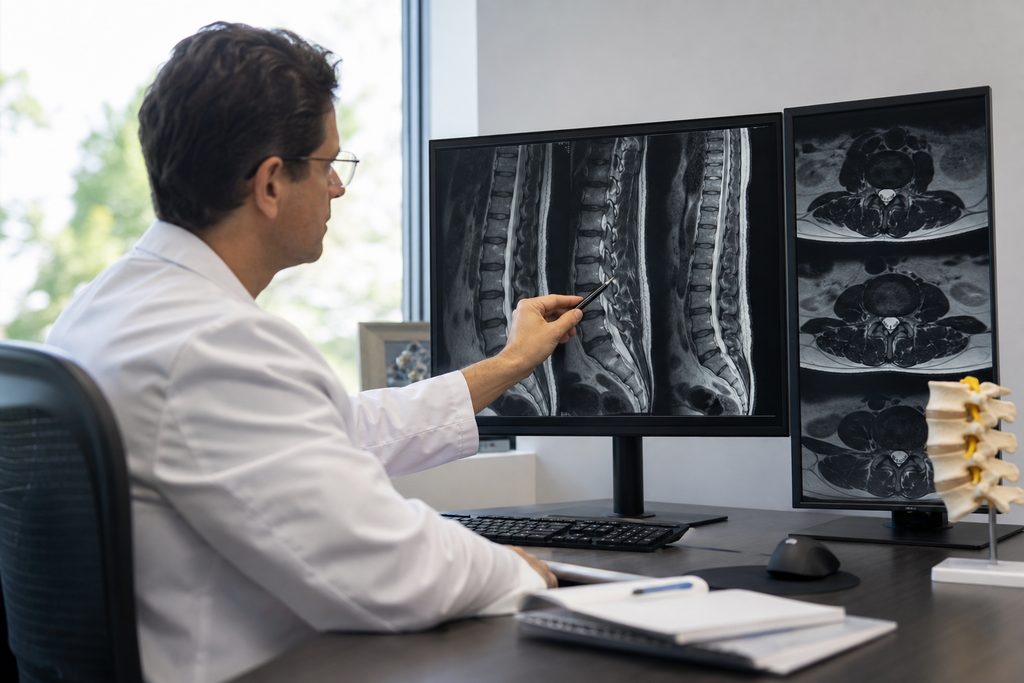
What Does a Spine Surgeon Look for in an MRI?
Every year, roughly 1 in 3 adults experiences significant back pain, and a growing number of them end up staring at a glowing MRI screen wondering what it all means. If you have been handed a disc with hundreds of cross-sectional images and a radiology report full of terms like “foraminal stenosis” or “disc desiccation,” you are not alone. The real question most patients ask is not just what the images show, but whether the findings actually explain the pain — and whether surgery is truly necessary. Understanding how a spine surgeon reads an MRI can save you from unnecessary procedures and help you make a confident decision about treatment, whether at home or when comparing the spine surgery cost China offers against prices in the United States or Europe.
Key Takeaways
- An MRI shows anatomy, not pain. A spine surgeon reads it alongside your symptoms, physical exam, and history — never in isolation.
- Degenerative findings like bulging discs and facet arthritis appear in over 50% of pain-free adults over 40. The presence of a finding does not prove it is the pain generator.
- Spine surgeons look for a specific match between a nerve compression pattern on MRI and the exact distribution of your leg or arm pain.
- If surgery is recommended, a second opinion is reasonable. The average spine surgery cost in China runs 60–80% lower than comparable procedures in the US, making remote consultation a practical first step.
The Problem: MRI Findings Do Not Always Explain Your Pain
A 2015 systematic review in the American Journal of Neuroradiology found that 37% of asymptomatic 20-year-olds already have disc degeneration on MRI, and that number climbs to 96% by age 80. Let that sink in. Nearly all 80-year-olds show disc degeneration on imaging — yet most do not have disabling back pain. This is the central dilemma of spine imaging: the scan reveals structural changes, but structure and pain are not the same thing.
Patients often arrive at a consultation convinced that a herniated disc seen on MRI means surgery is inevitable. But the clinical reality is far more nuanced. A disc bulge may be an incidental finding, present for years without causing any symptoms. Meanwhile, a small disc herniation in a narrow spinal canal can cause excruciating sciatica. The MRI alone cannot distinguish between these two scenarios. That is why spine surgeons approach every scan with a specific set of questions, not just a list of abnormalities.
How Does a Spine Surgeon Read an MRI? The Systematic Approach
The single most important task is correlating imaging findings with symptom distribution. A disc herniation at L4-L5 compressing the L5 nerve root should produce pain, numbness, or weakness in a very specific pattern — down the outside of the leg, across the top of the foot, into the big toe. If your pain is in a different location, the surgeon will look elsewhere on the scan. This is why a detailed symptom history matters as much as the images themselves.
Surgeons first check the spinal cord and cauda equina for compression, signal change, or mass lesions. In the cervical spine, cord compression with signal change (myelomalacia) is a strong surgical indicator, especially with progressive neurological symptoms. In the lumbar spine, cauda equina compression is a surgical emergency. Nerve roots are then traced from their exit points, looking for mechanical compression, swelling, or displacement.
An MRI is not the best test for instability, but it offers clues. Spondylolisthesis — one vertebra slipping forward on another — is visible on sagittal images. Flexion-extension X-rays are often ordered separately to confirm whether the slip is stable or dynamic. Alignment matters because a fusion surgery addresses instability, while a decompression alone does not.
Modic changes, endplate signal alterations, and disc height loss tell a story about how long a problem has been present. An acute disc herniation often shows high signal intensity on T2-weighted images, indicating fluid and inflammation. Chronic degenerative changes look different — darker, drier, more collapsed. This distinction influences treatment choices, including whether a herniated disc might resorb on its own.
Can a Spine Surgeon Tell If I Need Surgery from MRI?
The short answer: no single test determines surgical necessity. But an MRI, combined with a clinical exam, can make the case strongly in certain scenarios. Surgery is generally considered when three conditions align. First, the MRI shows a clear structural lesion that matches the patient’s symptoms. Second, conservative treatment — physical therapy, medication, injections — has failed after an adequate trial, typically 6 to 12 weeks for radiculopathy. Third, there is progressive neurological deficit, such as worsening weakness, or intractable pain that limits basic function.
Certain MRI findings push the decision toward surgery more quickly. Cauda equina syndrome, characterized by saddle anesthesia, bowel or bladder dysfunction, and bilateral leg weakness, demands urgent decompression. Cervical myelopathy with cord signal change also trends surgical, because the natural history is one of stepwise decline rather than spontaneous recovery. But for the vast majority of degenerative disc disease, the MRI is one data point among many.
Why China Has Become a Serious Option for Spine Surgery
For patients facing a surgical recommendation, the question of where to have surgery becomes unavoidable. The United States and Western Europe offer excellent care, but at prices that push many patients into financial distress. China’s top-tier orthopedic and neurosurgical centers have emerged as a credible alternative, combining high surgical volume with significantly lower costs. This is not a compromise on quality — it is a structural difference in how healthcare is delivered.
Clinical Volume Drives Surgical Expertise
A spine surgeon at a major Chinese tertiary hospital may perform 300 to 500 spinal procedures annually. By comparison, the average US orthopedic spine surgeon completes roughly 100 to 150 cases per year, according to data from the American Academy of Orthopaedic Surgeons. Volume matters in spine surgery. The learning curve for complex procedures like pedicle screw placement, minimally invasive fusion, and deformity correction is steep, and surgeons who perform these operations daily develop an efficiency and pattern recognition that lower-volume surgeons cannot match.
Several Chinese centers are recognized globally for their spinal surgery programs. The orthopedic departments at major Shanghai hospitals, including institutions ranked among China’s top 10 for orthopedics by the Fudan University hospital rankings, handle complex spinal deformity and revision cases referred from across Asia. For patients researching the best hospital for spine surgery in Shanghai, the Fudan specialty reputation rankings provide a starting point for shortlisting centers with proven clinical volume.
Technology and Surgical Innovation at Scale
Chinese hospitals have invested heavily in surgical technology over the past decade. Robotic-assisted spine surgery systems, including locally developed platforms and imported systems like Mazor X, are now deployed in major centers. Intraoperative CT and navigation systems allow for real-time verification of implant placement. Minimally invasive techniques — tubular retractors, endoscopic discectomy, and percutaneous fusion — are widely available at top centers, often at a fraction of the cost charged for the same technology in Western hospitals.
The workflow is also structurally different. A patient who needs a lumbar fusion at a Chinese tertiary hospital can often complete preoperative imaging, cardiac clearance, and surgical scheduling within one to two weeks of arrival. The same process in many Western systems stretches across months, with separate appointments for each step.
Spine Surgery Cost China vs. the United States
The cost differential is the most frequently cited reason international patients consider China for spine surgery. A single-level lumbar fusion in the United States typically costs between $80,000 and $150,000, depending on the hospital and geographic region. The same procedure at a top Chinese public hospital or international department generally ranges from $15,000 to $30,000. Even accounting for travel and accommodation, the total out-of-pocket expense is often 70% lower.
| Procedure | US Average Cost (USD) | China Top Hospital Range (USD) |
|---|---|---|
| Lumbar microdiscectomy | $20,000 – $50,000 | $6,000 – $12,000 |
| Single-level lumbar fusion | $80,000 – $150,000 | $15,000 – $30,000 |
| Cervical disc replacement | $40,000 – $80,000 | $12,000 – $25,000 |
| Spinal deformity correction | $150,000 – $300,000+ | $35,000 – $70,000 |
These figures are ranges, not quotes. Final pricing varies by hospital, surgeon seniority, implant choice, and case complexity. But the structural gap is consistent: labor costs, hospital overhead, and implant pricing are all lower in China, while clinical outcomes at top centers are comparable to international benchmarks. That does not mean every patient should fly to China for surgery. It does mean the option deserves serious evaluation.
What to Look for When Choosing a Spine Surgery Destination
Deciding to have spine surgery abroad is not a casual choice. The decision criteria should be specific and rigorous. Start with surgeon credentials and case volume. Ask how many times the surgeon has performed your specific procedure in the past year. Ask about complication rates, revision rates, and infection rates — and expect a direct answer. A hospital that cannot provide these numbers is not a hospital you should trust with your spine.
Evaluate the hospital’s international patient infrastructure. Does the facility have an international department with English-speaking coordinators? Are medical records translated accurately? Is there a clear process for preoperative consultation, surgical scheduling, and postoperative follow-up? These operational details matter as much as clinical skill when you are navigating a foreign healthcare system.
Consider the implant brands. Top Chinese hospitals use the same implants available in Western markets — Medtronic, DePuy Synthes, Stryker, and Zimmer Biomet. Confirm that the implant planned for your surgery is one you recognize and can verify. Avoid any facility that is vague about implant specifications.
And be honest about who this option is not suitable for. Patients with unstable medical conditions, complex multi-level revisions, or those who cannot tolerate long-haul travel should think carefully. Spine surgery involves a recovery period, and follow-up care after returning home must be arranged in advance with a local provider.
Practical Considerations: Documentation, Visas, and Follow-Up
If you are evaluating spine surgery packages abroad, the logistics are manageable but require preparation. Start with your medical records. You will need a complete set: MRI images in DICOM format, X-rays, any CT scans, operative notes from previous surgeries, and a current medication list. Most Chinese hospitals accept digital records, but originals or certified copies may be required for the visa application.
Visa requirements are specific. Foreign nationals traveling to China for medical treatment typically apply for an S2 visa, which covers short-term private affairs including medical treatment. The application requires an invitation letter or confirmation from the receiving hospital, along with proof of the medical appointment. Accompanying family members also apply for S2 visas. Processing times vary by embassy, so begin the process at least 4 to 6 weeks before your planned travel date. The M visa is for commercial and trade activities and is not appropriate for medical travel.
Payment is generally required in advance at Chinese public hospitals. International departments and private hospitals may accept major credit cards, but many public hospitals operate on a prepaid deposit system. Insurance reimbursement depends entirely on your policy — most Western insurers will reimburse for medically necessary care abroad, but you should obtain pre-authorization in writing before committing. Keep every receipt, every medical record, and every imaging report.
Language is a real barrier in Chinese public hospitals. Even top-tier facilities with international departments may have limited English fluency among nursing staff and administrative personnel. A bilingual medical companion who handles registration, queueing, payment, and translation is not a luxury — it is often the difference between a smooth experience and a frustrating one. Our team at China Medical Services has coordinated care for international patients across 37 cities and 340+ top-ranked hospitals, and the pattern is consistent: patients who arrive with professional language support report dramatically lower stress and fewer logistical problems.
Frequently Asked Questions
Will a spine surgeon operate based on MRI findings alone?
No responsible surgeon will operate based on MRI images without a clinical examination. The MRI must be interpreted alongside your symptoms, neurological exam, and response to conservative treatment. Any surgeon who recommends surgery based solely on a scan you emailed should be treated with extreme caution.
How do I get a second opinion on my MRI without traveling to China first?
Written second opinions are a practical first step. You send your MRI images and clinical history to a Chinese spine specialist, who reviews the records and provides a written assessment with treatment recommendations. This service typically costs $300–500 and takes 5–7 business days. Video consultations are also available, ranging from $100 to $800 depending on the specialist’s seniority. Any consultation fee is credited in full toward on-the-ground coordination if you later proceed with treatment in China.
What if the surgery does not go as planned?
Complications happen in every healthcare system. What matters is how they are handled. Top Chinese hospitals have well-established protocols for managing surgical complications, including revision surgery, infection control, and neurological monitoring. Before committing, ask the hospital directly about its complication rates and its process for managing adverse outcomes. A hospital that answers honestly is one you can work with.
Is the quality of implants used in China the same as in Western countries?
Yes, at accredited top-tier hospitals. The major international implant manufacturers — Medtronic, DePuy Synthes, Stryker, Zimmer Biomet — all operate in China and supply the same products used in Western operating rooms. Confirm the specific implant planned for your surgery before consenting, and verify that it is a brand you recognize.
How long do I need to stay in China after spine surgery?
For a routine lumbar microdiscectomy, most patients can fly home 7 to 10 days after surgery. For a fusion, plan for 10 to 14 days of local monitoring before long-haul travel. Your surgeon will provide specific guidance based on your procedure and recovery progress. You should also arrange follow-up care with a local spine specialist before leaving China.
Your Next Step
An MRI is a powerful diagnostic tool, but it is not a verdict. The most important thing you can do is understand what your scan actually shows and whether the findings match your symptoms. If surgery is on the table, evaluate your options carefully — including the substantial cost savings available at top Chinese spine centers without compromising on surgical quality. We help international patients navigate that process, from remote second opinions to on-the-ground coordination. We are not a hospital and we do not provide diagnoses. But we can help you get the right information from the right specialists. When you are ready, request a free consultation to discuss your MRI findings and what your options might look like.
For more medical information and treatment options in China, visit chinamedservices.com (China Medical Services).
